Parkinson disease (PD) is a clinical diagnosis: first confirm parkinsonism, which the MDS criteria define as bradykinesia plus rest tremor, rigidity or both, then make sure nothing excludes PD and that supportive features (such as a clear response to levodopa) outweigh any red flags. The pathology is loss of dopaminergic neurons in the substantia nigra pars compacta with α-synuclein Lewy bodies, which depletes dopamine in the striatum. Carbidopa/levodopa is the most effective drug; dopamine agonists, MAO-B and COMT inhibitors, amantadine and, in advanced disease, infusions or deep brain stimulation are added as the disease progresses.
The flowchart at a glance
- Bradykinesia plus rest tremor and/or rigidity? No → not parkinsonism (think essential tremor). Yes → step 2.
- Absolute exclusion? Dopamine blocker, downgaze palsy, cerebellar or cortical signs, normal DaT scan, no levodopa response → not PD: find the mimic.
- Red flags? Early falls, early autonomic failure, rapid progression, stridor, symmetric onset → suspect atypical parkinsonism.
- Supportive features (dramatic levodopa response, levodopa-induced dyskinesia, rest tremor, smell loss) → established or probable PD.
- Pathology: nigral neuron loss + Lewy bodies → less striatal dopamine → thalamus over-inhibited → small, slow movements.
- Treat when symptoms interfere: carbidopa/levodopa for most; agonist or MAO-B inhibitor for some younger or milder patients.
- Fluctuations: add COMT or MAO-B inhibitor, agonist or istradefylline; amantadine for dyskinesias → DBS or a continuous infusion.
- Nonmotor problems throughout: psychosis, dementia, constipation, orthostatic hypotension, depression.
Step 1: Is it parkinsonism? (MDS core criteria)
| Feature | MDS definition | How the stem describes it |
|---|---|---|
| Bradykinesia (required) | Slowness of movement and decrement in amplitude or speed (or hesitations and halts) as movements continue | Trouble starting movements, reduced arm swing, micrographia, masked face (hypomimia), soft voice |
| Rest tremor | A 4-6 Hz tremor in the fully resting limb, suppressed when movement starts | "Pill-rolling," often one hand first |
| Rigidity | "Lead-pipe" resistance to slow passive movement | Cogwheeling when tremor rides on the rigidity |
- TRAP (Tremor at rest, Rigidity, Akinesia/bradykinesia, Postural instability) is the classic mnemonic, but postural instability is not a core MDS criterion: it comes late, and recurrent falls within 3 years of onset are a red flag.
- Gait: narrow-based and shuffling, with festination (steps quicken as they shorten) that often precedes freezing.
- Mean age at onset is about 60; onset before 50 counts as early-onset PD.
Step 2: Rule out the mimics
| Clue | Think | MDS status |
|---|---|---|
| Symmetric parkinsonism after haloperidol, metoclopramide, prochlorperazine, reserpine or tetrabenazine | Drug-induced parkinsonism: stop the drug; it usually resolves over weeks to months | Absolute exclusion |
| Downgaze palsy, early falls, axial rigidity | Progressive supranuclear palsy (PSP) | Exclusion (gaze palsy); red flag (falls) |
| Severe early orthostatic hypotension or urinary failure, cerebellar signs, stridor | Multiple system atrophy | Red flags; cerebellar signs exclude |
| Limb apraxia, alien limb, cortical sensory loss | Corticobasal degeneration | Absolute exclusion |
| Dementia and visual hallucinations before or within about a year of parkinsonism | Dementia with Lewy bodies (DLB) | Separate DLB criteria |
| Parkinsonism confined to the legs, vascular risk factors | Vascular parkinsonism | Exclusion if legs only for >3 years |
| Gait apraxia, urinary incontinence, dementia | Normal pressure hydrocephalus | Alternative condition |
| Young patient, liver disease, Kayser-Fleischer rings | Wilson disease | Alternative condition |
| Bilateral action tremor (hands, head, voice), family history, better with alcohol, no bradykinesia | Essential tremor: propranolol or primidone | Not parkinsonism |
- Atypical parkinsonism (PSP, MSA, CBD) responds poorly to levodopa.
- DaT scan (dopamine transporter SPECT): reduced uptake supports a degenerative parkinsonian syndrome but cannot separate PD from MSA or PSP; it is normal in essential tremor and drug-induced parkinsonism. MRI mainly rules out structural causes.
Step 3: Make the call (MDS levels of certainty)
- Clinically established PD: no absolute exclusions, at least 2 supportive criteria and no red flags.
- Clinically probable PD: no absolute exclusions, and any red flags counterbalanced by supportive criteria (1 red flag needs at least 1; 2 red flags need at least 2; more than 2 red flags rules it out).
- Supportive criteria: a clear, dramatic response to dopaminergic therapy; levodopa-induced dyskinesia; rest tremor of a limb on examination; smell loss or cardiac sympathetic denervation on MIBG scintigraphy.
- Other red flags: wheelchair within 5 years, no progression over 5 years, unexplained pyramidal signs.
Step 4: Pathology and the circuit
- Gross: a pale (depigmented) substantia nigra from loss of the pigmented dopaminergic neurons of the pars compacta.
- Microscopic: Lewy bodies, eosinophilic cytoplasmic inclusions of α-synuclein, in the surviving neurons.
- Beyond the nigra: α-synuclein also accumulates in the gut's myenteric plexus, the olfactory system and the brainstem, which explains early constipation, smell loss and REM sleep behavior disorder.
- Circuit: less dopamine in the dorsal putamen weakens the direct pathway (D1) and releases the indirect pathway (D2), so the GPi over-inhibits the thalamus and movement shrinks; the relative cholinergic excess is why anticholinergics help tremor (see basal ganglia direct and indirect pathways).
- Genetics: autosomal dominant SNCA and LRRK2; autosomal recessive PRKN (parkin), PINK1 and PARK7, typically early onset; GBA1 variants raise risk.
- Toxins: MPTP (a meperidine-analog contaminant) is converted by MAO-B to MPP+, which kills nigral neurons: sudden parkinsonism in a young drug user. Carbon monoxide and manganese also cause parkinsonism.
Step 5: Choose the first drug
| Class | Drugs | How it works | When | Classic adverse effects |
|---|---|---|---|---|
| Levodopa + carbidopa | Carbidopa/levodopa | Levodopa crosses the blood-brain barrier and becomes dopamine; carbidopa blocks peripheral dopa decarboxylase and does not enter the brain | Most effective; first choice for most patients | Nausea, orthostatic hypotension, dyskinesias, motor fluctuations, hallucinations, sudden sleep, impulse control problems |
| Dopamine agonists | Pramipexole, ropinirole, rotigotine patch; apomorphine (rescue); tavapadon (selective D1/D5 agonist, FDA-approved 25 Sept 2026, alone or with levodopa) | Stimulate dopamine receptors directly | Younger patients (<60) at high risk of dyskinesias, with small levodopa doses; add-on later | Impulse control disorders (gambling, shopping, binge eating, hypersexuality), sleepiness and sleep attacks, hallucinations, orthostatic hypotension, edema |
| MAO-B inhibitors | Selegiline, rasagiline; safinamide (add-on to levodopa) | Block dopamine breakdown | Mild early symptoms; add-on for off time | Selegiline has amphetamine-like metabolites (insomnia); serotonin syndrome with meperidine, tramadol, methadone or antidepressants |
| COMT inhibitors | Entacapone, opicapone, tolcapone | Block levodopa breakdown, so each dose lasts longer | Wearing-off; always given with levodopa | More dyskinesia; tolcapone hepatotoxicity (monitor liver enzymes) |
| Amantadine | Immediate or extended release | NMDA antagonist | Levodopa-induced dyskinesias; mild tremor | Livedo reticularis, leg edema, confusion, urinary retention |
| Anticholinergics | Trihexyphenidyl, benztropine | Muscarinic blockade | Young patients with tremor-predominant disease or dystonia | Dry mouth, urinary retention, constipation, confusion; avoid in older adults |
- Label rules for carbidopa/levodopa: nonselective MAO inhibitors are contraindicated (stop them at least 2 weeks before), and dose reduction or withdrawal can trigger an NMS-like syndrome of hyperpyrexia and confusion (compare serotonin syndrome vs NMS).
- Carbidopa saturates peripheral decarboxylase at about 70-100 mg/day; dietary protein reduces levodopa absorption.
Step 6: When the response starts to wobble
- After 2-5 years of treatment most patients develop motor fluctuations: wearing-off before the next dose, unpredictable on-off swings and peak-dose dyskinesias (choreiform movements).
- Wearing-off: smaller, more frequent levodopa doses, or add a COMT inhibitor, MAO-B inhibitor, dopamine agonist or istradefylline (adenosine A2A antagonist, add-on to levodopa for off episodes). Subcutaneous apomorphine rescues an off period within 5-10 minutes and lasts 60-90 minutes.
- Dyskinesias: lower each levodopa dose; add amantadine.
- Deep brain stimulation (subthalamic nucleus or GPi): for troublesome dyskinesias or motor fluctuations despite medication, usually in patients younger than 70 who have had PD for 5-15 years and have no significant cognitive or psychiatric illness.
- Continuous infusions for advanced disease with motor fluctuations: levodopa-carbidopa enteral suspension through a jejunal tube; subcutaneous foscarbidopa/foslevodopa (Vyalev), prodrugs converted to carbidopa and levodopa and infused continuously over 24 hours or over waking hours (infusion-site reactions and infections are common); and a subcutaneous apomorphine infusion (Onapgo).
- Focused ultrasound can treat disabling tremor.
Step 7: Nonmotor symptoms
- Psychosis: first cut back the likeliest culprits (anticholinergics, amantadine, dopamine agonists), then use pimavanserin (5-HT2A inverse agonist, labeled for PD psychosis), quetiapine or clozapine. Avoid haloperidol and other D2 blockers, and metoclopramide, which worsen parkinsonism (typical vs atypical antipsychotics).
- Dementia: rivastigmine is approved for mild to moderate PD dementia.
How USMLE tests it
- No bradykinesia, no parkinsonism. Tremor can be absent.
- Early falls or downgaze palsy = PSP; early autonomic failure or cerebellar signs = MSA.
- New symmetric parkinsonism on an antipsychotic or metoclopramide: stop or switch the drug.
- MAO-B inhibitor + meperidine, tramadol or an SSRI = serotonin syndrome risk; levodopa + nonselective MAOI = hypertensive crisis.
- Tremor types: rest tremor that improves with action = PD; intention tremor = cerebellum; action tremor improved by alcohol = essential tremor.
Practice question
A 58-year-old man has had a resting tremor of the right hand, slowness and rigidity for a year, consistent with early Parkinson disease. Eight months ago he started a medication that improved his symptoms. His wife reports that he has since lost 40,000 dollars gambling online and binge eats at night, which he never did before. Last week he fell asleep while stopped at a red light. Which drug is he most likely taking?
A. Amantadine B. Carbidopa/levodopa C. Ropinirole D. Selegiline E. Trihexyphenidyl
Answer: C. New impulse control disorders (pathological gambling, binge eating) plus sudden sleep attacks are the signature adverse effects of dopamine agonists such as ropinirole and pramipexole; the fix is tapering the agonist.
- A: amantadine treats dyskinesias and mild tremor; its classic effects are livedo reticularis, leg edema and confusion.
- B: levodopa's label warns of the same behaviors, but they are far more frequent with agonists; levodopa's signature problems are nausea, dyskinesias and wearing-off.
- D: selegiline (MAO-B inhibitor) is known for insomnia and for serotonin syndrome with meperidine or antidepressants.
- E: trihexyphenidyl (anticholinergic) causes dry mouth, urinary retention, constipation and confusion.
Key takeaways
- Parkinsonism = bradykinesia + rest tremor and/or rigidity (MDS); early falls are a red flag.
- Exclude mimics: drug-induced, PSP, MSA, CBD, DLB, essential tremor.
- Pathology: loss of pigmented dopaminergic neurons in the substantia nigra pars compacta with α-synuclein Lewy bodies.
- Carbidopa/levodopa is the most effective drug; carbidopa works only in the periphery.
- Agonists → impulse control disorders and sleep attacks; tolcapone → liver injury; MAO-B inhibitors → serotonin syndrome with meperidine or SSRIs; amantadine → livedo reticularis.
- Fluctuations: COMT or MAO-B inhibitors, agonists, istradefylline, apomorphine; amantadine for dyskinesias; then DBS or an infusion.
- PD psychosis: pimavanserin, quetiapine or clozapine, never haloperidol.
Sources
- MDS Clinical Diagnostic Criteria for Parkinson's Disease — Postuma et al., Movement Disorders, via eScholarship (2015)
- Parkinson Disease — Merck Manual Professional Edition (2026)
- Secondary and Atypical Parkinsonism — Merck Manual Professional Edition (2026)
- Parkinson's disease — MedlinePlus Genetics, NLM
- N-Methyltetrahydropyridines and Pyridinium Cations as Toxins and Comparison With Naturally-Occurring Alkaloids — Food and Chemical Toxicology, PubMed (2016)
- SINEMET (carbidopa and levodopa) label — DailyMed, NLM (2026)
- AZILECT (rasagiline) label — DailyMed, NLM (2020)
- VYALEV (foscarbidopa/foslevodopa) label — DailyMed, NLM (2026)
- DATSCAN (ioflupane I-123) label — DailyMed, NLM (2026)
- Novel Drug Approvals for 2026 — U.S. Food and Drug Administration (2026)
- U.S. FDA Approves AbbVie's JUVMO (tavapadon) for Parkinson's Disease — AbbVie (2026)
- Tremor — Merck Manual Professional Edition (2026)
Visual explanations from the StepGenie QBank
Infographics StepGenie drew to explain questions in its own QBank, matched to this article's topic. Each caption is the takeaway of the question it explains.
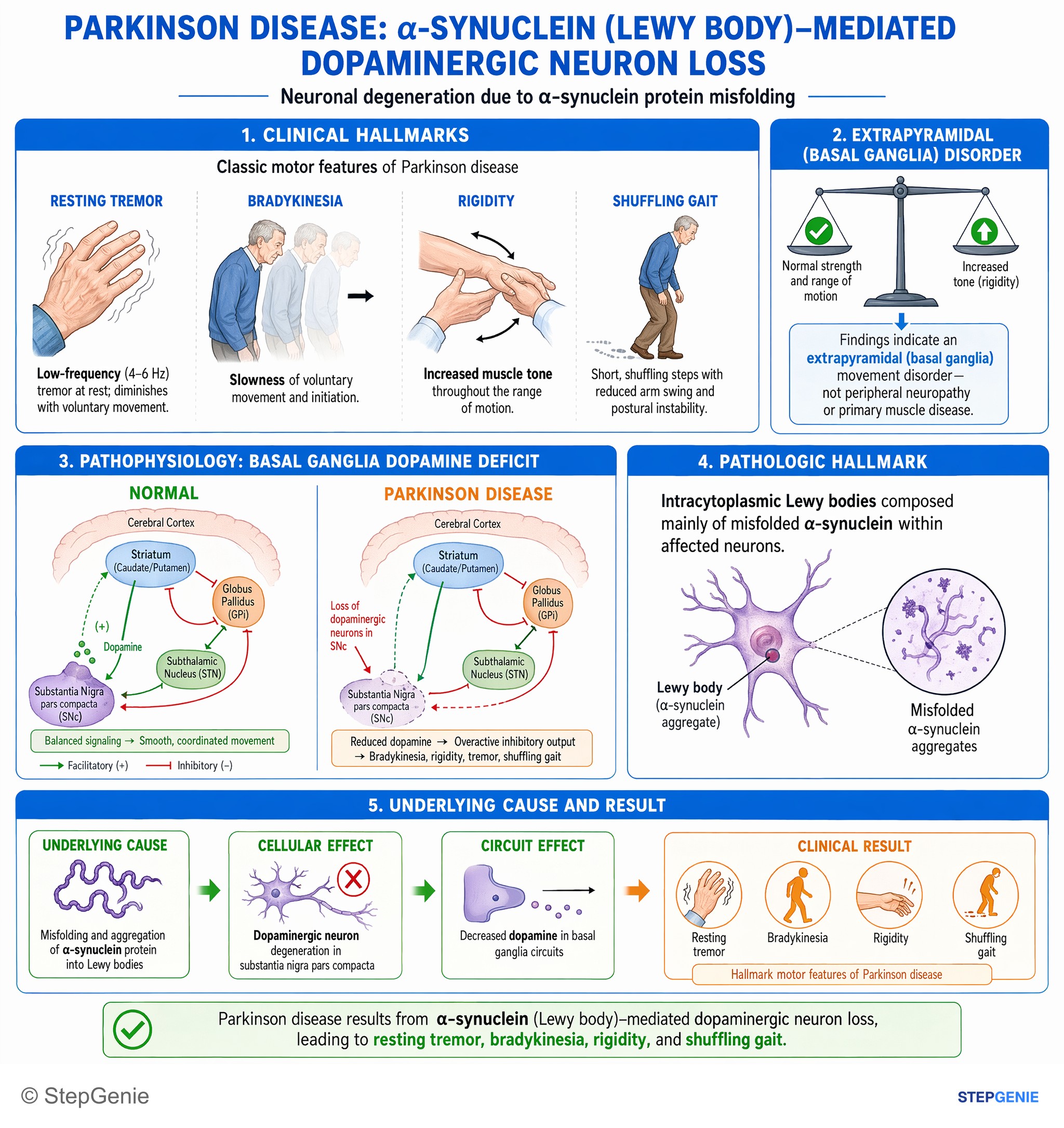
Parkinson disease from α-synuclein (Lewy body)–mediated dopaminergic neuron loss causes resting tremor, bradykinesia, rigidity, and…
USMLE Step 1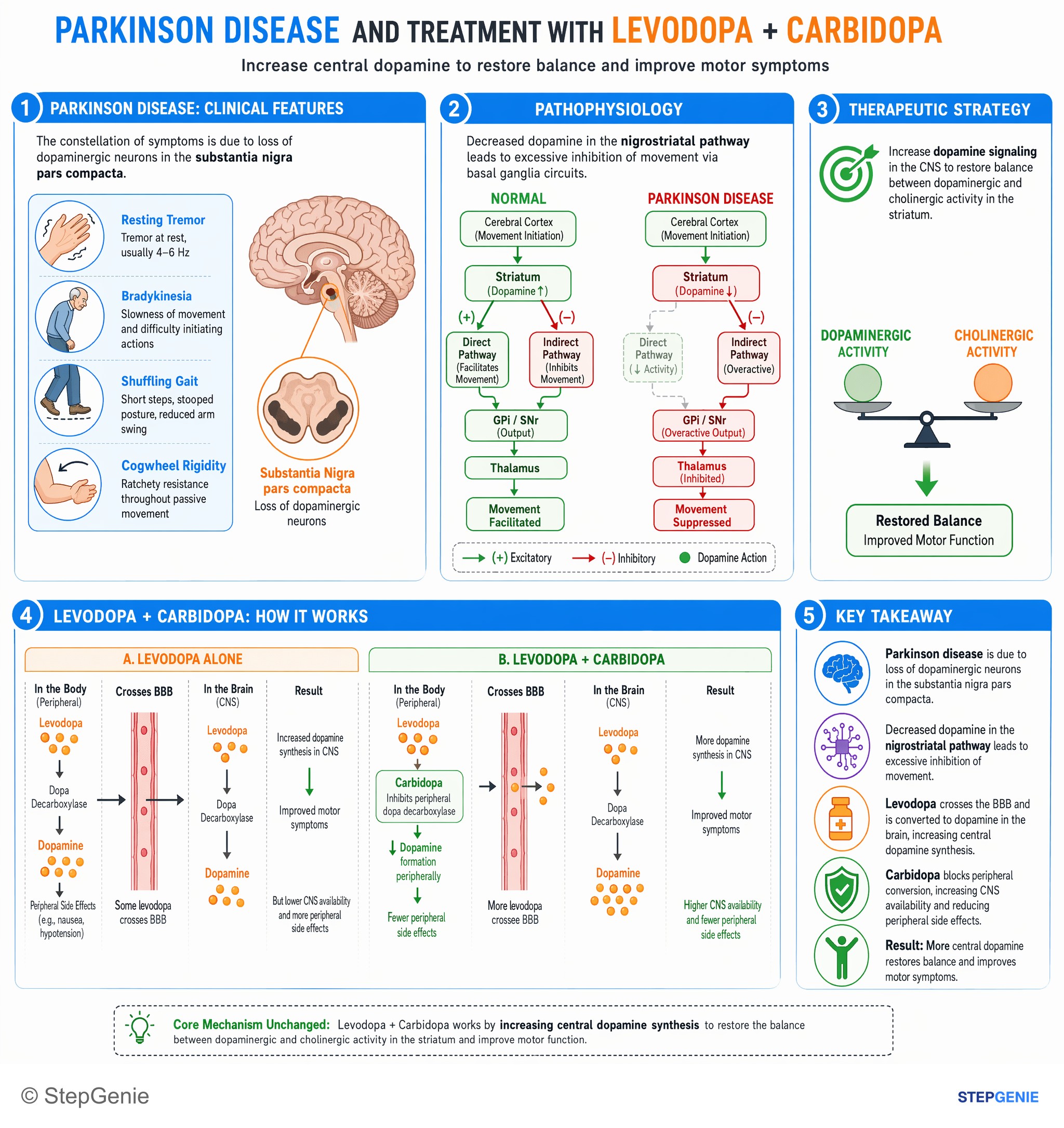
Parkinson disease treated with levodopa + carbidopa: levodopa crosses BBB and is converted to dopamine, increasing central dopamine…
USMLE Step 1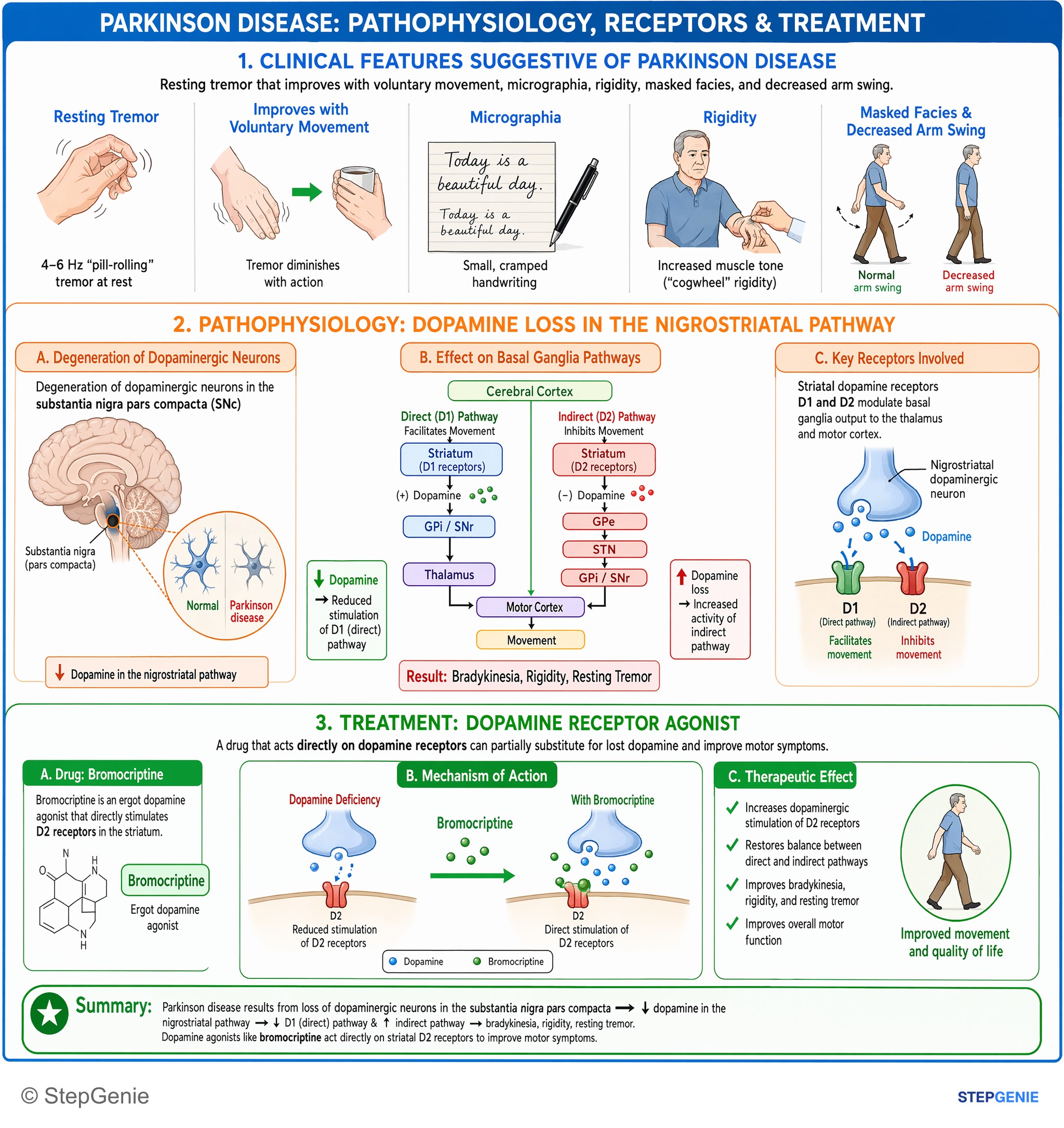
Parkinson disease from nigrostriatal dopamine loss; dopamine agonists (eg, bromocriptine) act directly on striatal D2 receptors to improve…
USMLE Step 1Frequently Asked Questions
What are the MDS diagnostic criteria for Parkinson disease?
The 2015 Movement Disorder Society criteria first require parkinsonism, defined as bradykinesia combined with rest tremor, rigidity or both. Clinically established Parkinson disease then needs no absolute exclusion criteria, at least two supportive criteria and no red flags. Clinically probable disease allows up to two red flags if each is balanced by a supportive criterion. Supportive criteria are a dramatic levodopa response, levodopa-induced dyskinesia, rest tremor on examination, and smell loss or cardiac sympathetic denervation on MIBG scintigraphy.
Why is carbidopa given with levodopa?
Levodopa crosses the blood-brain barrier and is converted to dopamine in the brain, but much of an oral dose would otherwise be decarboxylated to dopamine in the periphery, causing nausea and orthostatic hypotension and wasting the drug. Carbidopa blocks peripheral dopa decarboxylase and does not cross the blood-brain barrier, so more levodopa reaches the brain with fewer peripheral side effects. Peripheral decarboxylase is saturated by about 70 to 100 mg of carbidopa a day.
What are the side effects of dopamine agonists like pramipexole and ropinirole?
Dopamine agonists are best known for impulse control disorders such as pathological gambling, compulsive shopping, binge eating and hypersexuality, and for daytime sleepiness with sudden sleep attacks, even while driving. They also cause hallucinations and confusion, especially in older adults, as well as nausea, orthostatic hypotension and leg edema. Patients should be asked about impulsive behavior at every visit, and the usual fix is to taper the agonist.
How do you tell Parkinson disease from essential tremor and drug-induced parkinsonism?
Parkinson disease causes a slow rest tremor that improves with movement, plus bradykinesia and rigidity, usually starting on one side. Essential tremor is a bilateral action or postural tremor of the hands, often with head or voice tremor and a family history, that improves with alcohol and has no bradykinesia. Drug-induced parkinsonism is usually symmetric, follows a dopamine blocker such as haloperidol or metoclopramide and fades after the drug is stopped. A DaT scan is normal in both mimics.
What does the pathology of Parkinson disease show?
Parkinson disease shows loss of the pigmented dopaminergic neurons of the substantia nigra pars compacta, so the nigra looks pale on gross examination. Surviving neurons contain Lewy bodies, eosinophilic cytoplasmic inclusions made of alpha-synuclein. Dopamine falls in the striatum, especially the dorsal putamen, which increases basal ganglia inhibition of the thalamus and slows movement. Alpha-synuclein also builds up in the gut, olfactory system and brainstem, explaining early constipation, smell loss and REM sleep behavior disorder.
What are the newest Parkinson disease treatments?
Tavapadon (Juvmo), a once-daily selective D1/D5 dopamine receptor agonist, was approved by the FDA on 25 September 2026 for adults with Parkinson disease, taken alone or with levodopa. For advanced disease with motor fluctuations, foscarbidopa/foslevodopa (Vyalev) is a continuous subcutaneous infusion of prodrugs that the body converts to carbidopa and levodopa, given over 24 hours or over waking hours, and apomorphine is also available as a subcutaneous infusion (Onapgo). Deep brain stimulation and enteral levodopa-carbidopa remain established options.