Progressive supranuclear palsy (PSP) is one of those “looks like Parkinson’s… but isn’t” zebras that USMLE loves because it forces you to localize neuroanatomy, recognize atypical parkinsonism, and connect pathology (tau) to a very specific eye movement deficit. If you can quickly spot early falls + vertical gaze palsy, you can beat a lot of tricky answer choices.
Where PSP Fits (Big-Picture Classification)
PSP is an atypical parkinsonian syndrome (aka “Parkinson-plus”) and a tauopathy.
Key Step framing
- Parkinson disease (PD): -synuclein (Lewy bodies), resting tremor, good levodopa response (early).
- PSP: tau, early postural instability, vertical gaze palsy, poor levodopa response.
First Aid cross-reference (conceptual): Neurodegenerative diseases / Parkinsonism differentials; tauopathies (tau also shows up in Alzheimer disease, frontotemporal dementias).
Definition (Know This Cold)
Progressive supranuclear palsy is a neurodegenerative tauopathy characterized by:
- Supranuclear ophthalmoplegia (classically vertical gaze palsy, especially downgaze)
- Early postural instability and falls
- Axial rigidity and parkinsonism that is poorly responsive to levodopa
- Frontal/executive dysfunction and pseudobulbar features
“Supranuclear” = the problem is above the ocular motor nuclei (brainstem gaze centers and their control), so reflex pathways can be relatively spared early.
Pathophysiology (What’s Degenerating and Why It Matters)
The protein: Tau
- PSP is a 4R tauopathy (high yield association in neurology pathology discussions).
- Abnormal hyperphosphorylated tau aggregates → neuronal dysfunction and death.
Neuroanatomy: why the eye findings happen
Key structures often involved:
- Midbrain (especially dorsal midbrain)
- Basal ganglia
- Brainstem gaze centers and their connections
Mechanism of gaze palsy
- The hallmark is impaired voluntary vertical saccades (classically downward gaze).
- Early on, oculocephalic reflex (Doll’s eyes) may be preserved because it bypasses cortical control and uses brainstem reflex circuits—this is the “supranuclear” clue.
Motor phenotype: “Parkinsonism, but axial”
- More axial rigidity (neck/trunk) than limb-predominant rigidity.
- Tremor is usually minimal compared with PD.
- Postural reflex impairment early → falls.
Clinical Presentation (The HY Symptom Stack)
The classic triad for exams
- Early falls (often within the first year or two)
- Vertical gaze palsy (especially downward gaze, slowed vertical saccades)
- Axial rigidity / parkinsonism with poor levodopa response
Common additional findings
- “Staring” facial expression with reduced blinking (often described as a surprised, wide-eyed look)
- Dysarthria and dysphagia
- Pseudobulbar affect (emotional lability)
- Frontal lobe/executive dysfunction: apathy, slowed thinking, impaired planning
How it’s tested in vignettes
Look for:
- Older adult with “Parkinsonism” but no classic pill-rolling tremor
- Frequent unexplained falls
- Trouble going downstairs (downward gaze impairment)
- “Can’t look down” + neck/trunk stiffness
- Minimal improvement with carbidopa/levodopa
Diagnosis (Clinical + Imaging Clues)
Step-style approach
PSP is primarily a clinical diagnosis supported by imaging and exclusion of mimics.
Core clinical criteria (high yield):
- Progressive course
- Supranuclear vertical gaze palsy or markedly slowed vertical saccades
- Early postural instability/falls
- Parkinsonism with poor levodopa response
Imaging (board-relevant associations)
MRI may show:
- Midbrain atrophy with relatively preserved pons
- Classic description: “hummingbird sign” (or “penguin sign”) on sagittal MRI.
You don’t need to memorize radiology minutiae, but midbrain atrophy → hummingbird sign is a common question stem clue.
Treatment (Realistic Expectations = HY)
There is no disease-modifying therapy currently. Management is symptomatic and supportive.
Symptomatic management
- Levodopa trial: often minimal or transient benefit (contrast with PD).
- Physical/occupational therapy: fall prevention, gait training, assistive devices.
- Speech/swallow therapy: dysphagia management; aspiration precautions.
- Botulinum toxin may help focal dystonia/blepharospasm in select patients.
- Treat mood/cognitive symptoms as appropriate (SSRIs sometimes used for mood/pseudobulbar symptoms).
Prognosis (Step-appropriate)
- Progressive disability; complications often related to falls and aspiration.
High-Yield Differential: PSP vs Parkinson Disease vs Other Parkinson-Plus
| Condition | Key pathology | Signature clinical clue | Levodopa response |
|---|---|---|---|
| Parkinson disease | -synuclein (Lewy bodies) | Resting tremor, bradykinesia, postural instability later | Good early |
| PSP | Tau | Vertical gaze palsy + early falls + axial rigidity | Poor |
| Multiple system atrophy (MSA) | -synuclein | Early autonomic failure (orthostatic hypotension, urinary retention), cerebellar signs | Poor |
| Corticobasal degeneration (CBD) | Tau | Asymmetric rigidity/apraxia, “alien limb” | Poor |
| Dementia with Lewy bodies (DLB) | -synuclein | Dementia + visual hallucinations + parkinsonism | Variable |
Fast test-day rule:
If the stem screams eye movement problem (vertical gaze) + falls early, pick PSP.
HY Associations & Buzzwords (Memorize These)
High-yield associations
- Tauopathy (hyperphosphorylated tau)
- Supranuclear ophthalmoplegia: impaired voluntary gaze; reflex eye movements may be relatively preserved early
- Downward gaze palsy is especially suggestive
- Hummingbird sign on MRI (midbrain atrophy)
- Poor levodopa response
Buzzphrases USMLE uses
- “Frequent falls early in disease”
- “Difficulty looking down” / trouble reading or descending stairs
- “Staring facial expression”
- “Parkinsonism with no tremor and no response to levodopa”
First Aid-Style Cross-References (What to Connect It To)
Even if your First Aid edition places details differently, PSP hooks into these recurring Step frameworks:
- Parkinsonism differential: PD vs atypical parkinsonism (PSP/MSA/CBD/DLB)
- Neurodegenerative protein pathology:
- Tau: PSP, Alzheimer disease, corticobasal degeneration (and other tau-related frontotemporal syndromes)
- -synuclein: PD, DLB, MSA
- Eye movement neuroanatomy: supranuclear vs nuclear/infranuclear lesions; saccades and brainstem gaze centers
Rapid Review (Exam-Day Checklist)
- PSP = tauopathy
- Vertical gaze palsy (especially downgaze) + early falls
- Axial rigidity > limb rigidity; minimal tremor
- Poor response to levodopa
- MRI: midbrain atrophy → hummingbird sign
Visual explanations from the StepGenie QBank
Infographics StepGenie drew to explain questions in its own QBank, matched to this article's topic. Each caption is the takeaway of the question it explains.
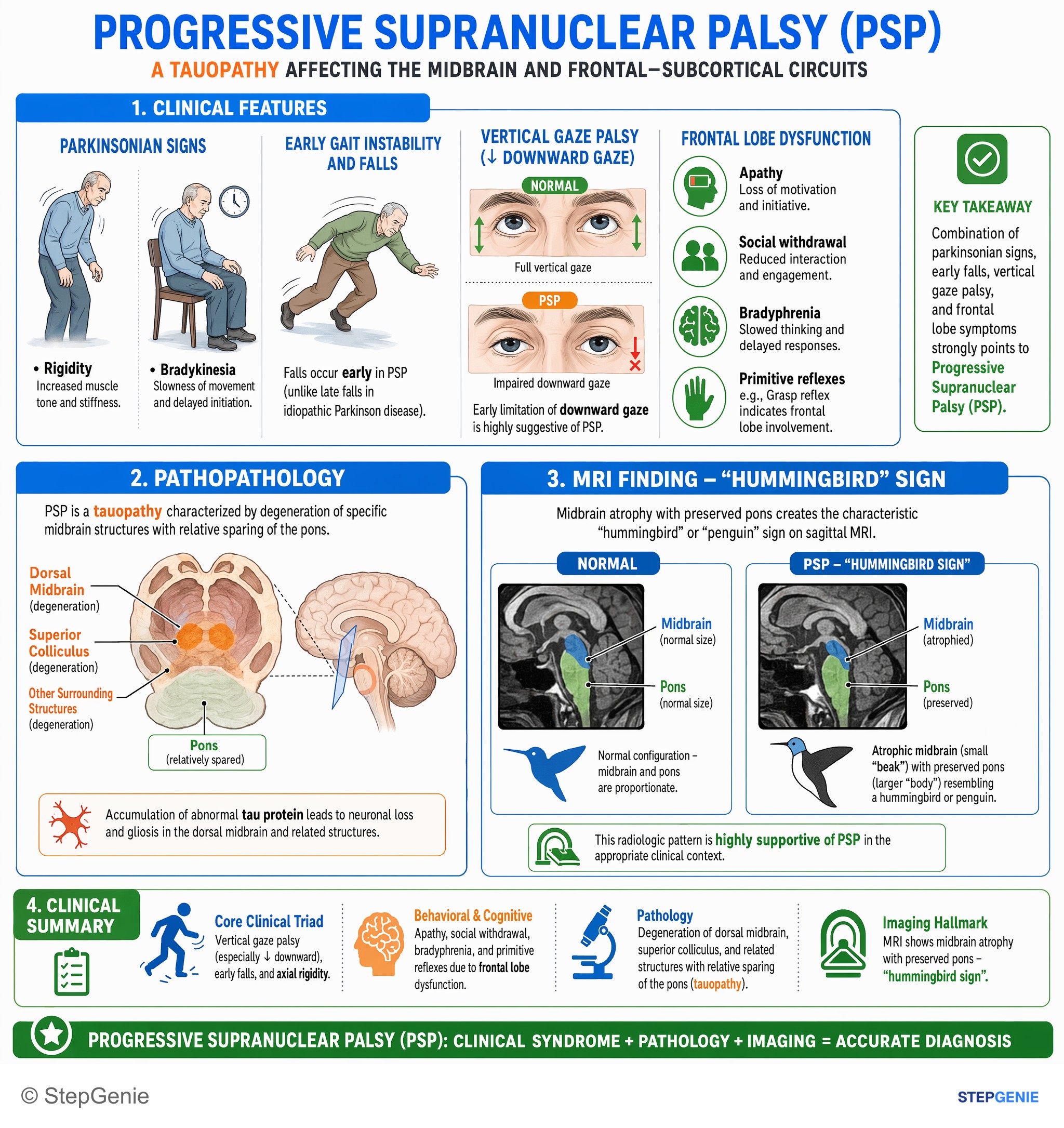
Progressive supranuclear palsy: vertical gaze palsy, early falls, axial rigidity, apathy; MRI shows midbrain atrophy with preserved pons…
USMLE Step 1Frequently Asked Questions
How do you tell progressive supranuclear palsy from Parkinson disease on a vignette?
Progressive supranuclear palsy is suggested by early falls, vertical gaze palsy, and axial rigidity with a poor levodopa response. Parkinson disease instead is associated with alpha-synuclein Lewy bodies, a resting tremor, and a good early response to levodopa. On exam stems, PSP often appears as parkinsonism without the classic pill-rolling tremor plus frequent unexplained falls and difficulty looking down.
Why does progressive supranuclear palsy cause vertical gaze palsy with preserved Doll’s eyes early on?
Progressive supranuclear palsy causes a supranuclear ophthalmoplegia because degeneration affects brainstem gaze centers and their control above the ocular motor nuclei. The hallmark is impaired voluntary vertical saccades, especially downward gaze. Early in the disease, the oculocephalic reflex can remain relatively preserved because it bypasses cortical control and uses brainstem reflex circuits, which creates the classic supranuclear pattern.
What MRI finding is classically associated with progressive supranuclear palsy?
The classic MRI clue in progressive supranuclear palsy is midbrain atrophy with a relatively preserved pons, producing the hummingbird sign on sagittal imaging. PSP is still primarily a clinical diagnosis, but this imaging pattern is a common board-style association. When a vignette gives parkinsonism with early falls and vertical gaze palsy plus midbrain atrophy, PSP is the key diagnosis.
What is the treatment approach for progressive supranuclear palsy?
Treatment for progressive supranuclear palsy is symptomatic and supportive because there is no disease-modifying therapy. A levodopa trial may be attempted, but benefit is often minimal or only transient. Management also includes physical and occupational therapy for fall prevention and gait training, speech and swallow therapy for dysphagia and aspiration precautions, and targeted treatment of mood, cognitive, or focal dystonic symptoms.
What clinical clues make progressive supranuclear palsy high-yield for Step 1?
The highest-yield clue set is early falls, vertical gaze palsy, and axial rigidity in an older adult with parkinsonism that responds poorly to levodopa. Downward gaze impairment is especially suggestive, so trouble going downstairs is a classic stem detail. Other supporting clues include minimal tremor, a staring facial expression with reduced blinking, dysarthria, dysphagia, and frontal or pseudobulbar features.