You’re doing a Q-bank and the stem feels like “dementia” — but the answer choices are packed with look-alikes that are all testable for different reasons. Lewy body dementia (LBD) is a classic Step diagnosis because it lives at the intersection of cognition, movement disorders, psychiatry, and medication side effects. The key is to commit to the pattern and then use that same pattern to eliminate each distractor on purpose, not by vibes.
Tag: Neurology > Neurodegenerative & Demyelinating
The Clinical Vignette (Typical Q-Bank Style)
A 72-year-old man is brought by his spouse for 1 year of progressive cognitive difficulties. Some days he is “totally with it,” while other days he seems confused and inattentive. Over the last few months, he has described seeing children and animals in the house that others don’t see. His spouse notes he has become slow to move and has a shuffling gait. On exam, he has bradykinesia and rigidity. When he was given an antipsychotic at an outside hospital for agitation, he became profoundly rigid and “out of it.”
Most likely diagnosis? → Lewy body dementia
Why the Correct Answer Is Lewy Body Dementia
The 4 pillars you should actively look for
Lewy body dementia = dementia + fluctuating cognition + visual hallucinations + parkinsonism.
High-yield features:
- Fluctuating cognition/attention (big clue; day-to-day or hour-to-hour variability)
- Recurrent well-formed visual hallucinations (people/animals, detailed)
- Spontaneous parkinsonism (bradykinesia, rigidity, gait changes)
- REM sleep behavior disorder (often precedes cognitive symptoms): vivid dreams, acting out dreams
Extra Step-relevant associations:
- Severe sensitivity to antipsychotics (especially typical antipsychotics): can cause marked worsening of parkinsonism, sedation, confusion → sometimes described as “neuroleptic sensitivity.”
- Pathology: alpha-synuclein Lewy bodies (classically in cortex for DLB; also in substantia nigra in Parkinson disease).
- Neurotransmitter angle: prominent cholinergic deficits → acetylcholinesterase inhibitors can help cognitive + hallucination symptoms (e.g., rivastigmine).
Differentiating from Parkinson disease dementia (PDD): the “1-year rule”
- Dementia with Lewy bodies (DLB): cognitive symptoms occur before or within 1 year of parkinsonism.
- Parkinson disease dementia (PDD): established Parkinson motor symptoms for >1 year before dementia.
USMLE loves this timeline detail.
Management Pearls (Step-Style)
Cognition / hallucinations:
- Acetylcholinesterase inhibitors (e.g., rivastigmine, donepezil)
Parkinsonism:
- Levodopa can be used but may worsen hallucinations/confusion; treat carefully.
Psychosis/agitation if needed (be cautious):
- Avoid typical antipsychotics.
- If you must treat, use the lowest effective dose of an atypical with less D2 blockade (clinically: quetiapine; clozapine works but requires monitoring).
Step takeaway: Antipsychotics can dramatically worsen LBD symptoms.
Rapid Comparison Table (High-Yield)
| Disorder | Hallucinations | Motor findings | Cognitive pattern | Signature clue |
|---|---|---|---|---|
| Lewy body dementia | Visual, well-formed | Parkinsonism | Fluctuating cognition | Neuroleptic sensitivity, REM sleep behavior disorder |
| Alzheimer disease | Uncommon early | None early | Gradual decline | Hippocampal atrophy; Aβ plaques + tau tangles |
| Parkinson disease dementia | Can occur | Parkinsonism first | Dementia later | >1 year of PD before dementia |
| Frontotemporal dementia | Not typical early | Variable | Early behavioral/language change | Disinhibition, aphasia; younger onset |
| Vascular dementia | Possible | Focal deficits | Stepwise decline | Stroke/TIA history; imaging vascular changes |
Now the Real Skill: Why Each Distractor Is Wrong (and What Would Make It Right)
Below are the common answer choices that show up with LBD vignettes, and exactly how to eliminate them.
Distractor 1: Alzheimer Disease (AD)
Why it’s tempting: “Old patient + dementia.”
Why it’s wrong here:
- AD is typically insidious and steadily progressive, not markedly fluctuating.
- Visual hallucinations are not a core early feature.
- Parkinsonism and neuroleptic sensitivity point away from AD.
What would make AD the best answer:
- Prominent episodic memory impairment early (forgetting recent events, repeating questions)
- Hippocampal atrophy, impaired new learning
- Later: language/executive dysfunction
Step 1 pathology tie-in:
- Aβ plaques (APP cleavage) and tau neurofibrillary tangles
- Cholinergic deficit in basal nucleus of Meynert → AChE inhibitors for symptoms
Distractor 2: Parkinson Disease Dementia (PDD)
Why it’s tempting: Parkinsonism + dementia.
Why it’s wrong here:
- The vignette has dementia and hallucinations around the same time as motor symptoms.
- Use the 1-year rule: if cognitive symptoms start before or within 1 year of motor symptoms → DLB, not PDD.
What would make PDD correct:
- A clear history of Parkinson disease for years (resting tremor, bradykinesia, rigidity) followed later by dementia.
High-yield overlap:
- Both are alpha-synuclein disorders, and both can have hallucinations (especially with dopaminergic therapy). The timeline is the testable divider.
Distractor 3: Frontotemporal Dementia (FTD; Pick disease spectrum)
Why it’s tempting: Dementia can present with “psychiatric” symptoms.
Why it’s wrong here:
- FTD classically presents with early personality/behavior change (disinhibition, apathy, loss of empathy) or primary progressive aphasia.
- Visual hallucinations + fluctuating cognition + parkinsonism is much more LBD.
What would make FTD correct:
- Age often younger (50s–60s)
- Early: socially inappropriate behavior, impulsivity, hyperorality, executive dysfunction
- Imaging: frontal/anterior temporal atrophy
Step 1 pathology tie-in:
- Pick bodies can contain tau (depending on subtype); “knife-edge” atrophy is a buzzword.
Distractor 4: Vascular Dementia
Why it’s tempting: Common dementia type; older patient.
Why it’s wrong here:
- Vascular dementia is usually stepwise decline with focal neurologic deficits (depending on stroke locations).
- Does not classically cause prominent, well-formed visual hallucinations with fluctuating attention as a core triad.
What would make it correct:
- Stroke/TIA history, carotid disease, AFib risk, diabetes/HTN
- Exam: asymmetric reflexes, focal weakness, gait disorder from subcortical ischemia
- Imaging: infarcts, white matter changes
High-yield phrasing: “Stepwise cognitive decline after multiple infarcts.”
Distractor 5: Normal Pressure Hydrocephalus (NPH)
Why it’s tempting: Older patient + gait issues + cognitive changes.
Why it’s wrong here:
- NPH is the triad: wet, wobbly, wacky (urinary incontinence, magnetic gait, dementia).
- Visual hallucinations + clear parkinsonism + antipsychotic sensitivity are not NPH hallmarks.
What would make NPH correct:
- Prominent gait disturbance earliest (“magnetic,” difficulty initiating steps)
- Urinary urgency/incontinence
- Imaging: ventriculomegaly out of proportion to cortical atrophy
- Improvement after large-volume LP supports diagnosis
Distractor 6: Delirium
Why it’s tempting: Fluctuating attention.
Why it’s wrong here:
- Delirium is acute (hours to days) and typically reversible with an underlying trigger (infection, drugs, metabolic).
- This vignette describes chronic progressive symptoms over ~1 year.
What would make delirium correct:
- Acute onset, waxing/waning consciousness, inattention
- Trigger: UTI, pneumonia, anticholinergics, benzos, withdrawal, metabolic derangements
USMLE pearl: Delirium = impaired attention first; dementia = memory/executive decline over time.
Distractor 7: Multiple Sclerosis (MS) or Other Demyelinating Disease
Why it’s tempting: If the choices include MS, it’s there to see if you chase neuro buzzwords.
Why it’s wrong here:
- MS is typically relapsing neurologic deficits in a younger patient (often female), e.g., optic neuritis, internuclear ophthalmoplegia, sensory level.
- It does not classically present as late-life dementia with formed hallucinations + parkinsonism.
What would make MS correct:
- Episodes separated in time and space
- MRI: periventricular plaques; CSF oligoclonal bands
- Symptoms: optic neuritis, Lhermitte sign, INO
High-Yield “If You See This, Think LBD” Checklist
- Visual hallucinations (formed, recurrent)
- Fluctuating cognition (attention changes day-to-day)
- Parkinsonism (bradykinesia/rigidity)
- REM sleep behavior disorder
- Severe reaction to antipsychotics (marked rigidity/confusion)
If you can say “yes” to at least 2–3 of these in a vignette, LBD should jump to the top.
Take-Home Q-Bank Strategy
When the stem screams “Lewy body,” don’t stop at the correct option. Immediately ask:
- Why isn’t this Alzheimer? (steady memory-first vs fluctuating + hallucinations)
- Where’s the timeline vs PD dementia? (the 1-year rule)
- Are there focal deficits/stepwise decline? (vascular)
- Is gait + incontinence the lead story? (NPH)
- Could this be acute and reversible? (delirium)
That’s how you turn one question into 5–6 guaranteed points later.
Visual explanations from the StepGenie QBank
Infographics StepGenie drew to explain questions in its own QBank, matched to this article's topic. Each caption is the takeaway of the question it explains.
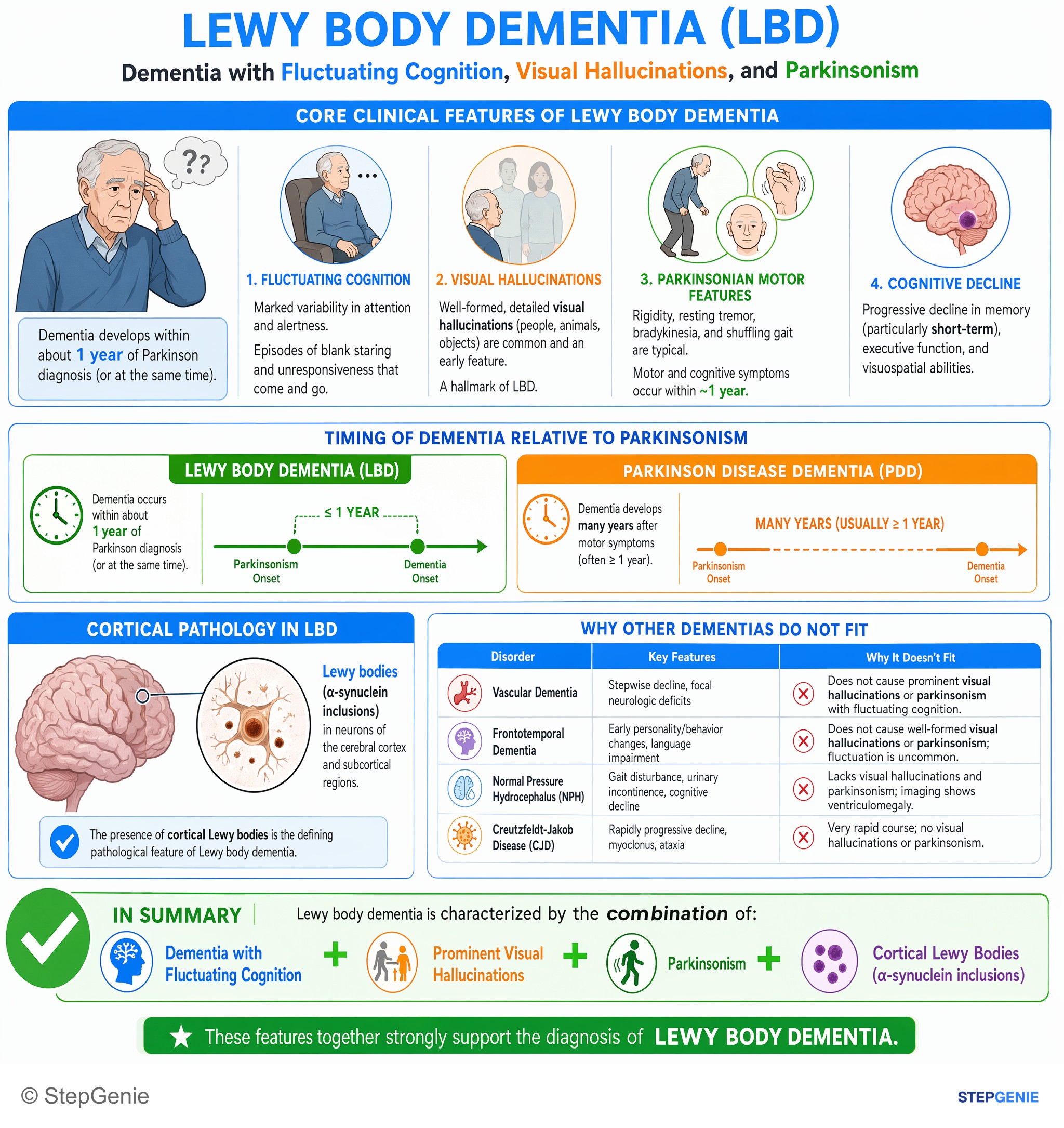
Lewy body dementia: dementia with fluctuating cognition, visual hallucinations, and parkinsonism; cortical Lewy bodies (α-synuclein…
USMLE Step 1Frequently Asked Questions
What clues point to Lewy body dementia instead of just “generic dementia”?
Lewy body dementia is suggested by a specific pattern: dementia with fluctuating cognition, recurrent well-formed visual hallucinations, and spontaneous parkinsonism. Patients may seem attentive on some days and confused on others, report seeing people or animals, and have bradykinesia, rigidity, or gait changes. Severe worsening after an antipsychotic is another strong clue because neuroleptic sensitivity is a classic association.
How do you tell Lewy body dementia from Parkinson disease dementia on exams?
The key difference is the timing of cognitive symptoms relative to parkinsonism. In dementia with Lewy bodies, dementia develops before or within 1 year of motor symptoms. In Parkinson disease dementia, the patient has established Parkinson motor symptoms for more than 1 year before dementia appears. Both are alpha-synuclein disorders, so the timeline is the high-yield testable divider.
Why do antipsychotics make Lewy body dementia worse?
Patients with Lewy body dementia can have severe sensitivity to antipsychotics, especially typical antipsychotics, so these drugs can markedly worsen parkinsonism, sedation, and confusion. This is often described as neuroleptic sensitivity. A stem describing profound rigidity and mental status decline after an antipsychotic strongly supports Lewy body dementia rather than another dementia syndrome.
What is the first-line treatment approach for cognition and hallucinations in Lewy body dementia?
Acetylcholinesterase inhibitors are used for cognition and hallucinations in Lewy body dementia. Drugs such as rivastigmine or donepezil can help because Lewy body dementia has prominent cholinergic deficits. If psychosis or agitation still requires treatment, typical antipsychotics should be avoided, and if necessary an atypical with less D2 blockade should be used at the lowest effective dose.
How do you distinguish Lewy body dementia from Alzheimer disease in a vignette?
Lewy body dementia differs from Alzheimer disease by its fluctuating cognition, early well-formed visual hallucinations, parkinsonism, and neuroleptic sensitivity. Alzheimer disease is more typically insidious and steadily progressive, with prominent early episodic memory impairment rather than marked day-to-day variability. Parkinsonism and antipsychotic sensitivity point away from Alzheimer disease and toward Lewy body dementia.