Progressive supranuclear palsy (PSP) is one of those neurodegenerative diagnoses that shows up on exams as a “pattern recognition” vignette: an older adult with early falls, vertical gaze palsy, and a stiff, axial, upright posture that doesn’t fit classic Parkinson disease (PD). If you can spot that triad fast, you’ll snag easy points.
PSP in one line (memorize this)
Progressive supranuclear palsy = a tauopathy causing early postural instability with falls + vertical (especially downward) gaze palsy + axial rigidity with poor levodopa response.
Visual / mnemonic device (quick-hit)
“PSP = Penguin Staring Problem”
Picture a tall, stiff penguin standing upright, falling backward, and staring straight ahead because it can’t look down.
- Penguin posture → axial rigidity, extended neck, upright stance
- Falling backward → early postural instability, early falls
- Staring / can’t look down → vertical gaze palsy (classically downward)
The high-yield core: how PSP presents
Key clinical features
- Early falls (often backward) due to postural instability
- Vertical supranuclear gaze palsy
- Impaired voluntary vertical eye movements (often downgaze first)
- Reflex eye movements may be relatively preserved early (think “supranuclear”)
- Axial rigidity > limb rigidity
- Pseudobulbar features: dysarthria, dysphagia, emotional lability
- Cognitive/behavioral changes (frontal executive dysfunction)
What makes it not typical Parkinson disease
- Poor or minimal response to levodopa
- Early gait/postural instability rather than late
- Prominent eye movement abnormalities (vertical gaze palsy is a giant clue)
- Tremor is usually less prominent than in PD
“Supranuclear” eye findings (exam-friendly)
Supranuclear palsy means the problem is above the ocular motor nuclei, so:
- Voluntary vertical gaze is impaired early
- Vestibulo-ocular reflex (VOR) can be relatively preserved early (you can sometimes elicit eye movement with head rotation when the patient can’t do it on command)
USMLE-style phrasing:
- “Difficulty looking down to read or descend stairs”
- “Frequent falls when walking, especially backward”
- “Staring, reduced blinking, masked facies”
Pathology: what PSP is made of
Etiology / pathology
- Sporadic neurodegenerative disorder
- Tauopathy: abnormal hyperphosphorylated tau accumulation in neurons and glia
- Classically involves:
- Midbrain (key for vertical gaze control)
- Basal ganglia and brainstem circuits for posture/gait
Gross imaging clue (Step 2-level pattern recognition)
- MRI may show midbrain atrophy with preserved pons → “hummingbird sign” (aka “penguin sign” in some descriptions)
Quick comparison table: PSP vs Parkinson disease vs MSA
| Feature | PSP | Parkinson disease | MSA (Multiple system atrophy) |
|---|---|---|---|
| Falls | Early, often backward | Later | Early-ish possible |
| Eye movements | Vertical gaze palsy (downgaze) | Usually normal early | No classic vertical palsy |
| Rigidity | Axial > limbs | Limbs often prominent | Variable |
| Autonomic failure | Not the main feature | Can occur later | Prominent early (orthostasis, urinary) |
| Levodopa response | Poor | Good (esp early) | Poor/limited |
| Pathology | Tau | -synuclein (Lewy bodies) | -synuclein (glial cytoplasmic inclusions) |
| MRI clue | Midbrain atrophy (“hummingbird”) | Often nonspecific | “Hot cross bun” (pons) can be seen |
Classic vignette (what the question stem will look like)
An older adult with:
- Frequent falls within the first year or two of symptoms
- Stiff, upright posture and gait instability
- Difficulty looking down (trouble reading, going down stairs)
- Parkinsonism that does not improve with levodopa
Diagnosis: Progressive supranuclear palsy
Management (what USMLE expects you to know)
- No disease-modifying therapy
- Symptomatic and supportive:
- Trial of levodopa may be attempted but usually minimal benefit
- PT/OT, gait training, fall prevention
- Speech/swallow evaluation (aspiration risk)
- Address mood/cognition and caregiver support
High-yield prognosis note: progressive course with increasing falls, dysphagia, aspiration risk.
Rapid-fire “don’t miss” facts
- PSP is a tauopathy, not a synucleinopathy.
- Vertical gaze palsy (especially downward) is the single most testable distinguishing feature.
- Think PSP when you see early falls + axial rigidity + poor levodopa response.
- MRI clue: midbrain atrophy → “hummingbird sign.”
Visual explanations from the StepGenie QBank
Infographics StepGenie drew to explain questions in its own QBank, matched to this article's topic. Each caption is the takeaway of the question it explains.
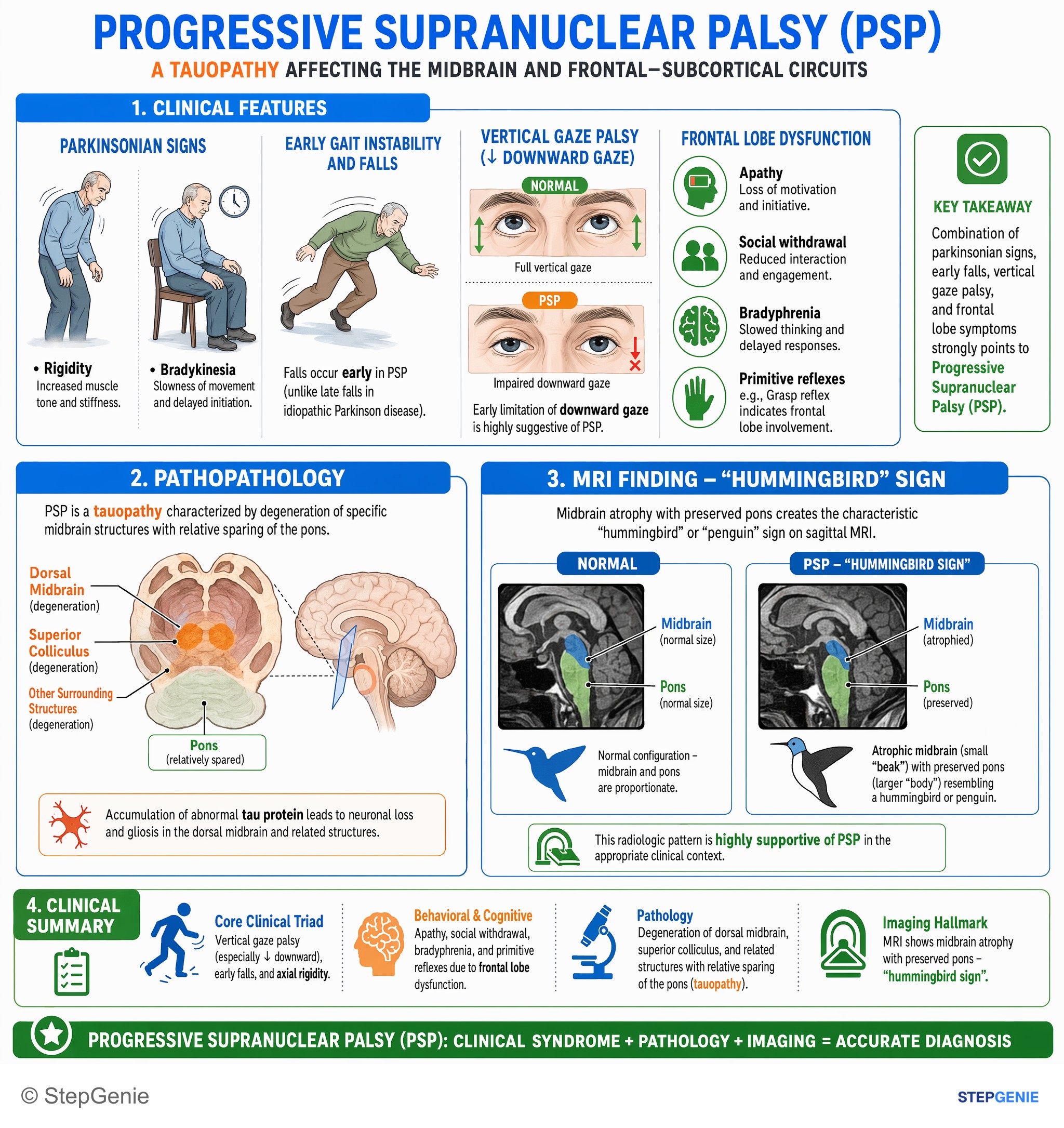
Progressive supranuclear palsy: vertical gaze palsy, early falls, axial rigidity, apathy; MRI shows midbrain atrophy with preserved pons…
USMLE Step 1Frequently Asked Questions
How do you tell progressive supranuclear palsy from Parkinson disease on an exam question?
Progressive supranuclear palsy is distinguished by early falls, vertical gaze palsy, axial rigidity, and poor levodopa response. In contrast to classic Parkinson disease, gait and postural instability appear early rather than late, eye movement abnormalities are prominent, and tremor is usually less prominent. The most testable clue is vertical gaze palsy, especially difficulty with downgaze.
Why can patients with progressive supranuclear palsy sometimes move their eyes with head rotation but not on command?
This happens because PSP causes a supranuclear gaze palsy, meaning the lesion is above the ocular motor nuclei. Voluntary vertical gaze is impaired early, especially downgaze, but reflex eye movements can be relatively preserved at first. That is why vestibulo-ocular reflex testing with head rotation may still produce eye movements even when the patient cannot look down on command.
What is the classic clinical triad of progressive supranuclear palsy?
The classic triad is early postural instability with falls, vertical gaze palsy, and axial rigidity with an upright stiff posture. Falls are often backward, and the eye movement problem usually affects downward gaze first. This pattern is a high-yield way to recognize PSP in an older adult whose presentation does not fit typical Parkinson disease.
What pathology and MRI finding are associated with progressive supranuclear palsy?
Progressive supranuclear palsy is a sporadic tauopathy caused by abnormal hyperphosphorylated tau accumulation in neurons and glia. It classically involves the midbrain, along with basal ganglia and brainstem circuits involved in posture and gait. On MRI, a characteristic clue is midbrain atrophy with relative preservation of the pons, producing the hummingbird sign.
What is the treatment approach for progressive supranuclear palsy?
Treatment is supportive because there is no disease-modifying therapy for PSP. A trial of levodopa may be attempted, but it usually provides minimal benefit. Management focuses on physical and occupational therapy, gait training, fall prevention, speech and swallow evaluation because of aspiration risk, and support for mood, cognition, and caregivers as the disease progresses.