Klinefelter syndrome is the presence of at least one extra X chromosome in a male, most often 47,XXY, caused by nondisjunction during egg or sperm formation in either parent. It is the most common sex chromosome disorder (about 1 in 500 to 1,000 newborn males) and the most common genetic cause of primary hypogonadism. The classic adult is tall with long legs, small firm testes, gynecomastia and azoospermia, with low testosterone and high LH and FSH. A karyotype confirms it. Testosterone treats the hypogonadism but does not restore fertility; sperm can often be retrieved surgically (micro-TESE) for IVF with intracytoplasmic sperm injection (ICSI).
The one-page cheat sheet
| Topic | High-yield facts |
|---|---|
| Karyotype | 47,XXY in most; mosaic 46,XY/47,XXY in about 10-15% (milder); rarely 48,XXYY, 48,XXXY or 49,XXXXY (more severe) |
| Cause | Meiotic nondisjunction; the extra X is maternal in about half of cases and paternal in the rest; not inherited |
| Frequency | About 1 in 500-1,000 newborn males (MedlinePlus: 1 in 650); about 65% are never diagnosed |
| Testes | Small (rarely over 4 mL) and firm; hyalinized, fibrotic seminiferous tubules |
| Hormones | Low or low-normal testosterone, high LH and FSH, very low inhibin B, high-normal or high estradiol |
| Body | Tall with long legs, gynecomastia, sparse facial and body hair, low muscle mass |
| Development | Speech and language delay, reading problems, ADHD, anxiety; most have a normal IQ |
| Fertility | 95-99% infertile, yet sperm can be found in more than half, allowing micro-TESE with ICSI |
| Risks | Breast cancer, extragonadal germ cell tumors, osteoporosis, metabolic syndrome, VTE, autoimmune disease |
| Barr bodies | X chromosomes minus 1: one Barr body in 47,XXY |
| Diagnosis | Karyotype (at least 20 cells) or chromosomal microarray |
| Treatment | Testosterone, fertility counseling before it starts, speech and learning support |
Why it happens
- Nondisjunction: an egg carrying two X chromosomes is fertilized by a Y-bearing sperm, or an XY sperm fertilizes a normal egg. Pregnancy after 35 might slightly raise the risk, but about half of cases come from the father.
- Mosaicism (46,XY/47,XXY) arises from an error after fertilization. MedlinePlus puts it at about 10% and Merck at about 15%; signs are milder and some men are fertile. See the mosaicism comparison table.
- More X chromosomes, more severity: 48,XXYY, 48,XXXY and 49,XXXXY add seizures, strabismus, constipation, recurrent ear infections and more intellectual disability; Merck estimates each extra X lowers IQ by 15-16 points.
- Barr body: in any cell, all X chromosomes but one are inactivated (the XIST-driven process explained in the X-linked disorders flowchart). A Barr body in a phenotypic male means an extra X; 49,XXXXY has three.
- Why so tall: the extra copy of SHOX, a pseudoautosomal gene, lengthens the limbs (low upper-to-lower segment ratio), and low testosterone can add eunuchoid proportions, with an arm span more than 5 cm greater than height, because the growth plates close late.
Hormones and testicular pathology
Klinefelter syndrome is primary (hypergonadotropic) hypogonadism: the testes fail, so the pituitary pushes harder. Secondary hypogonadism is the opposite: low testosterone with low or inappropriately normal LH and FSH.
| Lab | Klinefelter result | Why |
|---|---|---|
| Testosterone | Low or low-normal | Leydig cell failure |
| LH | High | Less testosterone negative feedback |
| FSH | High | Tubular damage, so little inhibin B |
| Inhibin B | Usually undetectable in adults | Seminiferous tubule failure |
| Estradiol and SHBG | High-normal or high | A high estrogen-to-androgen ratio drives gynecomastia |
| Semen analysis | Azoospermia in most | Germ cells do not survive |
Histology: hyalinization and fibrosis of the seminiferous tubules, with Leydig cell hyperplasia. Puberty usually starts on time but then stalls as testosterone falls.
Features by age
| Age | What you see |
|---|---|
| Infancy and early childhood | Often nothing; mild hypotonia, walking at about 18 months, speech delay |
| School age | Taller than peers, clumsiness, language and reading problems (25-85% have a learning or language issue), shyness, ADHD |
| Puberty | Small testes and penis, gynecomastia in about a third, sparse facial and body hair, narrow shoulders and wide hips |
| Adulthood | Infertility, fatigue, low libido and muscle mass, osteoporosis, metabolic syndrome |
Associated risks: what to screen for
- Breast cancer: risk is higher than in other men; NICHD says men with breast growth need regular checks.
- Extragonadal germ cell tumors: Klinefelter syndrome is a recognized risk factor; these tumors arise mainly in the mediastinum, retroperitoneum or pineal gland. Tumor markers are reviewed in seminoma vs nonseminoma.
- Bone: osteopenia in 25-48% and osteoporosis in 6-15% (StatPearls), driven largely by low testosterone; more in the osteoporosis guide.
- Metabolic: metabolic syndrome in about 44%, insulin resistance and type 2 diabetes.
- Venous: venous thromboembolism (deep vein thrombosis, pulmonary embolism) and varicose veins.
- Autoimmune: systemic lupus erythematosus, rheumatoid arthritis, autoimmune thyroid disease and type 1 diabetes have all been reported more often.
- Other: tremor, hypothyroidism, anxiety, depression and autism spectrum disorder. StatPearls notes a median lifespan 5-6 years shorter than in other men.
Diagnosis
- Karyotype confirms it, and NICHD calls it the only way to confirm an extra chromosome. StatPearls asks for at least 20 cultured lymphocyte metaphases and notes that FISH can help detect mosaicism; Merck also lists chromosomal microarray.
- When it is found: fewer than 1 in 10 is diagnosed before puberty, and US newborns are not screened for it. StatPearls puts it at about 3% of men evaluated for infertility.
- Infertility workup: the AUA/ASRM guideline recommends a karyotype for men with primary infertility and either azoospermia or fewer than 5 million sperm/mL when FSH is raised, the testes are atrophic or sperm production is impaired.
- Prenatal: cell-free DNA screening can flag it, but published positive predictive values are only 67-78%, so confirm with chorionic villus sampling or amniocentesis.
Treatment
- Testosterone replacement, usually from puberty or once hypogonadism appears, builds muscle and bone strength, deepens the voice, promotes facial and body hair, and can improve focus and mood. It comes as injections, gels, patches or pills.
- What testosterone cannot do: NICHD notes it will not enlarge the testes, shrink breast tissue or correct infertility. Exogenous testosterone also suppresses spermatogenesis, so the AUA/ASRM guideline says not to prescribe it to men who want children now or later. Plan fertility before starting it.
- Fertility: NICHD reports that 95-99% of men with Klinefelter syndrome are infertile, yet sperm are found in more than half of them; StatPearls says micro-TESE with ICSI has let up to 50% of men previously considered infertile father biological children. Success falls with age and after hormone therapy begins, and freezing sperm collected in adolescence may improve later outcomes. A child conceived this way could also have an extra X.
- Gynecomastia does not regress with testosterone; about 10% need breast reduction surgery.
- Development and bone: speech and language therapy, school support, occupational and physical therapy, and mental health care; calcium and vitamin D, with bisphosphonates for marked bone loss.
Klinefelter vs Turner vs Kallmann
| Feature | Klinefelter | Turner | Kallmann |
|---|---|---|---|
| Karyotype | 47,XXY or variants | 45,X in about half; the rest mosaic or with a structurally altered X | Usually 46,XY or 46,XX; ANOS1 (X-linked), FGFR1 and other genes |
| Who | Males | Females | Both sexes; about 1 in 30,000 males and 1 in 120,000 females |
| Defect | Primary testicular failure | Primary ovarian insufficiency | GnRH neurons fail to migrate: secondary hypogonadism |
| LH and FSH | High | High | Low or inappropriately normal |
| Sex steroid | Low testosterone | Low estrogen | Low testosterone or estrogen |
| Height | Tall | Short, evident by about age 5 | Eunuchoid proportions possible if untreated |
| Signature extras | Small firm testes, gynecomastia, language-based learning problems | Webbed neck (about 30%), lymphedema, coarctation or aortic valve disease (one-third to one-half have a heart defect), kidney anomalies | Anosmia or hyposmia, micropenis, undescended testes, unilateral renal agenesis, cleft lip or palate, mirror movements |
| Fertility | Micro-TESE with ICSI | Most cannot conceive naturally | In men, often restored with hCG plus FSH or pulsatile GnRH |
For Turner syndrome traps, see the Turner syndrome question.
How USMLE tests Klinefelter syndrome
- Small firm testes + tall + gynecomastia + infertility = 47,XXY. Small testes with anosmia and low LH and FSH = Kallmann syndrome.
- Lab logic: low testosterone with high LH and FSH = primary testicular failure; Klinefelter syndrome is its most common genetic cause.
- A Barr body in a male = an extra X.
- Fertility trap: testosterone treats the hypogonadism, not the infertility, and suppresses sperm production. Mosaic patients may be fertile.
- Look-alikes: 47,XYY males are often tall but usually have normal testosterone, sexual development and fertility; a 46,XY patient with complete androgen insensitivity looks female and has undescended testes and no uterus.
Practice question
A 28-year-old man is evaluated for infertility after 2 years of unprotected intercourse. He is 191 cm (6 ft 3 in) tall with long legs, sparse facial and body hair and bilateral gynecomastia. Each testis is about 3 mL and firm. His sense of smell is normal. Two semen analyses show no sperm. Serum testosterone is low, and LH and FSH are both elevated. He hopes to father children.
Which is the most appropriate next step?
- A. Begin testosterone replacement therapy
- B. Karyotype
- C. MRI of the pituitary
- D. CFTR gene testing
- E. Testicular biopsy to establish the diagnosis
Answer: B, karyotype. Low testosterone with high LH and FSH is primary hypogonadism, and tall stature, gynecomastia, small firm testes and azoospermia make Klinefelter syndrome the leading cause. A karyotype confirms it (expect 47,XXY or a mosaic), and the AUA/ASRM guideline recommends one for azoospermic men with a raised FSH or testicular atrophy.
- A: exogenous testosterone suppresses spermatogenesis, and the AUA/ASRM guideline advises against it in men who want children. He will likely need it, but only after the diagnosis and a fertility plan.
- C: pituitary imaging belongs to secondary hypogonadism, with low or inappropriately normal gonadotropins. His high LH and FSH point to the testes.
- D: CFTR testing fits congenital bilateral absence of the vas deferens: obstructive azoospermia with normal sperm production, normal testes and normal hormones.
- E: histology would show hyalinized tubules but cannot make the chromosomal diagnosis. Testicular tissue is taken later, as micro-TESE, to retrieve sperm.
Follow-up twist: the karyotype is 47,XXY. The next step is referral for micro-TESE with ICSI before any testosterone is started, with counseling that sperm are found in roughly half of men.
Key takeaways
- 47,XXY from meiotic nondisjunction (maternal or paternal); about 1 in 500-1,000 males; often never diagnosed.
- Primary hypogonadism: low testosterone, high LH and FSH, very low inhibin B; hyalinized seminiferous tubules.
- Tall (extra SHOX), small firm testes, gynecomastia, azoospermia, language-based learning problems.
- One Barr body; mosaics are milder; 48,XXXY and 49,XXXXY are more severe.
- Risks: breast cancer, extragonadal germ cell tumors, osteoporosis, metabolic syndrome, VTE, autoimmune disease.
- Karyotype confirms; testosterone treats hypogonadism but not infertility; plan micro-TESE with ICSI before starting it.
- Turner: short female, high gonadotropins. Kallmann: anosmia, low gonadotropins.
Sources
- Klinefelter syndrome — MedlinePlus Genetics (2023)
- Klinefelter Syndrome (47,XXY) — Merck Manual Professional Edition (2025)
- Klinefelter Syndrome — StatPearls, NCBI Bookshelf (2025)
- What are common symptoms of Klinefelter syndrome? — NICHD (2024)
- What are the treatments for symptoms in Klinefelter syndrome? — NICHD (2024)
- How do health care providers diagnose Klinefelter syndrome? — NICHD (2024)
- Male Hypogonadism — Merck Manual Professional Edition (2026)
- How many people are affected by or at risk for Klinefelter syndrome? — NICHD (2025)
- Extragonadal Germ Cell Tumors Treatment (PDQ) — National Cancer Institute (2025)
- Diagnosis and Treatment of Infertility in Men: AUA/ASRM Guideline — American Urological Association (2020, amended 2024)
- Turner syndrome — MedlinePlus Genetics (2023)
- Kallmann syndrome — MedlinePlus Genetics (2016)
Visual explanations from the StepGenie QBank
Infographics StepGenie drew to explain questions in its own QBank, matched to this article's topic. Each caption is the takeaway of the question it explains.
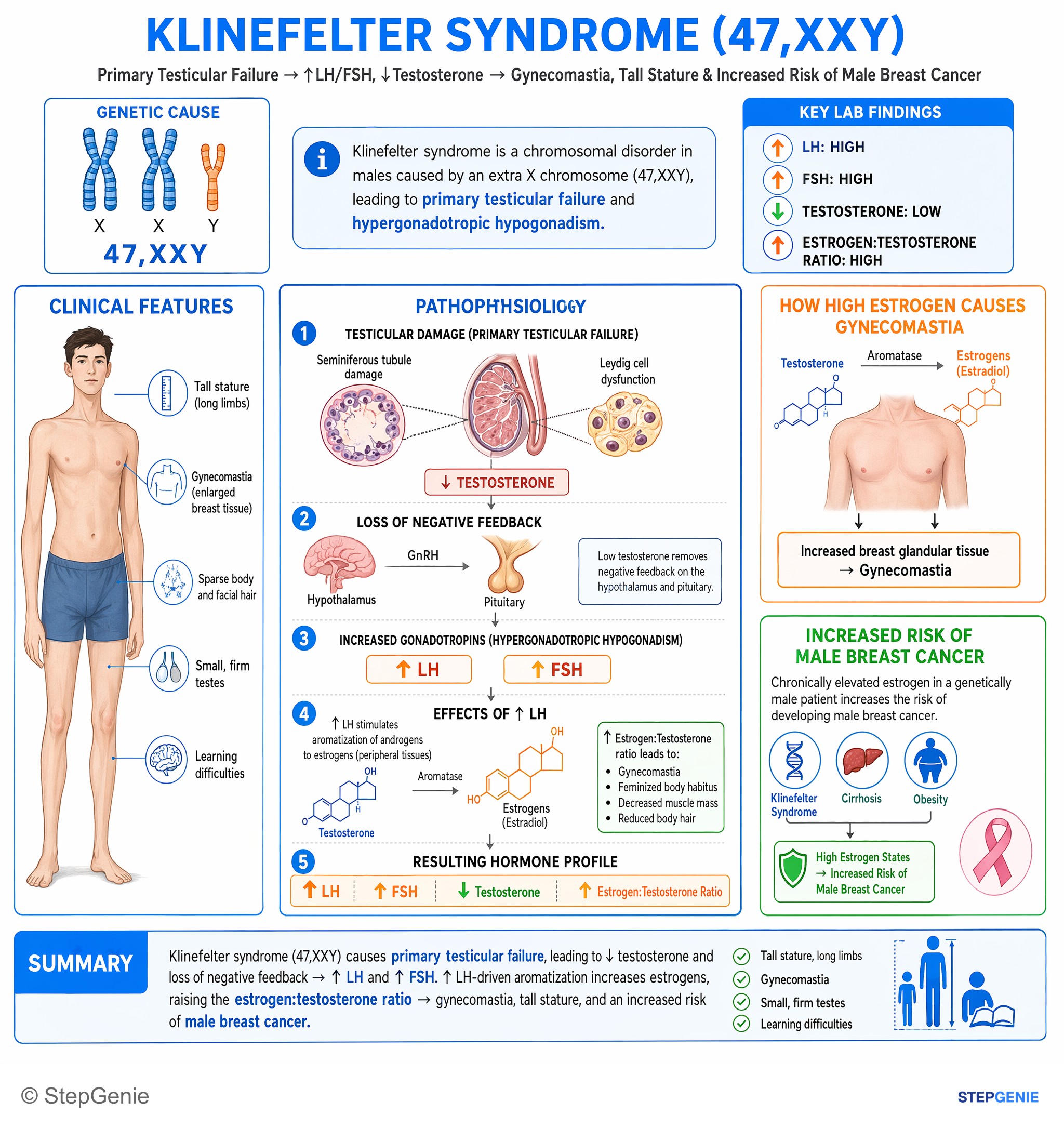
Klinefelter syndrome (47,XXY) causes primary testicular failure with ↑LH/FSH, ↓testosterone, gynecomastia, tall stature, and increased…
USMLE Step 1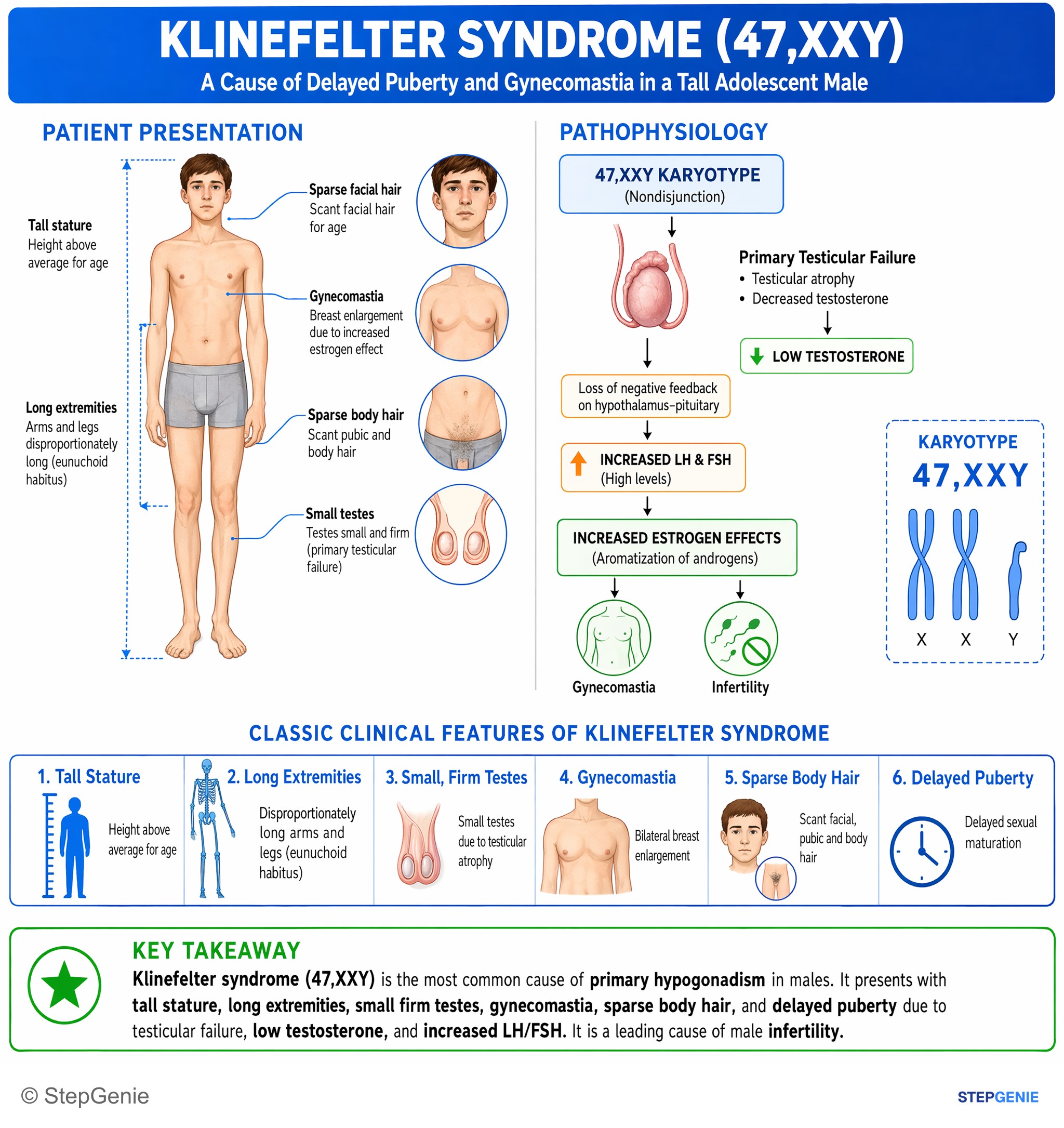
Klinefelter syndrome (47,XXY): tall, thin male with small firm testes, gynecomastia, sparse body hair, long extremities, and delayed…
USMLE Step 1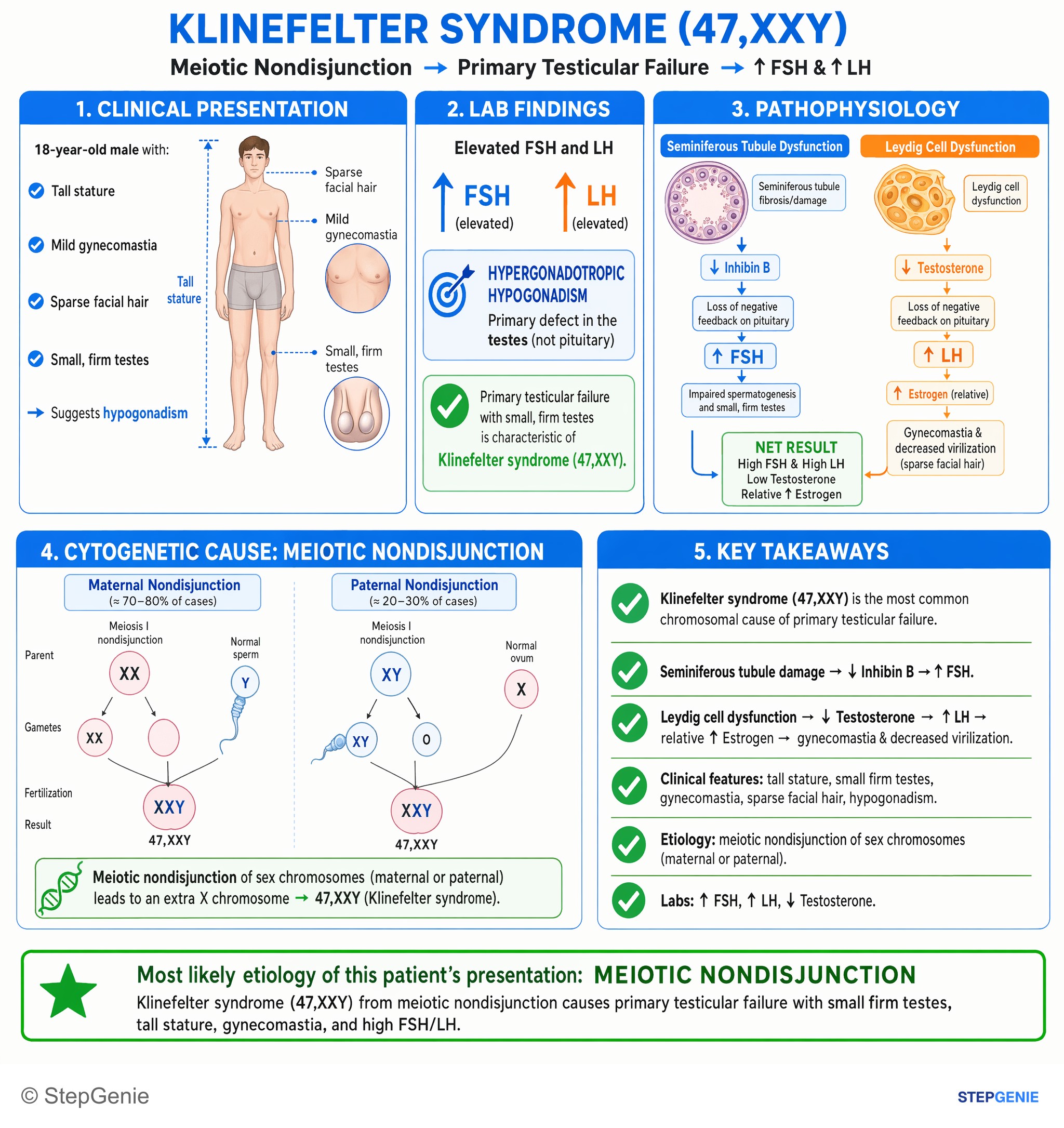
Klinefelter syndrome (47,XXY) from meiotic nondisjunction causes primary testicular failure with small firm testes, tall stature…
USMLE Step 1Frequently Asked Questions
What causes Klinefelter syndrome?
Klinefelter syndrome is caused by an extra X chromosome, most often giving a 47,XXY karyotype. It results from nondisjunction during egg or sperm formation: the extra X comes from the mother in about half of cases and from the father in the rest, and because it is a random error it is not inherited. About 10 to 15 percent of patients are mosaic (46,XY/47,XXY) after an error early in development and tend to have milder features. Because all X chromosomes but one are inactivated, a 47,XXY male has one Barr body.
What are the hormone levels in Klinefelter syndrome?
Klinefelter syndrome is primary (hypergonadotropic) hypogonadism. Testosterone is low or low-normal, and LH and FSH are high because the failing testes no longer provide negative feedback. Inhibin B is very low or undetectable in adults because the seminiferous tubules are damaged, and estradiol and SHBG are often high-normal or high, which favors gynecomastia. By contrast, secondary hypogonadism such as Kallmann syndrome shows low testosterone with low or inappropriately normal LH and FSH.
What are the signs of Klinefelter syndrome?
The classic adult is tall with long legs and has small, firm testes (rarely over 4 mL), gynecomastia, sparse facial and body hair, reduced muscle mass and infertility from azoospermia. Childhood clues are subtle: mild hypotonia, late walking, speech and language delay and reading problems. Puberty usually starts on time but stalls. Signs can be so mild that about 65 percent of affected men are never diagnosed, and fewer than 1 in 10 is diagnosed before puberty.
Can men with Klinefelter syndrome have children?
Most cannot father children naturally: NICHD estimates that 95 to 99 percent are infertile. However, sperm can be found in more than half of men with Klinefelter syndrome, and microdissection TESE combined with intracytoplasmic sperm injection has allowed up to half of men previously considered infertile to have biological children. Success falls with age and after testosterone therapy starts, so fertility planning, sometimes including sperm banking in adolescence, should come before testosterone. Mosaic patients may be fertile.
How is Klinefelter syndrome diagnosed and treated?
A karyotype, analyzing at least 20 cells, or chromosomal microarray confirms the diagnosis; it is often made during an infertility workup with low testosterone and high LH and FSH. Testosterone replacement, usually from puberty, improves muscle, bone strength, body hair, focus and mood, but it does not enlarge the testes, reverse gynecomastia or restore fertility, and it suppresses sperm production. Care also includes speech and learning support, bone health, breast checks and sometimes breast reduction surgery.
How is Klinefelter syndrome different from Turner and Kallmann syndrome?
Klinefelter syndrome is a 47,XXY male with primary testicular failure: tall stature, small firm testes, gynecomastia, low testosterone and high LH and FSH. Turner syndrome is a female with a missing or altered X (45,X in about half) who has short stature, ovarian insufficiency with high gonadotropins, a webbed neck and heart defects such as coarctation. Kallmann syndrome is secondary hypogonadism from failed GnRH neuron migration: low LH and FSH plus anosmia, and fertility can often be restored with gonadotropins.