Cri-du-chat syndrome (5p minus syndrome) is caused by a deletion at the end of the short (p) arm of chromosome 5. Its signature is a high-pitched, mewing, cat-like cry in the newborn period, from a small, narrow larynx and a floppy epiglottis plus neurologic factors, together with microcephaly, low birth weight, hypotonia, a round face with widely spaced eyes, and marked developmental delay and intellectual disability. About 90% of cases are new (de novo) deletions; about 10% are inherited from a healthy parent who carries a balanced translocation. It affects about 1 in 20,000 to 50,000 newborns. Larger deletions usually mean more severe disability; many affected children survive into adulthood with significant disability, and care is supportive, centered on early intervention.
Cri-du-chat at a glance
| Feature | Cri-du-chat (5p-) | Exam cue |
|---|---|---|
| Genetic lesion | Deletion of the end of 5p (critical region 5p15) | "Deletion", not a trisomy and not imprinting |
| Cry | High-pitched, cat-like (mewing) cry, heard in the immediate newborn period; it typically lasts several weeks and then disappears | The hallmark clue |
| Growth and head | Low birth weight, microcephaly | Small head, not large |
| Tone and development | Hypotonia; marked developmental delay and intellectual disability | Larger deletions tend to be more severe |
| Face in infancy | Round face, widely spaced eyes (hypertelorism), downslanting palpebral fissures, strabismus, broad nasal bridge, low-set abnormally shaped ears, small jaw | The face becomes long and narrow with age |
| Other anomalies | Heart defects in some; syndactyly | A murmur doesn't rule it out |
| Inheritance | About 90% de novo; about 10% from a parent with a balanced translocation | A recurrence in siblings means a parental translocation |
| Diagnosis | Karyotype; FISH for a deletion too small to see; chromosomal microarray sizes the deletion | Parents need a karyotype to look for a balanced translocation |
| Management | No specific therapy; early rehabilitative and educational intervention | "Treatment" answers are supportive care |
Mnemonic: the cat got its 5th paw clipped: cat cry, chromosome 5, p arm, clipped = deletion.
Comparison table: cri-du-chat vs other chromosomal syndromes
| Syndrome | Chromosome change | Signature clue | Other high-yield features |
|---|---|---|---|
| Cri-du-chat | Deletion, end of 5p | Cat-like cry in the newborn | Microcephaly, low birth weight, hypotonia, round face, hypertelorism; heart defects in some |
| Wolf-Hirschhorn | Deletion near the end of 4p | "Greek warrior helmet" face | Growth deficiency starting before birth, microcephaly, seizures that can be hard to treat, cleft lip or palate, colobomas, heart and genitourinary defects; many die in infancy |
| Williams | Deletion of 7q11.23 (includes ELN) | Overly friendly child with hypercalcemia in infancy | Broad forehead, puffy eyes, full cheeks, small chin; weak visual-spatial skills but strong language and music; supravalvular aortic stenosis |
| 22q11.2 deletion (DiGeorge) | Deletion of 22q11.2 (TBX1) | Hypocalcemia with seizures plus conotruncal heart defects | Thymic hypoplasia (immune problems), submucosal cleft palate and velopharyngeal insufficiency, learning problems, psychiatric illness |
| Prader-Willi | Loss of the paternal 15q11-q13 (deletion about 70%, maternal uniparental disomy about 25%) | Floppy, poor-feeding infant who later develops hyperphagia and obesity | Hypogonadism, short stature, small hands and feet, mild to moderate intellectual disability, skin picking |
| Angelman | Loss of the maternal UBE3A (15q11-q13 deletion about 70%) | Happy, excitable child with frequent laughter and hand-flapping | Severe speech impairment, ataxia, seizures, microcephaly |
| Down (trisomy 21) | Extra chromosome 21 | Upslanting eyes, hypotonia | Heart defects in about half; reflux, celiac disease, hypothyroidism, leukemia, early Alzheimer disease |
| Edwards (trisomy 18) | Extra chromosome 18 | Clenched fists with overlapping fingers | Slow growth before birth, small abnormally shaped head, small jaw and mouth, heart defects; only 5-10% live past the first year |
| Patau (trisomy 13) | Extra chromosome 13 | Extra fingers or toes, cleft lip or palate and brain malformations | Small or underdeveloped eyes, hypotonia, heart defects; only 5-10% live past the first year |
The two 15q11-q13 disorders are imprinting problems: the same region causes Prader-Willi when the father's copy is lost and Angelman when the mother's is lost.
Why the cry, and why severity varies
- The cry: the larynx is small, narrow and diamond-shaped, and the epiglottis is small, floppy and hypotonic, with neurologic changes adding to it. One review reports the cry in about 96% of affected newborns.
- Two critical regions: loss of 5p15.3 is linked to the cry; loss of 5p15.2 is linked to the facial features, microcephaly and intellectual disability. So people with smaller or atypical deletions may show only part of the picture.
- Size matters: larger deletions generally cause more severe intellectual disability and developmental delay. Loss of one gene in the region, CTNND2, is associated with severe intellectual disability in some people.
- The face changes: the round face of infancy becomes long and narrow in later childhood and adulthood, often with a short philtrum and dental malocclusion.
Inheritance and recurrence risk
- Most cases (about 90%) are not inherited: the deletion arises as a random event during formation of the egg or sperm or in early fetal development. In three molecular studies summarized in a 2006 review, the deleted chromosome 5 came from the father in 80-90% of cases.
- About 10% are inherited from an unaffected parent who carries a balanced translocation: no genetic material is missing in the parent, but a child can receive an unbalanced set with 5p material missing. (That is the MedlinePlus figure; in an Italian registry of 80 patients, familial translocations accounted for about 4%.)
- Exam rule: two affected siblings with healthy parents point to a parental balanced translocation, so both parents need chromosome studies and genetic counseling.
Diagnosis
- Suspect it from the cry plus microcephaly, low birth weight, hypotonia and the facial features.
- Karyotype has long been the first confirmatory test; larger terminal deletions are visible.
- FISH with a 5p probe is the classic next step when suspicion is high but the karyotype looks normal (a small deletion).
- Chromosomal microarray scans the whole genome for missing or extra material and shows the size of the deletion.
- Parents: microarray cannot detect balanced rearrangements, so a parent's balanced translocation needs a karyotype.
Management and prognosis
- There is no specific therapy; early rehabilitative and educational interventions (such as physical and speech therapy and special education) improve the outlook.
- Treat associated problems, such as heart defects, as they arise.
- Prognosis: many children survive into adulthood but have significant disability. In one series, half of the children walked independently by age 3 and half used sentences by about 5.5 years.
How USMLE tests it
- "What chromosome?" Cat cry = 5p deletion. Don't swap it with 4p deletion (Wolf-Hirschhorn: warrior-helmet face and seizures).
- "What mechanism?" A structural deletion, not nondisjunction (trisomies) and not imprinting (Prader-Willi, Angelman).
- "Why did it happen twice?" A balanced translocation in a parent.
- "Which test?" Karyotype (with FISH for small deletions) is the classic answer for the child; remember that microarray can't see a balanced translocation in a parent.
- The cat cry separates it from other syndromes that present with neonatal hypotonia, such as Prader-Willi and Down syndrome.
Practice question
A 2-day-old girl has a weak, high-pitched cry that the nurses describe as sounding like a kitten. She was born at term weighing 2.3 kg (5 lb 1 oz). Examination shows microcephaly, a round face, widely spaced eyes, downslanting palpebral fissures, low-set ears, a small jaw and hypotonia. Her parents are healthy, but their first child, a boy, had the same cry and severe developmental delay. Which mechanism most likely explains why both children are affected?
A. Meiotic nondisjunction associated with advanced maternal age B. A balanced chromosomal translocation carried by one parent C. Loss of the paternally inherited 15q11-q13 region D. An expanding trinucleotide repeat E. Maternal uniparental disomy of chromosome 15
Answer: B. The cat-like cry, microcephaly, low birth weight, round face with hypertelorism and hypotonia are cri-du-chat syndrome (5p deletion). Most cases are de novo, but about 10% are inherited from a healthy parent with a balanced translocation, the best explanation for two affected siblings. Both parents should have chromosome studies.
- A: Nondisjunction adds or removes whole chromosomes (trisomies 21, 18 and 13), not the end of one arm.
- C: Loss of the paternal 15q11-q13 region causes Prader-Willi syndrome: a floppy, poor-feeding infant who later develops hyperphagia and obesity; most cases are not inherited.
- D: A trinucleotide repeat expansion lengthens a repeat inside one gene, as in fragile X syndrome (a CGG repeat in FMR1 that can expand when a mother passes it on); it doesn't remove the end of a chromosome arm.
- E: Maternal uniparental disomy of chromosome 15 is the second most common cause of Prader-Willi syndrome, not cri-du-chat.
Key takeaways
- Cri-du-chat = deletion at the end of 5p: high-pitched cat-like newborn cry, microcephaly, low birth weight, hypotonia, round face with hypertelorism, then severe developmental delay.
- The cry comes from a small, narrow larynx and floppy epiglottis plus neurologic changes; it maps to 5p15.3.
- About 90% de novo, about 10% from a parental balanced translocation; recurrence in siblings means testing the parents.
- Confirm with karyotype, FISH or microarray; microarray misses balanced translocations.
- Separate it from Wolf-Hirschhorn (4p-), Williams (7q11.23), 22q11.2 deletion, Prader-Willi/Angelman (15q11-q13) and the trisomies.
- Management is supportive, with early intervention.
Sources
- Cri-du-chat syndrome — MedlinePlus Genetics (2022)
- Chromosomal Deletion Syndromes — Merck Manual Professional Edition (2025)
- Overview of Chromosomal Abnormalities — Merck Manual Professional Edition (2025)
- Cri du Chat syndrome — Orphanet Journal of Rare Diseases (2006)
- Wolf-Hirschhorn syndrome — MedlinePlus Genetics (2023)
- Williams syndrome — MedlinePlus Genetics (2022)
- 22q11.2 deletion syndrome — MedlinePlus Genetics
- Prader-Willi syndrome — MedlinePlus Genetics
- Angelman syndrome — MedlinePlus Genetics (2022)
- Down syndrome — MedlinePlus Genetics (2020)
- Trisomy 18 — MedlinePlus Genetics (2021)
- Trisomy 13 — MedlinePlus Genetics (2021)
Visual explanations from the StepGenie QBank
Infographics StepGenie drew to explain questions in its own QBank, matched to this article's topic. Each caption is the takeaway of the question it explains.
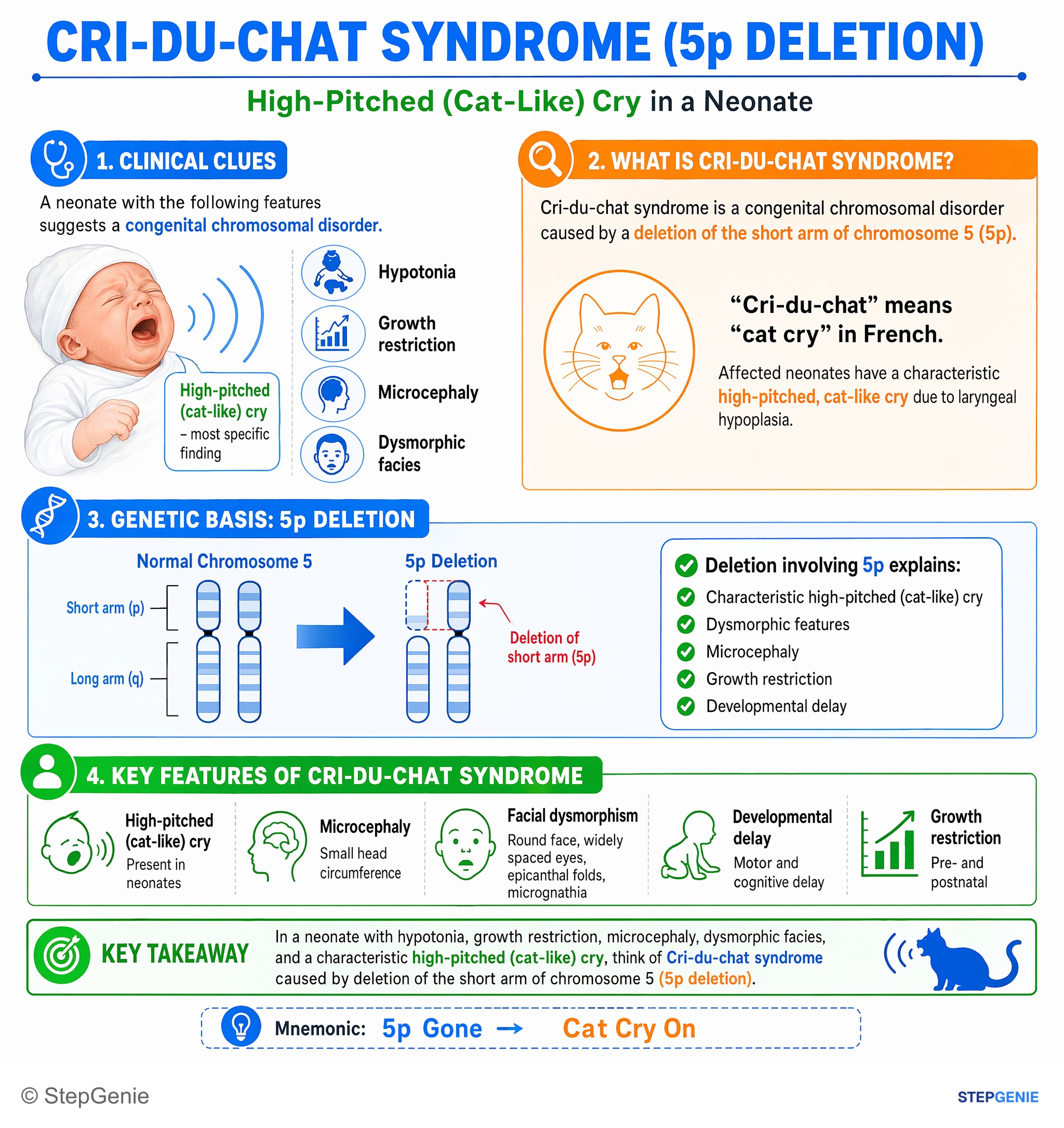
Cri-du-chat syndrome: 5p deletion causing microcephaly, facial dysmorphism, developmental delay, and characteristic high-pitched…
USMLE Step 1Frequently Asked Questions
What chromosome is affected in cri-du-chat syndrome?
Cri-du-chat syndrome is caused by a deletion at the end of the short (p) arm of chromosome 5, which is why it is also called 5p minus syndrome. The size of the deletion varies, and larger deletions generally cause more severe intellectual disability and developmental delay. Loss of the 5p15.3 region is linked to the cat-like cry, and loss of 5p15.2 to the facial features, microcephaly and intellectual disability.
Why do babies with cri-du-chat syndrome cry like a cat?
The high-pitched, mewing cry comes from a small, narrow, diamond-shaped larynx and a small, floppy epiglottis, together with neurologic changes. It is typically heard in the immediate newborn period and is the most specific clue to the diagnosis. The cry is linked to loss of the 5p15.3 region near the very end of the short arm of chromosome 5.
Is cri-du-chat syndrome inherited?
Usually not. About 90% of cases are new deletions that occur at random during formation of the egg or sperm or in early fetal development, and the parents are unaffected. About 10% are inherited from a healthy parent who carries a balanced translocation, which can pass to a child in an unbalanced form with 5p material missing. When a couple has two affected children, a parental balanced translocation is the likely cause, and both parents should have chromosome studies.
What are the main features of cri-du-chat syndrome?
The classic newborn has a high-pitched cat-like cry, low birth weight, microcephaly and hypotonia, with a round face, widely spaced eyes, downslanting palpebral fissures, low-set ears and a small jaw. Some babies have heart defects. Over time the face becomes long and narrow, and developmental delay and intellectual disability become the main problems; many people survive into adulthood with significant disability.
How is cri-du-chat syndrome diagnosed?
A karyotype has long been the first confirmatory test and shows larger deletions of 5p. When the clinical picture fits but the karyotype looks normal, FISH with a 5p probe can find a smaller deletion. Chromosomal microarray scans the whole genome for missing material and shows the size of the deletion. Because microarray cannot detect balanced rearrangements, parents are tested with a karyotype to look for a balanced translocation.
How is cri-du-chat syndrome different from Wolf-Hirschhorn syndrome?
Both are deletions near the end of a chromosome's short arm, which is why they are easy to mix up. Cri-du-chat is a 5p deletion marked by the high-pitched cat-like cry, a round face and hypotonia. Wolf-Hirschhorn is a 4p deletion marked by a 'Greek warrior helmet' facial appearance, growth deficiency that begins before birth and seizures that can be hard to treat, along with cleft lip or palate and heart defects.