A simple mnemonic for the four classic trinucleotide repeat disorders is "Hunt My Fragile Friend": Huntington disease (CAG), myotonic dystrophy type 1 (CTG), fragile X syndrome (CGG) and Friedreich ataxia (GAA). In each, a three-base DNA sequence expands past a disease threshold. In Huntington disease, myotonic dystrophy type 1 and fragile X, the expanded repeat is unstable and tends to grow between generations; because longer repeats cause earlier, more severe disease, the result is anticipation (recessive Friedreich ataxia does not show it). Huntington disease (HTT, chromosome 4) and myotonic dystrophy type 1 (DMPK, chromosome 19) are autosomal dominant, fragile X syndrome (FMR1) is X-linked and Friedreich ataxia (FXN, chromosome 9) is autosomal recessive. Parent of origin is the favorite exam twist: large Huntington expansions come almost only from fathers, while fragile X full mutations and congenital myotonic dystrophy come from mothers.
Trinucleotide repeat disorders mnemonic
"Hunt My Fragile Friend" lists the four classics: Huntington disease, Myotonic dystrophy, Fragile X syndrome and Friedreich ataxia. Then attach each repeat to a hook that encodes a real finding:
| Disease | Repeat | Hook | What the hook stands for |
|---|---|---|---|
| Huntington disease | CAG | Caudate And Glutamine | CAG codes for glutamine, so huntingtin carries a long polyglutamine tract; the caudate atrophies |
| Fragile X syndrome | CGG | Chin, Giant Gonads | Prominent jaw; large testes after puberty |
| Myotonic dystrophy type 1 | CTG | Cataracts, Toupee, Gonadal atrophy | Early cataracts, frontal balding, small testes |
| Friedreich ataxia | GAA | Ataxic GAAit | Progressive gait ataxia that begins in childhood or adolescence |
Two more hooks:
- The odd ones out. Of the four, fragile X is the only X-linked disorder (the X is in its name) and Friedreich ataxia the only recessive one; Huntington disease and myotonic dystrophy type 1 are autosomal dominant.
- Location predicts mechanism. Walk along a gene from 5′ to 3′: fragile X CGG (5′ untranslated region) silences the gene, Huntington CAG (coding sequence) makes a toxic protein, Friedreich GAA (intron 1) blocks transcription and myotonic dystrophy CTG (3′ untranslated region) makes toxic RNA.
Fragile X syndrome mnemonic
Start with CGG = Chin, Giant Gonads, then picture everything extra large: a long face with a prominent forehead and jaw, large ears and macroorchidism, present in essentially all males after puberty. Add intellectual disability and autism spectrum disorder (50–70% of people with fragile X syndrome). For inheritance, remember "mothers make it full": with extremely rare exceptions, a premutation expands to a full mutation only when a mother passes it on.
CTG mnemonic for myotonic dystrophy
CTG = Cataracts, Toupee, Gonadal atrophy covers early cataracts, premature frontal balding (in women as well as men) and small testes. Add what the mnemonic leaves out: myotonia (a grip that is slow to release), distal and facial weakness with ptosis, cardiac conduction disease, insulin resistance and respiratory weakness.
The big four at a glance
| Disease | Inheritance | Repeat and location | Mechanism | Disease range | Expands mainly through | Hallmark clues |
|---|---|---|---|---|---|---|
| Huntington disease | AD | CAG in the coding sequence of HTT (chromosome 4) | Toxic polyglutamine huntingtin (gain of function) | 40 or more (36–39 reduced penetrance) | Father | Chorea, depression, dementia; caudate and putamen atrophy |
| Fragile X syndrome | X-linked | CGG in the 5′ untranslated region of FMR1 | Promoter hypermethylation silences the gene; little or no FMRP (loss of function) | More than 200 (full mutation) | Mother | Intellectual disability, autism, long face, large ears, macroorchidism |
| Myotonic dystrophy type 1 | AD | CTG in the 3′ untranslated region of DMPK (chromosome 19) | Toxic CUG RNA traps splicing regulators (RNA gain of function) | 50 or more | Mother for the congenital form | Myotonia, distal weakness, cataracts, conduction disease, frontal balding |
| Friedreich ataxia | AR | GAA in intron 1 of FXN (chromosome 9) | Silenced transcription, too little frataxin (loss of function) | 66 or more, on both alleles in about 96% | No anticipation (both parents are carriers) | Ataxia, absent leg reflexes with upgoing toes, hypertrophic cardiomyopathy, diabetes |
Repeat numbers: normal, intermediate, premutation and full
| Disease (repeat) | Normal | Gray zone | Premutation or reduced penetrance | Disease range |
|---|---|---|---|---|
| Huntington disease (CAG) | 26 or fewer | 27–35 intermediate: normal but unstable, so a child can inherit an allele in the disease range | 36–39 reduced penetrance | 40 or more; juvenile cases usually more than 55 |
| Fragile X syndrome (CGG) | About 5–44 | 45–54 intermediate: not seen to expand to a full mutation in one generation | 55–200 premutation, unmethylated | More than 200 full mutation, methylated |
| Myotonic dystrophy type 1 (CTG) | 34 or fewer | None | 35–49 premutation | 50 or more: mild about 50–150, classic about 100–1,000, congenital more than 1,000 |
| Friedreich ataxia (GAA) | 5–33 | 34–65 intermediate (mutable) | 44–65 borderline: reduced penetrance possible | 66 to about 1,300, on both alleles |
| Kennedy disease (CAG in AR) | 34 or fewer | 35 of uncertain significance | 36–37 reduced penetrance | 38 or more |
Why the location of the repeat decides the disease
The rule: a repeat inside the coding sequence makes a toxic protein; a repeat in a noncoding region either silences the gene (CGG, GAA) or makes toxic RNA (CTG).
- Coding CAG makes a toxic protein. CAG codes for glutamine, so a CAG expansion inside the coding sequence produces a protein with a long polyglutamine stretch. Huntington disease, Kennedy disease and several autosomal dominant spinocerebellar ataxias work this way.
- A 5′ untranslated CGG silences the gene. A full mutation hypermethylates the FMR1 promoter, so the gene makes little or no FMRP, a protein that shuttles mRNAs and controls when they are translated, which matters for synapse development and learning.
- An intronic GAA starves the cell of frataxin. Repressive chromatin spreads from the expanded GAA tract to the FXN promoter and blocks transcription. Frataxin helps assemble mitochondrial iron–sulfur clusters, so its loss brings mitochondrial iron overload, energy failure and reactive oxygen species.
- A 3′ untranslated CTG makes toxic RNA. The expanded CUG tract in the DMPK transcript gathers in nuclear foci and traps MBNL splicing proteins while CELF1 rises, so many transcripts switch back to fetal splice forms: a mis-spliced muscle chloride channel (CLCN1) causes myotonia and a mis-spliced insulin receptor causes insulin resistance.
- A CGG premutation makes too much RNA. A premutation (55–200 repeats) is not hypermethylated; instead it overproduces abnormal FMR1 mRNA, which is thought to drive the premutation disorders (in FXPOI, by binding other proteins and keeping them from working). That is why carriers develop FXTAS and FXPOI rather than fragile X syndrome.
Anticipation and parent of origin
Expanded repeats are unstable in a parent's germline, and which parent drives the expansion differs by disease; questions test exactly that. For a full question on the concept, see the anticipation Q-bank breakdown.
| Disease | Expansion bias | What the exam wants you to say |
|---|---|---|
| Huntington disease | Father: large expansions (a gain of more than 7 repeats) occur almost exclusively through paternal transmission | Juvenile Huntington disease, usually with more than 55 repeats, is most often inherited from the father |
| Fragile X syndrome | Mother: with extremely rare exceptions, only a mother expands a premutation to a full mutation | A father with a premutation passes it to all of his daughters and to none of his sons |
| Myotonic dystrophy type 1 | Mother for congenital disease, rarely the father | A floppy newborn whose mother has myotonia or cataracts |
| Friedreich ataxia | No anticipation: GAA repeats tend to contract through fathers and contract or expand equally often through mothers | Autosomal recessive: two carrier parents, a 25% risk for each child; carriers (about 1 in 60 to 1 in 100 people of European ancestry) are asymptomatic |
How big is a mother's fragile X risk? If she transmits her premutation, the chance it expands to a full mutation depends on its size: about 3% for 55–59 repeats, rising to about 100% at 90 or more, in ACMG's 2013 testing standards; the smallest premutation reported to expand in one generation had 56 repeats. AGG interruptions within the repeat lower the risk.
Huntington disease
Huntington disease is a progressive disorder of movement, cognition and behavior, with a mean onset around 45 years and a median survival of 15–18 years after onset. Chorea is the classic motor sign. Depression is the most common psychiatric feature (about 40% of patients), and suicidal ideation and suicide are common, especially just before diagnosis and later, when independence is lost. Onset before age 20 defines juvenile Huntington disease, usually with more than 55 repeats inherited from the father; the Westphal variant is a rare akinetic-rigid form.
- Pathology: progressive bilateral atrophy of the caudate and putamen from selective loss of GABAergic medium spiny neurons. For how losing these striatal neurons connects to chorea, work through the direct vs indirect pathway question.
- Repeat sizes: a person with 36–39 repeats may or may not develop the disease, the textbook case of reduced penetrance in the penetrance vs expressivity cheat sheet.
- Chorea treatment: VMAT2 inhibitors (tetrabenazine, deutetrabenazine, valbenazine), neuroleptics or benzodiazepines. Tetrabenazine reversibly inhibits VMAT2 and depletes monoamines such as dopamine; its label carries a boxed warning for depression and suicidality and rules it out in patients who are actively suicidal or have untreated or inadequately treated depression.
- Testing minors: each child of an affected parent has a 50% risk, but the AAP and ACMG support deferring genetic testing of children for late-onset conditions until adulthood, because testing at a parent's request preempts the child's own choice. Fewer than 20% of at-risk adults choose to be tested for Huntington disease.
The Huntington disease cheat sheet covers the clinical side.
Fragile X syndrome and the premutation disorders
Fragile X syndrome is the most common inherited cause of intellectual disability and of autism spectrum disorder, affecting roughly 1 in 4,000 to 7,000 males and about half as many females. Affected males have intellectual disability, frequent autism, a long face with a prominent forehead and jaw, large ears, joint laxity and macroorchidism after puberty; mitral valve prolapse and aortic root dilation occur, mostly in adults. About 50% of females with a full mutation have intellectual disability, usually milder than in males. For how it fits among X-linked conditions, see the X-linked disorders flowchart.
Premutation carriers (55–200 CGG repeats) do not have fragile X syndrome, but they have their own disorders:
- FXTAS (fragile X–associated tremor/ataxia syndrome): late-onset cerebellar ataxia and intention tremor, often with memory loss, executive dysfunction, parkinsonism and neuropathy; a major MRI sign is white matter lesions in the middle cerebellar peduncles (the MCP sign). In male carriers the risk climbs from 17% at 50–59 to 75% at 80 or older (about 40% overall after 50); 16–20% of female carriers are affected.
- FXPOI (fragile X–associated primary ovarian insufficiency): hypergonadotropic hypogonadism before age 40 in about 20% of female carriers, compared with 1% of women overall.
Testing: PCR sizes the CGG repeat, and current methods detect virtually all expansion sizes; Southern blot is now used mainly to show whether a full mutation is methylated. Boys with autism and intellectual disability should be tested, especially when maternal relatives are similarly affected. Treatment is supportive. The fragile X overview has more detail.
Myotonic dystrophy type 1
Myotonic dystrophy type 1 (DM1) is the most common adult muscular dystrophy. Classic DM1, with onset typically at 10–30 years, causes myotonia (trouble releasing a grip that eases with repeated movement, the warm-up phenomenon), distal and facial weakness with ptosis and temporal muscle atrophy, early cataracts, frontal balding, small testes, diabetes, hypothyroidism, dysphagia and constipation. Cardiac involvement (up to 80% of adults) includes arrhythmias, cardiomyopathy and sudden death, and chronic respiratory failure is common.
Repeat size roughly tracks severity, with overlapping ranges: about 50–150 repeats gives mild adult-onset disease with a normal lifespan, about 100–1,000 the classic form and more than 1,000 the congenital form. Congenital DM1 brings reduced fetal movements, polyhydramnios, hypotonia, contractures, feeding difficulty and respiratory insufficiency, and it usually comes from the mother.
Management: an annual ECG, with a pacemaker or other intervention when needed. Mexiletine is first-line for functionally limiting myotonia but is contraindicated in second- or third-degree AV block; weakness, which has no treatment, is what usually disables patients. Avoid depolarizing muscle relaxants during anesthesia. Death is most often from respiratory or cardiac disease, at a mean age of 55.
Trap: myotonic dystrophy type 2 is a CCTG tetranucleotide repeat, not a trinucleotide disorder.
| Feature | Myotonic dystrophy type 1 | Myotonic dystrophy type 2 |
|---|---|---|
| Repeat | CTG, 3′ untranslated region of DMPK (chromosome 19) | CCTG, intron 1 of CNBP (chromosome 3) |
| Weakness | Distal limbs and face | Proximal and axial |
| Congenital form | Yes, usually maternal | No true congenital form |
| Anticipation | Yes | Not confirmed |
| Other clues | Cataracts, conduction disease | Early cataracts, as in DM1; muscle pain and stiffness; conduction disease in 10–20% |
Friedreich ataxia
Friedreich ataxia is the classic autosomal recessive repeat disorder. About 96% of patients have GAA expansions in intron 1 on both FXN alleles; the other 4% have one expansion plus a point variant or deletion. Mean onset is at 10–15 years, but about 15% begin after age 25, sometimes with preserved reflexes. The longer the shorter allele's GAA tract, the earlier the onset.
| Finding | How often |
|---|---|
| Gait ataxia | All patients |
| Dysarthria | 95% |
| Absent ankle and knee jerks with upgoing plantar responses | Usual |
| Loss of position and vibration sense in the legs | Most patients within 5 years of onset |
| Scoliosis | About two-thirds |
| Pes cavus | 55% |
| Hypertrophic cardiomyopathy | About two-thirds |
| Diabetes mellitus | Up to 30% |
| Optic atrophy, often silent | About 25% |
| Sensorineural hearing loss | 13% |
Why absent reflexes and upgoing toes together? Degenerating dorsal root ganglia remove the reflex arc while degenerating corticospinal tracts produce extensor plantar responses; posterior column loss takes away vibration and position sense, and the dorsal spinocerebellar tracts and dentate nucleus add to the ataxia. Cardiac disease (arrhythmias and heart failure) is the most common cause of death. Omaveloxolone, an Nrf2 pathway activator, is approved for patients 16 and older. For the recurrence math, including why a healthy sibling has a 2/3 chance of being a carrier, see the autosomal recessive inheritance guide.
Other repeat disorders to recognize
- Spinal and bulbar muscular atrophy (Kennedy disease): X-linked CAG expansion (38 or more) in the androgen receptor gene. Men develop lower motor neuron weakness, atrophy and fasciculations, usually at 30–50, with bulbar involvement and mild-to-moderate distal sensory loss, plus androgen insensitivity (gynecomastia from adolescence, testicular atrophy, reduced fertility). Carrier women are usually asymptomatic.
- Spinocerebellar ataxias: the main autosomal dominant ataxias; several are caused by CAG repeats that code for glutamine, the same polyglutamine mechanism as Huntington disease.
How USMLE tests trinucleotide repeat disorders
Stems give a phenotype and a family history, then ask for the repeat, the mechanism, the transmitting parent or a relative's risk. These are the traps:
| Trap | What is actually true |
|---|---|
| All four classics are autosomal dominant | Friedreich ataxia is autosomal recessive (loss of function); fragile X is X-linked |
| Myotonic dystrophy type 2 is a trinucleotide disorder | It is a CCTG tetranucleotide repeat in CNBP, with proximal weakness and no congenital form |
| A fragile X premutation causes mild fragile X syndrome | Carriers get FXTAS (older men with tremor and ataxia) and FXPOI (ovarian failure before 40) through excess FMR1 mRNA |
| A father with a premutation can have a son with fragile X | Fathers pass FMR1 only to daughters; the expansion happens in her children |
| Earlier onset in each generation means imprinting or variable expressivity | It is anticipation, driven by a measurable rise in repeat number |
| Chorea plus psychiatric symptoms is always Huntington disease | Without a family history, consider tardive dyskinesia, levodopa dyskinesia, thyrotoxicosis, CNS lupus, post-streptococcal chorea and other drugs |
| Parents ask to test their healthy 12-year-old for Huntington disease | Defer predictive testing until the child can decide as an adult |
| Teenage ataxia with areflexia and upgoing toes is always Friedreich ataxia | If FXN testing is negative, consider ataxia with vitamin E deficiency and ataxia-telangiectasia |
Worked vignettes
Vignette 1. A 31-year-old man has 2 years of irritability, depression and brief, irregular, flowing movements of his face and fingers. His father developed similar symptoms at 52. MRI shows atrophy of both caudate nuclei. Genetic testing shows 48 CAG repeats in one HTT allele; his father's expanded allele had 41. Why did his symptoms begin so much earlier than his father's? Later, his wife asks for their healthy 12-year-old daughter to be tested. What is the best response?
Answer: Anticipation from paternal expansion of the CAG repeat; defer the daughter's predictive test until adulthood.
Reasoning: CAG repeats in HTT are unstable in the male germline, so the repeat grew when it passed from father to son, and longer repeats cause earlier onset. Each of his children has a 50% risk, but testing a healthy child for an untreatable adult-onset disease preempts her own future choice, so it waits.
Vignette 2. A 4-year-old boy has speech delay, hand flapping, poor eye contact, a long face and large ears. His mother developed primary ovarian insufficiency at 34. Her 67-year-old father has an intention tremor, a wide-based gait and T2 hyperintensities in the middle cerebellar peduncles on MRI. What will the boy's FMR1 testing show?
Answer: A full mutation (more than 200 CGG repeats) with promoter methylation, silencing FMR1.
Reasoning: The grandfather's FXTAS comes from a premutation that all his daughters inherit; his daughter's FXPOI comes from the same premutation, which expanded to a full mutation when she passed it to her son. Their disease comes from excess FMR1 mRNA; the boy's from absent FMRP.
Vignette 3. A newborn girl is profoundly hypotonic, needs ventilatory support, feeds poorly and has contractures; the pregnancy had polyhydramnios and reduced fetal movements. Her 28-year-old mother has ptosis, a weak face, trouble letting go after a handshake and had cataract surgery at 26. What is the mechanism?
Answer: Congenital myotonic dystrophy type 1: a very large CTG expansion in the 3′ untranslated region of DMPK, inherited from the mother.
Reasoning: The expanded CUG RNA traps MBNL splicing proteins, so CLCN1, the insulin receptor and many other transcripts are mis-spliced. The mother needs an ECG, because conduction disease and arrhythmias can cause sudden death.
Vignette 4. A 13-year-old girl has 2 years of worsening clumsiness, dysarthria, absent ankle and knee jerks, upgoing toes, lost vibration and joint position sense in her feet, scoliosis and pes cavus. Echocardiography shows left ventricular hypertrophy. Her parents and brother are healthy. What is the cause, and what is her brother's chance of being a carrier?
Answer: Friedreich ataxia from GAA expansions in intron 1 of both FXN alleles; her brother has a 2/3 chance of being a carrier.
Reasoning: Areflexia (dorsal root ganglia) with upgoing toes (corticospinal tracts), posterior column loss and hypertrophic cardiomyopathy in a teenager with healthy parents point to Friedreich ataxia. An unaffected sibling has one of three equally likely unaffected genotypes, two of them carriers. Heart disease is the leading cause of death.
Key takeaways
- Hunt My Fragile Friend: Huntington (CAG), myotonic dystrophy (CTG), fragile X (CGG), Friedreich (GAA); hooks Caudate And Glutamine, Cataracts-Toupee-Gonadal atrophy, Chin-Giant Gonads, ataxic GAAit.
- Anticipation: unstable repeats grow between generations, and longer repeats mean earlier, more severe disease. Huntington expands through fathers; fragile X full mutations and congenital DM1 through mothers.
- Mechanism: coding CAG = toxic protein; 5′ untranslated CGG = silencing; 3′ untranslated CTG = toxic RNA; intronic GAA = too little frataxin.
- Numbers: Huntington 40 or more (36–39 reduced penetrance); fragile X premutation 55–200, full mutation more than 200; DM1 50 or more; Friedreich 66 or more on both alleles.
- Traps: a fragile X premutation causes FXTAS and FXPOI, not fragile X syndrome; Friedreich ataxia is recessive; myotonic dystrophy type 2 is a four-base CCTG repeat.
More genetics guides are collected on the Biochemistry hub.
Sources
- Huntington Disease — GeneReviews, NCBI Bookshelf (2026)
- FMR1 Disorders — GeneReviews, NCBI Bookshelf (2024)
- Friedreich Ataxia — GeneReviews, NCBI Bookshelf (2025)
- Myotonic Dystrophy Type 2 — GeneReviews, NCBI Bookshelf (2025)
- Spinal and Bulbar Muscular Atrophy — GeneReviews, NCBI Bookshelf (2026)
- ACMG Standards and Guidelines for Fragile X Testing — American College of Medical Genetics and Genomics (2013)
- Technical Report: Ethical and Policy Issues in Genetic Testing and Screening of Children — AAP and ACMG, Genetics in Medicine (2013)
- Huntington Disease — Merck Manual Professional Edition (2026)
- Fragile X Syndrome — Merck Manual Professional Edition (2025)
- Myotonic Dystrophy — Merck Manual Professional Edition (2024)
- Cerebellar Disorders — Merck Manual Professional Edition (2026)
- FMR1 Gene — MedlinePlus Genetics, National Library of Medicine (2020)
- Myotonic Dystrophy Type 1 — ARUP Consult, ARUP Laboratories (2019)
- Myotonic Dystrophy Type 1 Testing, 2024 Revision: A Technical Standard of the ACMG — Genetics in Medicine (2024)
- Soltanzadeh P. Myotonic Dystrophies: A Genetic Overview — Genes, MDPI (2022)
- López-Martínez A, et al. An Overview of Alternative Splicing Defects Implicated in Myotonic Dystrophy Type I — Genes, MDPI (2020)
- Ørstavik K, et al. Myotonic Dystrophy Type 1 – a Multiorgan Disorder — Tidsskrift for Den norske legeforening (2024)
- Bürk K. Friedreich Ataxia: Current Status and Future Prospects — Cerebellum & Ataxias (2017)
- Xenazine (tetrabenazine) Prescribing Information — DailyMed, National Library of Medicine (2019)
- Skyclarys (omaveloxolone) Prescribing Information — DailyMed, National Library of Medicine (2026)
Visual explanations from the StepGenie QBank
Infographics StepGenie drew to explain questions in its own QBank, matched to this article's topic. Each caption is the takeaway of the question it explains.
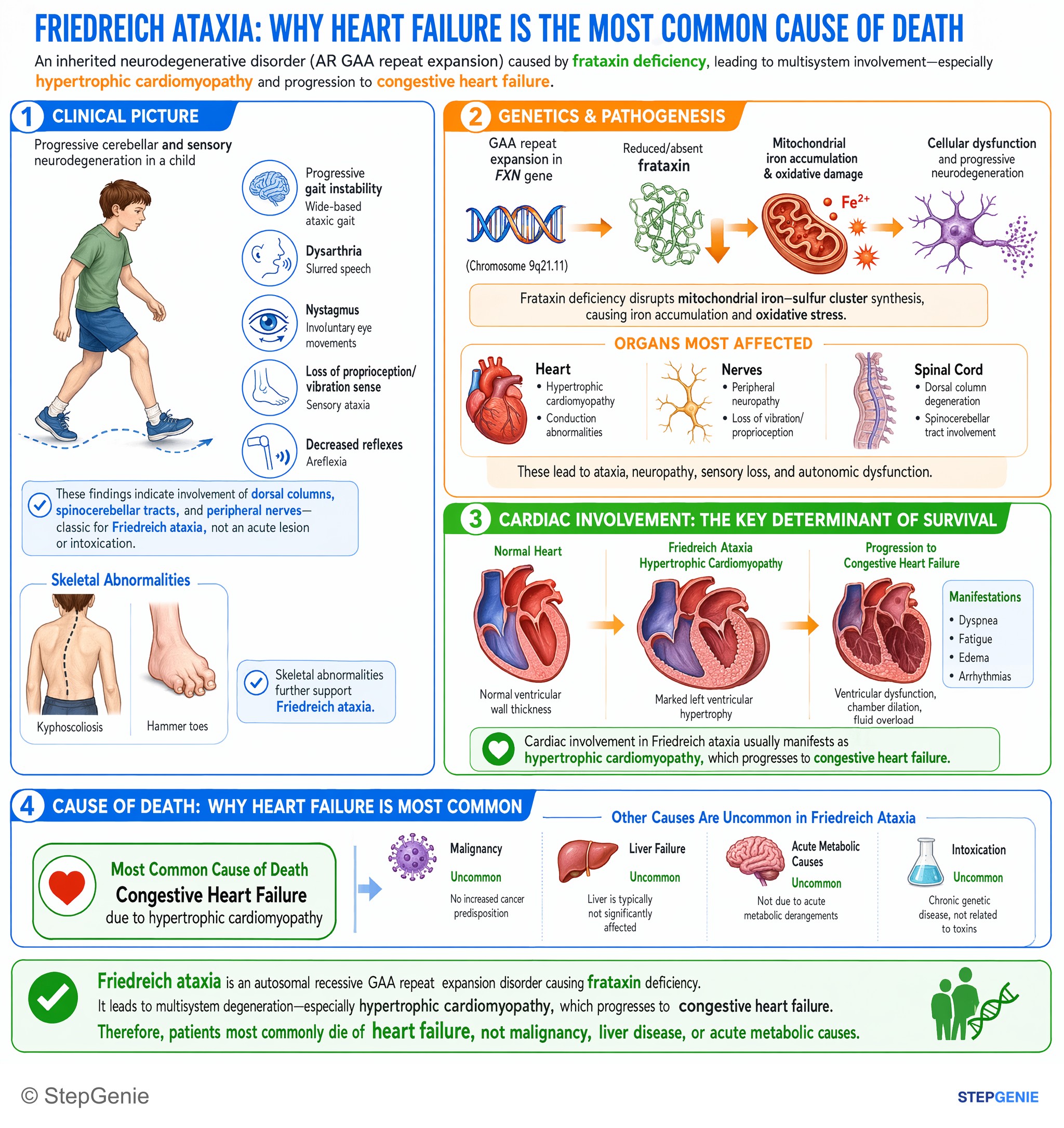
Friedreich ataxia (AR GAA repeat, frataxin deficiency) causes hypertrophic cardiomyopathy; patients most commonly die of congestive heart…
USMLE Step 1Frequently Asked Questions
What is a mnemonic for trinucleotide repeat disorders?
Use "Hunt My Fragile Friend" for the four classic trinucleotide repeat disorders: Huntington disease, myotonic dystrophy type 1, fragile X syndrome and Friedreich ataxia. Then attach each repeat to a hook: CAG for Huntington disease (Caudate And Glutamine), CTG for myotonic dystrophy (Cataracts, Toupee, Gonadal atrophy), CGG for fragile X (Chin, Giant Gonads) and GAA for Friedreich ataxia (ataxic GAAit). Of the four, fragile X is the only X-linked disorder and Friedreich ataxia the only autosomal recessive one.
What is a good mnemonic for fragile X syndrome?
Remember CGG as "Chin, Giant Gonads": a prominent jaw and macroorchidism, which is present in essentially all affected males after puberty. Then picture everything extra large: a long face, prominent forehead and large ears, along with intellectual disability and autism spectrum disorder, which affects 50% to 70% of people with fragile X syndrome. For inheritance, remember "mothers make it full": an FMR1 premutation (55 to 200 CGG repeats) expands to a full mutation (more than 200) almost only when a mother passes it on.
What does CTG stand for in myotonic dystrophy?
CTG is the trinucleotide repeat that expands in the 3′ untranslated region of the DMPK gene on chromosome 19 in myotonic dystrophy type 1, and it doubles as a mnemonic: Cataracts, Toupee (premature frontal balding) and Gonadal atrophy (small testes). Add the features the mnemonic misses: myotonia with trouble releasing a grip, distal and facial weakness with ptosis, cardiac conduction disease and insulin resistance. Fifty or more repeats cause disease, and the congenital form usually has more than 1,000.
What is anticipation in trinucleotide repeat disorders?
Anticipation is earlier onset and more severe disease in successive generations. In trinucleotide repeat disorders it happens because an expanded repeat is unstable and tends to lengthen when it is passed on, and longer repeats cause earlier, more severe disease. The transmitting parent matters: large Huntington disease expansions occur almost exclusively through fathers, while fragile X full mutations and congenital myotonic dystrophy come from mothers. Friedreich ataxia is autosomal recessive and does not show anticipation.
What is the difference between a fragile X premutation and a full mutation?
A full mutation has more than 200 CGG repeats in FMR1; the promoter becomes hypermethylated, the gene is silenced and little or no FMRP is made, causing fragile X syndrome. A premutation has 55 to 200 repeats, is not methylated and does not cause fragile X syndrome, but it overproduces abnormal FMR1 mRNA. About 40% of male carriers over 50 develop FXTAS (tremor and ataxia), and about 20% of female carriers develop primary ovarian insufficiency. With extremely rare exceptions, only mothers expand a premutation to a full mutation.
Which trinucleotide repeat disorder is autosomal recessive?
Friedreich ataxia is the autosomal recessive trinucleotide repeat disorder. About 96% of patients have GAA expansions in intron 1 of both FXN alleles, which block transcription and cause frataxin deficiency and mitochondrial iron overload. Onset is usually at 10 to 15 years with gait ataxia, dysarthria, absent leg reflexes, upgoing toes and loss of vibration and position sense. About two-thirds develop hypertrophic cardiomyopathy, and heart disease is the leading cause of death. Huntington disease and myotonic dystrophy are dominant; fragile X is X-linked.