Autosomal dominant (AD) questions on USMLE are usually “spot the pedigree” + “name the disease” + “predict the risk.” The fastest way to make AD stick is to anchor the pattern to a vivid scene you can replay in seconds—then attach the high-yield rules you’ll use on test day.
The Memory Palace: “The Dominant High-Rise”
Picture a tall apartment building where a single loud landlord controls each floor. If the landlord is present on a floor, everyone notices.
Walk-through (your visual mnemonic)
- A giant neon sign on the building says “DOMINANT” → one copy is enough to show the trait.
- The building has many floors stacked vertically → vertical transmission (seen in multiple generations).
- On each floor, one parent landlord can be heard by half the residents → ~50% risk to each child when an affected parent is heterozygous.
- Men and women live on every floor equally → both sexes affected equally.
- A father landlord can pass his “loudness” to his son down the stairwell → male-to-male transmission present (key distinction from X-linked dominant).
- Some apartments have thick soundproofing → reduced penetrance (genotype present, phenotype absent).
- Some apartments have amplifiers and are extra loud → variable expressivity (same mutation, different severity).
- The penthouse is under renovation and gets worse over time → anticipation in certain AD disorders (repeat expansion).
One-Liner (what you say in your head)
Autosomal dominant = “vertical transmission” with ~50% risk to each child (if heterozygous), both sexes equally affected, and male-to-male transmission can occur.
High-Yield Rules You’ll Use on USMLE
1) Pedigree pattern recognition (classic AD)
- Multiple successive generations affected (vertical pattern)
- Affected person usually has an affected parent
- Exception: new mutation (common in some AD disorders)
- Male-to-male transmission can occur
- If you see father → son, it’s not X-linked
2) Risk math (testable and quick)
If one parent is heterozygous affected () and the other is unaffected ():
- Offspring risk:
- Each child is an independent event (prior kids don’t change the probability)
If an affected individual is homozygous () (rare; sometimes lethal or very severe):
- Offspring risk with unaffected partner ():
3) The “why does it skip a generation?” trap
If an AD disease seems to “skip”:
- Reduced penetrance (genotype present but not expressed)
- Variable expressivity (mild case overlooked)
- De novo mutation (especially if family history is negative)
Autosomal Dominant vs the Look-Alikes (Fast Differentials)
| Feature | Autosomal Dominant | Autosomal Recessive | X-linked Dominant |
|---|---|---|---|
| Generations | Vertical | Often skips | Vertical |
| Sexes affected | Equal | Equal | Often more females |
| Male-to-male transmission | Yes | Yes | No |
| Typical risk if one heterozygous affected parent | 50% | Usually low unless both carriers/affected | Depends; affected father → all daughters affected, no sons |
“Dominant High-Rise” Disease Anchors (Classic AD Conditions)
Use these as “tenants” in your high-rise—each one is a frequent USMLE cameo.
The big 5+ you should recognize immediately
- Marfan syndrome (FBN1)
- Tall “high-rise” vibe; aortic root dilation, lens subluxation (up/out)
- Neurofibromatosis type 1 (NF1)
- Café-au-lait, neurofibromas, Lisch nodules; variable expressivity is common
- Autosomal dominant polycystic kidney disease (PKD1/PKD2)
- Flank pain, hematuria, HTN; berry aneurysms, hepatic cysts
- Familial hypercholesterolemia (LDL receptor/ApoB/PCSK9)
- Early ASCVD; tendon xanthomas
- Huntington disease (CAG repeat, anticipation)
- Chorea, psychiatric changes, dementia; anticipation (often worse/earlier in successive generations)
Also high-yield AD
- Hereditary spherocytosis (also can be AR): anemia, jaundice, splenomegaly; ↑MCHC
- Von Willebrand disease (often AD): mucosal bleeding, ↑bleeding time, ±↑PTT
- Hereditary hemorrhagic telangiectasia (Osler-Weber-Rendu): recurrent epistaxis, AVMs
Mini-Checkpoint: If you see this stem…
“Affected father and affected son” → think autosomal (AD or AR), not X-linked.
“Every generation has affected individuals” + both sexes + ~50% risk → classic autosomal dominant.
Quick Share Mnemonic (screenshot-ready)
AD = “DOMINANT High-Rise”
- Vertical floors → vertical transmission
- 50% residents hear landlord → 50% risk (heterozygous parent)
- Men + women on every floor → equal sexes
- Dad → son down stairwell → male-to-male transmission exists
- Soundproof rooms → reduced penetrance
- Different loudness → variable expressivity
- Penthouse gets worse → anticipation (repeat expansions)
Visual explanations from the StepGenie QBank
Infographics StepGenie drew to explain questions in its own QBank, matched to this article's topic. Each caption is the takeaway of the question it explains.
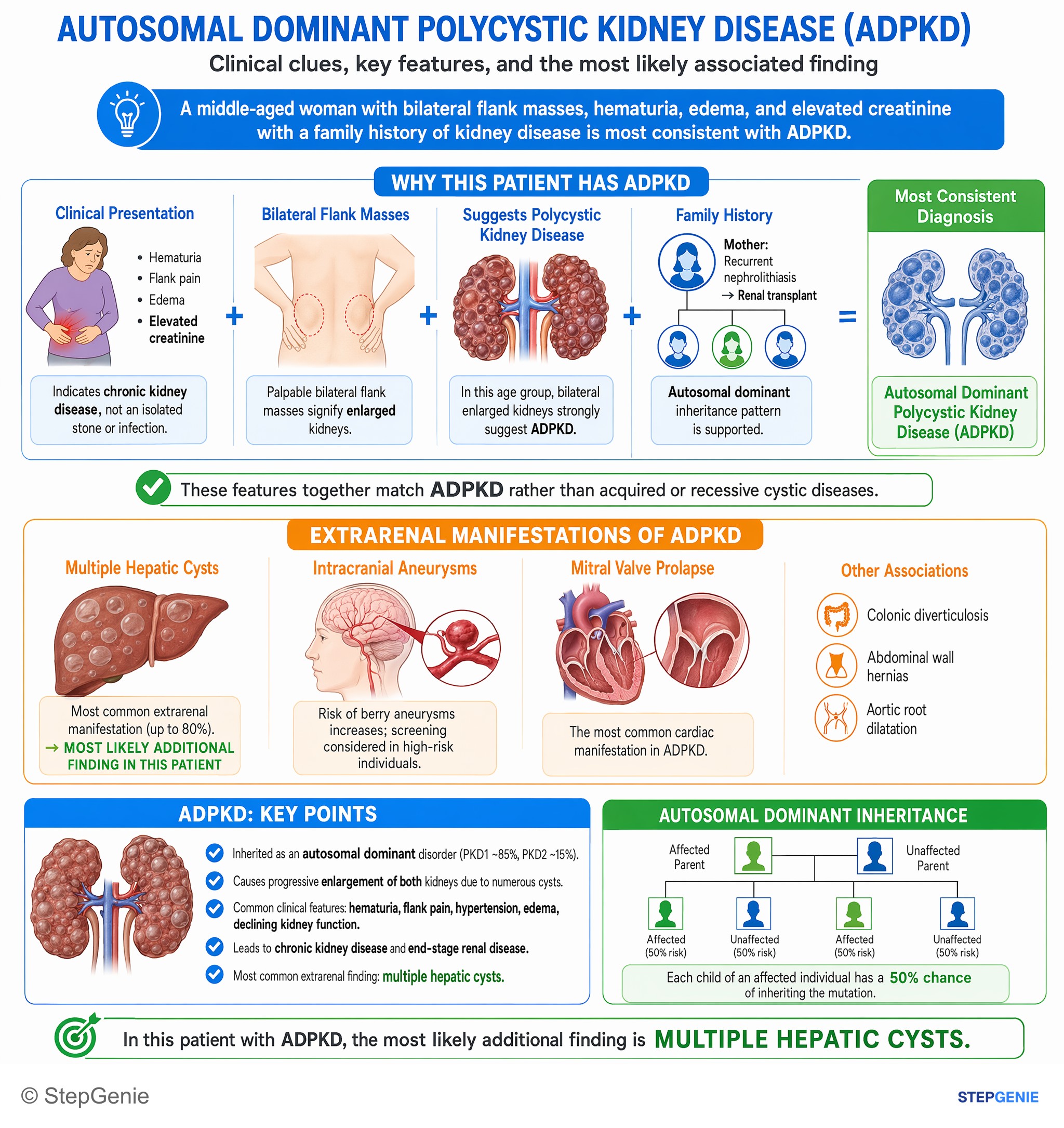
Autosomal dominant polycystic kidney disease causes bilateral renal enlargement, hematuria, renal failure, and is commonly associated with…
USMLE Step 1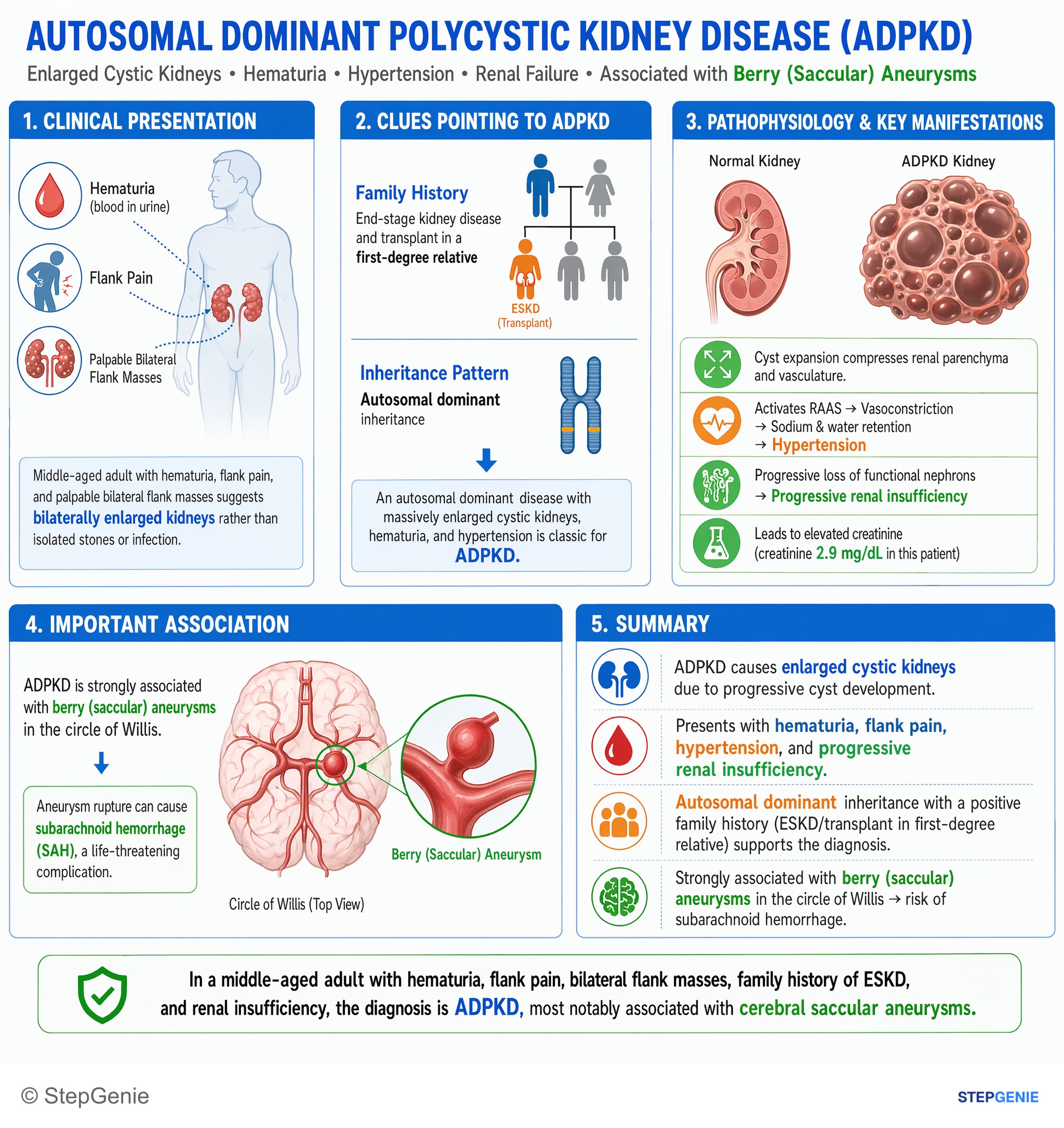
Autosomal dominant polycystic kidney disease (ADPKD) causes enlarged cystic kidneys, hematuria, HTN, renal failure, and is associated with…
USMLE Step 2Frequently Asked Questions
How do you recognize an autosomal dominant pedigree on USMLE questions?
Autosomal dominant pedigrees usually show vertical transmission across multiple successive generations, with both sexes affected equally. An affected person usually has an affected parent, and male-to-male transmission can occur. A classic exam clue is father-to-son transmission, which argues against an X-linked pattern and supports an autosomal pattern such as autosomal dominant.
What is the risk to each child if one parent has an autosomal dominant disease?
The risk is 50% for each child if the affected parent is heterozygous and the other parent is unaffected. This comes from an Aa affected parent and an aa unaffected parent, giving a one-half chance of inheriting the disease allele. Each child is an independent event, so previous children do not change the probability for the next child.
Why can an autosomal dominant disease seem to skip a generation?
An autosomal dominant disease can appear to skip a generation because of reduced penetrance, variable expressivity, or a de novo mutation. Reduced penetrance means the genotype is present but the phenotype is absent. Variable expressivity can make a case so mild that it is overlooked. A de novo mutation can also explain an apparently negative family history.
How do you tell autosomal dominant inheritance from X-linked dominant inheritance?
The easiest distinction is male-to-male transmission: autosomal dominant can be passed from father to son, but X-linked dominant cannot. Both patterns may show vertical transmission, but X-linked dominant often affects more females. Another classic clue is that an affected father with X-linked dominant inheritance passes the trait to all daughters and no sons.
Which diseases are classic autosomal dominant conditions to recognize quickly?
Classic autosomal dominant diseases include Marfan syndrome, neurofibromatosis type 1, autosomal dominant polycystic kidney disease, familial hypercholesterolemia, and Huntington disease. Other high-yield examples include hereditary spherocytosis, which can also be autosomal recessive, von Willebrand disease, which is often autosomal dominant, and hereditary hemorrhagic telangiectasia.