Physician-assisted death (also called physician-assisted suicide or medical aid in dying, MAID) means a physician prescribes a lethal dose of medication that a terminally ill patient with decision-making capacity takes on their own; in euthanasia, the clinician administers the lethal agent, and euthanasia is illegal in every US state. Aid in dying is legal only in a minority of US jurisdictions (13 states plus DC as of September 2026), and no physician is required to take part. On USMLE the best first response to a request is neither "prescribe it" nor "refuse it": explore why the patient is asking (pain, depression, fear of losing control, feeling a burden), check capacity, treat what is treatable and offer palliative care. Withholding or withdrawing life-sustaining treatment, symptom relief under the doctrine of double effect, and palliative sedation for refractory symptoms are accepted practice and are not assisted death.
Five end-of-life acts you must tell apart
Every vignette turns on two questions: who performs the final act, and what is the intent?
| Act | Who acts last | Intent | US legal status | Ethics bottom line |
|---|---|---|---|---|
| Withholding or withdrawing life-sustaining treatment (ventilator, dialysis, tube feeding, CPR) | No one: the disease causes death | Respect a refusal | Legal: a capable patient may refuse any treatment | No ethical difference between withholding and withdrawing (AMA) |
| Symptom relief that may hasten death (opioids for pain or dyspnea) | Clinician | Relieve suffering | Legal | Permissible under the double effect when the dose is proportionate |
| Palliative sedation to unconsciousness | Clinician | Relieve refractory clinical symptoms at the end of life | Accepted as a last resort | Never to cause death; not for existential suffering alone |
| Physician-assisted death (MAID) | Patient self-administers | End life | Legal in 13 states plus DC (as of September 2026) | AMA opposes it, but lawful, conscientious participation is not a Code violation |
| Euthanasia | Clinician administers the lethal agent | End life | Illegal in every US state | AMA: incompatible with the physician's role as healer |
The tension underneath is autonomy versus nonmaleficence (see the four principles of medical ethics): the right to refuse treatment is near absolute; access to the means to die exists only where a state grants it.
Where aid in dying is legal (as of September 2026)
- Jurisdictions: California, Colorado, Delaware, Hawaii, Illinois, Maine, Montana, New Jersey, New Mexico, New York, Oregon, Vermont and Washington, plus the District of Columbia (Death with Dignity National Center list, current as of September 12, 2026). The newest laws took effect in Delaware (January 1, 2026), New York (August 5, 2026) and Illinois (September 12, 2026, Public Act 104-0441). Montana's rests on a 2009 state Supreme Court ruling (Baxter v. Montana), not a statute; Oregon's act, approved by voters in 1994, took effect in 1997. Laws change often, so check the current law of the state.
- The Supreme Court left it to the states. In 1997 it held that the Due Process Clause protects no fundamental right to assistance in suicide (Washington v. Glucksberg), and that a state may ban assisted suicide while letting patients refuse life-sustaining treatment (Vacco v. Quill), because "when a patient refuses life-sustaining medical treatment, he dies from an underlying fatal disease or pathology; but if a patient ingests lethal medication prescribed by a physician, he is killed by that medication."
Typical safeguards (Oregon and New York shown; details vary by state):
- Who qualifies: an adult (18 or older) with capacity and a terminal illness expected to cause death within 6 months, who can self-administer the drug; New York bars injection or infusion. Residency rules differ (Oregon dropped its requirement in 2023).
- The patient must ask, not the family: oral and written requests (the written one signed before two witnesses), with waiting periods that are shortened when death is expected sooner.
- Checks: a consulting physician confirms the diagnosis, prognosis and capacity. Oregon requires referral for a psychological examination when either physician believes a disorder such as depression is impairing judgment; New York requires a mental health evaluation for every patient.
- Alternatives: the physician must explain feasible options, including comfort care, hospice care and pain control. The patient can rescind at any time, and participation is voluntary for physicians, pharmacists and other providers. New York's law states that taking the drug is not legally suicide.
What the professional codes say
- AMA, Opinion 5.7: physician-assisted suicide is "fundamentally incompatible with the physician's role as healer." Physicians must instead "aggressively respond to the needs of patients at the end of life": no abandonment, respect for autonomy, good communication and emotional support, comfort care and adequate pain control. A note to the opinion says the AMA's position "is not one of neutrality," but physicians who, "after due moral consideration," follow their conscience and legally participate "will not have acted in violation of the Code."
- AMA, Opinion 5.8: euthanasia is opposed outright, partly because it "could readily be extended to incompetent patients and other vulnerable populations."
- Conscience (Opinion 1.1.7): an objecting physician says so up front, generally refers (or gives impartial guidance on how to find the service) and keeps providing other care. Conscience never excuses refusing emergency care or overriding an informed refusal of life-sustaining treatment.
- AAHPM (2016): "studied neutrality" on legalization; clinicians should "carefully evaluate the patient's concerns precipitating the inquiry and address the sources." Family requests are not pursued without talking to the patient, and surrogates of incapacitated patients cannot request it.
Why patients ask: treat the request as a symptom
Oregon's 2025 report (637 people received prescriptions; 400 died in 2025 after taking the drug, including 42 prescribed in earlier years) shows that pain is not the main driver:
| End-of-life concern (Oregon, 2025) | Share of the 400 who died |
|---|---|
| Losing autonomy | 89% |
| Less able to engage in activities that make life enjoyable | 89% |
| Loss of dignity | 65% |
| Losing control of bodily functions | 53% |
| Burden on family, friends or caregivers | 40% |
| Inadequate pain control, or concern about it | 37% |
| Financial implications of treatment | 6% |
Most had cancer (61%), then neurological disease (14%) and heart disease (11%); 92% were enrolled in hospice. The exam point: a request to die opens a conversation, because each driver has a response. Depression can be treated, pain and dyspnea controlled, and fears of dependence or of burdening family eased by hospice and home support.
How to respond to a request: the USMLE sequence
- Explore the request first. Ask open-ended questions ("What is making you feel this way?" "What worries you most?"). Don't shut the discussion down, and don't agree on the spot.
- Check capacity and voluntariness. Can the patient communicate a choice, understand, appreciate and reason? Is anyone pressuring them? Capacity is a clinical, decision-specific judgment; competence is a legal ruling (see capacity vs competence).
- Look for depression and delirium. Anhedonia, hopelessness, guilt and insomnia suggest major depressive disorder: treat it, involve psychiatry and reassess. Depression does not automatically remove capacity, but it can distort judgment.
- Treat the suffering. Optimize analgesia and dyspnea control, and involve palliative care or hospice.
- Lay out every lawful alternative. The patient may decline or stop any treatment (ventilation, dialysis, tube feeding), choose DNR or DNI orders (see advance directives), and receive palliative sedation if symptoms become refractory.
- Then apply the law and your conscience. Where aid in dying is illegal, you cannot provide it; where it is legal, follow the statutory process or, if you object, say so and refer or give impartial guidance. Either way, keep caring for the patient.
Double effect and palliative sedation
The doctrine of double effect permits an act with a good and a bad effect when four classic conditions hold:
- The act itself is good or neutral (giving analgesia).
- Only the good effect is intended (relief); the bad one (earlier death) may be foreseen but not intended.
- The good effect is not achieved by means of the bad effect (the drug relieves the pain; death does not).
- There is a proportionately grave reason (severe suffering at the end of life).
Morphine titrated to relieve terminal dyspnea passes; a deliberately lethal dose given to end life is euthanasia. The Supreme Court noted in 1997 that states may permit palliative care with the "foreseen but unintended 'double effect' of hastening the patient's death." Nuance: when opioids are used appropriately and titrated carefully, clinically important respiratory depression is rare, so fear of hastening death is no reason to under-treat pain.
Palliative sedation (AMA, Opinion 5.6) is a last resort for terminally ill patients whose severe pain or other clinical symptoms do not respond to aggressive, symptom-specific palliation. It "must never be used to intentionally cause a patient's death," and it is not a response to existential suffering alone (death anxiety, isolation, loss of control).
How USMLE tests it
| Stem | Trap answer | Best answer |
|---|---|---|
| Request plus anhedonia, hopelessness and insomnia | Proceed because the patient seems capable | Evaluate and treat depression, then reassess |
| Capable patient with ALS asks to have the ventilator removed | "That would be assisted suicide" or "get a court order" | Withdraw it as requested, with sedation and symptom control as needed |
| Morphine increased for terminal dyspnea; the patient dies hours later | "The physician committed euthanasia" | Ethically appropriate under the double effect |
| Daughter asks you to "help Dad go peacefully"; he is unconscious | Increase opioids to hasten death | Decline; surrogates cannot request assisted death; focus on comfort and goals of care |
| You object to aid in dying in a state where it is legal | Ignore the request or end the relationship abruptly | Say so, refer or give impartial guidance, and keep providing care |
Practice question
A 66-year-old man with metastatic pancreatic cancer and an expected survival of a few months tells his physician at a clinic visit, "I want you to give me something so I can end this on my own terms." He lives in a state where medical aid in dying is legal. He is alert and oriented, rates his pain 6/10 on his current regimen and has never raised the topic before. Which of the following is the most appropriate response?
A. "Can you tell me more about what is making you feel this way?" B. "Physicians are not allowed to take part in ending a patient's life." C. "I will start the paperwork for your written request today." D. "I am going to start you on an antidepressant." E. "We can arrange palliative sedation so that you are comfortable."
Answer: A. A first request calls for exploration. Open-ended questions uncover the drivers (uncontrolled pain, depression, fear of losing control or of being a burden), each of which changes management, and lead into assessing capacity and voluntariness and offering palliative care.
- B: false where aid in dying is legal, and it shuts the conversation down; even a physician who declines to participate must not abandon the patient.
- C: skips the evaluation; the legal process still requires confirming prognosis and capacity and explaining alternatives (comfort care, hospice, pain control).
- D: treats a diagnosis that has not been made; screen for depression first and treat it if present.
- E: palliative sedation is a last resort for refractory symptoms near death; his pain has not been optimized.
Key takeaways
- PAD/MAID: physician prescribes, patient self-administers. Euthanasia: clinician administers; illegal in every US state.
- As of September 2026, aid in dying is legal in 13 states plus DC, for capable adults with a terminal illness (6 months or less) who ask voluntarily and self-administer.
- First response to any request: explore why, then check capacity, treat depression and symptoms, and offer palliative care and hospice.
- Withholding and withdrawing are ethically equivalent; stopping treatment at a capable patient's request is not assisted death.
- Double effect: relief intended, death foreseen but not intended, proportionate dose. Palliative sedation is for refractory clinical symptoms, never to cause death.
- Physicians may decline but must not abandon the patient; family and surrogates cannot request assisted death.
Sources
- Opinion 5.7: Physician-Assisted Suicide — AMA Code of Medical Ethics
- Opinion 5.6: Sedation to Unconsciousness in End-of-Life Care — AMA Code of Medical Ethics
- Opinion 5.3: Withholding or Withdrawing Life-Sustaining Treatment — AMA Code of Medical Ethics
- Opinion 1.1.7: Physician Exercise of Conscience — AMA Code of Medical Ethics
- Physician-Assisted Dying: Position Statement — American Academy of Hospice and Palliative Medicine (2016)
- Death with Dignity Act Frequently Asked Questions — Oregon Health Authority
- 2025 Oregon Death with Dignity Act Data Summary — Oregon Health Authority (2026)
- Medical Aid in Dying Law Frequently Asked Questions — New York State Department of Health (2026)
- Death with Dignity States — Death with Dignity National Center (2026)
- End of Life Options — Delaware Health and Social Services, Division of Public Health (2026)
- Illinois SB1950, End-of-Life Options for Terminally Ill Patients Act (Public Act 104-0441) — LegiScan
- Vacco v. Quill, 521 U.S. 793 (1997) — Justia
Visual explanations from the StepGenie QBank
Infographics StepGenie drew to explain questions in its own QBank, matched to this article's topic. Each caption is the takeaway of the question it explains.
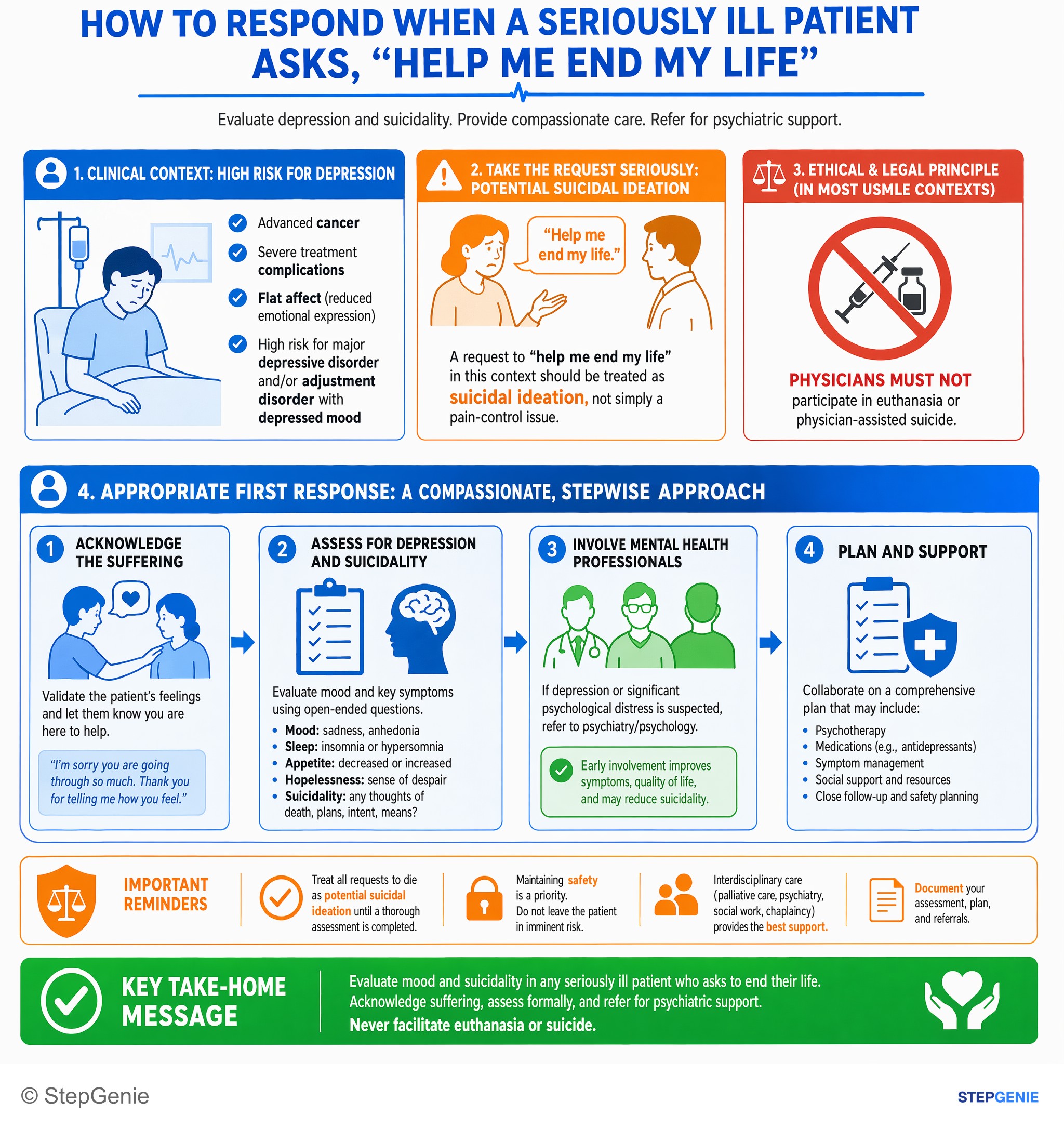
Evaluate depression and suicidality in a seriously ill patient requesting death; explore mood and refer for psychiatric support, never…
USMLE Step 2Frequently Asked Questions
What is the difference between physician-assisted death and euthanasia?
In physician-assisted death, also called physician-assisted suicide or medical aid in dying, a physician prescribes a lethal dose of medication and the patient takes it themselves. In euthanasia, the clinician directly administers the lethal agent, for example by injection. The key exam question is who performs the final act. Euthanasia is illegal in every US state, while aid in dying is legal only in some jurisdictions and under strict conditions.
Where is physician-assisted death legal in the United States?
As of September 2026, medical aid in dying is legal in 13 states plus the District of Columbia: California, Colorado, Delaware, Hawaii, Illinois, Maine, Montana, New Jersey, New Mexico, New York, Oregon, Vermont and Washington. Montana's rests on a 2009 state Supreme Court ruling rather than a statute, and the Delaware, New York and Illinois laws took effect in 2026. These laws change often, so the current law of each state should be checked.
What should a physician do first when a patient asks for help to die?
Explore the request with open-ended questions to learn what is driving it, such as uncontrolled pain, depression, fear of losing control or of being a burden. Then assess decision-making capacity and voluntariness, screen for and treat depression or delirium, optimize symptom control and offer palliative care or hospice. On USMLE, refusing outright and agreeing on the spot are both wrong first steps.
What is the doctrine of double effect in end-of-life care?
The doctrine of double effect allows an action that has a good effect and a foreseen bad effect when the act itself is good or neutral, only the good effect is intended, the good effect does not come about by means of the bad one, and there is a proportionately grave reason. The classic example is titrating opioids to relieve pain or breathlessness in a dying patient, even if death might come sooner.
Is withdrawing life support the same as physician-assisted suicide?
No. A patient with decision-making capacity can refuse or stop any treatment, including a ventilator, dialysis or tube feeding, even if death follows, and a surrogate can make that decision for a patient who lacks capacity. When treatment is withdrawn, the underlying disease causes death; in assisted death, the patient dies from a drug prescribed for that purpose. Ethically, withholding and withdrawing a treatment are equivalent.
Can a physician refuse to participate in medical aid in dying?
Yes. In the states that allow it, participation is voluntary and no physician is required to write the prescription. Under the AMA Code, a physician who objects should make that clear, generally refer the patient or give impartial guidance on how to find the service, and keep providing other care without abandoning the patient. The AMA opposes physician-assisted suicide but says physicians who legally participate after due moral consideration do not violate its Code.