You’re cruising through an ethics block in your Q-bank when a deceptively “simple” question shows up: mandatory reporting. These items are classic Step traps because multiple answers sound “reasonable” if you’re thinking like a good human—but only one is legally required. The key is to know what must be reported, to whom, and when, and to separate mandatory reporting from permitted disclosures and ethical counseling.
Tag: Ethics > Medical Ethics & Law
The Clinical Vignette (Q-bank style)
A 28-year-old woman comes to the emergency department with a swollen left eye and bruises on her arms. She is tearful and says she “fell down the stairs.” On exam, you note patterned bruising in different stages of healing. She avoids eye contact and becomes anxious when her partner enters the room and answers questions for her. She asks you, “Please don’t tell anyone. I’m scared what he’ll do if you report this.” She is otherwise stable and declines to involve police.
Question: What is the most appropriate next step?
Answer choices
A. Report the suspected intimate partner violence to the police immediately, even without the patient’s consent
B. Notify Child Protective Services because she is being abused
C. Provide resources and safety planning; offer assistance contacting law enforcement or a shelter, but do not report without consent (unless required by state law)
D. Contact the patient’s partner to obtain collateral information
E. Break confidentiality and notify the employer because she has visible injuries and may be unsafe at work
Correct Answer: C. Provide resources and safety planning; offer assistance contacting law enforcement or a shelter, but do not report without consent (unless required by state law)
Why this is correct (Step-level reasoning)
For competent adults, intimate partner violence (IPV) is not universally mandatory to report to police at the federal level. The clinician’s core obligations are to:
- Assess immediate danger (risk of homicide/suicide, escalating violence, access to weapons)
- Ensure privacy (separate partner from patient; use a professional interpreter if needed)
- Offer resources (shelters, hotlines, advocacy services)
- Safety plan (safe place to go, emergency contacts, code words, copies of important documents)
- Document carefully (objective descriptions, body map, photos per policy; quote patient statements)
- Offer help contacting law enforcement, but respect autonomy if the adult patient declines—unless a specific state statute requires reporting, or another mandatory reporting category applies (e.g., gunshot wound, child/elder abuse).
High-yield principle:
Mandatory reporting is not “anything bad happening.” It’s a defined list (varies by jurisdiction) that most reliably includes:
- Child abuse/neglect
- Elder abuse/neglect
- Abuse of dependent/vulnerable adults
- Certain injuries (often gunshot wounds, sometimes stabbings)
- Certain infectious diseases (to public health authorities)
- Dangerousness (credible threats to identifiable persons in some jurisdictions—Tarasoff-type duties)
The Mandatory Reporting Framework (Use this on test day)
1) Identify the category
Ask: “Does this situation fit a category with a legal duty to report?”
| Situation | Usually mandatory to report? | Report to whom? |
|---|---|---|
| Child abuse/neglect (including sexual abuse) | Yes | Child Protective Services (CPS) |
| Elder abuse/neglect | Yes | Adult Protective Services (APS) |
| Dependent/vulnerable adult abuse | Often | APS / designated agency |
| Gunshot wound | Often | Law enforcement (varies) |
| Certain infectious diseases (TB, HIV in some contexts, syphilis, gonorrhea, etc.) | Yes | Local/state public health department |
| IPV in a competent adult | Not universally | Depends on state; often not mandated |
| Sexual assault in competent adult | Varies | Often patient-directed; some states mandate evidence kit offer/reporting pathways |
2) Report the minimum necessary
Even when reporting is mandatory, disclose only what is required.
3) Tell the patient what you’re doing
You should generally inform the patient about the report (unless doing so increases immediate danger or is prohibited by law), and document that discussion.
Why Each Distractor Is Wrong (and what it’s testing)
A. Report the suspected intimate partner violence to the police immediately, even without the patient’s consent
Why it’s wrong (in most Step contexts):
- IPV against a competent adult is typically handled with support, safety planning, and resources, not automatic police reporting.
- Mandatory reporting for IPV varies by state; USMLE questions usually avoid state-specific mandates unless explicitly stated.
What it’s testing:
Students overgeneralize “abuse = mandatory reporting.” On Step, remember: child/elder/dependent adult are the most consistent mandatory categories.
Exception worth knowing (high-yield):
- Some jurisdictions mandate reporting of certain assault-related injuries, weapons-related injuries, or IPV specifically. If the stem says “state law requires reporting,” then you report.
B. Notify Child Protective Services because she is being abused
Why it’s wrong:
- CPS is for minors (or situations involving risk to minors). This patient is an adult.
- You’d contact CPS only if there is a child at risk (e.g., children in the home witnessing violence, direct child abuse, or credible risk of harm/neglect).
What it’s testing:
Knowing who the protective services agencies serve:
- CPS → children
- APS → elders/dependent adults
How this could become correct:
If the stem included: “She has a 2-year-old at home and the partner has threatened the child,” then CPS reporting becomes mandatory.
D. Contact the patient’s partner to obtain collateral information
Why it’s wrong:
- This is a major safety risk and a confidentiality breach.
- It can escalate violence and undermines trust.
- In IPV, you should separate the partner from the patient and speak privately.
What it’s testing:
Trauma-informed care and safety: Never “verify” abuse with the suspected abuser.
E. Break confidentiality and notify the employer because she has visible injuries and may be unsafe at work
Why it’s wrong:
- Employers are not part of the mandatory reporting pathway for IPV.
- Disclosing to an employer violates confidentiality and can worsen patient safety (retaliation, job loss, stalking).
What it’s testing:
Distinguishing workplace safety concerns from actual legal reporting channels. You can encourage the patient to consider workplace safety measures, but you don’t disclose without consent unless there’s a specific legal duty.
What You Should Do in the Room (Practical, Step-friendly checklist)
Immediate actions
- Ensure privacy: “I speak with all patients alone for part of the visit.”
- Assess danger: escalating violence, strangulation history, weapon access, threats to kill.
- Offer resources: social work, domestic violence advocate, hotline, shelter info.
- Safety plan: safe destination, emergency bag, phone access, code word.
- Treat injuries and address medical needs.
Documentation pearls (high-yield)
- Use objective language: “ecchymosis 4 cm, purple/yellow, left orbital rim”
- Quote the patient verbatim when possible
- Photograph injuries per policy and with consent
- Avoid conclusory statements like “patient is abused” unless it’s a diagnosis you are making with supporting facts; document findings and statements clearly.
Common USMLE “Mandatory Reporting” Rapid-Fire Triggers
Almost always mandatory
- Child abuse (including suspected)
- Elder/dependent adult abuse
- Certain communicable diseases (report to public health)
- Gunshot wounds (often mandated)
Not automatic (usually patient-directed)
- IPV in competent adults
- Sexual assault in competent adults (varies; focus on consent, evidence options, resources)
When confidentiality can be breached without consent (classic ethics set)
- Imminent threat to an identifiable person (jurisdiction-dependent “duty to warn/protect”)
- Mandatory reporting categories above
- Court order/subpoena (follow legal process; minimum necessary)
Exam Takeaway: “Mandatory” Means Legally Required, Not Morally Urgent
You can (and should) be proactive—screen, counsel, safety plan, document, connect to resources—without automatically reporting to police for every adult IPV situation. On Step, the best answer often protects patient autonomy while meeting clearly defined legal reporting duties.
Visual explanations from the StepGenie QBank
Infographics StepGenie drew to explain questions in its own QBank, matched to this article's topic. Each caption is the takeaway of the question it explains.
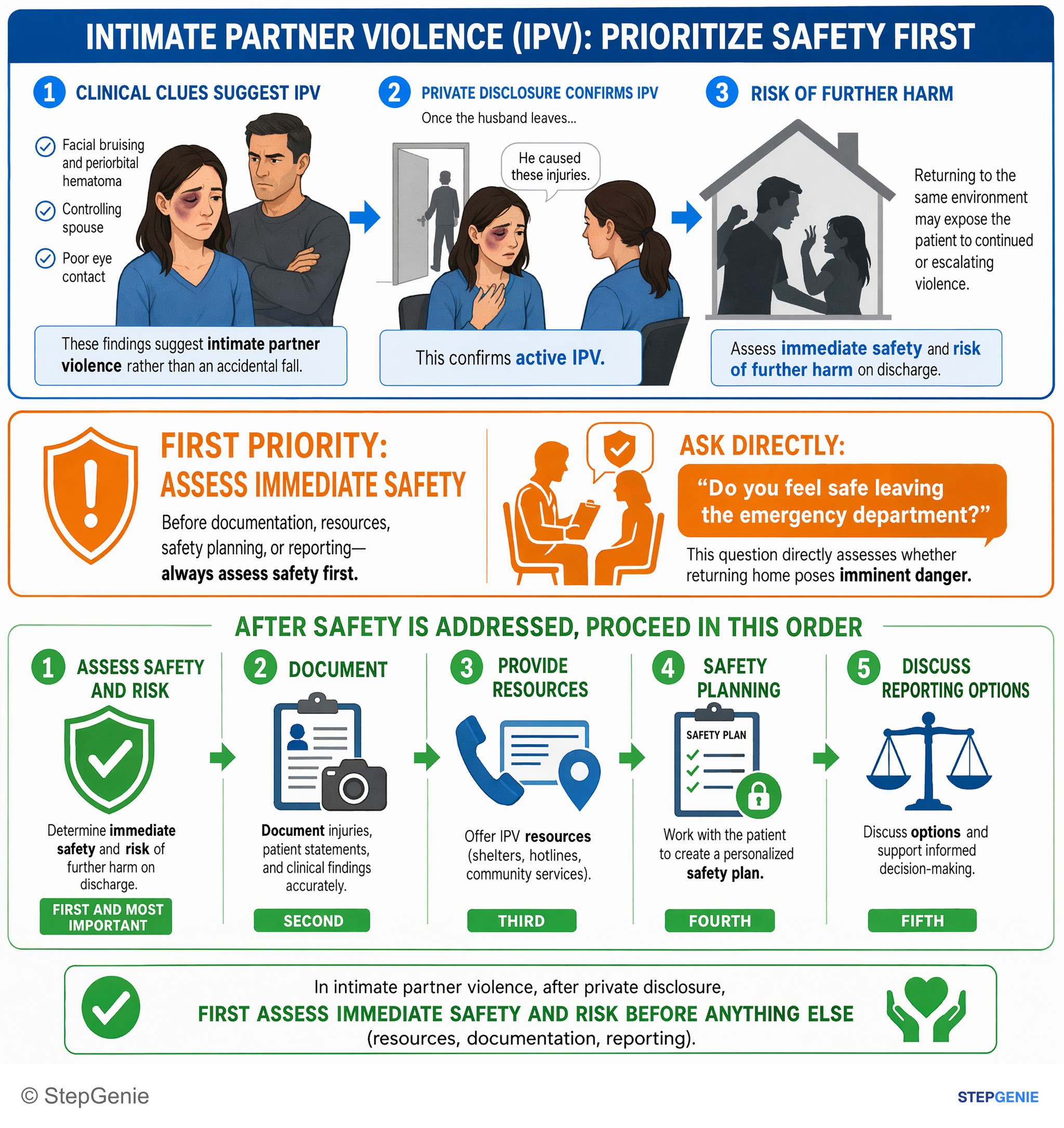
Intimate partner violence: after private disclosure, first assess immediate safety and risk before anything else (resources…
USMLE Step 2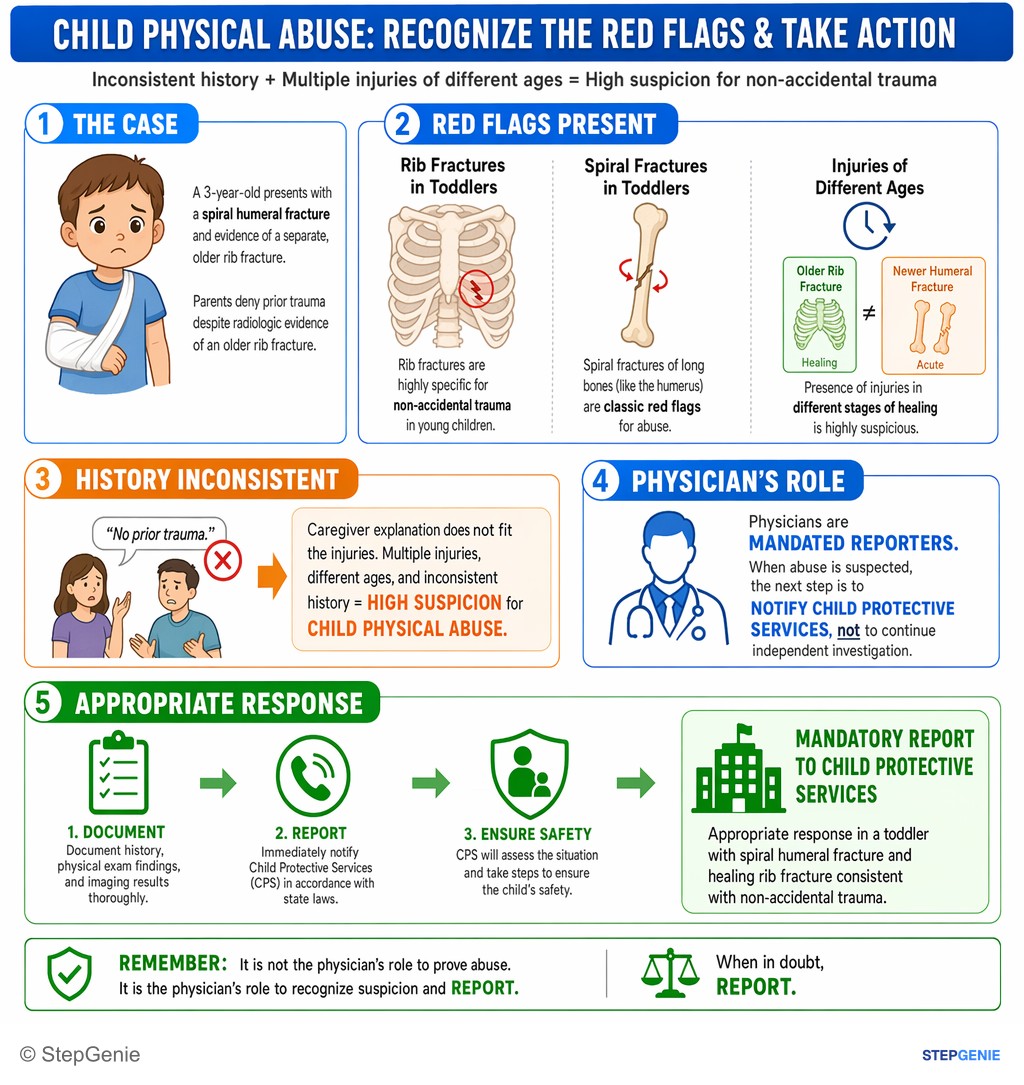
Child physical abuse: non-accidental trauma with spiral humeral fracture plus healing rib fracture in toddler → mandatory report to Child…
USMLE Step 2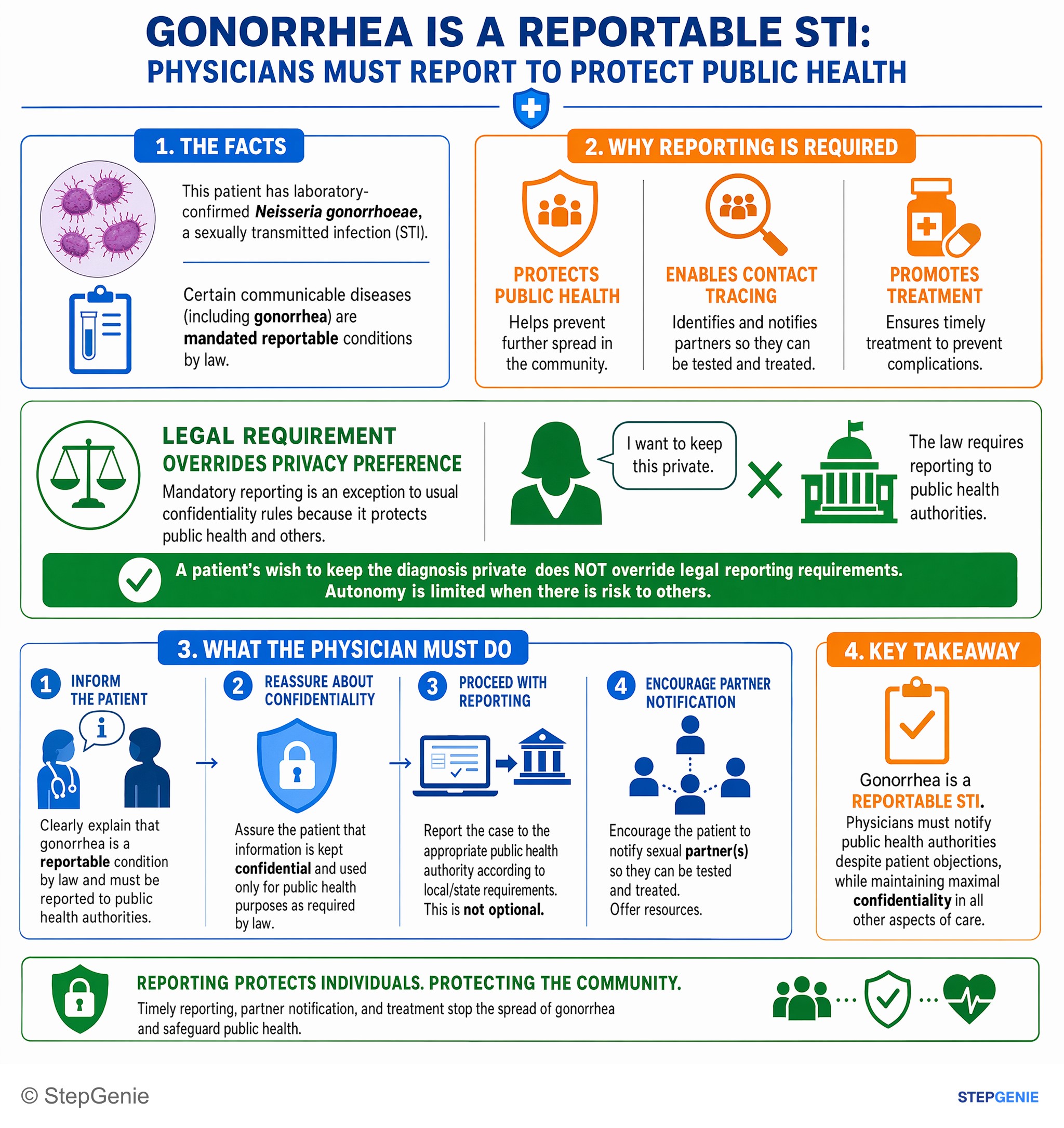
Gonorrhea is a reportable STI; physicians must notify public health authorities despite patient objections, while maintaining maximal…
USMLE Step 2Frequently Asked Questions
Do you have to report intimate partner violence to police if a competent adult patient refuses?
No, not universally. For a competent adult, suspected intimate partner violence is generally managed by assessing immediate danger, ensuring privacy, offering resources, helping with safety planning, and offering assistance contacting law enforcement or a shelter. Reporting without consent depends on state law or on whether another mandatory reporting category applies, such as a gunshot wound or child, elder, or dependent adult abuse.
What is the most appropriate next step when you suspect intimate partner violence in a competent adult?
The best next step is to provide resources and safety planning, offer help contacting law enforcement or a shelter, and avoid reporting without consent unless required by state law. The clinician should also assess immediate danger, separate the partner from the patient to ensure privacy, and document findings carefully using objective descriptions, patient quotes, and photos or body maps according to policy.
What situations are usually mandatory to report on ethics questions?
The most reliable mandatory reporting categories are child abuse or neglect, elder abuse or neglect, abuse of dependent or vulnerable adults, certain injuries such as gunshot wounds and sometimes stabbings, certain infectious diseases, and dangerousness involving credible threats to identifiable persons in some jurisdictions. The core exam strategy is to ask whether the case fits a defined legal category rather than assuming any harmful situation must be reported.
When would Child Protective Services be the right report instead of just offering IPV resources?
Child Protective Services is appropriate when a child is at risk, not simply because an adult patient is being abused. If the situation includes direct child abuse, children exposed to violence in the home, or a credible risk of harm or neglect to a minor, CPS reporting becomes mandatory. For an abused competent adult alone, the focus is usually support, safety planning, and respecting autonomy.
How much information should you disclose when a report is mandatory?
You should disclose only the minimum necessary information. Even when the law requires reporting, the clinician should limit the disclosure to what is required, generally inform the patient about the report unless that would increase immediate danger or is prohibited by law, and document the discussion. This helps balance legal obligations with patient confidentiality and safety.