The Kübler-Ross stages of grief are denial, anger, bargaining, depression and acceptance, remembered as DABDA. Elisabeth Kübler-Ross drew them from interviews with terminally ill patients for On Death and Dying (1969), and they were later applied to bereavement; they are not a fixed sequence, not everyone goes through all five, and the model has limited empirical support. USMLE tests them by asking you to match a patient's words to a stage and then pick an empathic, open-ended response. Grief that stays intense and impairing at least 12 months after a death (6 months in children and adolescents) may be prolonged grief disorder, which DSM-5-TR added in 2022.
The acronym: DABDA
Learn each stage's signature sentence:
| Letter | Stage | What the patient says | What is going on | Your best move |
|---|---|---|---|---|
| D | Denial | "The scan must be wrong. I feel fine." | Shock; the news has not landed | Acknowledge, ask what they understand, offer to review the results together |
| A | Anger | "Why didn't anyone catch this sooner?" | Distress aimed at staff, family or God | Name and validate the feeling; do not get defensive |
| B | Bargaining | "If I can just make it to my daughter's wedding, I'll do anything." | Deal-making to postpone the loss | Explore hopes and clarify realistic goals |
| D | Depression | "What's the point anymore?" Tearful, withdrawn | Sadness about what is being lost | Stay present, allow silence, ask about support; assess safety if hopelessness appears |
| A | Acceptance | "I want to go home with hospice." | Facing reality and planning | Goals of care, advance directives, hospice referral |
Memory hook: Doubt it, Attack it, Bargain with it, Despair over it, Accept it. Each verb starts with the stage's letter and says what the patient is doing.
Don't mix up the two stage models. Kübler-Ross describes reactions to dying or loss; Prochaska's stages of change (precontemplation, contemplation, preparation, action, maintenance) describe readiness to change a behavior. A smoker who has no plans to quit is in precontemplation, not denial; review them in the stages of change memory palace.
How to tell the stages apart in a vignette
- Denial rejects the premise: "the test is wrong," repeated tests to undo the result, or a surprisingly calm patient who minimizes the illness.
- Bargaining accepts the premise but negotiates: one more round of treatment, a promise to God, a deadline such as a wedding.
- Anger needs a target: the clinician, the hospital, family or fate. Respond to the feeling; do not defend.
- Depression is sadness about the loss itself, not automatically major depressive disorder (see the table below).
- Acceptance is planning, not happiness: code status, hospice, a will, saying goodbye.
- The second-opinion trap. A second opinion is often reasonable autonomy: the patient asks questions, weighs options and acknowledges the diagnosis. It suggests denial only when the patient insists well-established facts are impossible.
Worked example: the patient who says the CT is wrong
A 58-year-old man is told that his newly diagnosed metastatic pancreatic cancer is not curable, and hospice is recommended. He replies calmly, "This can't be happening. The CT must be wrong. I feel fine. I want another scan and a second opinion." Imaging and biopsy are unequivocal.
- Stage: denial. He is rejecting the diagnosis itself.
- Not anger: he blames no one. Not bargaining: he is not negotiating for time or conditions. Not depression: he is not sad or withdrawn. Not acceptance: he is not planning around the prognosis.
- Best response: acknowledge the emotion before adding facts, for example "This is a lot to take in. What is your understanding of what the scan shows?", then offer to go through the images together. Arguing, more data or false reassurance all miss the emotion.
- Capacity is a separate question. Denial alone does not mean he lacks decision-making capacity. Capacity is the ability to understand and retain the relevant information, weigh the options and communicate a decision; mental illness or a severe medical condition does not by itself remove it (StatPearls). Capacity is judged by clinicians for each decision, whereas competence is a legal determination. Practice the distinction in the capacity vs competence breakdown.
Respond to the emotion: NURSE and SPIKES
NURSE gives five ways to respond to emotion (examples from a Journal of Clinical Oncology review):
- Name: "You seem very upset by the news."
- Understand: "I can't imagine how difficult this news must be for you."
- Respect: "You've shown a lot of courage in coming to grips with the situation."
- Support: "No matter what happens, we are going to be here to support you and your family."
- Explore: "Tell me more about what you are feeling right now."
SPIKES (Baile and colleagues, 2000) structures breaking bad news: Setting (private and quiet, few distractions), Perception (what does the patient understand?), Invitation (how much detail do they want?), Knowledge (plain language, pausing to check understanding), Emotions (respond with empathy), Strategy and summary (present the plan and decide together).
Test-day rule: when the stem is emotional, the best answer names or validates the feeling and invites the patient to say more; correcting the patient, quoting statistics or saying "don't worry" are the classic wrong answers. Acceptance stems often turn to advance directives and hospice.
What the evidence says about the stages
- Origin. Developed for medical student education from a series of clinical interviews with terminally ill patients; the model has limited empirical support (NCI).
- Not a ladder. A 2-year study that tested the stage theory in bereaved people (Maciejewski and colleagues, JAMA 2007) suggested a more common pathway of disbelief, yearning, anger, depression and acceptance, with yearning in place of bargaining and the negative reactions peaking about 6 months after the loss. The model was then reframed from stages to domains that a person can move back and forth between, with no predefined path (NCI).
- Most people adapt over time, typically within the first 6 months to 2 years. Normal grief can include waves or pangs of sadness, yearning, and dreams, illusions or even hallucinations of the deceased (NCI).
- Anticipatory grief is grief that starts before an expected loss; about 25% of patients with incurable cancer experience it (NCI).
- Exam framing: USMLE still uses the stages as vocabulary, but not every patient passes through them in order.
Normal grief vs prolonged grief disorder vs major depression
| Feature | Normal grief | Prolonged grief disorder (DSM-5-TR) | Major depressive disorder |
|---|---|---|---|
| Timing | Eases with time; most adapt within 6 months to 2 years | At least 12 months after the death in adults (6 months in children and adolescents) | 5 or more symptoms for at least 2 weeks, at any time |
| Core feature | Waves of sadness tied to reminders, mixed with positive memories | Intense yearning for the deceased and/or preoccupation with thoughts or memories of them | Pervasive depressed mood or loss of interest or pleasure |
| Self-image | Self-esteem preserved | Identity disruption ("part of me died") | Worthlessness and self-loathing |
| Thoughts of death and meaning | Focused on the deceased | Feeling that life is meaningless without the person | Suicidal thoughts directed at oneself |
| Treatment | Support; no treatment needed | Grief-targeted psychotherapy | Antidepressants and psychotherapy |
Prolonged grief disorder (PGD) sits in DSM-5-TR's trauma- and stressor-related disorders chapter. The core yearning or preoccupation and at least 3 of 8 further symptoms must each be present nearly every day for at least the last month: identity disruption, marked disbelief about the death, avoidance of reminders that the person is dead, intense emotional pain (anger, bitterness, sorrow), difficulty reintegrating into relationships and activities, emotional numbness, feeling that life is meaningless, and intense loneliness. The reaction must also clearly exceed social, cultural or religious norms in duration and severity and cause clinically significant distress or impairment (Prigerson and colleagues, World Psychiatry 2021). ICD-11 uses 6 months after the death instead of 12 (NCI).
- Treat PGD with grief-focused therapy. In one trial in adults aged 60 and older, complicated grief treatment (16 weekly sessions combining CBT with elements of interpersonal therapy) had a response rate of 70.5%, more than twice the 32.0% with interpersonal therapy. Antidepressants improve depressive symptoms but have limited impact on grief intensity; combined with grief-directed therapy, they improve both (NCI).
- Grief does not protect against MDD. DSM-5 removed the bereavement exclusion because grief can precipitate major depression, so MDD can be diagnosed during bereavement (NCI). Diagnosis needs 5 or more symptoms, including depressed mood or anhedonia, most of the day nearly every day for at least 2 weeks (StatPearls, NIMH); clues are pervasive low mood, worthlessness and suicidal thoughts aimed at oneself. Review the major depressive disorder breakdown.
Practice question
A 66-year-old woman sees her physician 4 months after her husband of 40 years died of a myocardial infarction. She cries most days when she sees his chair or hears their favorite songs, and twice, while falling asleep, she has heard his voice calling her name. She sleeps a little less than before but enjoys weekly visits from her grandchildren and has gone back to her volunteer work. She misses him terribly, denies feeling worthless and has no thoughts of harming herself. Which of the following is the most likely diagnosis?
A. Brief psychotic disorder B. Major depressive disorder C. Normal grief (uncomplicated bereavement) D. Persistent depressive disorder E. Prolonged grief disorder
Answer: C. Waves of sadness triggered by reminders, preserved enjoyment and self-esteem, no self-directed suicidal thoughts and only 4 months since the death add up to normal grief. Hearing the deceased's voice is a recognized part of normal grief (NCI).
- A: a brief, grief-related perception of the deceased's voice is not psychosis; she has no delusions, disorganized speech or behavior, and her functioning is intact.
- B: MDD needs 5 or more symptoms over the same 2 weeks, including depressed mood or loss of interest or pleasure. She still enjoys her grandchildren and volunteering and feels no worthlessness.
- D: persistent depressive disorder needs depressed mood on most days for at least 2 years (see the persistent depressive disorder comparison table).
- E: prolonged grief disorder cannot be diagnosed until at least 12 months after the death in an adult; intense grief at 4 months is expected.
Key takeaways
- DABDA: denial, anger, bargaining, depression, acceptance; hook: Doubt it, Attack it, Bargain with it, Despair over it, Accept it.
- The stages come from interviews with dying patients (1969), are not linear or universal, and have limited empirical support.
- Match the stage, then respond to the emotion: NURSE statements and open-ended questions beat arguing, statistics and false reassurance; SPIKES structures bad news.
- Denial is not incapacity: capacity is decision-specific and assessed separately.
- Normal grief comes in waves, preserves self-esteem and can include hearing or seeing the deceased.
- Prolonged grief disorder (DSM-5-TR, 2022): 12 months or more after the death in adults (6 months in children), yearning or preoccupation plus 3 of 8 symptoms nearly every day for the last month; ICD-11 uses 6 months.
- MDD can be diagnosed during bereavement: look for pervasive anhedonia, worthlessness and self-directed suicidal thoughts.
Sources
- Grief, Bereavement, and Coping With Loss (PDQ®)–Health Professional Version — National Cancer Institute (2024)
- Validation of the New DSM-5-TR Criteria for Prolonged Grief Disorder and the PG-13-Revised (PG-13-R) Scale — World Psychiatry (2021)
- Current State of the Art and Science of Patient-Clinician Communication in Progressive Disease — Journal of Clinical Oncology (2014)
- Reflecting on 25 Years of SPIKES: Bad News Communication in Our Modern Era — The Oncologist (2026)
- Informed Consent — StatPearls, NCBI Bookshelf (2024)
- Major Depressive Disorder — StatPearls, NCBI Bookshelf (2023)
- Depression — National Institute of Mental Health (2024)
Visual explanations from the StepGenie QBank
Infographics StepGenie drew to explain questions in its own QBank, matched to this article's topic. Each caption is the takeaway of the question it explains.
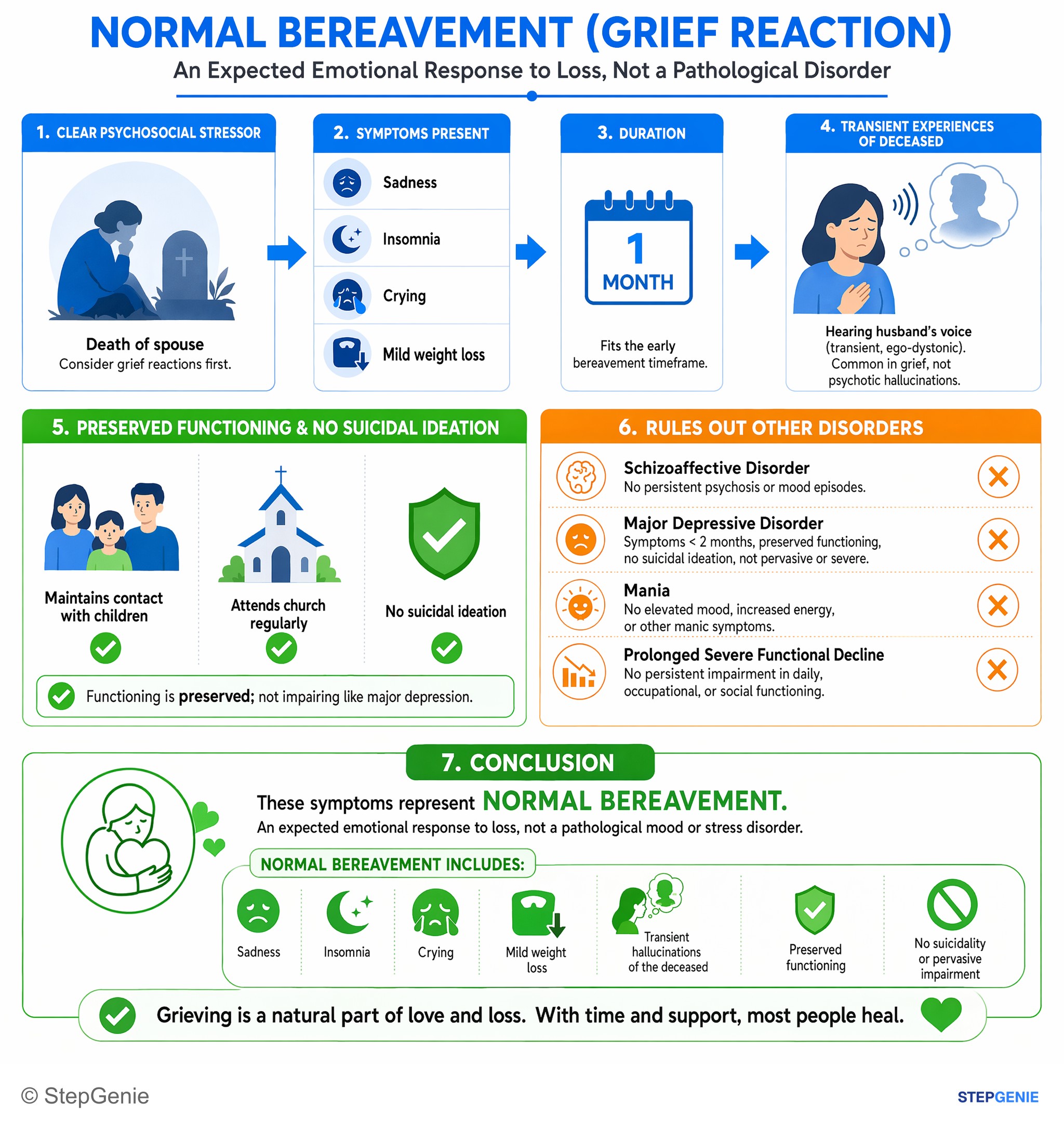
Normal bereavement: sadness, insomnia, mild weight loss, transient hallucinations of deceased, but preserved functioning and no…
USMLE Step 2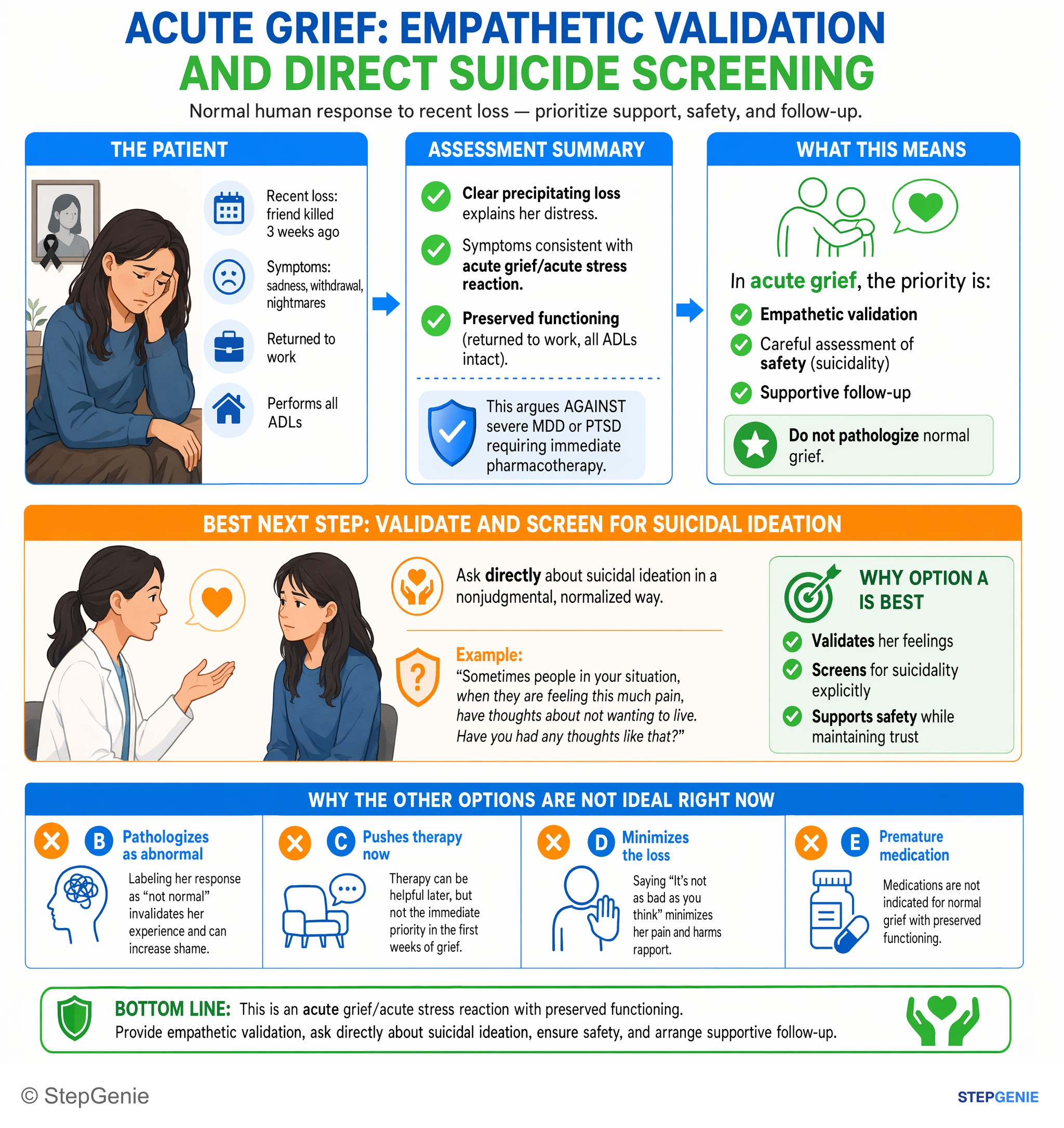
Acute grief reaction with preserved functioning requires empathetic validation and direct, nonjudgmental suicide screening, not…
USMLE Step 2Frequently Asked Questions
What are the 5 stages of grief in the Kübler-Ross model?
The five stages are denial, anger, bargaining, depression and acceptance, remembered with the acronym DABDA. Elisabeth Kübler-Ross described them in On Death and Dying (1969), based on interviews with terminally ill patients, and they were later applied to people grieving a death. A handy hook is: doubt it, attack it, bargain with it, despair over it, accept it, because each verb starts with the stage's letter.
Do people go through the stages of grief in order?
No. The stages are not a fixed sequence, people can move back and forth between them, and not everyone experiences all five. The National Cancer Institute notes the model has limited empirical support; a 2-year study of bereaved people suggested a more common pathway of disbelief, yearning, anger, depression and acceptance, with yearning in place of bargaining and negative feelings peaking around 6 months. Exams still use the five stages as vocabulary for recognizing reactions.
How do you tell denial from bargaining on a USMLE question?
Denial rejects the premise: the patient says the test must be wrong, the diagnosis cannot be real, or keeps asking for tests to undo the result. Bargaining accepts the diagnosis but tries to negotiate, for example promising to change in exchange for more time or asking for one more treatment to reach a wedding. A reasonable request for a second opinion, with questions and acknowledgment of the diagnosis, is not denial.
What is the best way to respond to a grieving or angry patient?
Respond to the emotion before giving more information. Name or validate the feeling and invite the patient to say more, using open-ended questions such as asking what worries them most. The NURSE framework (name, understand, respect, support, explore) gives examples. Arguing, getting defensive, quoting statistics or saying not to worry are the classic wrong answers on communication questions.
What is prolonged grief disorder in DSM-5-TR?
Prolonged grief disorder was added to DSM-5-TR in 2022. It requires the death of someone close at least 12 months earlier for adults, or 6 months for children and adolescents, with intense yearning for or preoccupation with the deceased, plus at least 3 of 8 symptoms such as identity disruption, disbelief, emotional numbness or intense loneliness, nearly every day for at least the last month. The reaction must clearly exceed social, cultural or religious norms and cause significant distress or impairment. ICD-11 uses 6 months.
How do you tell normal grief from major depressive disorder?
In normal grief, sadness comes in waves tied to reminders of the person, positive memories and enjoyment still occur, self-esteem is preserved, and any thoughts of death focus on the deceased. Major depression needs 5 or more symptoms, including depressed mood or loss of pleasure, for at least 2 weeks, often with worthlessness and suicidal thoughts aimed at oneself. DSM-5 removed the bereavement exclusion, so major depressive disorder can be diagnosed during bereavement when its criteria are met.