You’re cruising through an ethics Q-bank and then it hits: a patient says something chilling about harming someone else. The stem feels straightforward… until the answer choices all look “kind of right.” This is exactly where USMLE ethics questions separate pattern recognition from real clinical-legal reasoning. Let’s break down confidentiality exceptions—especially the Tarasoff-style duty to protect—and why every distractor matters.
Tag: Ethics > Medical Ethics & Law
The Clinical Vignette (Q-bank style)
A 28-year-old man with a history of paranoid schizophrenia is brought to the outpatient clinic by his mother. He has been nonadherent with antipsychotic medication. During the visit, he becomes visibly agitated and says, “My former roommate, Jason, ruined my life. I bought a gun yesterday, and I’m going to shoot him tonight at his apartment.” He provides Jason’s full name and address. He refuses voluntary hospitalization and storms out of the clinic.
Which of the following is the most appropriate next step?
The Correct Answer (What USMLE Wants)
Answer: Notify law enforcement and take steps to warn/protect the identifiable potential victim (duty to protect).
This is the classic Tarasoff-type scenario: a patient makes a credible threat of serious violence toward a reasonably identifiable victim. In that setting, confidentiality can be breached to protect the intended victim and the public.
High-yield core rule:
When a patient poses a serious, imminent threat to a specific person, clinicians have a duty to protect—which may include:
- Notifying law enforcement
- Warning the intended victim
- Arranging emergency psychiatric evaluation/hospitalization
- Documenting risk assessment and actions
USMLE doesn’t test state-by-state nuances; it tests the principle: confidentiality is not absolute, and preventing serious foreseeable harm can require disclosure.
Why This Is the Right Call (Key Criteria)
Tarasoff-style duty is triggered by a cluster of features:
| Feature | In the vignette | Why it matters |
|---|---|---|
| Threat is specific | Named roommate, address given | Identifiable target increases duty |
| Threat is credible | Purchased a gun | Means + planning = high risk |
| Threat is imminent | “Tonight” | Urgency supports immediate action |
| Harm is serious | Shooting | Serious bodily harm/death |
Exam phrasing to recognize:
- “I’m going to kill my ex tomorrow.”
- “I bought a weapon.”
- “Here’s where they live.”
- “You can’t stop me.”
Stepwise Approach You Can Use on Test Day
When you see a violent threat in a stem, run this checklist:
- Is there a specific, identifiable target?
- Is there a credible plan/means?
- Is the threat imminent?
- What action best reduces harm right now?
- Emergency evaluation/hospitalization plus
- Warning/protection steps as needed
If yes to the first three → confidentiality can be breached to protect.
Distractor Autopsy: Why the Wrong Answers Are Wrong (and tempting)
Below are common answer choices that show up in Q-banks, and how to dismantle them quickly.
Distractor 1: “Maintain confidentiality because the patient did not consent to disclosure.”
Why it’s tempting: Confidentiality is foundational, and many students over-apply it.
Why it’s wrong: Confidentiality has well-tested exceptions. A credible, imminent threat to an identifiable person is exactly when you do not keep the information private.
High-yield phrasing:
- Confidentiality is overridden by duty to protect when there’s foreseeable serious harm to an identifiable person.
Distractor 2: “Ask the patient to sign a release of information so you can contact the roommate.”
Why it’s tempting: Sounds “proper” and paperwork-y.
Why it’s wrong: The threat is imminent (“tonight”). Waiting for consent or releases delays protection. Also, a patient making threats is unlikely to consent.
USMLE angle: In emergencies, don’t pick an option that adds delay when immediate harm is likely.
Distractor 3: “Call the patient’s mother to discuss his threats.”
Why it’s tempting: Family involvement feels clinically reasonable, especially with serious mental illness.
Why it’s wrong: Family is not the main party at risk here. Also, disclosing to family is not the most direct protective step and may not fulfill the duty to protect the intended victim/public.
Better framing: Family contact can be part of care coordination, but it doesn’t replace warning/protecting the potential victim or involving authorities when risk is acute.
Distractor 4: “Schedule a follow-up appointment within 24–48 hours and adjust his antipsychotic medications.”
Why it’s tempting: Treating the underlying condition is always good medicine.
Why it’s wrong: This is a now problem. Medication changes won’t mitigate an imminent threat tonight. The test wants acute risk management, not longitudinal optimization.
Exam tell: Immediacy words (“tonight,” “tomorrow,” “right after this visit”) almost always mean urgent intervention.
Distractor 5: “Notify the potential victim only.”
Why it’s tempting: You remember “warn the victim” and stop there.
Why it’s incomplete (often wrong): Duty to protect may involve notifying law enforcement and/or arranging emergency evaluation. Many USMLE-style questions prefer the option that most comprehensively reduces risk—especially when a weapon is involved and timing is imminent.
Practical test strategy: If there’s an option that includes law enforcement + protective steps, it usually beats a narrower action.
Distractor 6: “Contact the police only if the patient actually harms someone.”
Why it’s tempting: Avoids breaching confidentiality prematurely.
Why it’s wrong: The whole concept is preventive—you act on credible, imminent threats, not after the fact.
Distractor 7: “Report the patient to the state medical board / file an incident report / call hospital legal later.”
Why it’s tempting: Sounds official and risk-management-y.
Why it’s wrong: These are not immediate protective actions. The question asks what to do next. Internal paperwork and delayed legal consults don’t address imminent danger.
What About Hospitalization?
A common follow-up question is whether you should hospitalize the patient involuntarily.
High-yield principle: Emergency psychiatric hold
If a patient is an imminent danger to others (or self), you can pursue involuntary evaluation/commitment per local law and institutional process.
USMLE phrasing:
- “Danger to self” → suicidal intent, plan, means
- “Danger to others” → credible homicidal threat with plan/means
- “Gravely disabled” → unable to provide basic needs due to mental illness (more Step 2-ish, varies)
Best-choice pattern:
If the answer choice says something like “Arrange emergency psychiatric evaluation/involuntary hospitalization and notify appropriate authorities to protect the victim”—that’s usually the money.
Rapid-Fire: Confidentiality Exceptions You Should Memorize
USMLE loves asking “When can you break confidentiality?” Here’s the high-yield shortlist.
| Exception | Examples | What you do |
|---|---|---|
| Danger to identifiable others (Tarasoff) | Credible threat to specific person | Warn/protect victim, notify law enforcement, emergency eval |
| Danger to self | Imminent suicide risk | Emergency intervention, possible involuntary hold |
| Suspected child abuse | Physical/sexual abuse, neglect | Mandatory report to CPS |
| Suspected elder abuse | Abuse/neglect of older adult | Mandatory report (agency varies) |
| Certain communicable diseases | TB, some STIs/HIV reporting depends on jurisdiction | Report to public health per law |
| Gunshot/stab wounds (jurisdictional but commonly tested) | Patient presents with GSW | Report to law enforcement per statute |
| Court order | Subpoena/court mandate | Disclose minimum necessary per order |
Test-day mantra:
Break confidentiality only to the minimum necessary to accomplish the protective/legal purpose.
Documentation: The Quiet “Next Best Step” Add-On
Even if not explicitly asked, Step 2-style questions reward recognizing that after urgent actions, you should document:
- Exact patient statements (quotes)
- Risk factors (plan, means, timing)
- Protective actions taken (who you called, when)
- Rationale for breaching confidentiality
This can show up as a distractor too—but rarely as the best next step when violence is imminent.
Take-Home Summary (What to Pick Under Pressure)
When you see:
- Specific victim + credible plan/means + imminence → choose the option that breaches confidentiality to protect:
- Notify law enforcement
- Warn/protect the identifiable victim
- Arrange emergency psychiatric evaluation/hospitalization
And when you review, don’t just memorize “Tarasoff”—train yourself to prove it from the stem (specificity, credibility, imminence). That’s how you stop distractors from stealing points.
Visual explanations from the StepGenie QBank
Infographics StepGenie drew to explain questions in its own QBank, matched to this article's topic. Each caption is the takeaway of the question it explains.
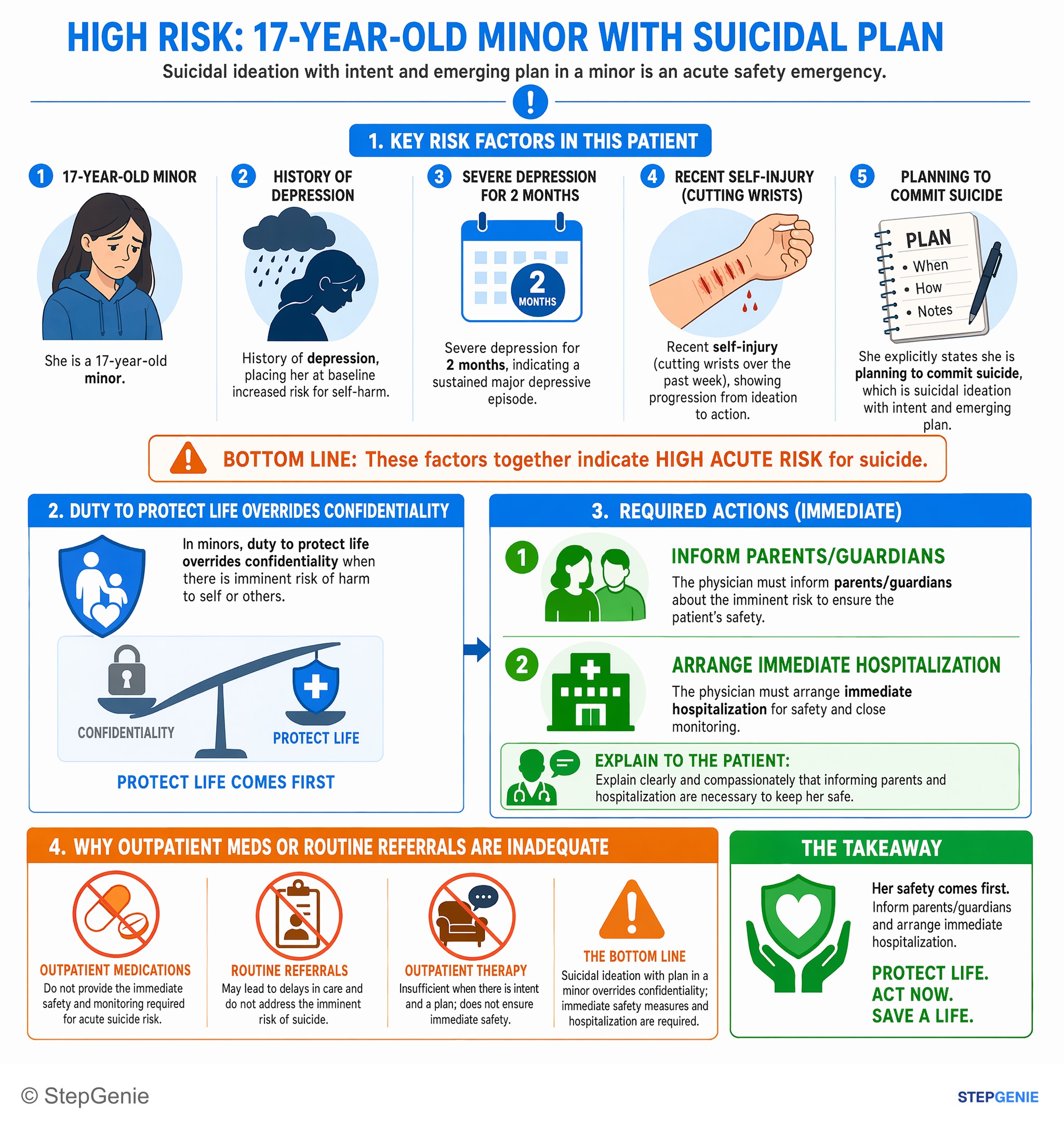
Suicidal ideation with plan in a minor overrides confidentiality; she requires immediate safety measures and hospitalization, even if…
USMLE Step 2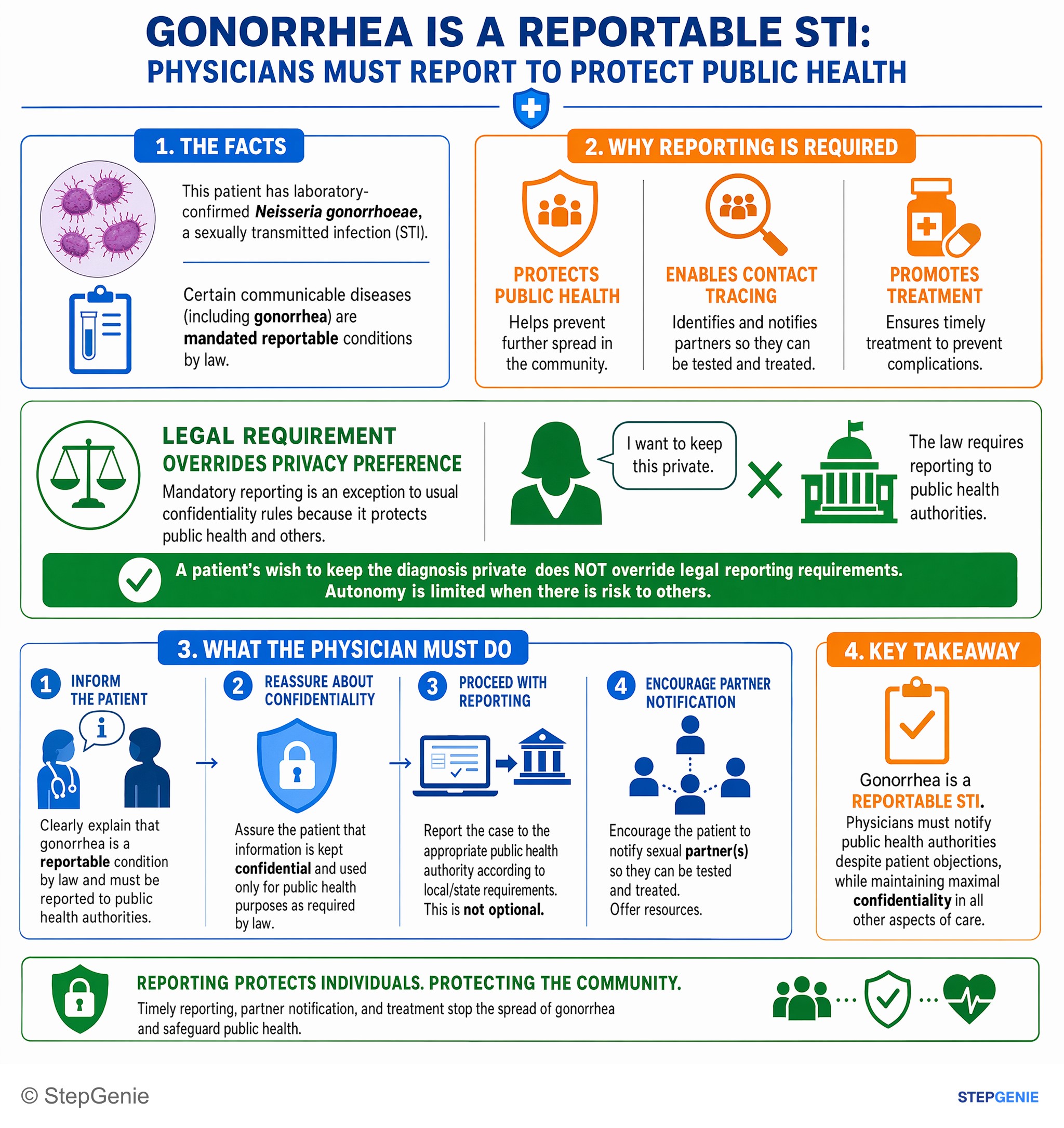
Gonorrhea is a reportable STI; physicians must notify public health authorities despite patient objections, while maintaining maximal…
USMLE Step 2Frequently Asked Questions
When can a doctor break confidentiality under Tarasoff-style duty to protect?
A doctor can break confidentiality when a patient makes a credible, imminent threat of serious violence toward a reasonably identifiable person. In that situation, confidentiality is not absolute because preventing serious foreseeable harm takes priority. Appropriate protective steps may include notifying law enforcement, warning the intended victim, arranging emergency psychiatric evaluation or hospitalization, and documenting the risk assessment and actions taken.
What clues in a vignette make a violent threat count as a Tarasoff scenario?
The key clues are specificity, credibility, imminence, and seriousness of harm. A classic vignette names a specific target, provides identifying details like an address, shows planning or means such as buying a weapon, and gives urgent timing like "tonight" or "tomorrow." Those features signal a serious, foreseeable risk that can justify breaching confidentiality to protect the victim and the public.
Why is maintaining confidentiality the wrong answer when a patient threatens a specific person?
Maintaining confidentiality is wrong because confidentiality has exceptions, and this is one of the classic ones. When a patient poses a serious, imminent threat to an identifiable person, the clinician has a duty to protect rather than keep the information private. The USMLE-tested principle is that confidentiality can be overridden when disclosure is necessary to prevent serious foreseeable harm.
Why is asking the patient to sign a release of information the wrong next step?
Asking for a release is wrong because it delays protection in an emergency. If the threat is imminent, such as a plan to shoot someone that night, the priority is immediate harm reduction, not waiting for consent or paperwork. In emergencies, the best next step is the one that reduces danger right away rather than adding delay when there is a credible, urgent risk of serious violence.
On ethics questions, why is "warn the potential victim only" often not the best answer?
Warning the potential victim only is often incomplete because the duty to protect may require broader action. In a high-risk scenario with a specific victim, a weapon, and imminent timing, the best next step is usually the option that most comprehensively reduces danger. That can include notifying law enforcement and arranging emergency psychiatric evaluation or hospitalization, not just giving a warning to the intended victim.