Malpractice questions love to disguise themselves as “just another ethics vignette”—until you realize they’re testing a rigid legal checklist. If you can see the elements instantly, you can answer fast and move on. Here’s a quick, shareable visual hack to lock in the malpractice elements for USMLE Step 1/2.
The 4 elements of malpractice (the whole game)
Medical malpractice (a form of negligence) requires all four:
- Duty
- Breach
- Causation
- Damages
Miss any one → no malpractice.
Visual hack: “4 D’s” = Malpractice
Think of a domino chain labeled D → D → D → D:
Duty → Dereliction (Breach) → Direct cause → Damage
If a domino is missing, the chain doesn’t fall—case fails.
One-liners (memorize these)
- Duty: “A doctor–patient relationship existed.”
- Dereliction (Breach): “They deviated from the standard of care.”
- Direct cause (Causation): “That breach is what caused the injury.”
- Damage (Damages): “The patient suffered a real, compensable harm.”
High-yield USMLE table: elements + what the vignette must show
| Element | What you’re looking for in the stem | Common USMLE trap |
|---|---|---|
| Duty | Established relationship (treated/consulted, on-call & accepted, ED evaluation) | “Curbside” advice without a patient relationship usually no duty |
| Breach | Failure to meet standard of care (what a reasonable clinician would do) | Bad outcome alone ≠ breach |
| Causation | Injury would not have happened but for breach + foreseeable link | Patient was injured, but not because of clinician’s deviation |
| Damages | Actual harm: physical injury, lost wages, added medical costs, pain/suffering | Near miss or “could have died” without injury → usually no damages |
The “standard of care” in 10 seconds (what USMLE expects)
Breach is judged against the standard of care: what a reasonably competent clinician in similar circumstances would do.
High-yield anchors:
- Clinical practice guidelines can inform standard of care but aren’t automatically decisive.
- Specialists are generally held to a specialist standard; students/residents still must meet expected training-level standards under supervision.
- Error ≠ negligence unless it reflects deviation from standard practice.
Mini-vignette pattern recognition (fast decision rules)
If you see this… think Duty
- “Established patient,” “seen in clinic/ED,” “admitted under your service”
- On exams: Duty is usually easy—rarely the contested element unless it’s curbside/telephonic.
If you see this… think Breach
- Missed diagnosis with clear red flags (e.g., classic SAH, cauda equina, MI equivalents)
- Wrong med/dose, ignored allergies, failure to follow up critical labs
- Not obtaining informed consent is typically framed as lack of informed consent (related, but tested distinctly)
If you see this… think Causation
- Timing is everything: harm occurs because of the delay or wrong action
- Alternate cause breaks the chain: “Even with correct care, outcome would be the same” → weak causation
If you see this… think Damages
- Must be real harm: additional surgery, disability, prolonged hospitalization, loss of function
- Emotional distress alone is usually not enough unless tied to a recognized claim framework (varies; USMLE tends to keep it straightforward)
“Malpractice vs everything else” (super high-yield differential)
| Concept | Key idea | Typical vignette clue |
|---|---|---|
| Malpractice (negligence) | Failure to meet standard of care causing harm | Preventable injury after deviation |
| Battery | Intentional unpermitted touching | Procedure without consent (or wrong procedure) |
| Assault | Threat creating fear of harmful contact | Patient fears you’re about to do something |
| Informed consent failure | Didn’t disclose risks/alternatives; patient would have refused if informed | “I was never told that could happen” |
| Res ipsa loquitur | “The thing speaks for itself”—event shouldn’t occur without negligence | Sponge left inside, wrong-site surgery |
Exam tip: A complication can occur without malpractice if it’s a known risk and care met standard.
Quick mnemonic card (shareable)
Malpractice = 4 D’s
- Duty: relationship
- Dereliction: below standard
- Direct cause: breach caused injury
- Damage: actual harm
No D? No $$.
Rapid-fire self-check (2 questions)
- Bad outcome after appropriate care → malpractice?
- Usually no (no breach).
- Clear breach but no patient harm → malpractice?
- Usually no (no damages).
Takeaway
Treat malpractice like a checklist, not a story: Duty → Breach → Causation → Damages. Use the 4 D’s domino chain to see missing elements instantly—then pick the answer and keep your time for the harder stuff.
Visual explanations from the StepGenie QBank
Infographics StepGenie drew to explain questions in its own QBank, matched to this article's topic. Each caption is the takeaway of the question it explains.
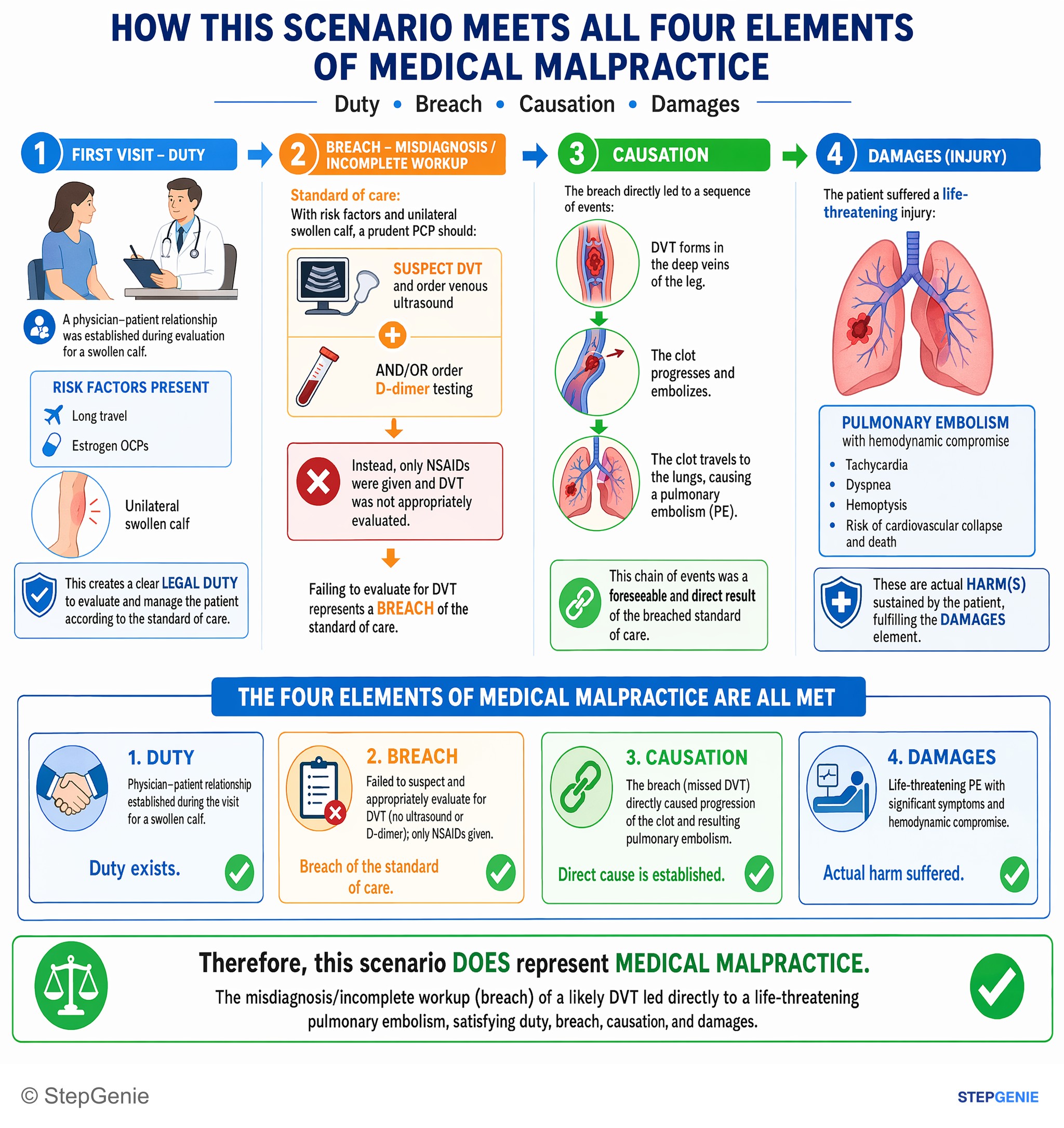
Medical malpractice requires duty, breach (misdiagnosis), causation, and damages; missed DVT leading to PE fulfills all four elements.
USMLE Step 2Frequently Asked Questions
What are the elements you need to prove medical malpractice?
Medical malpractice requires all four elements: duty, breach, causation, and damages. Duty means a doctor-patient relationship existed, breach means the clinician deviated from the standard of care, causation means that breach directly caused the injury, and damages means the patient suffered real, compensable harm. If any one element is missing, the malpractice claim fails.
Does a bad outcome automatically mean there was malpractice?
No, a bad outcome alone does not prove malpractice. The key question is whether there was a breach of the standard of care, meaning the clinician failed to do what a reasonably competent clinician would do in similar circumstances. A complication or poor outcome can still occur even when care met the standard, so without breach there is usually no malpractice.
How do you know if causation is the missing element in a malpractice question?
Causation is missing when the patient was injured, but not because of the clinician’s deviation from the standard of care. On exam vignettes, timing often helps: the harm must occur because of the delay or wrong action. If the same outcome would have happened even with correct care, causation is weak and the malpractice case usually fails.
What counts as damages in a malpractice case?
Damages means the patient suffered actual harm, such as physical injury, added medical costs, lost wages, pain and suffering, disability, prolonged hospitalization, or loss of function. A near miss or a situation where the patient could have died but was not actually injured usually does not satisfy damages. Without real, compensable harm, there is usually no malpractice.
How do you tell malpractice from battery or lack of informed consent on exams?
Malpractice is negligence: failure to meet the standard of care that causes harm. Battery is intentional unpermitted touching, such as doing a procedure without consent or performing the wrong procedure. Lack of informed consent means the clinician did not disclose risks or alternatives and the patient would have refused if properly informed. These can look similar in vignettes, but they are tested as distinct concepts.