THC, the main psychoactive compound in cannabis, is an agonist at CB1 receptors, which inhibit adenylyl cyclase and suppress presynaptic release of GABA and glutamate. Intoxication is a clinical diagnosis: recent use, problematic behavioral changes and at least 2 of conjunctival injection, increased appetite, dry mouth and tachycardia (DSM-5-TR). Withdrawal after heavy, prolonged use is the mirror image (irritability, anxiety, insomnia, poor appetite, restlessness), and chronic heavy use can cause cannabinoid hyperemesis syndrome: cyclic vomiting eased by hot showers that stops only with sustained abstinence. Federally, marijuana in FDA-approved products or under a state medical marijuana license has been Schedule III since April 28, 2026; all other marijuana is still Schedule I, and the DEA proceeding on moving all marijuana to Schedule III was stayed on September 29, 2026, before any recommended decision.
How THC works: CB1, CB2 and CBD
- CB1 receptors are dense in cortical, limbic and striatal regions; CB2 receptors are mainly on immune cells (StatPearls).
- CB1 signaling (Gi/o pattern): activation inhibits adenylyl cyclase, lowers cAMP and modulates calcium and potassium channels, suppressing presynaptic release of GABA and glutamate.
- Endocannabinoids help regulate appetite, pain sensation and memory (Merck): hence the "munchies" and short-term memory loss.
- CBD is nonintoxicating and may modulate THC's effects; average THC potency has risen 3- to 5-fold over the past 2 decades (StatPearls).
Acute intoxication
DSM-5-TR criteria: recent use; clinically significant problematic behavioral or psychological changes (impaired coordination, euphoria, anxiety, a sense of slowed time, impaired judgment); and at least 2 of 4 physical signs: conjunctival injection, increased appetite, dry mouth, tachycardia (StatPearls).
| What you see | Details |
|---|---|
| Physical signs | Red eyes, tachycardia and dry mouth occur regularly; appetite often increases (Merck) |
| Mood and perception | Euphoria, relaxation and a slowed sense of time; anxiety, panic and paranoia, particularly in naive users (Merck) |
| Cognition and motor | Concentration, time sense, fine coordination, depth perception, tracking and reaction time can be impaired for up to 24 hours (Merck) |
| Psychosis | Can worsen or even precipitate psychotic symptoms in people with schizophrenia, even those taking antipsychotics (Merck) |
- Route matters. Smoked cannabis acts within minutes and lasts about 4-6 hours (Merck). Edibles are absorbed slowly and variably, peaking at 2-6 hours, and first-pass metabolism prolongs their effects (StatPearls), so people re-dose before the first dose hits.
- Children who eat edibles can become very ill: in children younger than 5, THC doses above 5 mg/kg have caused respiratory depression needing supplemental oxygen (Merck).
- Management: most intoxicated patients need only observation and supportive care; get an ECG for chest pain after an edible (Merck).
Withdrawal: the mirror image
DSM-5-TR criteria: stopping after heavy, prolonged use, then 3 or more of these within about 1 week (StatPearls):
- Irritability, anger or aggression
- Nervousness or anxiety
- Sleep difficulty (insomnia, disturbing dreams)
- Decreased appetite or weight loss
- Restlessness
- Depressed mood
- Physical symptoms causing significant discomfort: abdominal pain, tremor, sweating, fever, chills or headache
Timeline: it usually begins 12-24 hours after the last use, peaks around days 2-3 and fades over about 1-2 weeks (Merck, StatPearls). Very little physical dependence is clinically apparent (Merck), so care is supportive, unlike alcohol withdrawal, which can bring seizures and delirium tremens.
Cannabis use disorder: about 20-30% of regular users meet criteria, and starting before age 15 roughly doubles the lifetime risk (StatPearls). First-line treatment is cognitive behavioral therapy, motivational enhancement therapy and contingency management. No medication is FDA-approved for it (StatPearls).
Cannabinoid hyperemesis syndrome (CHS)
The AGA clinical practice update on CHS (published in Gastroenterology) diagnoses it when all three are present:
- Stereotypical episodic vomiting resembling cyclic vomiting syndrome in onset, 3 or more times a year
- Cannabis use for more than 1 year before symptoms began, more than 4 times a week on average
- Resolution after abstinence for at least 6 months, or for at least the total duration of 3 of that patient's typical vomiting cycles
- The clue: hot baths or showers ease the symptoms (Merck). Proposed mechanisms include chronic overstimulation of the endocannabinoid system and cannabinoid effects on TRPV1, a heat-activated receptor (StatPearls).
- Complications: dehydration, electrolyte disturbances, aspiration pneumonitis and Boerhaave syndrome (StatPearls).
- Acute treatment: IV fluids, antiemetics, haloperidol and topical capsaicin (Merck); benzodiazepines in the short term (StatPearls). CHS is classically resistant to ondansetron and metoclopramide, and opioids are not appropriate because they can worsen nausea and vomiting (StatPearls). Compare ondansetron's usual role.
- Definitive treatment: stop cannabis. Acute symptoms usually resolve within about 48 hours of stopping, although persistent symptoms have been reported (Merck); tricyclic antidepressants have been suggested for long-term control (StatPearls).
Psychosis, cognition and long-term effects
- Cannabis-induced psychosis occurs during intoxication or withdrawal and resolves with abstinence. Psychosis that began before cannabis use, or that lasts beyond about a month of abstinence, points to an independent disorder such as schizophrenia (StatPearls); review schizophrenia: positive vs negative symptoms.
- Chronic heavy use is linked to schizophrenia, depression, anxiety and other substance use (Merck).
- Brain: habitual use is linked to cognitive impairment and hippocampal changes, especially when it starts in adolescence (Merck).
- Lungs: high-dose smokers can develop episodes of acute bronchitis, wheezing and coughing; there is no evidence of an increased risk of head and neck or airway cancers (Merck).
- Fertility: smoking marijuana may reduce sperm count, and women who smoke it have decreased fertility (Merck).
- Pregnancy and breastfeeding: safety has not been clearly proven, so pregnant people and those trying to conceive should avoid cannabis; THC is secreted in breast milk, and breastfeeding mothers should also avoid it (Merck).
Urine drug screens and synthetic cannabinoids
- Screens detect the metabolite THC-COOH for about 3 days after a single use and up to 30 days in chronic users (StatPearls). In people who use at least weekly, a positive screen adds nothing about the acute complaint (Merck): a positive test is not proof of intoxication.
- Synthetic cannabinoids ("K2," "Spice") are lab-made, can be life-threatening and are mostly undetected by routine urine drug screens (NIDA).
FDA-approved cannabinoid drugs
| Drug | What it is | FDA-approved use | Federal status |
|---|---|---|---|
| Dronabinol capsules (Marinol) | Synthetic delta-9-THC | Adults: anorexia with weight loss in AIDS; chemotherapy-induced nausea and vomiting after conventional antiemetics fail | Schedule III |
| Dronabinol oral solution (Syndros) | Synthetic delta-9-THC | The same two indications | Schedule II |
| Cannabidiol (Epidiolex) | CBD | Seizures of Lennox-Gastaut syndrome, Dravet syndrome or tuberous sclerosis complex, age 1 year and older | Not a controlled substance |
- Epidiolex can raise liver transaminases, mostly in patients also taking valproate (clobazam also adds risk), so check ALT, AST and total bilirubin before starting and at 1, 3 and 6 months. It also causes somnolence and carries the antiepileptic suicidality warning. See antiepileptic drugs by seizure type.
- FDA has also approved nabilone (Cesamet), a synthetic cannabinoid structurally similar to THC, but it has not approved cannabis itself for any disease or condition (FDA).
Federal legal status, as of October 2026
- Final: a rule signed by the Acting Attorney General on April 22, 2026, and effective April 28, 2026, moved marijuana (with marijuana extract and naturally derived delta-9-THC) to Schedule III when it is in an FDA-approved product or subject to a state medical marijuana license, with expedited DEA registration for those licensees (Federal Register).
- Still Schedule I: every other form of marijuana, including recreational (adult-use) marijuana and any marijuana outside a state medical license (Federal Register).
- Not final: moving all marijuana to Schedule III. DEA's chief administrative law judge heard testimony on that proposal from June 29 to July 15, 2026. On September 29, 2026, before any recommended decision, the judge stayed the case pending a motion by three parties opposed to rescheduling to add a September 23, 2026 GAO report on drug scheduling to the record; in its October 9, 2026 response the government deferred to the judge on admitting the report but opposed supplemental briefing on it, and on October 14, 2026 the judge reserved ruling on the motion, ordered the government to respond by October 21, 2026 to those parties' October 12 motion to reopen the hearing for limited discovery and testimony, and kept the case stayed (DEA Docket No. 1362).
- What comes next: the judge's recommended decision is not the final word; the DEA Administrator makes the final determination after the parties can file exceptions (Morgan Lewis). No final rule on the broader proposal had appeared in the Federal Register as of October 14, 2026.
How USMLE tests it
- Red eyes, increased appetite, tachycardia and slowed time after use: cannabis intoxication. Dilated pupils, hypertension and agitation point to stimulants instead.
- Daily user, cyclic vomiting, hot showers: CHS; the fix is stopping cannabis, never opioids.
- Psychosis lasting beyond about a month of abstinence: look for a primary psychotic disorder.
- Severe toxicity with a negative standard screen: consider synthetic cannabinoids.
Practice question
A 24-year-old man comes to the emergency department with 2 days of intractable nausea, vomiting and diffuse abdominal discomfort. He has had similar episodes every few months for 2 years, each lasting several days, and feels well between them. He has smoked cannabis several times a day for 5 years. During episodes he takes long hot showers many times a day because they ease the nausea. He is afebrile, and his abdomen is soft without guarding. Lipase, liver enzymes and right upper quadrant ultrasound are normal, potassium is mildly low, and the urine drug screen is positive for cannabinoids. He improves with IV fluids. Which of the following is most likely to prevent future episodes?
A. Daily oral ondansetron B. Oral oxycodone at the first sign of nausea C. Sustained cessation of cannabis use D. Laparoscopic cholecystectomy E. Topical capsaicin cream applied daily between episodes
Answer: C. Stereotyped, recurrent vomiting episodes in a long-term, frequent cannabis user, relieved by hot showers, is CHS. Only stopping cannabis removes the cause, and sustained abstinence (at least 6 months, or 3 typical cycles) also confirms the diagnosis (AGA).
- A: ondansetron classically does little in CHS and does not address the cause.
- B: opioids are not appropriate; they can worsen nausea and vomiting.
- D: normal liver enzymes, lipase and ultrasound give no reason to remove the gallbladder.
- E: capsaicin cream can relieve an acute episode, but it does not stop recurrences while cannabis use continues.
Key takeaways
- THC activates CB1 (Gi/o): less cAMP and less presynaptic GABA and glutamate release; CB2 is mainly immune.
- Intoxication: problematic behavior plus at least 2 of 4 signs: conjunctival injection, increased appetite, dry mouth, tachycardia.
- Withdrawal is the mirror image: irritability, anxiety, insomnia, poor appetite, restlessness, low mood; fades over 1-2 weeks.
- CHS: cyclic vomiting in a long-term frequent user, eased by hot showers; avoid opioids; stop cannabis.
- Urine THC-COOH lasts up to 30 days in chronic users, so positive does not mean intoxicated.
- FDA-approved: dronabinol (Marinol, Schedule III; Syndros, Schedule II), nabilone and CBD (Epidiolex, not controlled); nothing for cannabis use disorder.
- Federal law (October 2026): FDA-approved and state-medical-licensed marijuana is Schedule III since April 28, 2026; all other marijuana is Schedule I; broader rescheduling stayed September 29, 2026.
Sources
- Marijuana (Cannabis) — Merck Manual Professional Edition (2026)
- Cannabis Use Disorder — StatPearls, NCBI Bookshelf (2026)
- Cannabinoid Hyperemesis Syndrome — StatPearls, NCBI Bookshelf (2023)
- Cannabinoid Hyperemesis Syndrome Clinical Practice Update — American Gastroenterological Association
- Synthetic Cannabinoids — National Institute on Drug Abuse (2023)
- EPIDIOLEX (cannabidiol): prescribing information — DailyMed (2026)
- MARINOL (dronabinol) capsules: prescribing information — DailyMed (2023)
- SYNDROS (dronabinol) oral solution: prescribing information — DailyMed (2022)
- FDA Regulation of Cannabis and Cannabis-Derived Products, Including Cannabidiol (CBD) — U.S. Food and Drug Administration (2024)
- Schedules of Controlled Substances: Rescheduling of FDA Approved Products Containing Marijuana From Schedule I to Schedule III — Federal Register (2026)
- Order Staying Case and Ordering Response to Motion (DEA Docket No. 1362) — DEA Office of Administrative Law Judges (2026)
- High Time for a Change? Post-DEA Hearing, Broader Marijuana Rescheduling Questions Remain — Morgan Lewis (2026)
Visual explanations from the StepGenie QBank
Infographics StepGenie drew to explain questions in its own QBank, matched to this article's topic. Each caption is the takeaway of the question it explains.
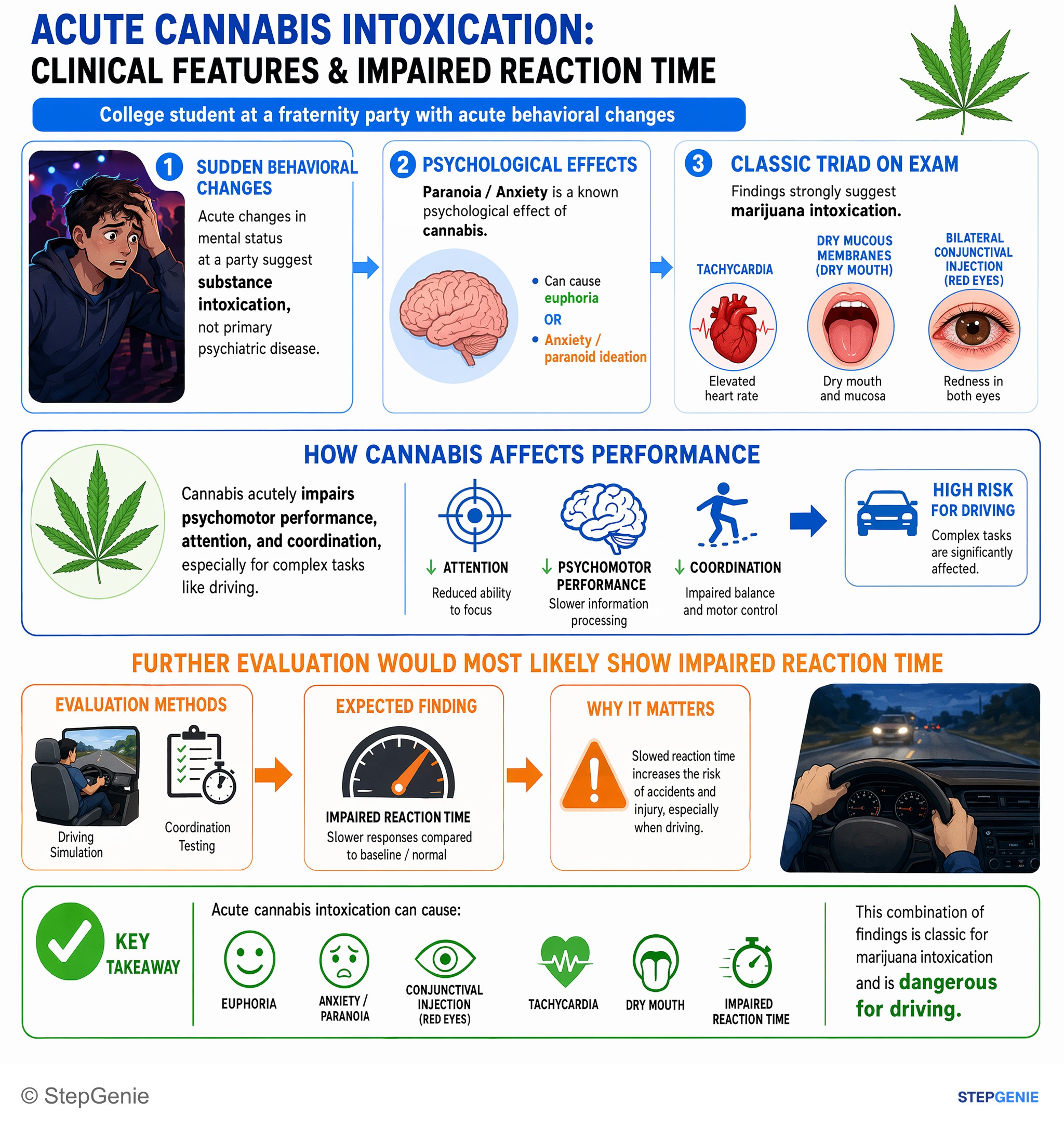
Acute cannabis intoxication causes euphoria, anxiety/paranoia, conjunctival injection, tachycardia, dry mouth, and impaired reaction time…
USMLE Step 1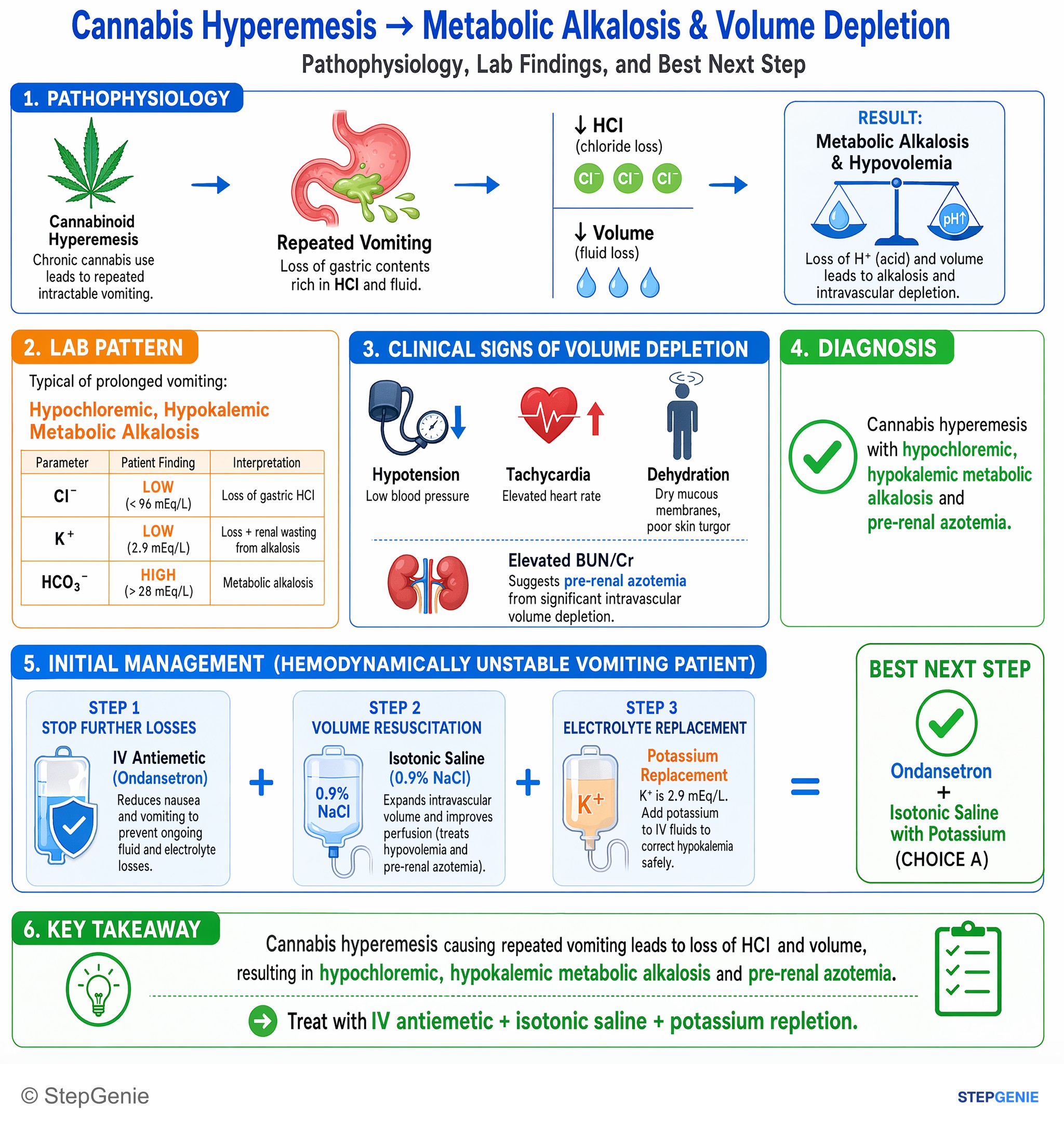
Cannabis hyperemesis with hypochloremic, hypokalemic metabolic alkalosis and volume depletion → treat with antiemetic + isotonic saline…
USMLE Step 2Frequently Asked Questions
What are the signs of cannabis intoxication on USMLE?
DSM-5-TR requires recent cannabis use, problematic behavioral or psychological changes such as impaired coordination, euphoria, anxiety or a sense of slowed time, and at least 2 of 4 signs: conjunctival injection (red eyes), increased appetite, dry mouth and tachycardia. Anxiety, panic and paranoia occur particularly in inexperienced users, and cannabis can worsen or even precipitate psychotic symptoms in people with schizophrenia. Concentration, coordination and reaction time can stay impaired for up to 24 hours.
What are the symptoms of cannabis withdrawal and how long does it last?
Within about a week of stopping heavy, prolonged use, people develop 3 or more of irritability or anger, anxiety, sleep difficulty with disturbing dreams, decreased appetite or weight loss, restlessness, depressed mood, and physical symptoms such as abdominal pain, tremor, sweating, fever, chills or headache. Symptoms usually start 12 to 24 hours after the last use, peak around days 2 to 3 and fade over about 1 to 2 weeks. Care is supportive, and no medication is FDA-approved for cannabis use disorder.
What is cannabinoid hyperemesis syndrome?
Cannabinoid hyperemesis syndrome is recurrent, stereotyped episodes of vomiting in a long-term, frequent cannabis user. The AGA clinical practice update requires episodes resembling cyclic vomiting syndrome at least 3 times a year, cannabis use for more than a year before symptoms at more than 4 times a week on average, and resolution after at least 6 months of abstinence or 3 typical vomiting cycles. Relief from hot showers is a classic clue. Stopping cannabis is the definitive treatment, and opioids are not appropriate.
How long does THC stay positive on a urine drug screen?
Urine screens detect the THC metabolite THC-COOH for about 3 days after a single use and for up to 30 days in chronic users. Because of this long window, a positive screen does not prove that a person is intoxicated now, and in someone who uses at least weekly it adds nothing about an acute complaint. Synthetic cannabinoids such as K2 or Spice are mostly missed by routine urine drug screens.
Which cannabinoid drugs are FDA-approved?
Dronabinol, synthetic delta-9-THC, is approved in adults for anorexia with weight loss in AIDS and for chemotherapy-induced nausea and vomiting that has not responded to conventional antiemetics; the Marinol capsules are Schedule III and the Syndros oral solution is Schedule II. Nabilone (Cesamet), a synthetic cannabinoid similar in structure to THC, is also FDA-approved. Cannabidiol (Epidiolex) treats seizures of Lennox-Gastaut syndrome, Dravet syndrome and tuberous sclerosis complex and is not a controlled substance. FDA has not approved the cannabis plant itself.
Is marijuana still Schedule I in 2026?
Partly. A federal rule effective April 28, 2026 moved marijuana to Schedule III when it is in an FDA-approved product or subject to a state medical marijuana license. All other marijuana, including recreational marijuana, remains Schedule I. The proposal to move all marijuana to Schedule III went to a DEA hearing from June 29 to July 15, 2026, and on September 29, 2026 the chief administrative law judge stayed the case before any recommended decision, so it was not final as of mid-October 2026.