Alcohol withdrawal questions love to test timelines, vitals, and what kills the patient. A memory palace is perfect here because the symptoms unfold in order—almost like walking through rooms in a house. Below is a quick-hit, shareable “house walkthrough” you can replay on test day to nail alcohol withdrawal vs delirium tremens, plus the must-know management.
The Memory Palace: “The Detox House Walkthrough”
Imagine a patient entering a Detox House right after their last drink. Each room represents a time window after cessation.
Visual Map (Rooms = Time)
| Room in the House | Time Since Last Drink | What You See | One-liner |
|---|---|---|---|
| Front Porch (Shaky Welcome Mat) | 6–12 hours | Tremor, anxiety, insomnia, GI upset, diaphoresis, palpitations | “Early withdrawal is shaky + sweaty but oriented.” |
| Living Room (Bottles Crawling on the Walls) | 12–48 hours | Alcoholic hallucinosis: visual > auditory/tactile hallucinations, normal vitals, clear sensorium | “Hallucinations with a clear mind = alcoholic hallucinosis.” |
| Staircase (Seizure Steps) | 12–48 hours | Generalized tonic-clonic seizures | “Withdrawal seizures are early and generalized.” |
| Basement (DT Dungeon) | 48–96 hours (can start ~72h) | Delirium tremens: delirium, severe agitation, fever, HTN, tachycardia, diaphoresis, hallucinations | “DTs = delirium + autonomic storm—this can kill.” |
Mnemonic headline:
“Shake → See → Seize → Storm (DTs)”
- Shake (6–12h)
- See (12–48h hallucinosis, oriented)
- Seize (12–48h)
- Storm (48–96h DTs with delirium + unstable vitals)
Quick Differentiator: Alcoholic Hallucinosis vs Delirium Tremens
Think: “Clear vs Cloudy”
- Alcoholic hallucinosis (12–48h)
- Hallucinations (often visual)
- Orientation intact / clear sensorium
- Vitals usually not wildly unstable
- Delirium tremens (48–96h)
- Delirium (inattention, fluctuating consciousness, disorientation)
- Autonomic hyperactivity: fever, HTN, tachycardia, diaphoresis
- Higher mortality if untreated
One-liner:
“Hallucinations with orientation = hallucinosis; hallucinations + delirium + autonomic instability = DTs.”
High-Yield Management (USMLE Favorite)
Step 1/2 “Do this first” moves
-
Benzodiazepines are first-line for alcohol withdrawal
- Prevents seizures and progression to DTs
- Common choices:
- Lorazepam (best if liver disease/elderly)
- Diazepam or chlordiazepoxide (long-acting; smoother course if normal liver)
-
Give thiamine before glucose
- Prevents precipitating/worsening Wernicke encephalopathy
- Practical order: Thiamine → glucose (if needed) → folate/multivitamins
-
Supportive care + monitoring
- IV fluids, correct electrolytes (Mg, K, phosphate), telemetry if severe
- Consider CIWA-Ar scoring to guide symptom-triggered benzo dosing (common Step 2 angle)
What not to mess up on exams
- Antipsychotics do NOT treat withdrawal (they can lower seizure threshold)
- May be adjunct for severe agitation/hallucinations after benzos, but never primary.
- Beta-blockers/clonidine can help autonomic symptoms but do not prevent seizures/DTs.
Why DTs Are So Dangerous (and What They Look Like)
DTs are basically hyperexcitation after chronic alcohol use. Alcohol enhances GABA and inhibits NMDA; chronic use causes the brain to compensate. When alcohol stops, you get:
- ↓ GABA tone + ↑ glutamate activity → tremors, seizures, delirium, autonomic hyperactivity
Classic DT vignette:
A hospitalized patient “doing fine” for a day or two after admission suddenly becomes confused, agitated, febrile, diaphoretic, tachycardic, and is “seeing bugs”—2–4 days after their last drink.
Mini Table: Withdrawal Timeline Snapshot
| Time | Key Syndrome | Hallmark | First-line |
|---|---|---|---|
| 6–12h | Early withdrawal | Tremor + anxiety + diaphoresis | Benzos |
| 12–48h | Hallucinosis | Hallucinations, oriented | Benzos (rule out other causes) |
| 12–48h | Withdrawal seizures | Generalized tonic-clonic | Benzos |
| 48–96h | DTs | Delirium + autonomic instability | High-dose benzos, ICU-level care often |
Shareable “One-Screen” Memory Palace Recap
- Front Porch (6–12h): Shake — tremor, anxiety, sweats
- Living Room (12–48h): See — hallucinosis but oriented
- Staircase (12–48h): Seize — generalized seizures
- Basement (48–96h): Storm — DTs = delirium + fever/HTN/tachycardia
Treatment anchor: Benzos + thiamine (before glucose).
Visual explanations from the StepGenie QBank
Infographics StepGenie drew to explain questions in its own QBank, matched to this article's topic. Each caption is the takeaway of the question it explains.
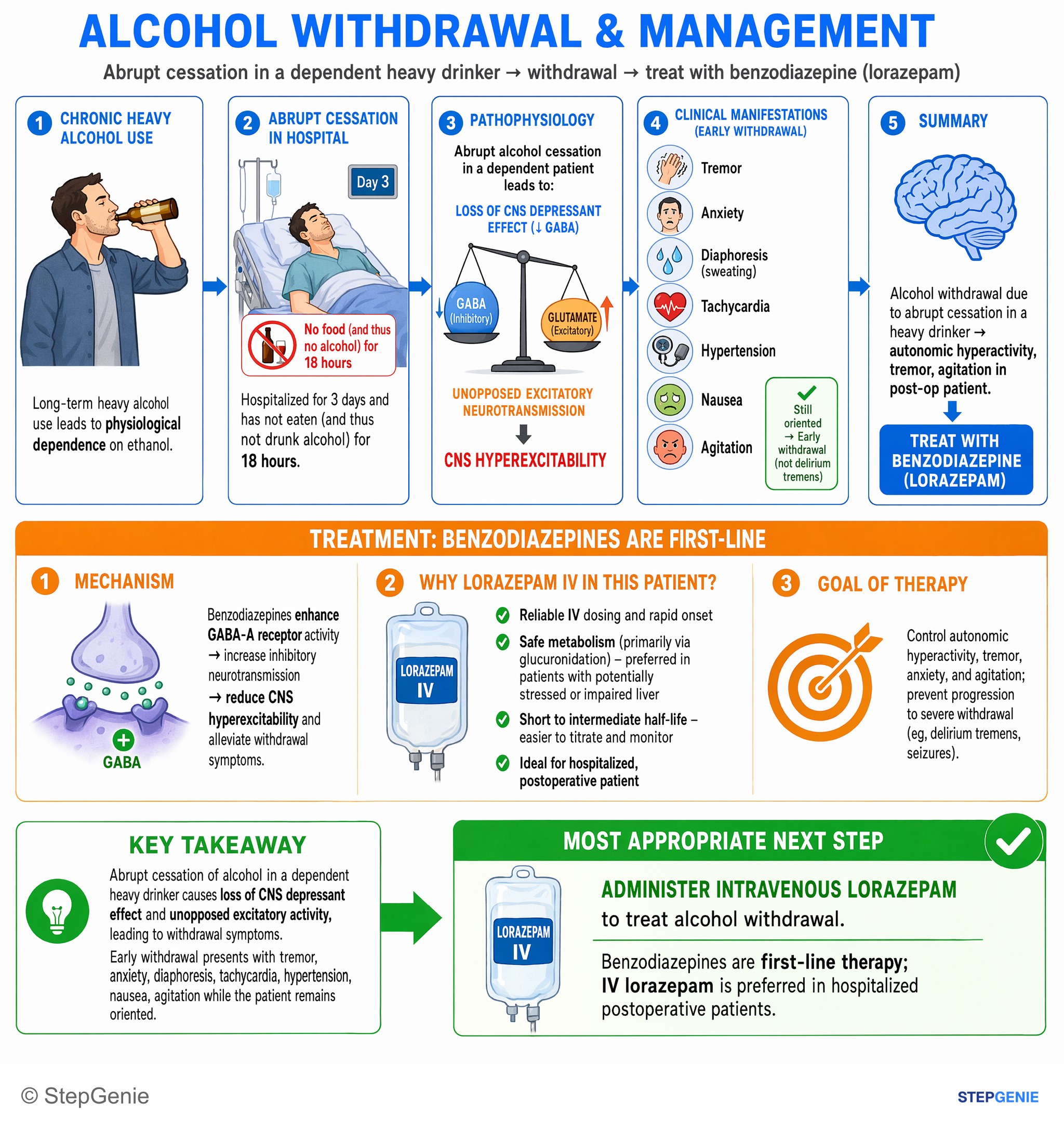
Alcohol withdrawal due to abrupt cessation in a heavy drinker → autonomic hyperactivity, tremor, agitation post-op → treat with…
USMLE Step 2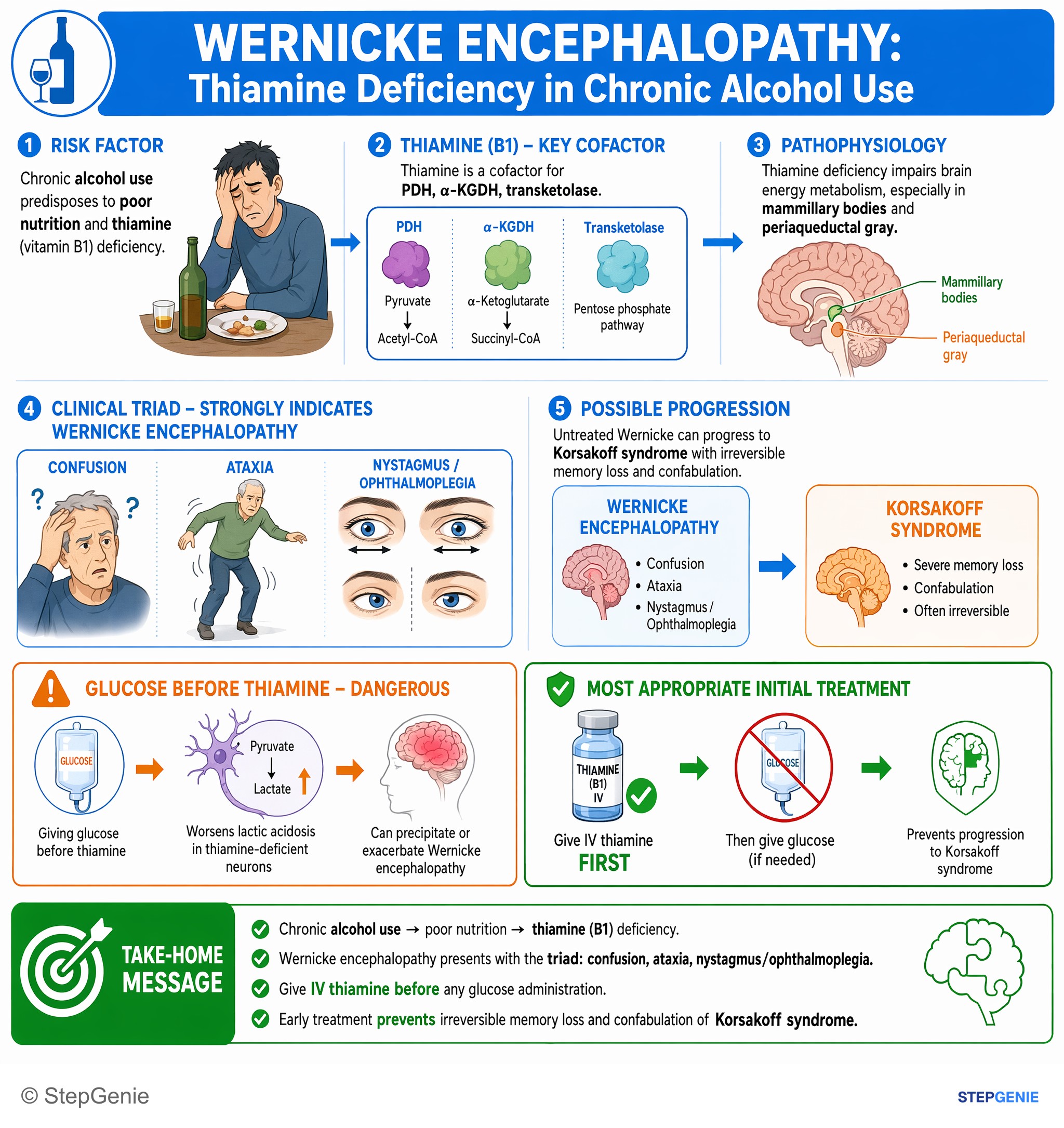
Wernicke encephalopathy from thiamine deficiency in an alcoholic: confusion, ataxia, nystagmus/ophthalmoplegia. Give IV thiamine before…
USMLE Step 2Frequently Asked Questions
How do you tell alcoholic hallucinosis from delirium tremens?
Alcoholic hallucinosis is distinguished by hallucinations with a clear sensorium and relatively stable vital signs, whereas delirium tremens causes hallucinations plus delirium and autonomic instability. Hallucinosis typically occurs 12–48 hours after the last drink and the patient remains oriented. Delirium tremens usually appears 48–96 hours after cessation and features disorientation, fluctuating consciousness, fever, hypertension, tachycardia, diaphoresis, and severe agitation.
What is the first-line treatment for alcohol withdrawal and delirium tremens?
Benzodiazepines are the first-line treatment for alcohol withdrawal because they prevent seizures and progression to delirium tremens. Common options include lorazepam, especially in liver disease or older patients, and diazepam or chlordiazepoxide when liver function is normal. In delirium tremens, high-dose benzodiazepines are used, and ICU-level care is often needed because the condition is severe and potentially fatal.
Why do you give thiamine before glucose in alcohol withdrawal?
Thiamine is given before glucose to avoid precipitating or worsening Wernicke encephalopathy. The practical treatment order is thiamine first, then glucose if needed, followed by folate or multivitamins. This sequencing is a classic management point in alcohol withdrawal care and is emphasized alongside benzodiazepines and supportive treatment such as fluids, electrolyte correction, and monitoring.
When do alcohol withdrawal seizures and delirium tremens usually happen after the last drink?
Alcohol withdrawal seizures usually occur early, about 12–48 hours after the last drink, while delirium tremens typically develops later at 48–96 hours and can start around 72 hours. The seizures are classically generalized tonic-clonic. Delirium tremens is marked by delirium, severe agitation, fever, hypertension, tachycardia, diaphoresis, and hallucinations, making the later timeline a key clue on exams.
Why are delirium tremens so dangerous?
Delirium tremens is dangerous because it reflects severe hyperexcitation with delirium and autonomic storm, and it can be fatal if untreated. Chronic alcohol use enhances GABA and inhibits NMDA, so the brain compensates over time. When alcohol suddenly stops, decreased GABA tone and increased glutamate activity lead to tremors, seizures, delirium, fever, hypertension, tachycardia, and diaphoresis.