Schizophrenia questions love to look “obvious”… until the answer choices start mixing positive symptoms, negative symptoms, mood disorders, and medication effects. The fastest way to level up your Q-bank score is to stop asking, “What’s the diagnosis?” and start asking, “Why is every other option wrong?” Let’s do exactly that with a classic vignette.
Tag: Psychiatry > Psychotic & Mood Disorders
The Clinical Vignette (Q-bank style)
A 24-year-old man is brought to the clinic by his sister because he has “not been himself” for the past 8 months. He was previously sociable and doing well in college but has since dropped out. He spends most of the day alone in his room and rarely speaks. When he does talk, his responses are brief and vague. His sister says he has stopped showering and no longer seems interested in hobbies he used to enjoy. He has no history of substance use. On exam, he makes minimal eye contact and shows little emotional expression. He denies feeling sad. Vitals are normal.
Question: Which of the following best describes this patient’s symptoms?
Answer choices (example set):
A. Delusions
B. Hallucinations
C. Negative symptoms
D. Manic episode
E. Major depressive disorder
Step 1: Identify the Key Findings
The vignette is built around negative symptoms and functional decline:
- Duration: 8 months (meets schizophrenia duration requirement if continuous signs persist ≥ 6 months)
- Functional deterioration: dropped out of college, social withdrawal
- Negative symptom cluster:
- Affective flattening (little emotional expression)
- Avolition (not initiating goal-directed activity)
- Anhedonia (loss of interest)
- Asociality (social withdrawal)
- Alogia (poverty of speech)
No clear positive symptoms are provided (e.g., hallucinations, delusions, disorganized speech), but schizophrenia can still present with prominent negative symptoms—especially in long, smoldering courses.
Correct Answer: C. Negative symptoms
Why this is correct (high-yield)
Negative symptoms reflect a loss of normal function and are often the main driver of long-term disability.
High-yield negative symptoms (“5 A’s”):
| Negative Symptom | What it looks like in vignettes |
|---|---|
| Affective flattening | Reduced emotional expression, monotone voice, poor eye contact |
| Alogia | Poverty of speech, brief answers |
| Avolition | Lack of motivation, poor self-care, can’t initiate tasks |
| Anhedonia | Loss of interest/pleasure |
| Asociality | Social withdrawal, isolation |
USMLE pearl: Negative symptoms tend to respond poorly to treatment compared with positive symptoms. Second-generation antipsychotics may help somewhat, but psychosocial interventions are often crucial.
Now Let’s Destroy the Distractors (Why Each Answer Choice Matters)
A. Delusions — tempting, but not supported
Delusions are fixed, false beliefs not consistent with cultural norms (e.g., persecutory, grandiose, erotomanic, somatic).
- Why it’s wrong here: The stem gives no delusional content. Withdrawal and poor self-care alone are not delusions.
- What would make it right: Statements like “My neighbors are broadcasting thoughts into my brain” (persecutory + thought broadcasting).
USMLE tie-in: Delusions are positive symptoms.
B. Hallucinations — also positive symptoms, but absent
Hallucinations are sensory perceptions without an external stimulus, most commonly auditory in schizophrenia.
- Why it’s wrong here: No report of hearing voices, seeing things, or responding to internal stimuli.
- What would make it right: “He hears voices commenting on his actions” or “multiple voices arguing.”
High-yield:
- Auditory hallucinations: schizophrenia, mood disorders with psychosis
- Visual hallucinations: think substances/withdrawal, delirium, neurologic causes first
D. Manic episode — look for mood + energy changes
Mania is defined by ≥ 1 week of elevated/irritable mood and increased energy plus ≥ 3 additional symptoms (DIGFAST).
DIGFAST:
-
Distractibility
-
Indiscretion (risky behavior)
-
Grandiosity
-
Flight of ideas
-
Activity/agitation
-
Sleep decreased
-
Talkative/pressured speech
-
Why it’s wrong here: This patient has low speech, low activity, social withdrawal—the opposite of mania’s increased energy and pressured speech.
-
How mania gets tricky on exams: Mania can have psychotic features, but the mood/energy syndrome must be prominent and time-locked to mood episodes.
USMLE tie-in: If psychosis occurs only during mood episodes → bipolar disorder with psychotic features (or MDD with psychotic features), not schizophrenia.
E. Major depressive disorder — don’t confuse anhedonia with depression
MDD requires ≥ 2 weeks with depressed mood and/or anhedonia plus additional SIGECAPS symptoms.
SIGECAPS:
-
Sleep changes
-
Interest decreased
-
Guilt/worthlessness
-
Energy low
-
Concentration impaired
-
Appetite changes
-
Psychomotor changes
-
Suicidality
-
Why it’s wrong here: He denies feeling sad, and the vignette emphasizes flat affect + alogia + avolition as primary. Those can mimic depression, but they’re classic negative symptoms.
-
What would make MDD more likely: Prominent depressed mood, guilt, suicidal ideation, diurnal variation, mood-congruent cognitive distortions.
High-yield differentiation tip:
- Depression: “I feel hopeless, guilty, and sad.”
- Negative symptoms: “I don’t feel much of anything,” with flat affect and poverty of speech.
Schizophrenia vs Related Diagnoses (Quick USMLE Sorting Table)
| Condition | Duration | Key feature |
|---|---|---|
| Brief psychotic disorder | < 1 month | Psychosis ± stressor, full return to baseline |
| Schizophreniform disorder | 1–6 months | Schizophrenia symptoms but shorter duration |
| Schizophrenia | ≥ 6 months | Functional decline + psychotic symptoms (can include negative symptoms) |
| Schizoaffective disorder | Mood episodes + psychosis | ≥ 2 weeks of psychosis without mood symptoms |
| Mood disorder w/ psychotic features | Mood episodes | Psychosis occurs only during mood episodes |
Exam trap: Don’t label it schizoaffective just because you see mood symptoms—schizoaffective requires the specific timing rule.
High-Yield Add-On: Positive vs Negative Symptoms (and what treats what)
Positive symptoms (additions)
- Delusions
- Hallucinations
- Disorganized speech/behavior
Pathophys association: often linked to mesolimbic dopamine hyperactivity
Treatment response: typically better response to antipsychotics
Negative symptoms (subtractions)
- Flat affect, alogia, avolition, anhedonia, asociality
Pathophys association: often linked to mesocortical dopamine hypoactivity
Treatment response: harder to treat; SGAs may help, plus psychosocial support
Test-Day Takeaways (What to remember in 10 seconds)
- Negative symptoms = “loss of normal function” (flat affect, alogia, avolition, anhedonia, asociality).
- Schizophrenia requires continuous signs ≥ 6 months with functional decline.
- Rule out mood disorders by checking whether psychosis is independent of mood episodes.
- Q-banks reward you for identifying what’s present and what’s missing.
Visual explanations from the StepGenie QBank
Infographics StepGenie drew to explain questions in its own QBank, matched to this article's topic. Each caption is the takeaway of the question it explains.
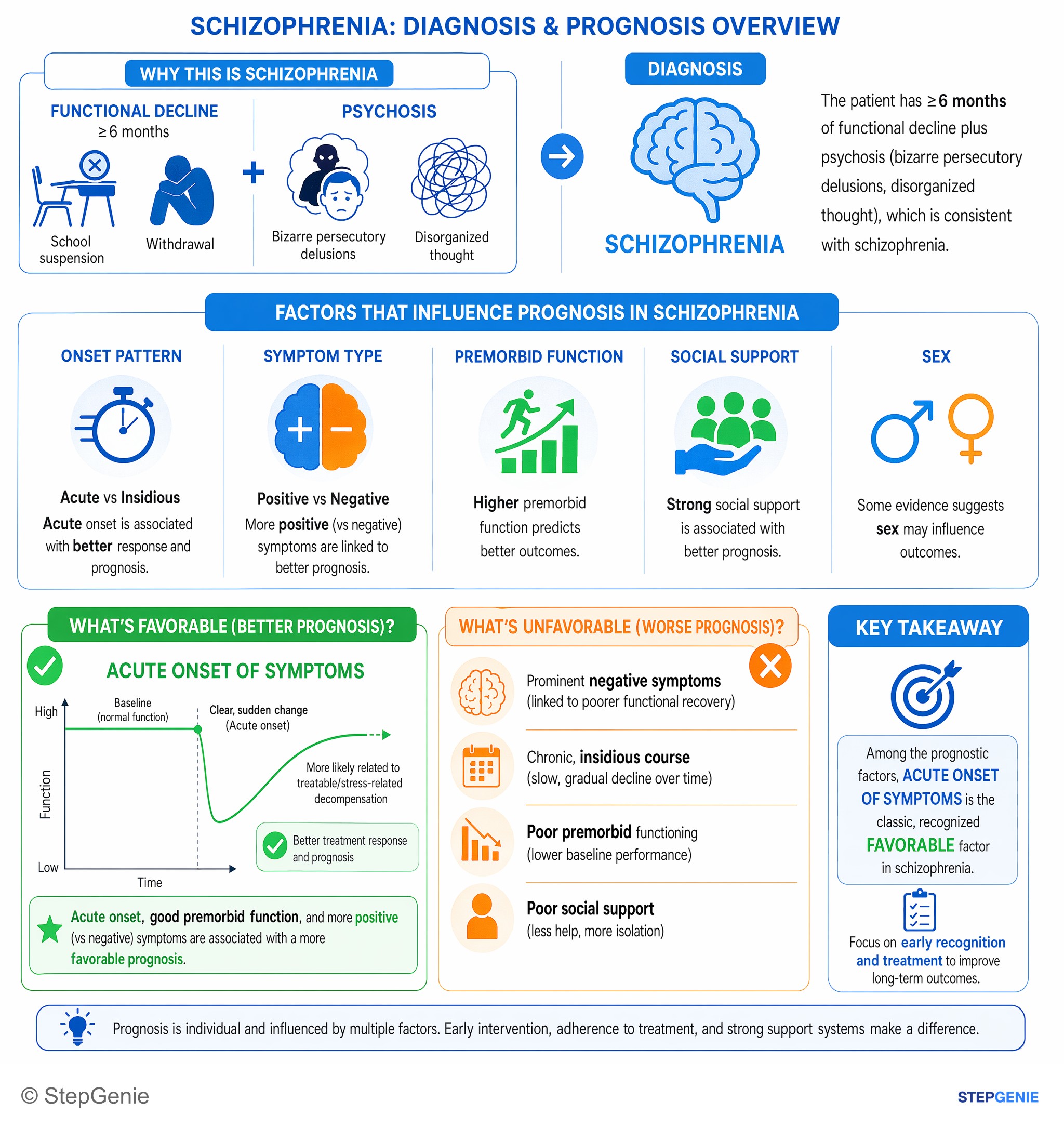
Schizophrenia with acute onset, good premorbid function, and more positive (vs negative) symptoms is associated with a more favorable…
USMLE Step 2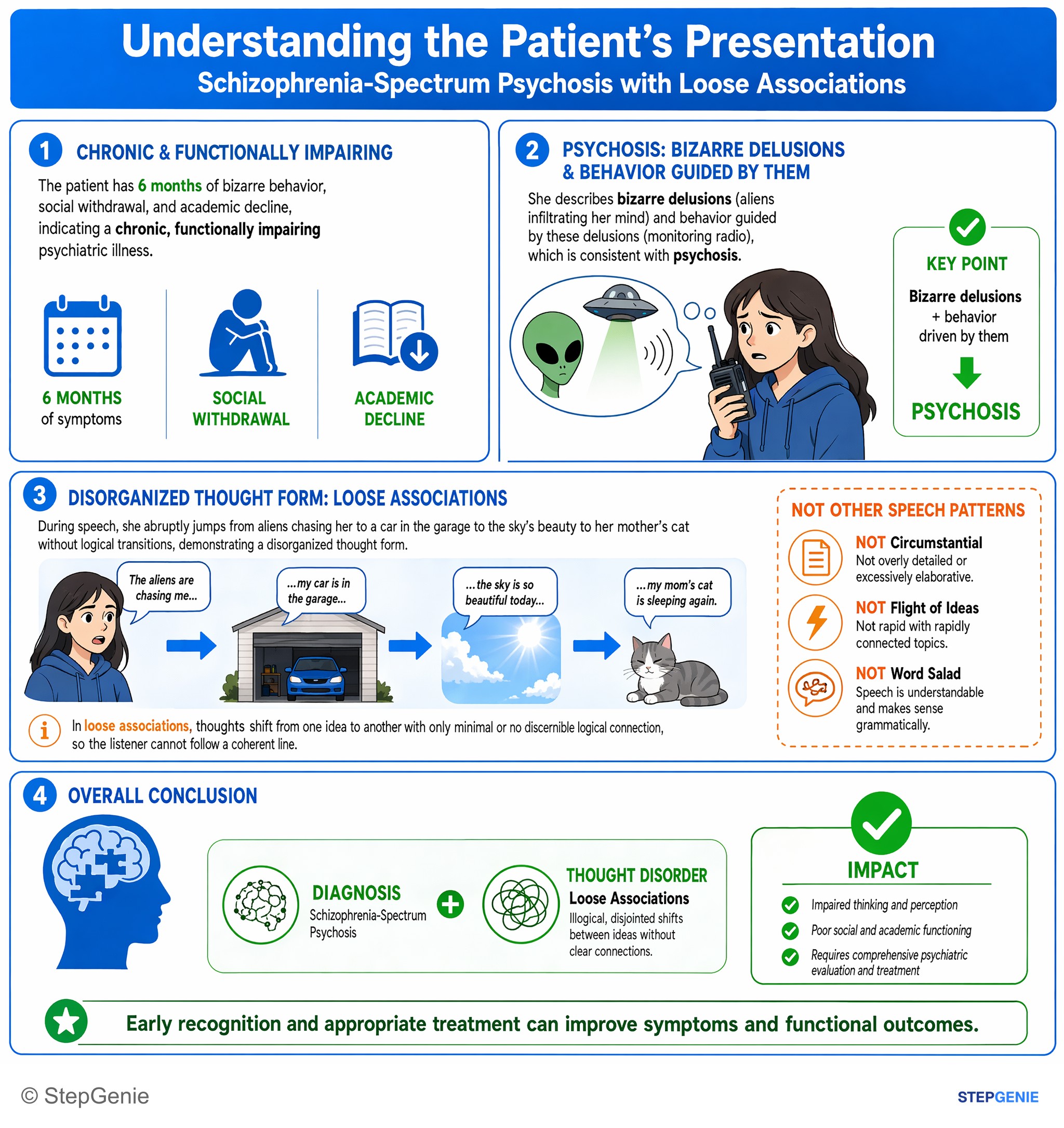
Schizophrenia-spectrum psychosis with loose associations: illogical, disjointed shifts between ideas without clear connections in the…
USMLE Step 1Frequently Asked Questions
How do you tell negative symptoms of schizophrenia from major depressive disorder in a vignette?
Negative symptoms are suggested by a loss of normal function with flat affect, poverty of speech, avolition, anhedonia, and social withdrawal, especially when the patient does not report feeling sad. Major depressive disorder is more likely when depressed mood or anhedonia is paired with other SIGECAPS features such as guilt, suicidality, sleep or appetite changes, and mood-congruent cognitive distortions.
What are the classic negative symptoms of schizophrenia you should recognize on exams?
The classic negative symptoms are the “5 A’s”: affective flattening, alogia, avolition, anhedonia, and asociality. In question stems, these appear as reduced emotional expression, brief or vague speech, poor motivation and self-care, loss of interest in hobbies, and social isolation. These symptoms reflect a loss of normal function rather than the addition of abnormal experiences.
Why isn’t this presentation mania if the patient’s behavior changed over time?
It is not mania because the vignette shows low speech, low activity, social withdrawal, and little emotional expression, which are the opposite of mania’s elevated or irritable mood and increased energy. Mania requires at least 1 week of mood and energy elevation plus DIGFAST features such as grandiosity, decreased need for sleep, pressured speech, distractibility, and risky behavior.
How do you know hallucinations or delusions are not the best answer here?
Hallucinations and delusions are not the best answer because the vignette gives no evidence of sensory perceptions without an external stimulus or fixed false beliefs. There is no report of hearing voices, seeing things, responding to internal stimuli, or expressing persecutory or grandiose beliefs. Withdrawal and poor self-care alone do not establish positive symptoms.
What makes schizophrenia more likely than a short psychotic disorder in this stem?
Schizophrenia is favored because the stem describes 8 months of continuous problems with functional decline, which fits the requirement that continuous signs persist for at least 6 months. The patient has dropped out of college, become socially withdrawn, and developed prominent negative symptoms. A brief psychotic disorder would last less than 1 month and then return to baseline.