Seizure classification sorts a seizure first by where it starts (focal, generalized, unknown whether focal or generalized, or unclassified) and then, for focal seizures, by whether consciousness is preserved or impaired. Under the ILAE's 2025 update, a staring spell with an aura, lip smacking, fumbling hands and postictal confusion is a focal impaired consciousness seizure (2017 name: focal impaired awareness; older name: complex partial), classically from the temporal lobe. A 10-30-second stare in a school-age child that ends abruptly with no postictal state, is provoked by hyperventilation and shows 3-Hz spike-and-wave on EEG is a typical absence seizure. The 2025 update replaced "awareness" with "consciousness", dropped "onset" from the class names and swapped motor vs nonmotor for observable vs non-observable manifestations.
The question
A 27-year-old woman is brought to the emergency department after an episode at work. She first felt a rising sensation in her stomach and an intense feeling that she had lived the moment before. Coworkers then saw her stare blankly and stop responding for about 90 seconds while she smacked her lips and picked at her shirt with her right hand. She did not fall, stiffen or jerk. Afterward she was confused for a few minutes, and she remembers nothing after the déjà vu. She has no fever, uses no drugs, and her neurologic examination is now normal. Which of the following best classifies this seizure?
A. Typical absence seizure B. Focal preserved consciousness seizure (focal aware; simple partial) C. Focal impaired consciousness seizure (focal impaired awareness; complex partial) D. Focal to bilateral tonic-clonic seizure E. Generalized myoclonic seizure F. Generalized atonic seizure G. Psychogenic nonepileptic seizure
Answer: C. The episode began with an aura (a rising epigastric sensation and déjà vu), which is itself a focal preserved consciousness seizure. It then progressed: she stopped responding and cannot recall what followed the aura, and the 2025 ILAE classification judges consciousness by exactly those two things, responsiveness and awareness (tested by recall). Lip smacking (oroalimentary automatisms) and picking at clothes (gestural automatisms) are classic temporal lobe semiology. In these seizures, motor features usually settle after 1-2 minutes, confusion can last another minute or two, and amnesia for the event is common. The 2025 update also asks you to describe the sequence: epigastric aura → impaired consciousness → oroalimentary and gestural automatisms.
Why every other answer choice is wrong
- A. Typical absence seizure: absence seizures last about 10-30 seconds and end as abruptly as they start, with no postictal confusion. They usually begin between ages 5 and 15, are provoked by hyperventilation and show 3-Hz spike-and-wave on EEG. Brief automatisms and eye blinks can occur in absence (one reason the 2025 update dropped the "nonmotor" label), so automatisms alone don't decide it; the aura, the 90-second duration, the postictal confusion and her age do.
- B. Focal preserved consciousness seizure: her aura was one, but the seizure went further. With preserved consciousness, the patient stays responsive and can describe the event afterward: a rising epigastric feeling, an odd smell, fear, déjà vu, or a Jacksonian march of jerking that starts in one hand and spreads up the arm.
- D. Focal to bilateral tonic-clonic seizure: she never stiffened or convulsed. This seizure (formerly "secondarily generalized") spreads to both hemispheres and evolves to complete loss of consciousness with bilateral tonic, then clonic, activity.
- E. Generalized myoclonic seizure: brief, shock-like jerks without prolonged unresponsiveness. Classic stem: a teenager with jerks on waking, worse after sleep deprivation or alcohol (juvenile myoclonic epilepsy, with 4-6 Hz polyspike-and-wave), often followed by generalized tonic-clonic seizures.
- F. Generalized atonic seizure: a brief, complete loss of tone and consciousness, so the child pitches to the ground and risks head injury. Think Lennox-Gastaut syndrome: onset before age 4, several seizure types, slow spike-and-wave under 2.5 Hz, and impaired intellect in most.
- G. Psychogenic nonepileptic seizure (PNES): events usually last longer (several minutes or more), the movements don't follow a true seizure pattern (side-to-side jerks, exaggerated pelvic thrusting, waxing and waning intensity), patients often resist passive eye opening, and there is no postictal confusion. Video-EEG monitoring confirms it, and treatment is cognitive behavioral therapy, not antiseizure drugs. Her stereotyped aura, automatisms and amnesia fit an epileptic seizure.
What changed in the 2025 ILAE classification
The ILAE published its "Updated classification of epileptic seizures" in Epilepsia on 23 April 2025. It keeps four classes but cuts the number of seizure types from 63 (2017) to 21.
| 2025 ILAE | 2017 ILAE | Older name |
|---|---|---|
| Focal seizure | Focal-onset seizure | Partial seizure |
| Focal preserved consciousness seizure | Focal aware seizure | Simple partial seizure |
| Focal impaired consciousness seizure | Focal impaired awareness seizure | Complex partial seizure |
| Focal to bilateral tonic-clonic seizure | Focal to bilateral tonic-clonic seizure | Secondarily generalized seizure |
| Generalized seizure | Generalized-onset seizure | — |
| Typical absence seizure | Generalized nonmotor (absence) seizure | Petit mal |
| Generalized tonic-clonic seizure | Generalized-onset motor (tonic-clonic) seizure | Grand mal |
| Unknown whether focal or generalized | Unknown-onset seizure | — |
| Observable vs non-observable manifestations | Motor vs nonmotor | — |
- "Onset" is gone from the class names. "Unknown" means some information exists but not enough to call it focal or generalized (a convulsion whose start nobody saw is a "bilateral tonic-clonic seizure, unknown whether focal or generalized"); "unclassified" means the clinician is confident the event was epileptic but has no detail. An unknown seizure can be reclassified later as more information emerges.
- Consciousness replaces awareness. It is judged by awareness (recall) plus responsiveness (verbal and motor tasks). "Impaired awareness" translates directly to "impaired consciousness".
- Observable vs non-observable manifestations replace motor vs nonmotor. Observable features are nonvolitional and obvious to an eyewitness (motor, aphasic, autonomic and others); a purely subjective aura has none.
- Describe the sequence, not only the first sign, and treat epileptic negative myoclonus as a seizure type. Classifiers (which change management) are now kept separate from descriptors (semiology details).
- Exam reality: question writers, drug labels and older books still use 2017 and pre-2017 names (the valproate label still lists "complex partial seizures"), so know all three columns.
Staring spell: absence vs focal impaired consciousness
| Feature | Typical absence | Focal impaired consciousness |
|---|---|---|
| Usual age | 5-15 years | Not age-restricted |
| Warning | None | Often an aura (epigastric rising, smell, fear, déjà vu) |
| Duration | About 10-30 seconds | Motor features 1-2 minutes, then 1-2 minutes of confusion |
| Automatisms | Possible but brief | Common: lip smacking, chewing, fumbling |
| Recovery | Abrupt; resumes activity unaware anything happened | Gradual, with confusion and amnesia; Todd paralysis possible |
| Trigger | Hyperventilation | — |
| EEG | Bilateral 3-Hz spike-and-wave | Focal epileptiform discharges in some; one normal EEG does not exclude epilepsy |
| Cause | Genetic | Mesial temporal sclerosis, cortical dysplasia, traumatic gliosis, tumors |
- Temporal lobe link: repeated temporal lobe seizures are often associated with shrinkage and scarring (sclerosis) of the hippocampus, and MRI can detect mesial temporal sclerosis, traumatic gliosis and small tumors in adults.
- Focal seizures are common: about 60% of people with epilepsy have focal seizures.
- One EEG is not enough: the first EEG shows epileptiform activity in only 30-55% of patients; serial EEGs raise that to 80-90%, and inpatient video-EEG is the most sensitive test.
- Todd paralysis: transient weakness of the limb contralateral to the focus after a seizure; don't mistake it for a stroke.
Mimics the exam uses
| Mimic | What gives it away |
|---|---|
| Convulsive syncope | Warning symptoms (dizziness, nausea, sweating), loss of consciousness with some brief myoclonic jerks, spontaneous revival; a bitten tongue, incontinence or prolonged confusion afterward points to a seizure |
| PNES | Long, waxing-waning events, pelvic thrusting, side-to-side movements, resistance to eye opening, normal vital signs, no postictal confusion; video-EEG confirms |
| Migraine aura | Zigzag lines, flashing lights or blind spots, or numbness spreading slowly from one hand up the arm to the face, usually before the headache (migraine vs tension vs cluster) |
| Cataplexy | Loss of tone triggered by laughter, anger or surprise without loss of consciousness, usually under 2 minutes; think narcolepsy |
| Provoked seizure | Low glucose, sodium, calcium or magnesium, alcohol or drug withdrawal, CNS infection; treat the cause. Epilepsy is generally diagnosed after 2 or more unprovoked seizures more than 24 hours apart |
| Febrile seizure | Simple: brief, solitary, generalized; complex: focal, over 15 minutes, or 2 or more in 24 hours (febrile seizure question) |
How USMLE tests it
- Aura + automatisms + postictal confusion = focal impaired consciousness seizure, usually temporal. Work up with glucose and electrolytes, neuroimaging (MRI shows mesial temporal sclerosis and cortical dysplasia better than CT) and EEG.
- Many brief daily stares in a child, hyperventilation, 3-Hz spike-and-wave = typical absence.
- A teenager with morning jerks after an all-nighter = juvenile myoclonic epilepsy.
- Seizure activity over 5 minutes, or 2 seizures without full recovery of consciousness between them = status epilepticus (work through the status epilepticus question).
- Classification picks the drug. Ethosuximide is labeled for absence epilepsy; carbamazepine does not control absence seizures and can worsen absence, myoclonic and atonic seizures; valproate is generally avoided in anyone who could become pregnant (neural tube defects and lower IQ after exposure). The full drug-by-type map is in antiepileptic drugs by seizure type.
- Old names still appear: complex partial = focal impaired awareness = focal impaired consciousness.
Key takeaways
- 2025 ILAE: four classes (focal, generalized, unknown whether focal or generalized, unclassified) and 21 seizure types.
- Focal seizures split by consciousness (awareness plus responsiveness): preserved vs impaired; "focal to bilateral tonic-clonic" is unchanged.
- Aura → stare → automatisms → postictal confusion and amnesia = focal impaired consciousness (complex partial) seizure, usually temporal lobe.
- Typical absence: 10-30 seconds, ages 5-15, hyperventilation, 3-Hz spike-and-wave, no postictal state; brief automatisms don't exclude it.
- Myoclonic = morning jerks in teenagers (juvenile myoclonic epilepsy, 4-6 Hz polyspike-and-wave); atonic = drop attacks (Lennox-Gastaut, slow spike-and-wave under 2.5 Hz).
- PNES: long, waxing-waning, pelvic thrusting, eyes resist opening, no postictal confusion; video-EEG to confirm, CBT to treat.
- Status epilepticus starts at 5 minutes.
Sources
- The International League Against Epilepsy Updates Classification of Epileptic Seizures — ILAE (2025)
- Updated classification of epileptic seizures: Position paper of the ILAE — Epilepsia, via ILAE (2025)
- Seizure Disorders — Merck Manual Professional Edition (2026)
- Antiseizure Medications — Merck Manual Professional Edition (2026)
- Epilepsy and Seizures — NINDS (2026)
- Types of Seizures — CDC (2024)
- Syncope — Merck Manual Professional Edition (2024)
- Migraine — Merck Manual Professional Edition (2025)
- Narcolepsy — Merck Manual Professional Edition (2026)
- ZARONTIN (ethosuximide) label — DailyMed (2023)
- TEGRETOL (carbamazepine) label — DailyMed (2026)
- DEPAKOTE (divalproex sodium) label — DailyMed (2026)
Visual explanations from the StepGenie QBank
Infographics StepGenie drew to explain questions in its own QBank, matched to this article's topic. Each caption is the takeaway of the question it explains.
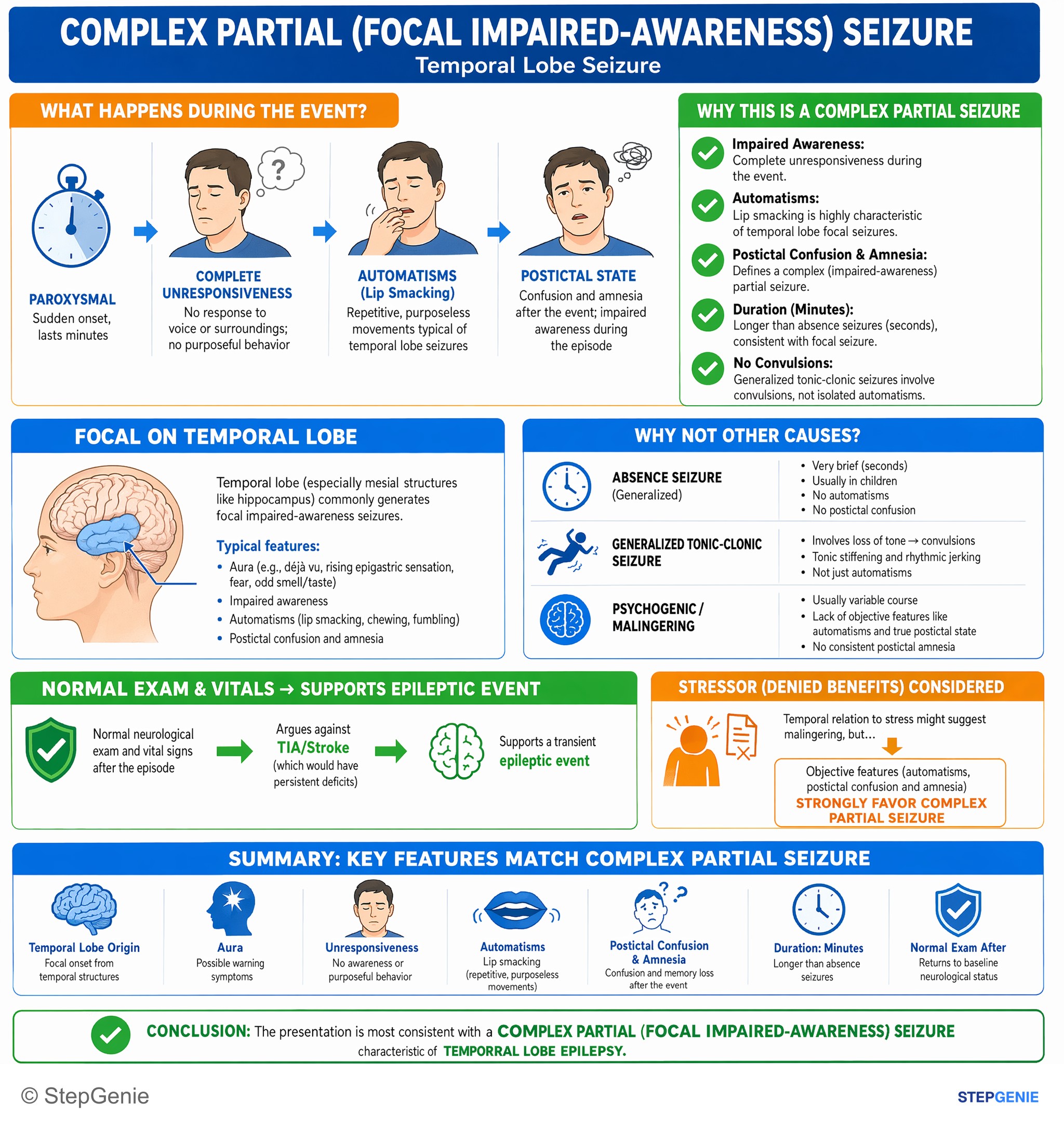
Complex partial (focal impaired-awareness) seizure: temporal-lobe seizure with aura, automatisms (lip smacking), unresponsiveness, and…
USMLE Step 2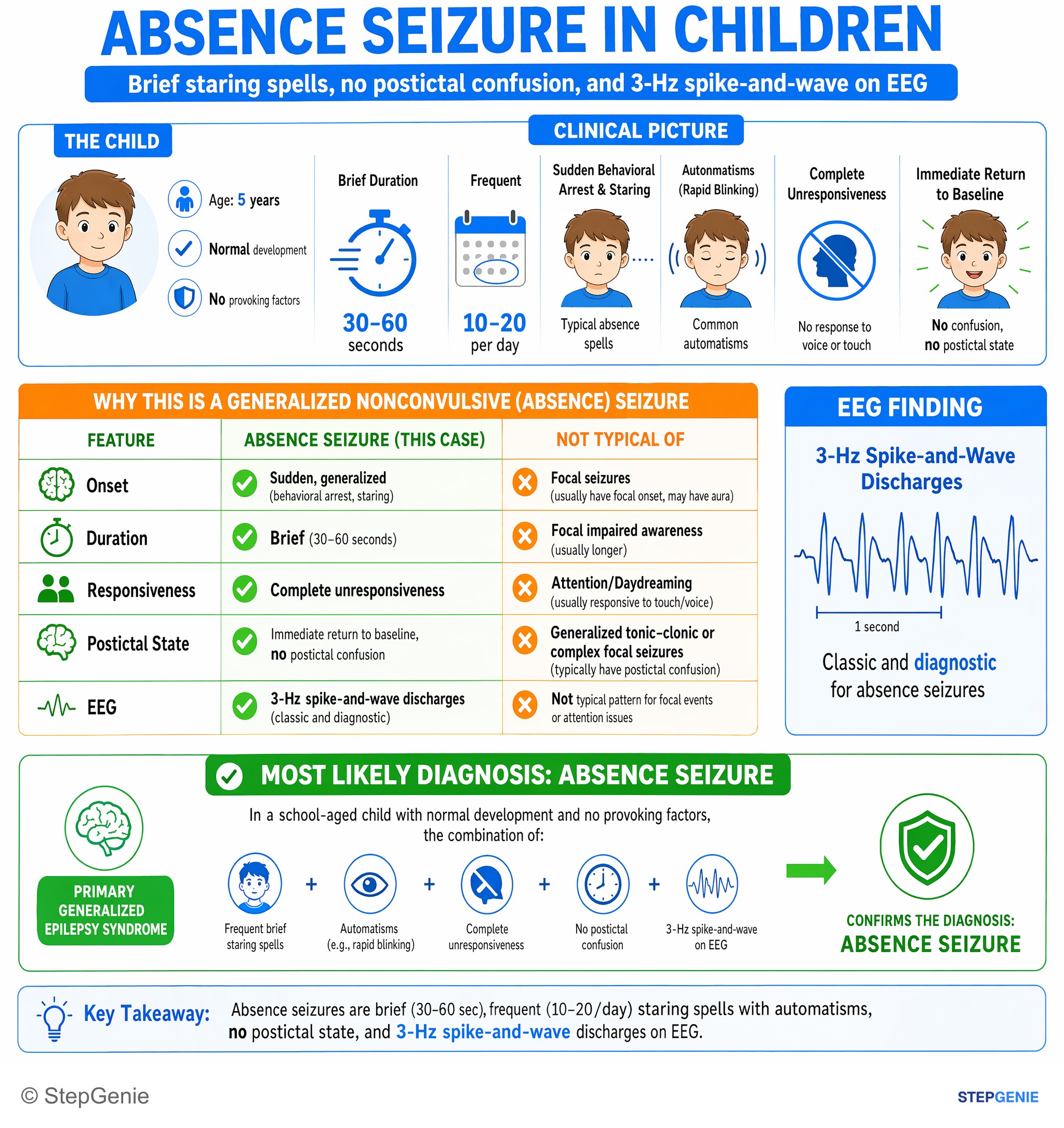
Absence seizure in child: frequent brief staring spells, automatisms, no postictal confusion, 3-Hz spike-and-wave on EEG.
USMLE Step 2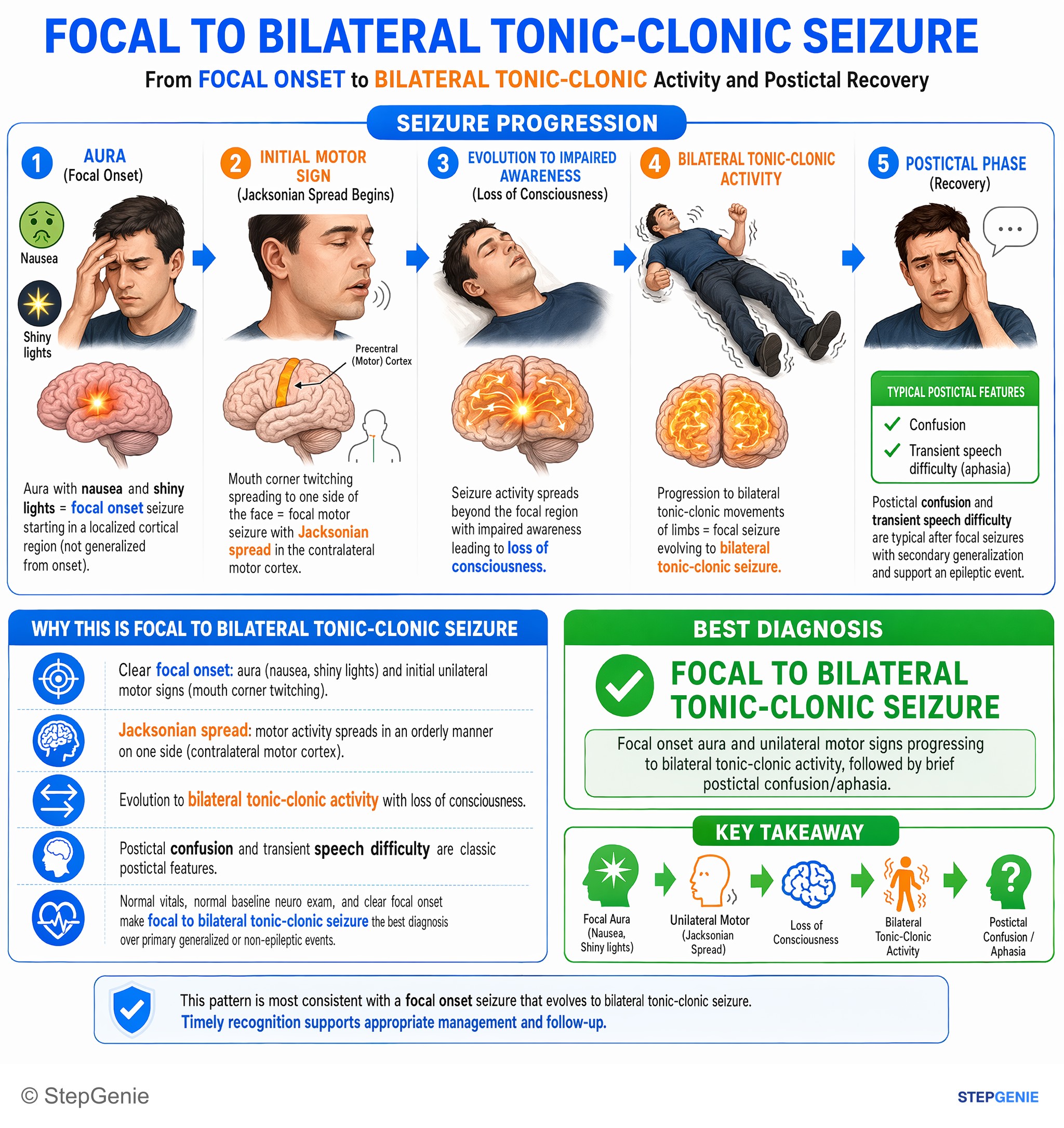
Focal to bilateral tonic-clonic seizure: focal onset aura and unilateral motor signs progressing to bilateral tonic-clonic activity…
USMLE Step 2Frequently Asked Questions
What did the 2025 ILAE seizure classification change?
The ILAE update, published in Epilepsia in April 2025, keeps four classes but drops the word onset from their names: focal, generalized, unknown whether focal or generalized, and unclassified. Consciousness, judged by awareness and responsiveness, replaces awareness as the classifier for focal seizures. Motor versus nonmotor becomes observable versus non-observable manifestations, absence seizures are no longer called nonmotor, and the number of seizure types falls from 63 to 21.
What is a focal impaired consciousness seizure?
It is a focal seizure during which the person stops responding normally and later cannot recall the event. It was called a focal impaired awareness seizure in the 2017 ILAE system and a complex partial seizure before that. It often starts with an aura, then a blank stare with automatisms such as lip smacking or fumbling with clothes, and is followed by brief confusion. It most often arises from the temporal lobe.
How do you tell an absence seizure from a focal impaired awareness seizure?
A typical absence seizure lasts about 10 to 30 seconds, starts and ends abruptly with no warning and no postictal confusion, usually begins between ages 5 and 15, is provoked by hyperventilation and shows 3 Hz spike-and-wave on EEG. A focal impaired awareness seizure often begins with an aura, lasts a minute or two, includes automatisms and is followed by confusion and amnesia. Brief automatisms can occur in absence, so use duration and the postictal state.
What is the difference between focal aware and focal impaired awareness seizures?
The difference is consciousness. In a focal aware seizure, now called a focal preserved consciousness seizure, the person stays responsive and can describe the event afterward, such as a rising stomach sensation, an odd smell, fear, deja vu or jerking that marches up one arm. In a focal impaired awareness seizure, now called a focal impaired consciousness seizure, responsiveness and recall are lost. An aura is a focal aware seizure that can progress to impaired consciousness.
How do you tell a psychogenic nonepileptic seizure from an epileptic seizure?
Psychogenic nonepileptic seizures usually last longer, often several minutes or more, with movements that do not follow a true seizure pattern, such as side-to-side jerks, pelvic thrusting and intensity that waxes and wanes. Patients often resist passive eye opening, vital signs usually stay normal, and there is no postictal confusion. Video-EEG monitoring confirms the diagnosis. Treatment is cognitive behavioral therapy rather than antiseizure medication.
Do USMLE questions use the new seizure names?
Expect any of three naming systems. The 2025 ILAE terms are focal preserved consciousness and focal impaired consciousness seizures; the 2017 terms are focal aware and focal impaired awareness seizures; older material, including some drug labels, still says simple partial and complex partial seizures. Focal to bilateral tonic-clonic seizure, formerly secondarily generalized, kept its 2017 name. Recognize all of them and classify by the clinical features, not the label.