Headache questions are deceptively simple: the stem feels “classic,” you pick the obvious diagnosis…and then the explanation demolishes you with one overlooked detail (duration, autonomic signs, triggers, meds, timing). Let’s do this the way Q-banks want you to think: pick the best answer, then prove why every other choice is wrong—using the same few high-yield discriminators that show up again and again on Step 1/2.
Clinical Vignette (Q-bank style)
A 34-year-old woman presents with recurrent headaches for the past year. Episodes occur 1–2 times per month, last 12–24 hours, and are unilateral and throbbing. They are associated with nausea, photophobia, and worsening with climbing stairs. About 20 minutes before the headache begins, she sometimes sees shimmering zig-zag lines in her visual field. She prefers to lie in a dark room and avoids activity until the headache resolves. Neurologic exam between episodes is normal.
What is the most likely diagnosis?
A. Cluster headache
B. Tension-type headache
C. Migraine headache
D. Trigeminal neuralgia
E. Subarachnoid hemorrhage
Correct Answer: C. Migraine headache
This stem hits the migraine “core triad”:
- Unilateral, pulsatile (throbbing) pain
- Moderate–severe intensity that worsens with routine activity
- Nausea and/or photophobia/phonophobia
- Duration: 4–72 hours (she’s 12–24 hours)
- Plus: Aura (visual scintillations) that’s gradual and precedes headache
Migraine high-yield snapshot (USMLE)
- Aura = focal neurologic symptoms (often visual) that develop gradually and last 5–60 minutes.
- Pathophys (board-usable): trigeminovascular activation → release of neuropeptides (e.g., CGRP) → neurogenic inflammation + vasodilation; aura associated with cortical spreading depression.
- Common triggers: stress, sleep changes, fasting, alcohol (red wine), certain foods (aged cheese), menstruation.
- First-line acute treatment: NSAIDs, acetaminophen; triptans (5-HT1B/1D agonists) for moderate–severe.
- Prevention: propranolol, topiramate, valproate, TCAs; CGRP monoclonals for frequent migraines.
- Key contraindication: avoid triptans/ergots in significant CAD/vasospasm (risk of ischemia via vasoconstriction).
The “Why Not” Breakdown: Destroying Each Distractor
A. Cluster headache — why it’s wrong here
Cluster headaches are about timing + autonomic signs + pacing behavior.
Classic cluster features:
- Severe unilateral periorbital/temporal pain
- Short duration: 15–180 minutes
- Occur in clusters (e.g., daily for weeks), often same time each day (circadian pattern)
- Ipsilateral autonomic symptoms:
- lacrimation, conjunctival injection
- rhinorrhea/nasal congestion
- ptosis/miosis (Horner syndrome)
- Patient is restless/agitated, often pacing, not lying quietly in a dark room
What the stem has instead:
- Long duration (12–24 hours)
- Photophobia + nausea
- Aura
- Prefers dark room (more migraine behavior)
High-yield treatment contrast:
- Acute: 100% oxygen, sumatriptan
- Prevent: verapamil (watch PR interval)
B. Tension-type headache — why it’s wrong here
Tension-type headaches are about pressure, bilateral, no GI symptoms, and not worse with activity.
Classic tension-type features:
- Bilateral, “band-like,” tight/pressure quality
- Mild–moderate intensity
- Not aggravated by routine physical activity
- No nausea/vomiting
- May have either photophobia or phonophobia (not typically both)
What the stem has instead:
- Unilateral throbbing
- Nausea
- Worse with activity
- Aura
Treatment:
- Acute: NSAIDs, acetaminophen
- Prevention if frequent: amitriptyline (also helps sleep)
D. Trigeminal neuralgia — why it’s wrong here
Trigeminal neuralgia is facial pain, not a headache syndrome with photophobia/nausea.
Classic trigeminal neuralgia features:
- Brief attacks lasting seconds (up to ~2 minutes)
- Electric shock-like facial pain
- Triggered by light touch: shaving, brushing teeth, wind, chewing
- Often in V2/V3 distribution
- Neuro exam usually normal
What the stem has instead:
- Hours-long headache with migraine-associated symptoms
- Visual aura
Treatment (Step favorite):
- Carbamazepine (first-line)
- Think secondary causes if atypical/younger: MS (demyelination affecting CN V pathways)
E. Subarachnoid hemorrhage — why it’s wrong here
SAH is a sudden catastrophic headache, not recurrent stereotyped episodes with aura.
Classic SAH features:
- Thunderclap: “worst headache of my life,” maximal at onset
- May have neck stiffness, photophobia, vomiting, altered mental status
- Often during exertion
- Can have sentinel headache, but still typically abrupt and alarming
What the stem has instead:
- Recurrent monthly episodes
- Gradual aura preceding headache
- Normal neuro exam between attacks and no red flags
High-yield diagnostic algorithm:
- Noncontrast CT head first
- If CT negative but suspicion high: LP (xanthochromia)
- CTA for aneurysm planning
The High-Yield “Discriminator Table” (memorize this)
| Feature | Migraine | Tension-type | Cluster |
|---|---|---|---|
| Pain quality | Throbbing/pulsatile | Tight/pressure (“band-like”) | Excruciating, boring |
| Laterality | Often unilateral | Usually bilateral | Strictly unilateral |
| Duration | 4–72 hr | 30 min–7 days | 15–180 min |
| Associated symptoms | Nausea, photo/phonophobia, ± aura | No nausea/vomiting; ± photo or phono | Autonomic (tearing, rhinorrhea), Horner |
| Behavior during attack | Wants dark/quiet, lies still | Can continue activity | Restless/pacing |
| Typical patient clue | Menstruation, triggers | Stress, muscle tension | Male, smoker (classic association), circadian pattern |
| Acute treatment | NSAIDs, triptans | NSAIDs | Oxygen, sumatriptan |
| Preventive | BB, topiramate, valproate, TCA, CGRP mAbs | TCA | Verapamil |
Q-bank “Trap Door” Concepts That Flip the Answer
1) Duration is a cheat code
- Seconds → trigeminal neuralgia
- 15–180 minutes → cluster
- 4–72 hours → migraine
- Variable, often days → tension-type
2) Autonomic symptoms = think cluster (or TACs)
If the stem emphasizes tearing/red eye/nasal congestion + unilateral orbital pain, cluster jumps to the top.
3) Aura language matters
- Migraine aura is typically positive symptoms (flashing lights, zig-zags) that spread gradually.
- Sudden negative deficits (e.g., abrupt hemiparesis) → worry about TIA/stroke, not “migraine until proven otherwise” in many Step 2 contexts.
Rapid-Fire USMLE Pearls (worth points)
- Migraine + aura: estrogen-containing OCPs can increase ischemic stroke risk—Step 2 loves counseling pivots.
- Triptans: 5-HT1B/1D agonists → cranial vasoconstriction + ↓ neuropeptide release; avoid in CAD/uncontrolled HTN.
- Cluster: hypothalamic involvement (circadian pattern); first-line preventive verapamil.
- Tension-type: if frequent/chronic, amitriptyline is a common preventive (and helps sleep).
- Red flags (secondary headache): sudden onset, neuro deficits, fever/meningismus, immunosuppression, papilledema, pregnancy/postpartum, age >50 with new headache, cancer history.
Takeaway: “Every Answer Choice Matters”
When two headache diagnoses feel plausible, don’t argue with vibes—interrogate the stem with three questions:
- How long does it last?
- What comes with it (GI vs autonomic vs none)?
- What does the patient do during it (lie still vs pace)?
That’s how you turn headache questions from coin flips into free points.
Visual explanations from the StepGenie QBank
Infographics StepGenie drew to explain questions in its own QBank, matched to this article's topic. Each caption is the takeaway of the question it explains.
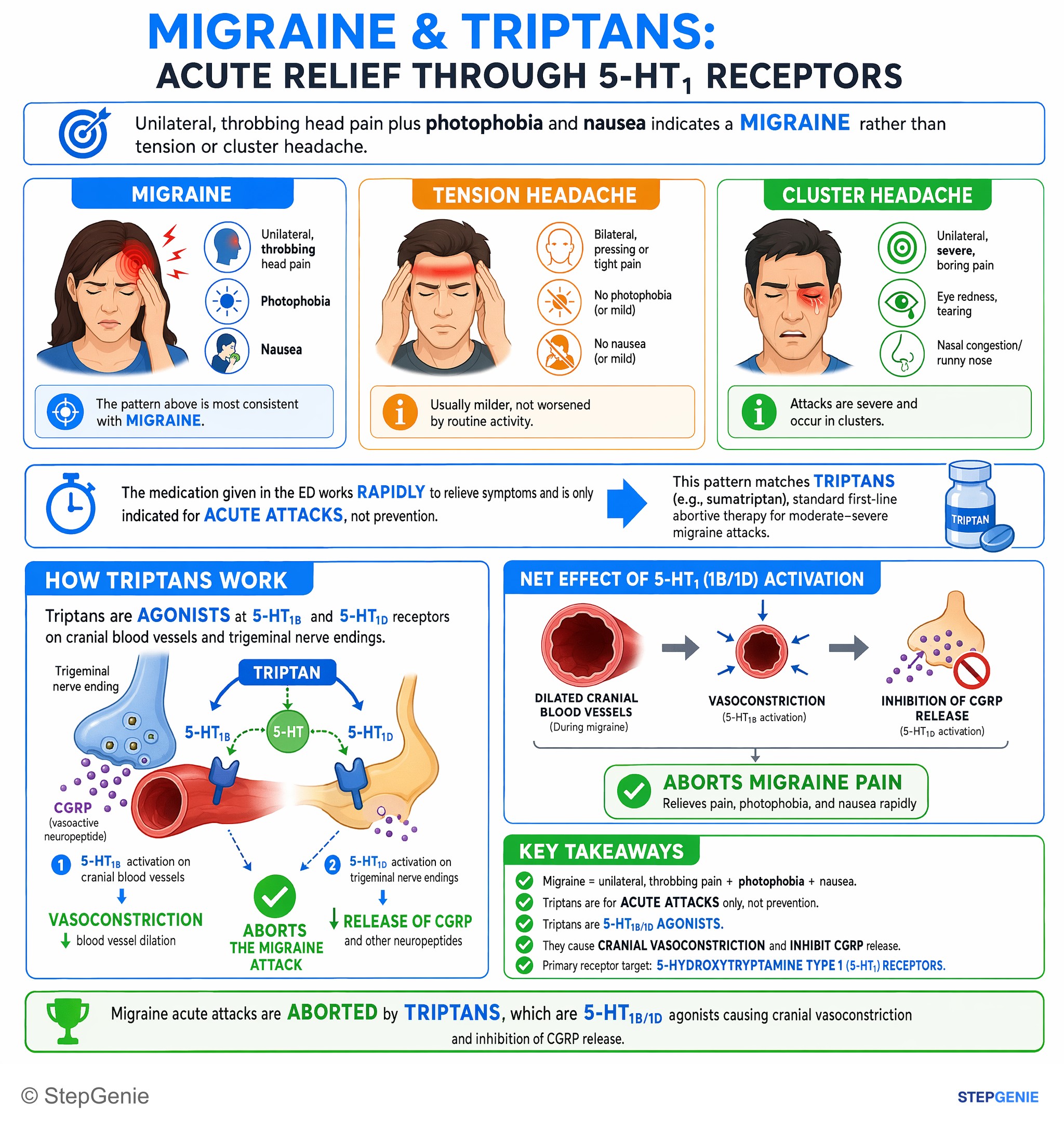
Migraine acute attacks are aborted by triptans, which are 5-HT1B/1D agonists causing cranial vasoconstriction and inhibition of CGRP…
USMLE Step 1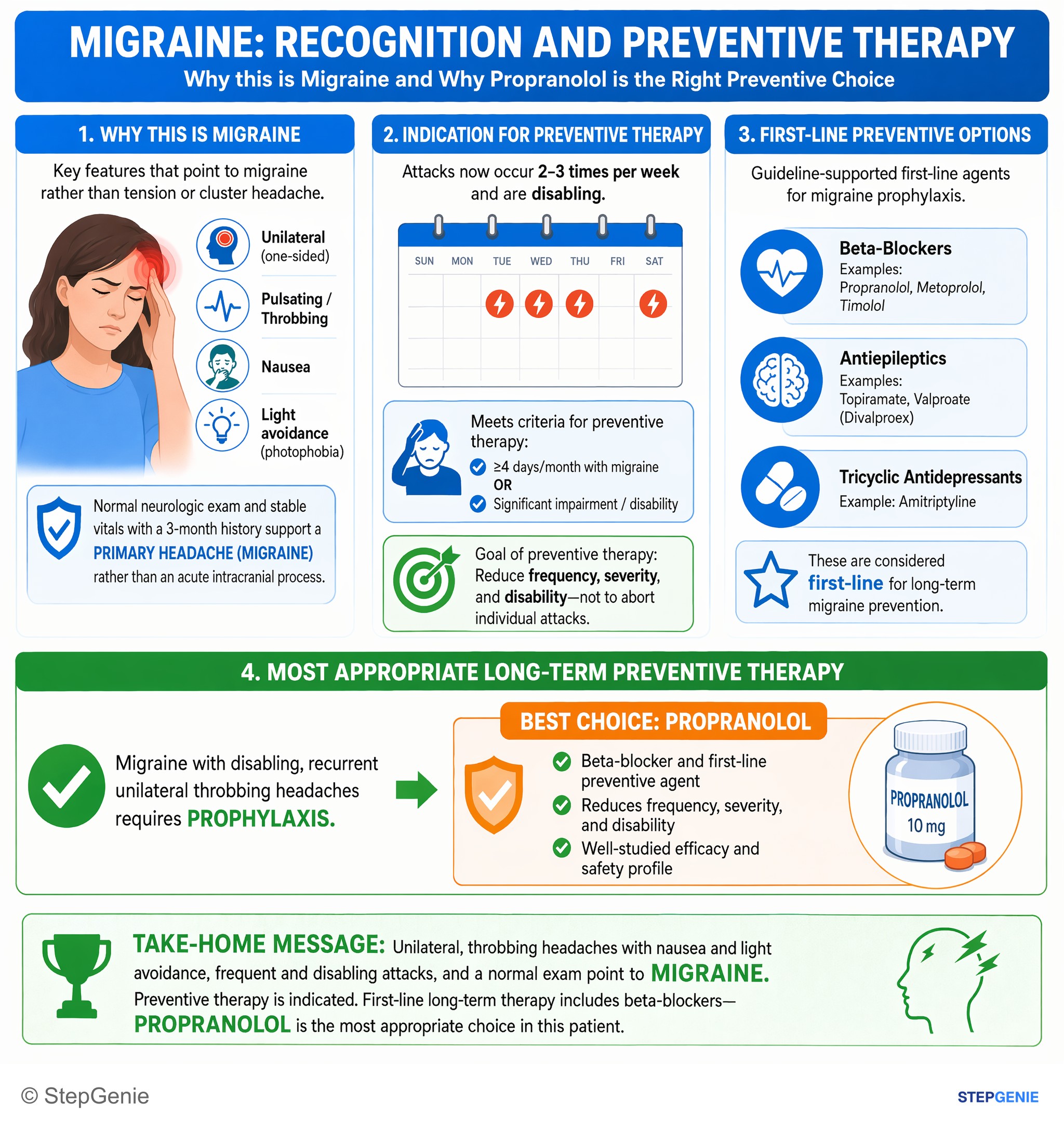
Migraine with disabling, recurrent unilateral throbbing headaches requires prophylaxis; first-line long-term preventive therapy includes…
USMLE Step 2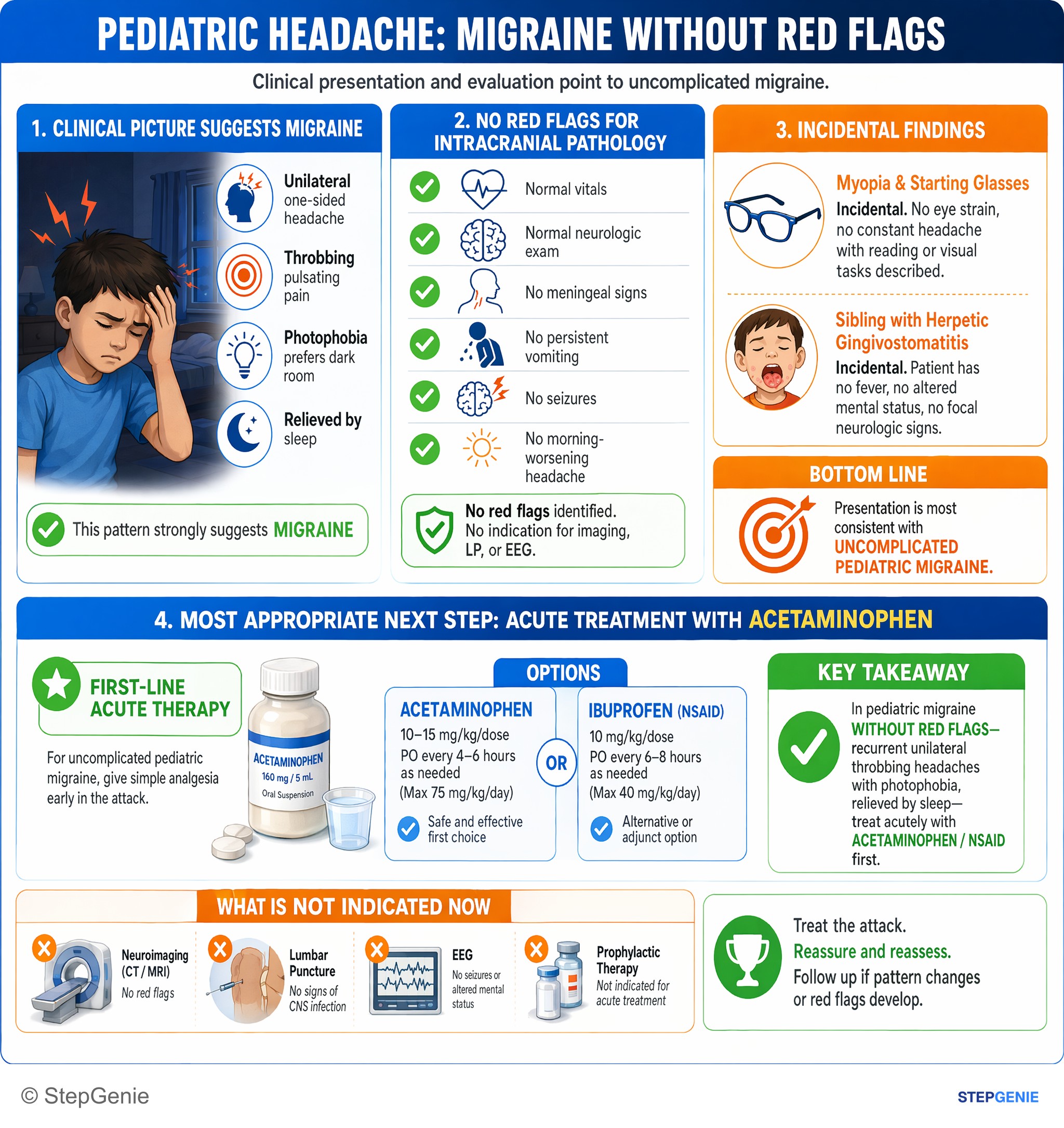
Pediatric migraine without red flags: recurrent unilateral throbbing headaches with photophobia, relieved by sleep → treat acutely with…
USMLE Step 2Frequently Asked Questions
How do you tell migraine from tension-type and cluster headache on a question stem?
Migraine is suggested by unilateral throbbing pain lasting 4 to 72 hours with nausea, photophobia or phonophobia, worsening with routine activity, and sometimes aura. Tension-type headache is usually bilateral, band-like pressure without nausea or vomiting and is not aggravated by activity. Cluster headache causes short attacks of severe unilateral periorbital or temporal pain with ipsilateral autonomic symptoms and a restless, pacing patient.
Why is visual aura a clue for migraine?
Visual aura points toward migraine because aura consists of focal neurologic symptoms, often visual, that develop gradually and last 5 to 60 minutes before the headache. Shimmering zig-zag lines beginning about 20 minutes before the pain fit this pattern. Aura is also associated with cortical spreading depression, which is a classic migraine mechanism tested on exams.
What is the first-line acute treatment for migraine, and when should you avoid triptans?
First-line acute treatment for migraine includes NSAIDs or acetaminophen, with triptans used for moderate to severe attacks. Triptans should be avoided in patients with significant coronary artery disease or vasospasm. The reason is that triptans and ergots cause vasoconstriction, which raises the risk of ischemia in those patients.
Why is cluster headache wrong if the patient wants to lie in a dark room?
Cluster headache is less likely because patients are typically restless and agitated during attacks, often pacing rather than lying quietly. Cluster attacks are also much shorter, usually 15 to 180 minutes, and are associated with ipsilateral autonomic symptoms such as lacrimation, conjunctival injection, rhinorrhea, nasal congestion, or ptosis and miosis. Wanting darkness and stillness fits migraine behavior much better.
How do you tell migraine from subarachnoid hemorrhage in a vignette?
Migraine causes recurrent stereotyped episodes that may be preceded by a gradual aura, whereas subarachnoid hemorrhage presents as a sudden thunderclap headache that is maximal at onset. SAH is often described as the worst headache of life and may include neck stiffness, vomiting, photophobia, or altered mental status. Recurrent monthly headaches with a normal neurologic exam between attacks support migraine instead.