Febrile seizures are one of those “you either know it cold or you overthink it” Step topics. Q-banks love them because the vignette feels scary (a seizing child!), but the management is usually reassuring—unless the stem quietly tells you this isn’t a simple febrile seizure. Let’s walk through a classic question and then dissect why every distractor is tempting—and why it’s wrong.
Clinical Vignette (Q-bank style)
A 20-month-old previously healthy boy is brought to the ED after a seizure at home. He developed a fever this morning and became fussy with rhinorrhea. His temperature is 39.4°C (102.9°F). Parents report the episode lasted about 2 minutes with generalized shaking of all extremities. He was sleepy afterward for 15 minutes but is now back to baseline, interactive, and drinking juice. No prior seizures. Vaccines up to date. Exam shows an erythematous tympanic membrane on the right; no neck stiffness, no focal neurologic deficits.
Question: What is the most appropriate next step?
Correct answer: Reassure parents; treat the fever/underlying infection; no neuroimaging or EEG is needed.
Why that’s the correct answer (and what makes it “simple”)
This stem screams simple febrile seizure:
Simple febrile seizure = ALL of the following
- Age: 6 months to 5 years
- Generalized (not focal)
- Duration < 15 minutes
- Occurs once in 24 hours
- No prior afebrile seizures or neurologic abnormalities
- Returns to baseline neurologic status (brief postictal sleepiness is fine)
High-yield management (Step-friendly)
- Supportive care: airway/breathing/circulation as needed (usually stable by the time you see them)
- Antipyretics for comfort (not proven to prevent recurrence)
- Treat the source (here: acute otitis media)
- No routine EEG, CT/MRI, labs, or lumbar puncture in a well-appearing, immunized child who returns to baseline
Prognosis pearls
- Excellent prognosis
- Recurrence risk is common (often quoted around 30%, higher with younger age, family history, and lower fever at onset)
- Epilepsy risk: slightly increased vs general population, but still low after a simple febrile seizure
The “Why Every Answer Choice Matters” Distractor Breakdown
Below are common answer choices that show up with this exact vignette—plus the clue that would make each one correct.
Distractor 1: Lumbar puncture to evaluate for meningitis
Why it’s tempting: Fever + seizure can equal CNS infection in your mind, and missing meningitis is disastrous.
Why it’s wrong here:
- Child is back to baseline
- No meningeal signs (no neck stiffness, no photophobia/irritability out of proportion)
- Immunizations up to date (reduces occult Hib/pneumococcal meningitis risk)
- Clear alternative source (AOM) and a classic simple febrile seizure pattern
When LP is the move (high-yield):
- Signs of meningitis/encephalitis (neck stiffness, persistent altered mental status, petechiae/purpura, bulging fontanelle, toxic appearance)
- Not fully immunized in the age group at risk
- Pretreated with antibiotics, which can mask meningitis signs
- Infants where exam is unreliable (especially younger infants—real-world nuance exists; Step questions usually give “toxic/ill-appearing” cues)
Distractor 2: EEG to assess for epilepsy
Why it’s tempting: Seizure = EEG, right?
Why it’s wrong here:
- EEG is not indicated after a simple febrile seizure
- EEG abnormalities don’t reliably predict recurrence or future epilepsy in this context
- It doesn’t change management in a classic case
When EEG becomes appropriate:
- Focal seizure features
- Multiple seizures within 24 hours
- Prolonged seizure (≥15 minutes)
- Persistent neurologic deficits or developmental delay
- Concern for an underlying epilepsy syndrome (e.g., afebrile seizures)
Distractor 3: Head CT or brain MRI
Why it’s tempting: People worry about intracranial pathology, especially with a “first-time seizure.”
Why it’s wrong here:
- Classic simple febrile seizure + normal neuro exam + quick return to baseline = no imaging
- CT adds radiation risk; MRI adds sedation/logistical burden
When neuroimaging is warranted:
- Focal neurologic deficits
- Suspicion of increased intracranial pressure (persistent vomiting, papilledema, worsening headache, depressed mental status)
- Head trauma
- Complex febrile seizure with concerning features (especially persistent focal findings)
Distractor 4: Start daily antiepileptic therapy (e.g., levetiracetam, valproate)
Why it’s tempting: “Prevent the next seizure.”
Why it’s wrong here:
- For simple febrile seizures, the risks and adverse effects outweigh benefits
- Febrile seizures are typically benign and self-limited
What you can do instead (more realistic/Step-relevant):
- Educate on seizure first aid and when to call EMS
- In select scenarios with recurrent prolonged febrile seizures, clinicians may prescribe rescue benzodiazepines (e.g., rectal diazepam) for home use—Step questions sometimes hint at this with repeated prolonged episodes.
Distractor 5: Give empiric antibiotics for meningitis right now
Why it’s tempting: Fear of missing bacterial meningitis.
Why it’s wrong here:
- No signs of meningitis and child is well-appearing
- Obvious localized infection (otitis media) explains fever; treat that appropriately
When empiric meningitis coverage is correct:
- Toxic appearance, petechiae/purpura, persistent AMS, seizures with meningeal signs
- In those cases: blood cultures + LP (if safe) + immediate antibiotics (don’t delay antibiotics if LP is delayed)
Distractor 6: “Febrile seizures are caused by electrolyte abnormalities—check a BMP urgently”
Why it’s tempting: Seizures can be caused by hyponatremia, hypoglycemia, etc.
Why it’s wrong here:
- The stem gives you a textbook febrile seizure presentation
- Routine labs are not indicated in an otherwise healthy child who returns to baseline
When labs matter:
- Persistent altered mental status
- Poor intake/dehydration, vomiting/diarrhea
- Suspicion of hypoglycemia/toxic ingestion
- Seizure without a clear fever source or atypical features
Quick Table: Simple vs Complex Febrile Seizures (Step 1/2 gold)
| Feature | Simple Febrile Seizure | Complex Febrile Seizure |
|---|---|---|
| Duration | < 15 min | ≥ 15 min |
| Type | Generalized | Focal and/or generalized |
| Frequency | 1 in 24 hours | >1 in 24 hours |
| Neuro status after | Returns to baseline | May have prolonged postictal state or deficits |
| Workup | Minimal; usually no EEG/imaging | Consider additional evaluation depending on signs |
Key exam move: If the seizure is complex, your threshold for further workup rises—but it’s still guided by the child’s appearance, neuro exam, and meningitis signs.
Parent Counseling: High-yield lines that match test logic
If asked what to tell parents, the “best answer” usually includes:
- These are common between 6 months and 5 years
- They do not usually cause brain damage
- Recurrence can happen, especially in the next 1–2 years
- Call EMS if:
- seizure lasts > 5 minutes
- repeated seizures occur
- child has persistent trouble breathing, cyanosis, or does not return to baseline
Seizure first aid (worth memorizing):
- Place child on their side, protect from injury
- Do not put anything in the mouth
- Time the seizure
Common “Gotchas” Q-banks use
1) Not actually febrile
If the child is afebrile or fever is minimal/absent, widen the differential:
- epilepsy, ingestion, metabolic derangements, CNS infection, trauma
2) Age outside the range
Febrile seizures outside 6 months–5 years should make you pause:
- consider CNS infection, epilepsy, metabolic issues
3) Focality and duration
A “febrile seizure” that’s focal, prolonged, or recurrent is complex until proven otherwise.
4) Persistent altered mental status
A child who is not returning to baseline suggests:
- meningitis/encephalitis
- ongoing subclinical seizure
- toxic/metabolic cause
Bottom Line (what Step wants you to do)
In a well-appearing 6-month to 5-year-old with a brief, generalized, single seizure in the setting of fever who returns to baseline, the correct move is:
- Reassurance + fever/trigger management
- No routine LP, EEG, labs, or neuroimaging
That’s the entire trick: know the definition, and you’ll stop ordering unnecessary—and incorrect—tests.
Visual explanations from the StepGenie QBank
Infographics StepGenie drew to explain questions in its own QBank, matched to this article's topic. Each caption is the takeaway of the question it explains.
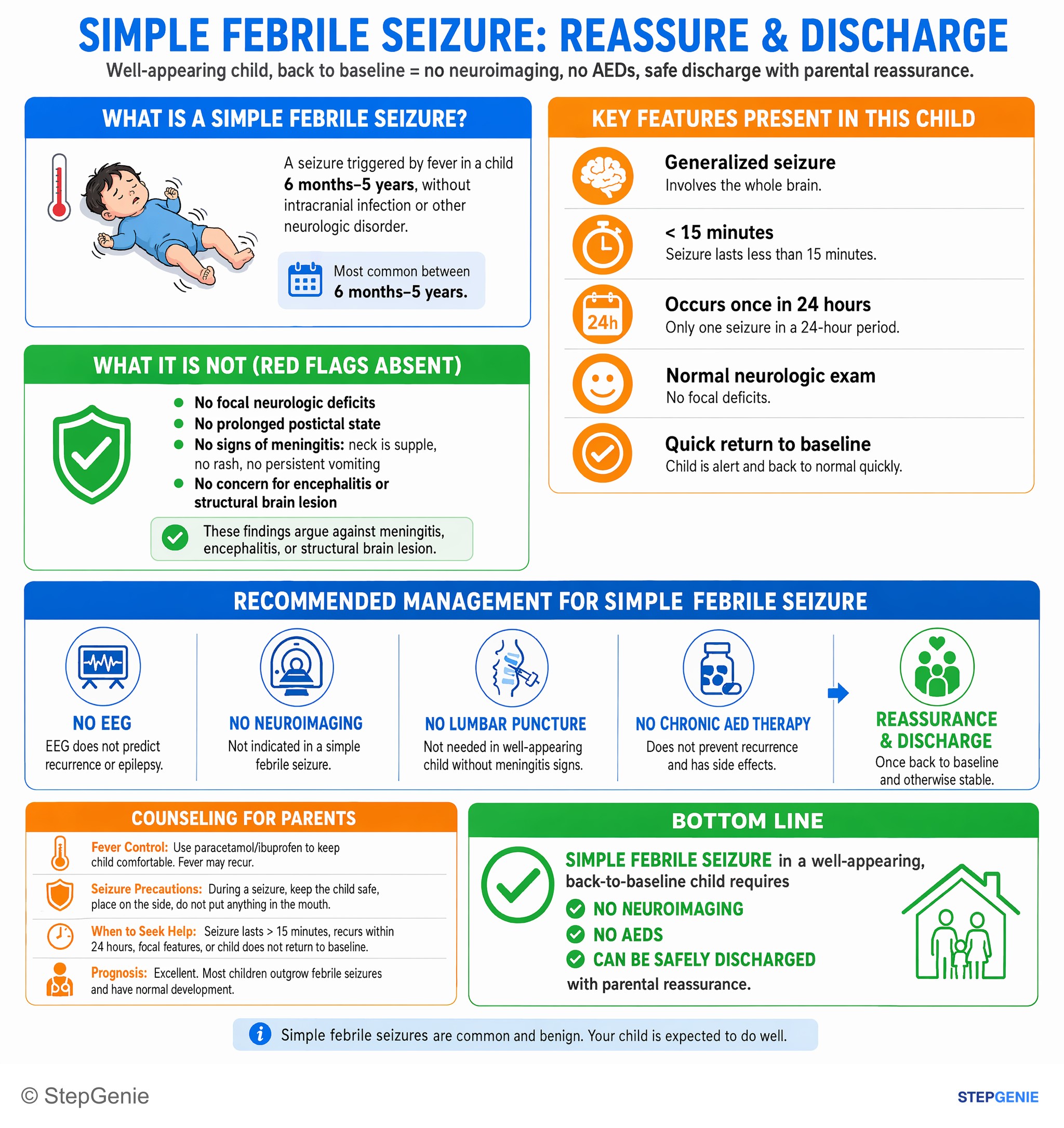
Simple febrile seizure in a well-appearing, back-to-baseline child requires **no neuroimaging, no AEDs, and can be safely discharged with…
USMLE Step 2Frequently Asked Questions
What is the next step for a simple febrile seizure in a well-appearing child?
The next step is reassurance, treatment of the fever and underlying infection, and no routine neuroimaging or EEG. A simple febrile seizure is defined by age 6 months to 5 years, generalized activity, duration under 15 minutes, occurring once in 24 hours, no prior afebrile seizures or neurologic abnormalities, and return to baseline afterward.
How do you tell a simple febrile seizure from a more concerning seizure on exam questions?
A simple febrile seizure is identified by a classic cluster of features: age 6 months to 5 years, generalized shaking, duration less than 15 minutes, only one seizure in 24 hours, no prior afebrile seizures or neurologic abnormalities, and return to baseline neurologic status. Focal features, multiple seizures in 24 hours, prolonged duration, or persistent deficits make the picture more concerning.
When should you do a lumbar puncture after a febrile seizure?
Lumbar puncture is indicated when meningitis or encephalitis is a concern, not for a classic simple febrile seizure in a well-appearing child. Clues that support LP include neck stiffness, persistent altered mental status, petechiae or purpura, bulging fontanelle, toxic appearance, incomplete immunizations, pretreatment with antibiotics that could mask signs, or infants in whom the exam is unreliable.
Do you need an EEG or head CT after a simple febrile seizure?
No, routine EEG and head CT or MRI are not needed after a simple febrile seizure. In a child with a normal neurologic exam and rapid return to baseline, these tests do not change management, and CT adds radiation while MRI adds sedation and logistical burden. They become appropriate when there are focal findings, prolonged seizures, repeated seizures, developmental concerns, trauma, or signs of increased intracranial pressure.
What is the prognosis after a simple febrile seizure, and should you start daily antiepileptic medication?
The prognosis is excellent, and daily antiepileptic therapy is not recommended for simple febrile seizures. Although recurrence is common and the risk of epilepsy is slightly increased compared with the general population, the overall epilepsy risk remains low after a simple febrile seizure. The risks and adverse effects of chronic antiseizure medication outweigh the benefits in this benign, self-limited condition.