Fibromyalgia is one of those “soft diagnosis” topics that shows up in Q-banks precisely because it forces you to reason clinically: normal labs, lots of symptoms, and answer choices that sound plausible if you don’t anchor on the core pattern. The trick isn’t memorizing a list—it’s recognizing the vignette and understanding why each distractor is wrong.
Tag: MSK > Bone & Joint Disorders
The Vignette (Q-bank style)
A 34-year-old woman comes to the clinic for 10 months of diffuse “aching all over” and profound fatigue. She says she wakes up unrefreshed and has trouble concentrating at work (“brain fog”). She also notes intermittent headaches and abdominal cramping with alternating constipation and diarrhea. She denies joint swelling, morning stiffness lasting > 1 hour, fevers, weight loss, or rash.
Exam shows diffuse tenderness to light palpation over the trapezius, lateral epicondyles, hips, and knees. There is no synovitis, erythema, or warmth. Strength is limited by pain but neurologic exam is normal.
Labs: CBC normal, CMP normal, ESR normal, CRP normal, TSH normal, CK normal. ANA negative.
Question: Which is the most appropriate initial management?
Answer choices:
A. Start duloxetine and recommend graded aerobic exercise and sleep hygiene
B. Start prednisone for suspected inflammatory arthritis
C. Start levothyroxine for subclinical hypothyroidism causing myalgias
D. Order EMG/NCS to evaluate for neuropathy
E. Start allopurinol for gout prophylaxis
F. Start hydroxychloroquine for systemic lupus erythematosus
Step-by-step: Why the Correct Answer Is Correct
✅ A. Duloxetine + graded exercise + sleep optimization (Correct)
This patient’s pattern is classic fibromyalgia:
- Chronic widespread pain (diffuse, non-articular tenderness)
- Fatigue + nonrestorative sleep
- Cognitive symptoms (“fibro fog”)
- Associated functional syndromes:
- IBS
- Tension-type or migraine headaches
- Normal inflammatory markers and no objective joint inflammation
Fibromyalgia is a central pain sensitization disorder (increased pain processing in CNS), not a peripheral inflammatory or muscle breakdown process—so labs are typically normal.
High-yield management (USMLE-style):
- First-line nonpharm:
- Graded aerobic exercise (strongest evidence)
- Sleep hygiene, CBT, stress reduction
- First-line pharmacologic options (if needed):
- SNRIs: duloxetine, milnacipran
- TCA: low-dose amitriptyline (often for sleep + pain)
- Gabapentinoids: pregabalin (neuropathic pain modulation)
- Avoid opioids (poor efficacy, worse outcomes), and avoid chronic benzos for sleep.
Pearl: Fibromyalgia is a diagnosis of pattern recognition. You don’t “confirm” it with labs—you use labs to exclude alternate diagnoses when indicated.
Why Every Distractor Is Wrong (and What It’s Trying to Trick You Into)
❌ B. Prednisone for suspected inflammatory arthritis
Why it’s tempting: diffuse pain makes people reach for “inflammation.”
Why it’s wrong here:
- No synovitis, no warm/swollen joints
- No prolonged morning stiffness > 1 hour
- ESR/CRP are normal
- Fibromyalgia pain is non-inflammatory; steroids don’t fix central sensitization
USMLE cue: Inflammatory arthritis (RA, psoriatic arthritis) = objective inflammation + morning stiffness + elevated inflammatory markers (often, not always). Fibromyalgia = tenderness + fatigue + normal labs.
❌ C. Levothyroxine for subclinical hypothyroidism causing myalgias
Why it’s tempting: hypothyroidism can cause fatigue, myalgias, weight gain, constipation.
Why it’s wrong here:
- TSH is normal
- Symptoms include brain fog + IBS + widespread tenderness without objective weakness—more consistent with fibromyalgia
- Hypothyroid myopathy tends to feature true proximal weakness and can have elevated CK
High-yield differential tip:
- Hypothyroidism: fatigue, cold intolerance, weight gain, constipation, bradycardia, dry skin; may see ↑TSH, ↓free T4; can see ↑CK
- Fibromyalgia: widespread pain + sleep disturbance + cognitive symptoms + normal CK/ESR/CRP
❌ D. EMG/NCS to evaluate for neuropathy
Why it’s tempting: “pain” and “tenderness” can be misread as nerve pain.
Why it’s wrong here:
- Neuropathy classically causes:
- Numbness/tingling
- Stocking-glove sensory loss
- Depressed reflexes
- Neuropathic burning pain
- This patient has diffuse tenderness and normal neuro exam—more consistent with central pain amplification, not peripheral nerve disease.
USMLE cue: EMG/NCS is for suspected peripheral neuropathy, radiculopathy, neuromuscular junction, or motor neuron disease—when neuro exam supports it.
❌ E. Allopurinol for gout prophylaxis
Why it’s tempting: joint pain = gout in the test-taker’s mind.
Why it’s wrong here:
- Gout is typically episodic, severe, and monoarticular (e.g., first MTP—podagra), with warmth/swelling
- Fibromyalgia is chronic and widespread with normal exam except tenderness
- Allopurinol is not started for nonspecific pain; it’s urate-lowering therapy with clear indications (recurrent flares, tophi, uric acid stones, CKD with high urate depending on context)
High-yield gout reminder:
- Acute flare: NSAIDs, colchicine, or steroids
- Prevention: allopurinol/febuxostat + flare prophylaxis at initiation (e.g., colchicine)
❌ F. Hydroxychloroquine for systemic lupus erythematosus
Why it’s tempting: fatigue + pain + female patient = “maybe lupus.”
Why it’s wrong here:
- No SLE clinical signs: malar rash, photosensitivity, oral ulcers, serositis, renal disease, cytopenias, inflammatory arthritis
- ANA is negative (highly sensitive; a negative makes SLE much less likely in typical presentations)
- Fibromyalgia can coexist with autoimmune disease, but this vignette doesn’t show autoimmune inflammation
USMLE nuance:
- SLE arthritis is typically inflammatory (pain + swelling), and labs may show cytopenias, proteinuria, +ANA/anti-dsDNA/anti-Smith depending on case.
How to Recognize Fibromyalgia Fast (USMLE Pattern)
Core clinical cluster
- Widespread musculoskeletal pain (both sides, above and below waist; often “hurts everywhere”)
- Fatigue
- Nonrestorative sleep
- Cognitive symptoms (“fibro fog”)
Supportive associations
- IBS
- Tension headaches / migraines
- Anxiety/depression (common comorbids)
What you don’t see
- Objective joint inflammation (synovitis)
- Weakness with abnormal neuro exam
- Lab evidence of inflammation or muscle breakdown (ESR/CRP/CK typically normal)
High-Yield Table: Fibromyalgia vs Common Look-Alikes
| Condition | Key Features | Labs/Exam | Treatment Clue |
|---|---|---|---|
| Fibromyalgia | Widespread pain + fatigue + poor sleep + cognitive symptoms; often IBS/headaches | Normal ESR/CRP/CK; no synovitis | Exercise + CBT; SNRI/TCA/pregabalin |
| Rheumatoid arthritis | Symmetric small-joint inflammatory arthritis; morning stiffness > 1 hr | Synovitis; often ↑ESR/CRP; RF/anti-CCP may be + | DMARDs (methotrexate); steroids as bridge |
| Polymyalgia rheumatica | Age > 50; proximal stiffness (shoulders/hips) | ↑ESR/CRP; rapid steroid response | Low-dose prednisone |
| Hypothyroidism | Fatigue, cold intolerance, constipation; can cause myalgias | ↑TSH, ↓free T4; possible ↑CK | Levothyroxine |
| Inflammatory myopathy (polymyositis/dermatomyositis) | True proximal muscle weakness > pain | ↑CK, abnormal EMG, biopsy | Immunosuppression |
| SLE | Multisystem; rash, serositis, nephritis, inflammatory arthritis | ANA usually +; cytopenias/proteinuria possible | Hydroxychloroquine baseline |
Test-Day Pitfalls (What Q-banks Love)
- “Tender points”: Older criteria emphasized them, but modern diagnosis is based on widespread pain index + symptom severity. Q-banks may still describe diffuse tenderness—use it as a clue, not a requirement.
- Normal labs don’t mean “nothing is wrong.” Fibromyalgia is real—just not inflammatory.
- Don’t chase zebras with big workups when the neuro and joint exams are normal and the symptom cluster is classic.
- Avoid opioids: if an answer choice offers chronic opioids for fibromyalgia, it’s almost always wrong.
Quick Takeaway (1-liner)
Fibromyalgia = chronic widespread pain + fatigue + nonrestorative sleep + cognitive symptoms with a normal exam aside from tenderness and normal inflammatory labs → treat with exercise/CBT and meds like duloxetine/amitriptyline/pregabalin.
Visual explanations from the StepGenie QBank
Infographics StepGenie drew to explain questions in its own QBank, matched to this article's topic. Each caption is the takeaway of the question it explains.
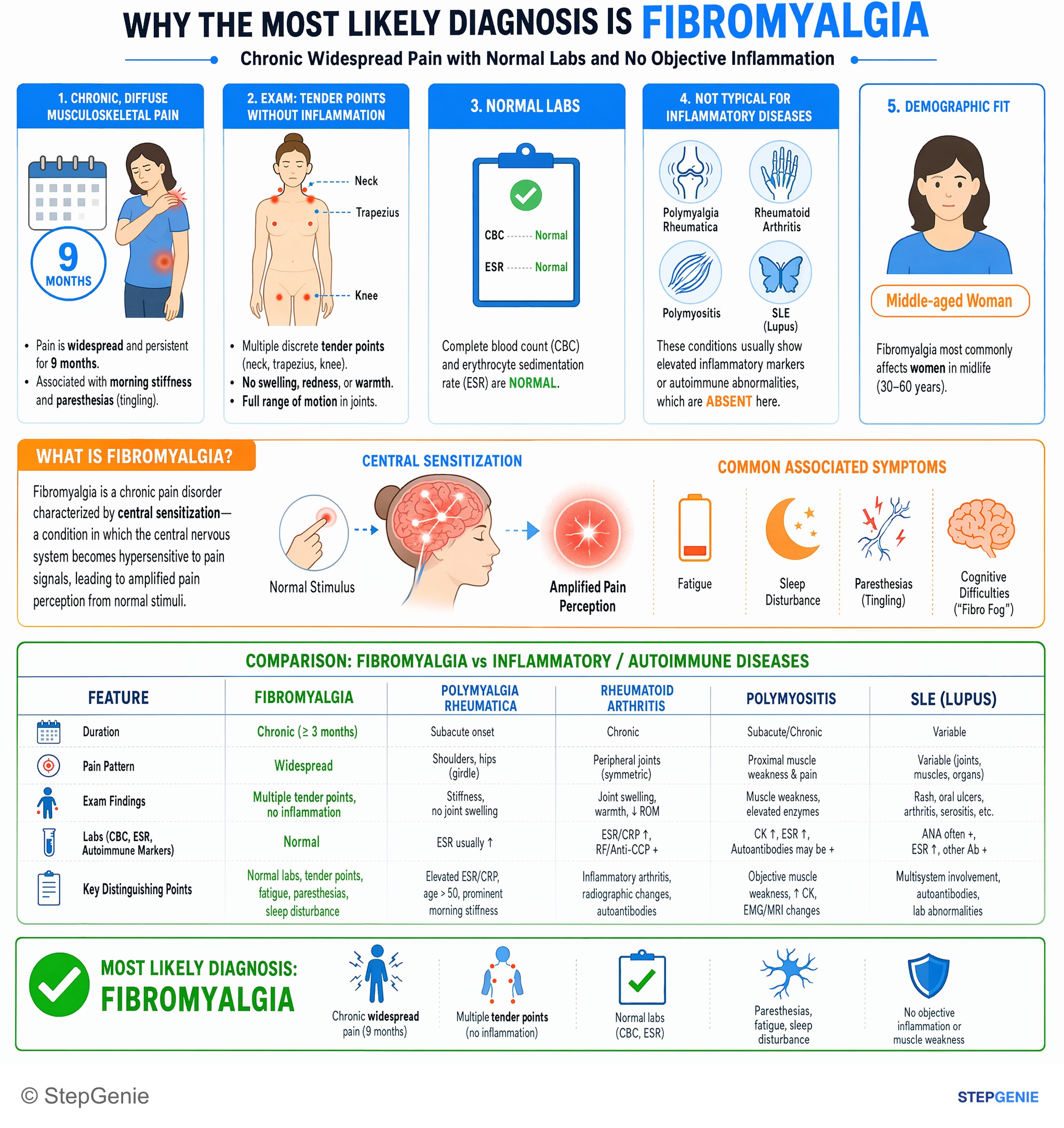
Fibromyalgia causes chronic widespread pain, tender points, and paresthesias with normal labs and no objective inflammatory or muscle…
USMLE Step 2Frequently Asked Questions
What is the most appropriate initial management for fibromyalgia in a classic vignette?
The most appropriate initial management is duloxetine along with graded aerobic exercise and sleep hygiene. Fibromyalgia presents with chronic widespread pain, fatigue, nonrestorative sleep, cognitive symptoms, and normal labs without objective inflammation. Graded aerobic exercise has the strongest evidence among nonpharmacologic treatments, and SNRIs such as duloxetine are first-line medication options when pharmacologic treatment is needed.
How do you recognize fibromyalgia on a question stem?
Fibromyalgia is recognized by chronic widespread non-articular pain plus fatigue, unrefreshing sleep, cognitive symptoms, and diffuse tenderness on exam with normal testing. Common associated clues include IBS and headaches. The key pattern is the absence of synovitis, warmth, erythema, neurologic deficits, or abnormal inflammatory markers, which helps distinguish it from inflammatory, muscular, or neurologic conditions.
Why are ESR, CRP, CK, and other labs usually normal in fibromyalgia?
ESR, CRP, CK, and other labs are usually normal in fibromyalgia because it is a central pain sensitization disorder rather than an inflammatory, muscle breakdown, or autoimmune process. The problem is increased pain processing in the central nervous system, not peripheral tissue injury. That is why patients can have significant widespread pain and fatigue despite normal inflammatory markers, thyroid testing, muscle enzymes, and autoimmune studies.
How do you tell fibromyalgia from inflammatory arthritis in a vignette?
Fibromyalgia is distinguished from inflammatory arthritis by diffuse tenderness without objective joint inflammation. Inflammatory arthritis typically has synovitis, warm or swollen joints, prolonged morning stiffness, and often elevated inflammatory markers. Fibromyalgia instead causes widespread pain, fatigue, sleep disturbance, and normal ESR and CRP. Steroids are not appropriate because fibromyalgia pain is non-inflammatory rather than driven by joint inflammation.
When is EMG or nerve conduction testing not the right next step for diffuse pain?
EMG and nerve conduction studies are not the right next step when diffuse pain occurs with a normal neurologic exam and the pattern fits fibromyalgia. Neuropathy more often causes numbness, tingling, stocking-glove sensory loss, depressed reflexes, or burning neuropathic pain. In fibromyalgia, the exam shows diffuse tenderness and pain-limited strength but no true neurologic deficits, which points to central pain amplification rather than peripheral nerve disease.