A scary but very “testable” moment on the wards (and in your Q-bank) is the patient with rapidly progressive, painful skin sloughing after a new medication. Stevens-Johnson syndrome (SJS) and toxic epidermal necrolysis (TEN) show up in vignettes because the diagnosis is pattern-based—and because the answer choices often include look-alike rashes where one key detail flips the entire management.
Tag: Dermatology > Skin Disorders
The Clinical Vignette (Q-bank style)
A 27-year-old man presents with 2 days of fever, malaise, and painful skin. One week ago, he started trimethoprim-sulfamethoxazole for a skin infection. Today he developed burning eye pain and painful oral ulcers. Exam shows dusky macules on the trunk that coalesce, with flaccid bullae and areas of epidermal detachment. Gentle lateral pressure causes sloughing of superficial skin (positive Nikolsky sign). Estimated involved body surface area (BSA) is ~20%.
Question: Most likely diagnosis?
Correct Answer: Stevens-Johnson Syndrome / Toxic Epidermal Necrolysis Spectrum
This is classic SJS/TEN, a life-threatening, medication-associated mucocutaneous reaction due to keratinocyte apoptosis (classically Fas–FasL–mediated, cytotoxic T-cell driven).
How to lock it in fast (exam pattern)
- Timing: Usually 1–3 weeks after starting a culprit drug (can be sooner with re-exposure)
- Prodrome: Fever, malaise, URI-like symptoms
- Skin: Painful (a huge clue), dusky/targetoid macules → bullae → sheet-like epidermal detachment
- Mucosa: Almost always involved (oral, ocular, genital)
- Nikolsky sign: Often positive (epidermis shears off with pressure)
SJS vs TEN: know the BSA cutoffs
| Entity | Epidermal detachment (BSA) |
|---|---|
| SJS | < 10% |
| SJS/TEN overlap | 10–30% |
| TEN | > 30% |
In the vignette, ~20% = SJS/TEN overlap.
High-Yield Etiology: The Usual Culprits
Medications are #1. Memorize the “high-risk list” because it’s basically free points.
Common triggers:
- Sulfonamides (TMP-SMX)
- Allopurinol
- Antiepileptics: lamotrigine, carbamazepine, phenytoin
- NSAIDs (especially oxicam class)
- Nevirapine (HIV)
Also possible:
- Mycoplasma pneumoniae (more often SJS-like, especially in children/young adults)
What the Next Step Looks Like (Management You’ll Be Tested On)
Immediate actions
- Stop the offending drug (most important intervention)
- Treat like a burn patient:
- ICU/burn unit care
- Aggressive fluids/electrolytes
- Wound care (nonadherent dressings)
- Pain control
- Temperature regulation
- Early ophthalmology consult (ocular involvement can cause long-term blindness)
- Infection surveillance (sepsis is a major cause of death), but avoid prophylactic antibiotics unless indicated
Adjunctive therapies (often tested as “controversial/center-dependent”)
Depending on institution and timing/severity:
- IVIG, cyclosporine, or TNF-α inhibitors may be used in some centers
(Boards tend to focus more on supportive care + stop drug than picking the “best immunotherapy.”)
Prognosis pearl
- TEN has a significant mortality; SCORTEN is a severity score used clinically.
Why Every Answer Choice Matters: Systematic Distractor Breakdown
Below are the common “trap” diagnoses that Q-banks love to place next to SJS/TEN—and the single best discriminator for each.
Distractor 1: Erythema Multiforme (EM)
Why it tempts you: “Target lesions” and sometimes mild mucosal symptoms.
How to distinguish:
- EM minor: target lesions, minimal/no mucosal involvement
- EM major: may involve mucosa but is typically less severe than SJS/TEN
- Lesions are true target lesions (3 zones) on extremities, often acral
- Common trigger: HSV (not usually high-risk meds)
Key board phrase:
- EM = HSV-associated target lesions, more acral, less skin sloughing.
Distractor 2: Bullous Pemphigoid
Why it tempts you: Bullae in an adult.
How to distinguish:
- Tense bullae (subepidermal) on erythematous/urticarial base
- Usually pruritic > painful
- Mucosal involvement is uncommon
- Nikolsky sign negative
- Path: IgG against hemidesmosomes (BP180/BP230)
- Linear IgG/C3 along basement membrane on immunofluorescence
Key board phrase:
- Bullous pemphigoid = tense, itchy, older patient, negative Nikolsky.
Distractor 3: Pemphigus Vulgaris
Why it tempts you: Painful erosions + mucosal involvement + Nikolsky can be positive.
How to distinguish from SJS/TEN:
- PV is chronic/insidious, not acute febrile illness after a new med
- Flaccid bullae and erosions, often starting in the oral mucosa
- Path: IgG against desmoglein (desmosomes) → intraepidermal acantholysis
- Immunofluorescence: “fishnet” intercellular IgG
Key board phrase:
- PV = chronic mucosal erosions + flaccid bullae; SJS/TEN = acute toxic patient after new drug.
Distractor 4: Staphylococcal Scalded Skin Syndrome (SSSS)
Why it tempts you: Skin sloughing + positive Nikolsky.
How to distinguish:
- Usually infants/young children (or renal failure/immunocompromised adults)
- Caused by exfoliative toxin from S. aureus
- No mucosal involvement (huge discriminator)
- Toxin targets desmoglein 1, mucosa spared (mucosa relies more on desmoglein 3)
Key board phrase:
- SSSS = kids, diffuse tenderness, mucosa spared.
Distractor 5: Fixed Drug Eruption
Why it tempts you: “Drug reaction” after starting a medication.
How to distinguish:
- One or a few well-demarcated dusky plaques (often lips/genitals)
- Re-exposure causes lesions to recur in the same location
- No large-scale epidermal detachment; systemic toxicity is minimal
Key board phrase:
- Fixed drug eruption = recurs at the same site, localized.
Distractor 6: DRESS Syndrome (Drug Reaction with Eosinophilia and Systemic Symptoms)
Why it tempts you: Severe drug reaction, systemic symptoms.
How to distinguish:
- Timing: typically 2–8 weeks after drug initiation (later than SJS/TEN)
- Morbilliform rash, facial edema
- Eosinophilia, atypical lymphocytes
- Organ involvement: hepatitis, nephritis, myocarditis, pneumonitis
- Less prominent skin sloughing; mucosal erosions are not the centerpiece
Key board phrase:
- DRESS = delayed, eosinophilia, organ damage.
Distractor 7: Toxic Shock Syndrome (TSS)
Why it tempts you: Fever + diffuse rash + sick patient.
How to distinguish:
- Diffuse erythematous “sunburn” rash with later desquamation of palms/soles
- Hypotension, multiorgan involvement
- Not primarily mucosal erosions with sheet-like detachment
Key board phrase:
- TSS = shock + sunburn rash; SJS/TEN = painful necrosis + mucosal erosions.
The “One-Minute” SJS/TEN Algorithm (Test Day)
- Painful rash + mucosal involvement + new med + toxic appearance → think SJS/TEN
- Confirm severity with BSA detachment
- Stop the drug immediately
- Burn-unit supportive care + ophthalmology early
Micro/Path Pearls That Show Up in Explanations
- Mechanism: CD8+ T-cell mediated keratinocyte apoptosis; Fas–FasL often cited
- Histology: Full-thickness epidermal necrosis with subepidermal split
- Complications: sepsis, fluid loss, ARDS, ocular scarring/synechiae, strictures
Quick Comparison Table (High Yield)
| Condition | Bullae? | Nikolsky | Mucosa? | Typical trigger/patient | Key clue |
|---|---|---|---|---|---|
| SJS/TEN | Yes (flaccid) + sloughing | + | Yes | New high-risk med; toxic | Painful dusky macules, epidermal detachment |
| EM | Sometimes | Usually − | Sometimes (mild) | HSV | True target lesions, acral |
| Pemphigus vulgaris | Yes (flaccid) | + | Yes | Autoimmune | Chronic course; “fishnet” IF |
| Bullous pemphigoid | Yes (tense) | − | Rare | Older adults | Itchy urticarial base; linear IF |
| SSSS | Yes (superficial slough) | + | No | Infants/kids; S. aureus toxin | Mucosa spared |
| DRESS | No (usually) | − | Not prominent | 2–8 w after drug | Eosinophilia + organ involvement |
Takeaway
SJS/TEN isn’t just “a bad rash”—it’s a medical emergency defined by painful skin, mucosal involvement, epidermal detachment, and a recent high-risk medication. Q-banks test it by surrounding it with close cousins. If you train yourself to ask “Is it painful? Are mucosa involved? Is there detachment? What’s the timing?”, you’ll pick the right answer—and understand exactly why the others are wrong.
Visual explanations from the StepGenie QBank
Infographics StepGenie drew to explain questions in its own QBank, matched to this article's topic. Each caption is the takeaway of the question it explains.
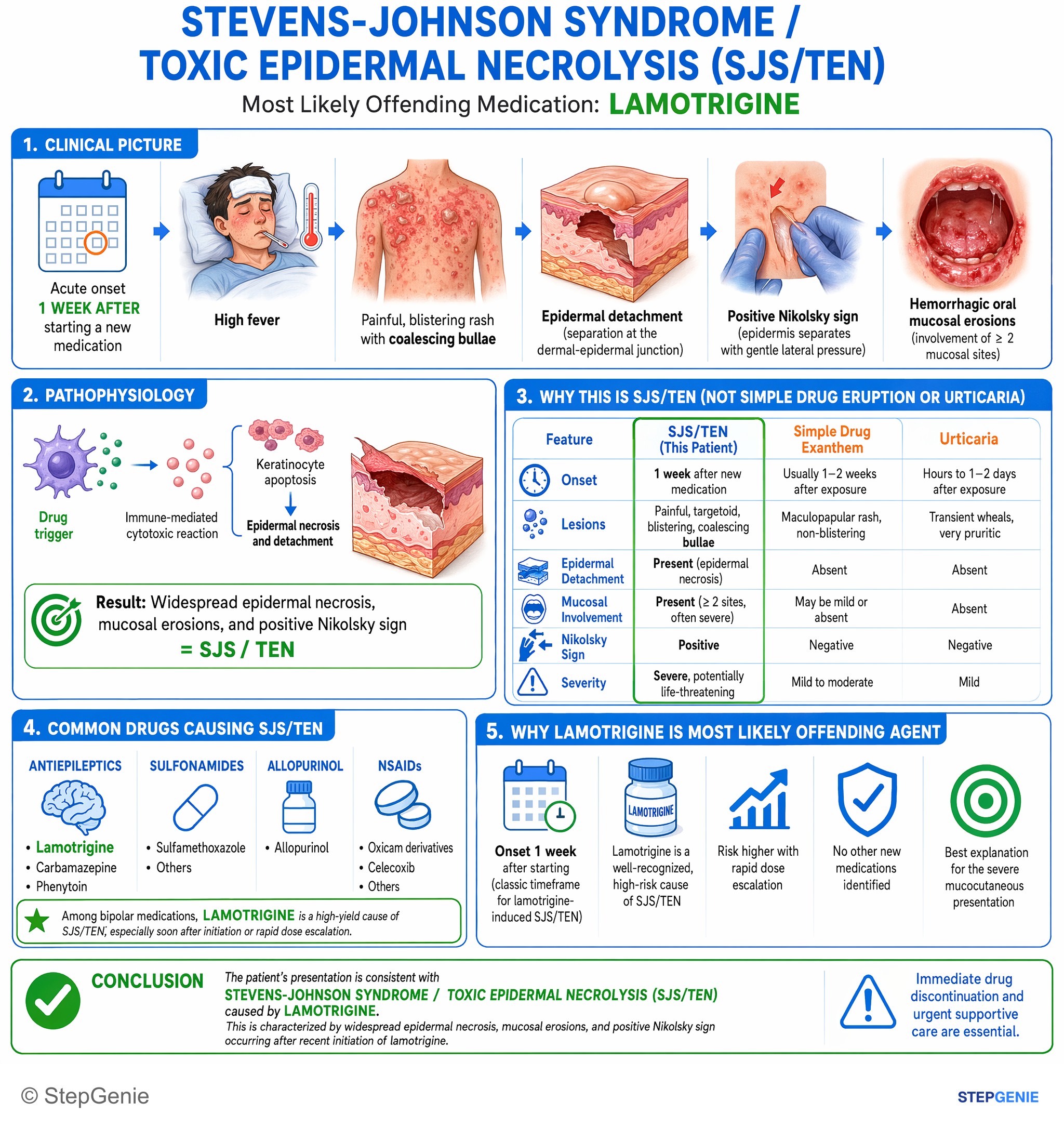
Stevens-Johnson syndrome/toxic epidermal necrolysis from lamotrigine: widespread epidermal necrosis, mucosal erosions, positive Nikolsky…
USMLE Step 1Frequently Asked Questions
How do you recognize Stevens-Johnson syndrome or TEN on a vignette?
Stevens-Johnson syndrome and TEN are recognized by an acute, painful mucocutaneous reaction after a new medication. The classic pattern is fever and malaise followed 1 to 3 weeks after drug exposure by painful dusky or targetoid macules, bullae, sheet-like epidermal detachment, mucosal involvement such as oral or ocular lesions, and often a positive Nikolsky sign.
What body surface area cutoff separates SJS from TEN?
The distinction is based on epidermal detachment by body surface area. Stevens-Johnson syndrome involves less than 10%, SJS/TEN overlap involves 10 to 30%, and toxic epidermal necrolysis involves more than 30%. A patient with about 20% body surface area involvement fits the SJS/TEN overlap category rather than pure SJS or pure TEN.
What is the first step in management of SJS/TEN?
The most important first step is to stop the offending drug immediately. Management then focuses on supportive care similar to burn treatment, including ICU or burn unit care, fluids and electrolyte management, wound care, pain control, temperature regulation, early ophthalmology consultation for eye involvement, and infection surveillance while avoiding prophylactic antibiotics unless indicated.
How do you tell SJS/TEN from erythema multiforme or staphylococcal scalded skin syndrome?
Mucosal involvement and overall severity are key clues. SJS/TEN almost always involves mucosa and causes painful skin sloughing in a toxic-appearing patient, often after a medication. Erythema multiforme is more often HSV-associated, has true target lesions on the acral extremities, and less skin sloughing. Staphylococcal scalded skin syndrome usually occurs in children and spares the mucosa.
Which drugs are high-yield triggers for SJS/TEN?
Medications are the highest-yield triggers, especially sulfonamides, allopurinol, certain antiepileptics, some NSAIDs, and nevirapine. Classic culprits include trimethoprim-sulfamethoxazole, lamotrigine, carbamazepine, and phenytoin. Mycoplasma pneumoniae can also cause an SJS-like picture, especially in children and young adults, but medications are the main association to remember.