Rosacea questions feel “easy” until you miss one because you ignored a single word like flushing or telangiectasias. USMLE-style derm vignettes love rosacea because it sits at the crossroads of acne, seb derm, lupus, and contact dermatitis—so the wrong answers are usually plausible. Let’s break it down like a Q-bank explanation where every answer choice earns (or loses) points.
Tag: Dermatology > Skin Disorders
The Clinical Vignette (USMLE Style)
A 34-year-old woman presents with episodic facial flushing and “acne-like bumps” for 8 months. Symptoms worsen after hot coffee, spicy foods, and red wine. Exam shows central facial erythema over the cheeks and nose with telangiectasias and scattered papules/pustules. No comedones are seen. She reports a gritty sensation in her eyes.
Most likely diagnosis?
A. Acne vulgaris
B. Rosacea
C. Seborrheic dermatitis
D. Systemic lupus erythematosus (malar rash)
E. Allergic contact dermatitis
Correct Answer: B. Rosacea
Why this is rosacea
Key words and exam clues:
- Central face involvement (cheeks, nose, chin, forehead)
- Flushing triggered by:
- heat, hot beverages, spicy foods
- alcohol (classically red wine)
- emotion/stress, sunlight
- Telangiectasias + persistent erythema
- Papules/pustules that look acneiform but without comedones
- Ocular symptoms: gritty eyes, burning, blepharitis, conjunctivitis
Core path + phenotype (what USMLE wants you to recognize)
Rosacea is a chronic inflammatory disorder with vascular hyperreactivity. Presentations often overlap:
| Rosacea feature | What you see | High-yield clue |
|---|---|---|
| Erythematotelangiectatic | Flushing, persistent erythema, telangiectasias | “Blushes easily,” red wine trigger |
| Papulopustular | Papules/pustules on central face | No comedones |
| Phymatous | Thickened skin, irregular surface | Rhinophyma (nose) |
| Ocular | Grittiness, dryness, blepharitis | Can be the main complaint |
High-yield treatment framework (Step-friendly)
- Trigger avoidance + skin care
- sunscreen, gentle cleansers
- avoid heat, alcohol, spicy foods if they trigger flares
- Topicals (mild to moderate)
- metronidazole
- azelaic acid
- ivermectin (esp if Demodex-associated inflammation suspected)
- brimonidine or oxymetazoline for erythema (alpha-agonists → vasoconstriction)
- Oral therapy (papulopustular/moderate-severe)
- doxycycline (often sub-antimicrobial dosing for anti-inflammatory effect)
- Procedures
- vascular lasers for telangiectasias/erythema
- surgery/laser for rhinophyma
Exam pearl: Rosacea is commonly associated with ocular involvement and rhinophyma; “adult acne” that flushes and has telangiectasias is usually rosacea.
Why Each Distractor Is Wrong (and When It Would Be Right)
A. Acne vulgaris
Why it’s wrong here
- Acne has comedones:
- open comedones (blackheads)
- closed comedones (whiteheads)
- Triggers like hot drinks/alcohol causing flushing are not classic for acne.
- Telangiectasias + persistent erythema point away from acne.
When acne would be right
- Teen/young adult with lesions on face, chest, back
- Mixed comedones + inflammatory papules/pustules/nodules
USMLE treatment anchors
- Topical retinoids (adapalene, tretinoin)
- Benzoyl peroxide ± topical antibiotics
- Oral doxy/mino for moderate inflammatory acne
- Isotretinoin for severe nodulocystic acne (monitor teratogenicity, lipids, LFTs; mood warnings)
C. Seborrheic dermatitis
Why it’s wrong here
- Seb derm is about greasy scale in sebaceous areas:
- scalp (“dandruff”)
- eyebrows, nasolabial folds
- postauricular area, presternal chest
- Rosacea can involve nasolabial region too, but seb derm usually has prominent scaling rather than flushing/telangiectasias and pustules.
When seb derm would be right
- Itchy erythematous patches with greasy yellow scale
- Infant: cradle cap
- Associations: Parkinson disease, HIV (more severe/refractory)
USMLE treatment anchors
- Ketoconazole shampoo/cream
- Low-potency topical steroids short course for flares
- Calcineurin inhibitors (tacrolimus/pimecrolimus) as steroid-sparing options
D. Systemic lupus erythematosus (malar rash)
Why it’s wrong here
- Lupus malar rash is classically:
- photosensitive
- malar distribution but spares the nasolabial folds
- typically no pustules
- This vignette highlights pustules, telangiectasias, and food/alcohol triggers—more rosacea.
When SLE would be right
- Facial rash + systemic signs:
- arthralgias, oral ulcers, serositis, nephritis
- Labs: ANA (sensitive), anti-dsDNA/anti-Smith (specific), low complement in active disease
USMLE visual pearl
- Rosacea: central facial erythema often includes nasolabial folds; papules/pustules may be present.
- SLE malar rash: erythema over cheeks/bridge of nose, typically spares nasolabial folds, no acneiform pustules.
E. Allergic contact dermatitis
Why it’s wrong here
- Allergic contact dermatitis (type IV hypersensitivity) is usually:
- intensely pruritic
- well-demarcated to exposure area
- may have vesicles/oozing/crusting
- Rosacea is more about flushing + central face erythema + papules/pustules, often with burning/stinging rather than dramatic itch.
When allergic contact dermatitis would be right
- History of new product/exposure:
- cosmetics, fragrances, nickel, poison ivy (urushiol), topical antibiotics (neomycin)
- Delayed onset (24–72 hours after exposure)
USMLE mechanism + testing
- Type IV (T-cell mediated) delayed hypersensitivity
- Diagnosis supported by patch testing (not prick testing)
Rapid-Fire High-Yield Differentiation Table
| Condition | Key lesion(s) | Key clue(s) | Comedones? | Typical distribution |
|---|---|---|---|---|
| Rosacea | Erythema, telangiectasias, papules/pustules | Flushing triggers; ocular symptoms | No | Central face |
| Acne vulgaris | Comedones ± papules/pustules/nodules | Teen/young adult; oiliness | Yes | Face, chest, back |
| Seb derm | Erythema with greasy scale | Dandruff; nasolabial folds + scalp | No | Scalp, face folds, chest |
| SLE malar rash | Erythematous “butterfly” rash | Photosensitivity; systemic symptoms | No | Cheeks/bridge; spares nasolabial folds |
| Allergic contact dermatitis | Pruritic erythema ± vesicles | New exposure; well-demarcated | No | Exposure pattern |
Exam-Day Takeaways (What to Circle in the Stem)
- Rosacea = flushing + telangiectasias + central face + no comedones.
- Think ocular rosacea when you see gritty eyes/blepharitis.
- Triggers (hot drinks, spicy foods, alcohol, heat, sun) are not filler—they’re diagnostic.
- Rhinophyma is a rosacea complication (phymatous rosacea), not “alcoholic nose” on exams.
- First-line therapies to remember: topical metronidazole, azelaic acid, ivermectin, and oral doxycycline.
Visual explanations from the StepGenie QBank
Infographics StepGenie drew to explain questions in its own QBank, matched to this article's topic. Each caption is the takeaway of the question it explains.
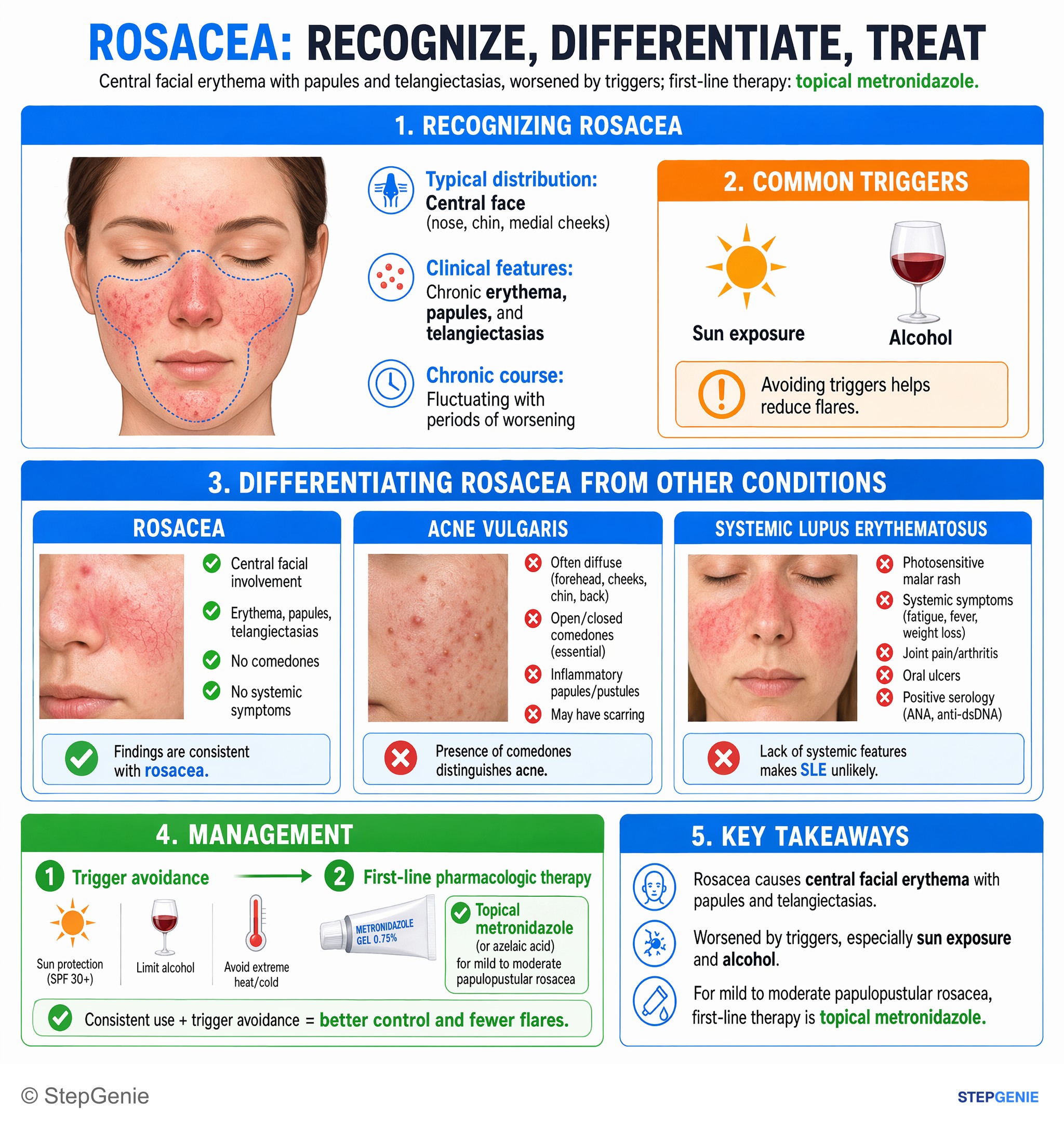
Rosacea causes central facial erythema with papules and telangiectasias, worsened by triggers; first-line pharmacologic therapy is topical…
USMLE Step 2Frequently Asked Questions
How do you tell rosacea from acne vulgaris on a vignette?
Rosacea is suggested by central facial erythema with telangiectasias and papules or pustules without comedones. It also often features episodic flushing triggered by heat, hot beverages, spicy foods, alcohol, stress, or sunlight. Acne vulgaris instead classically has open or closed comedones and more often involves the face, chest, and back rather than a flushing-predominant central facial pattern.
Why do hot coffee, spicy foods, and red wine trigger rosacea flares?
They trigger rosacea because rosacea is a chronic inflammatory disorder with vascular hyperreactivity. That vascular tendency makes patients flush easily, especially with heat, hot beverages, spicy foods, alcohol, emotion or stress, and sunlight. On exam, this often shows up as persistent central facial erythema and telangiectasias, which are classic clues pointing to rosacea rather than other acneiform conditions.
What eye symptoms can happen with rosacea?
Rosacea can cause ocular involvement, including gritty eyes, burning, blepharitis, and conjunctivitis. Ocular symptoms may even be the main complaint, so eye discomfort alongside central facial flushing, erythema, telangiectasias, or papules and pustules should raise suspicion for rosacea. This association is a high-yield clue because it helps distinguish rosacea from acne vulgaris and several other facial rashes.
What is the first-line treatment approach for rosacea?
The first step is trigger avoidance and gentle skin care. Patients should use sunscreen and gentle cleansers and avoid heat, alcohol, and spicy foods if these provoke flares. For mild to moderate disease, common topical options are metronidazole, azelaic acid, or ivermectin, while brimonidine or oxymetazoline can help erythema through vasoconstriction. More papulopustular or moderate to severe cases may need oral doxycycline.
How do you tell rosacea from an SLE malar rash?
Rosacea is favored when there is central facial erythema with telangiectasias and papules or pustules, especially with flushing triggered by foods or alcohol. SLE malar rash is classically photosensitive, usually spares the nasolabial folds, and typically does not have pustules. If the presentation also includes systemic features like arthralgias, oral ulcers, serositis, or nephritis, SLE becomes more likely.