Acne questions feel “easy” until the vignette forces you to separate acne vulgaris from look-alikes (and from complications of treatment). The trick on USMLE isn’t memorizing one-line descriptions—it’s understanding why each answer choice is tempting and what single clue rules it in or out.
Tag: Dermatology > Skin Disorders
The Clinical Vignette (Q-bank style)
A 16-year-old girl presents with a 1-year history of facial “breakouts” that worsen around her menstrual periods. She has multiple open and closed comedones with scattered erythematous papules and pustules on the cheeks and forehead. No fever, no systemic symptoms. She uses an over-the-counter face wash. Exam shows no perioral scaling, no telangiectasias, and no lesions on the palms/soles.
Which of the following is the most appropriate initial therapy?
A. Oral doxycycline
B. Topical clindamycin monotherapy
C. Topical tretinoin + benzoyl peroxide
D. Oral isotretinoin
E. Topical ketoconazole shampoo used as a face wash
Correct Answer: C. Topical tretinoin + benzoyl peroxide
This vignette is classic mild-to-moderate acne vulgaris: comedones (open/closed) + inflammatory lesions (papules/pustules) in a teen, often hormonally influenced.
Why this combo is first-line
Acne pathogenesis has 4 core mechanisms—and the best regimens cover more than one:
| Pathogenic factor | High-yield mechanism | Treatment that targets it |
|---|---|---|
| Follicular hyperkeratinization | Microcomedone formation | Topical retinoids (tretinoin, adapalene, tazarotene) |
| Increased sebum | Androgen-driven | Combined OCPs, spironolactone (selected patients) |
| Cutibacterium acnes proliferation | Pro-inflammatory milieu | Benzoyl peroxide, topical/oral antibiotics |
| Inflammation | Cytokine-mediated | Retinoids, antibiotics, BPO |
Topical retinoid + benzoyl peroxide (BPO) is a high-yield foundational regimen because:
- Retinoids normalize desquamation → treat and prevent comedones (key clue in acne vulgaris).
- BPO is bactericidal (free radicals) and helps prevent antibiotic resistance when antibiotics are used later.
Practical USMLE pearls (and real-life counseling)
- Retinoids can cause irritation, dryness, photosensitivity → start every other night, use moisturizer, sunscreen.
- BPO bleaches fabric (pillowcases, towels)—classic counseling detail.
- Expect improvement in ~6–8 weeks; maximal benefit often by 12 weeks.
Why Each Distractor Matters (and when it would be right)
A. Oral doxycycline
Tempting because tetracyclines are commonly used for acne—but this is not first-line for acne that can be managed topically.
When doxycycline is appropriate
- Moderate to severe inflammatory acne (numerous papules/pustules, nodules) or truncal involvement
- Failure of adequate topical therapy
High-yield antibiotic rules
- Never use oral (or topical) antibiotics as monotherapy for acne—pair with benzoyl peroxide to reduce resistance.
- Tetracyclines adverse effects:
- Photosensitivity
- Esophagitis (take with water, stay upright)
- Teeth discoloration + inhibited bone growth → avoid in pregnancy and children <8
- Vestibular toxicity (esp. minocycline)
Step-style trap: If the question stem includes “currently pregnant,” doxycycline is wrong; think azelaic acid or certain topical agents depending on severity.
B. Topical clindamycin monotherapy
This option is bait for “treat bacteria → treat acne.” But topical antibiotics alone quickly select resistant organisms.
When topical clindamycin is appropriate
- As part of combination therapy, typically:
- Clindamycin + benzoyl peroxide
- Often with a retinoid as well in mixed acne (comedonal + inflammatory)
High-yield point: Any acne regimen that includes an antibiotic should almost always include benzoyl peroxide.
D. Oral isotretinoin
Isotretinoin is the “nuclear option” and is extremely effective—but you reserve it for the right scenario.
When isotretinoin is appropriate
- Severe nodulocystic acne
- Acne causing scarring
- Refractory acne after adequate combination therapy (topicals ± oral antibiotics)
- Significant psychosocial distress with severe disease (context matters)
USMLE must-knows
- Teratogenicity: iPLEDGE, 2 forms of contraception, monthly pregnancy tests
- Adverse effects:
- Dry skin/cheilitis, epistaxis
- Hypertriglyceridemia (pancreatitis risk)
- Hepatotoxicity (monitor LFTs)
- Musculoskeletal aches
- Controversies: mood changes/depression are commonly tested conceptually, though causality is debated—still fair game as a counseling point.
Clue it’s not isotretinoin here: The stem describes comedones + mild inflammatory lesions, not nodules/cysts/scarring.
E. Topical ketoconazole shampoo used as a face wash
This is a smart distractor because fungal folliculitis can mimic acne. But the stem has a big giveaway: comedones.
When ketoconazole is appropriate
- Malassezia (Pityrosporum) folliculitis:
- Monomorphic itchy follicular papules/pustules
- Often on upper chest/back/shoulders, sometimes forehead
- No comedones
- Often worsens with antibiotics (since they alter flora)
Key distinguishing features
- Acne vulgaris: comedones + polymorphic lesions (comedones, papules, pustules, nodules)
- Malassezia folliculitis: itchy, uniform lesions, no comedones; responds to antifungals
Quick Differentials: How USMLE “acne” questions try to trick you
Acne vulgaris vs rosacea vs perioral dermatitis
| Condition | Hallmark clues | Comedones? | Typical triggers | Go-to treatments |
|---|---|---|---|---|
| Acne vulgaris | Comedones ± papules/pustules | Yes | Androgens, occlusion, some meds | Retinoid, BPO ± antibiotics |
| Rosacea | Flushing, erythema, telangiectasias, papules/pustules | No | Heat, alcohol, spicy foods | Topical metronidazole, azelaic acid; doxycycline |
| Perioral dermatitis | Perioral papules with sparing of vermillion border, often after topical steroids | No | Topical steroids, heavy cosmetics | Stop steroids; topical metronidazole/erythromycin; doxycycline if needed |
High-yield one-liner: Comedones = acne until proven otherwise.
High-Yield “Next Step” Algorithm (Step-friendly)
Start with severity
- Comedonal acne (mild): topical retinoid (± BPO)
- Mild inflammatory: topical retinoid + BPO (± topical antibiotic if needed)
- Moderate inflammatory: topical regimen + oral doxy/mino (always with BPO)
- Severe nodulocystic/scarring: isotretinoin
Add hormonal therapy when appropriate
Especially in females with:
- Cyclic flares, jawline distribution, signs of hyperandrogenism
Options:
- Combined OCPs (decrease ovarian androgen production)
- Spironolactone (androgen receptor blocker)
- Watch for hyperkalemia, gynecomastia (more in males), menstrual irregularities
- Avoid in pregnancy (antiandrogen effects)
Key Takeaways (what the exam wants you to say)
- Acne vulgaris is defined by comedones.
- First-line for mild-to-moderate acne: topical retinoid + benzoyl peroxide.
- Avoid antibiotic monotherapy (topical or oral); pair with benzoyl peroxide.
- Isotretinoin is for severe, scarring, or refractory acne and is highly teratogenic.
- If lesions are monomorphic + itchy + no comedones, think Malassezia folliculitis → antifungals.
Visual explanations from the StepGenie QBank
Infographics StepGenie drew to explain questions in its own QBank, matched to this article's topic. Each caption is the takeaway of the question it explains.
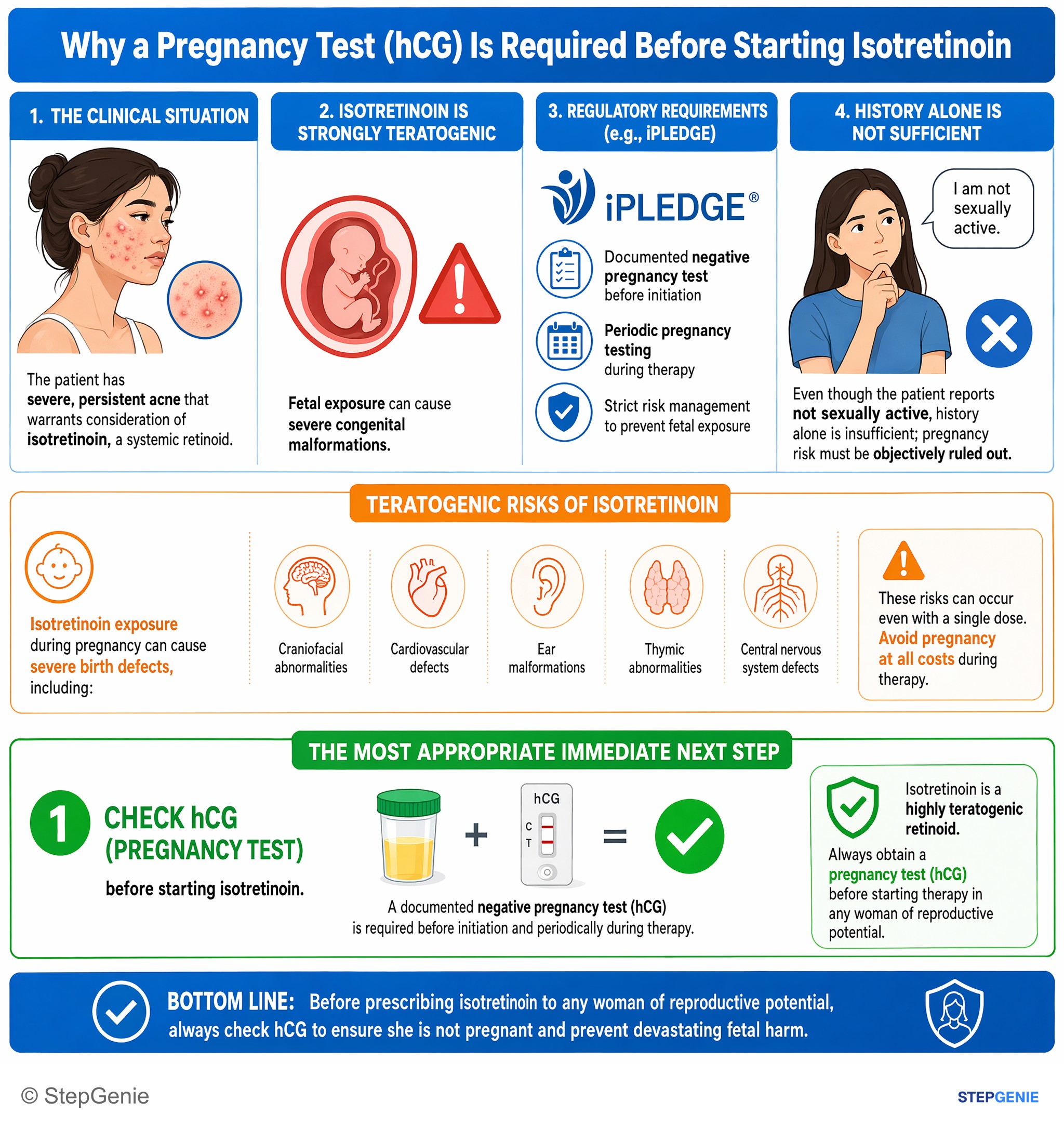
Isotretinoin is a highly teratogenic retinoid; always obtain a pregnancy test (hCG) before starting therapy in any woman of reproductive…
USMLE Step 2Frequently Asked Questions
What is the most appropriate initial treatment for mild-to-moderate acne vulgaris with comedones and papules/pustules?
The best initial treatment is topical tretinoin plus benzoyl peroxide. This combination is first-line for mild-to-moderate acne vulgaris because topical retinoids normalize desquamation and treat comedones, while benzoyl peroxide is bactericidal and helps with inflammatory lesions. A teen with open and closed comedones plus papules and pustules fits classic acne vulgaris that can usually be managed topically rather than with oral therapy.
Why is topical tretinoin plus benzoyl peroxide a high-yield acne regimen?
It is high-yield because it targets more than one major mechanism of acne. Acne pathogenesis includes follicular hyperkeratinization, increased sebum, Cutibacterium acnes proliferation, and inflammation. Topical retinoids treat and prevent comedones by normalizing desquamation, and benzoyl peroxide is bactericidal through free radicals. That makes the combination a foundational regimen for mixed comedonal and inflammatory acne.
Why is topical clindamycin alone not a good answer choice for acne?
Topical clindamycin alone is not recommended because antibiotic monotherapy promotes resistant organisms. In acne treatment, any regimen that includes an antibiotic should generally also include benzoyl peroxide to reduce resistance. Topical clindamycin can be appropriate as part of combination therapy, such as clindamycin plus benzoyl peroxide, often with a retinoid added when both comedonal and inflammatory lesions are present.
How do you tell acne vulgaris from Malassezia folliculitis on a vignette?
The key clue is the presence of comedones, which points to acne vulgaris. Acne usually has polymorphic lesions such as comedones, papules, pustules, and sometimes nodules. Malassezia folliculitis instead causes monomorphic, itchy follicular papules and pustules, often on the upper chest, back, shoulders, or forehead, and it does not produce comedones. It also tends to respond to antifungals like ketoconazole rather than acne therapy.
When would oral doxycycline or isotretinoin be appropriate instead of topical therapy for acne?
Oral doxycycline is more appropriate for moderate to severe inflammatory acne, especially with numerous papules and pustules, nodules, truncal involvement, or failure of adequate topical therapy. Oral isotretinoin is reserved for severe nodulocystic acne, acne causing scarring, or refractory disease after combination treatment. A vignette with comedones and only mild inflammatory lesions does not support jumping straight to either oral option.