Cervical cancer questions can feel like a blur of Pap schedules, HPV strains, and biopsy terminology—until you anchor the whole topic to one clean picture. Here’s a quick visual hack that turns cervical cancer (HPV) into a “see it once, recall it forever” pathway for USMLE Step 1/2.
The Visual Hack: “HPV climbs the SQUAMO-COLUMNAR Staircase”
Picture the cervix as a staircase:
- Top step = Columnar epithelium (endocervix)
- Bottom step = Squamous epithelium (ectocervix)
- The stair landing = Transformation zone (TZ) at the squamocolumnar junction
Now imagine HPV walking up to the landing and setting up camp there.
One-liner to memorize
HPV infects basal cells at the transformation zone → E6/E7 disable p53/Rb → CIN → invasive squamous cell carcinoma.
Why the Transformation Zone is “the money spot”
Most cervical cancers start in the transformation zone because it’s an area of active metaplasia (cells are proliferating and more vulnerable).
High-yield associations
- Most common cervical cancer: Squamous cell carcinoma
- Most common site of origin: Transformation zone
- Precursor lesion: Cervical intraepithelial neoplasia (CIN)
- CIN I = mild dysplasia
- CIN II/III = high-grade dysplasia (HSIL), carcinoma in situ risk
The USMLE Core Mechanism: HPV’s two “villains” (E6 & E7)
Think: E6 “sixes” p53, E7 “sevens” Rb.
| HPV Protein | Tumor Suppressor Target | What it does | Exam consequence |
|---|---|---|---|
| E6 | p53 | Inhibits p53 → ↓ apoptosis after DNA damage | Mutations persist |
| E7 | Rb | Inhibits Rb → ↑ E2F activity → pushes cell into S phase | Uncontrolled proliferation |
High-yield HPV types
- High-risk (oncogenic): 16, 18 (also 31, 33, 45)
- Low-risk: 6, 11 → condyloma acuminata (genital warts), laryngeal papillomas
The “Pap-to-Path” Mini Map (what the smear is actually catching)
Cytology clues you should recognize
- Koilocytes = HPV effect
- Perinuclear clearing/halo + nuclear atypia (wrinkled “raisin-like” nuclei)
Histology progression (classic USMLE framing)
- CIN I: dysplasia in lower 1/3
- CIN II: dysplasia in lower 2/3
- CIN III: full-thickness dysplasia (but no invasion)
- Invasive carcinoma: tumor cells breach the basement membrane
Quick-hit clinical pearls (Step 2 vibe)
Risk factors that show up in stems
- Early sexual activity, multiple partners
- Immunosuppression (HIV, transplant)
- Smoking (impairs local immune defense)
- Other STIs/inflammation
Symptoms (often late)
- Postcoital bleeding
- Intermenstrual bleeding
- Abnormal discharge
Early disease can be asymptomatic → screening matters.
Screening & prevention: what the exam wants you to do
Prevention headline
- HPV vaccination prevents infection with key high-risk strains (and wart strains in broader vaccines).
- Vaccines are prophylactic (best before exposure), not treatment for established infection.
Screening principles (high-yield takeaways)
- Screening targets precancerous lesions (CIN/HSIL) before invasion.
- If you see HSIL or concerning cytology, the next step often involves colposcopy ± biopsy (depending on age/risk profile in the question).
(On exams, the test usually provides enough context—age, cytology result, HPV status—to choose “repeat testing” vs “colposcopy.” The conceptual anchor: higher-risk results → tissue diagnosis.)
Mini Mnemonic Bundle (fast recall)
- “16/18 = malignancy; 6/11 = warts”
- “E6 kills p53; E7 wrecks Rb”
- “Cancer begins where squamous meets columnar” (Transformation zone)
15-second recap (what you should say to yourself)
HPV (esp. 16/18) infects basal cells at the transformation zone → koilocytes + dysplasia (CIN) → E6 inhibits p53 and E7 inhibits Rb → progression to invasive squamous cell carcinoma if basement membrane is breached.
Visual explanations from the StepGenie QBank
Infographics StepGenie drew to explain questions in its own QBank, matched to this article's topic. Each caption is the takeaway of the question it explains.
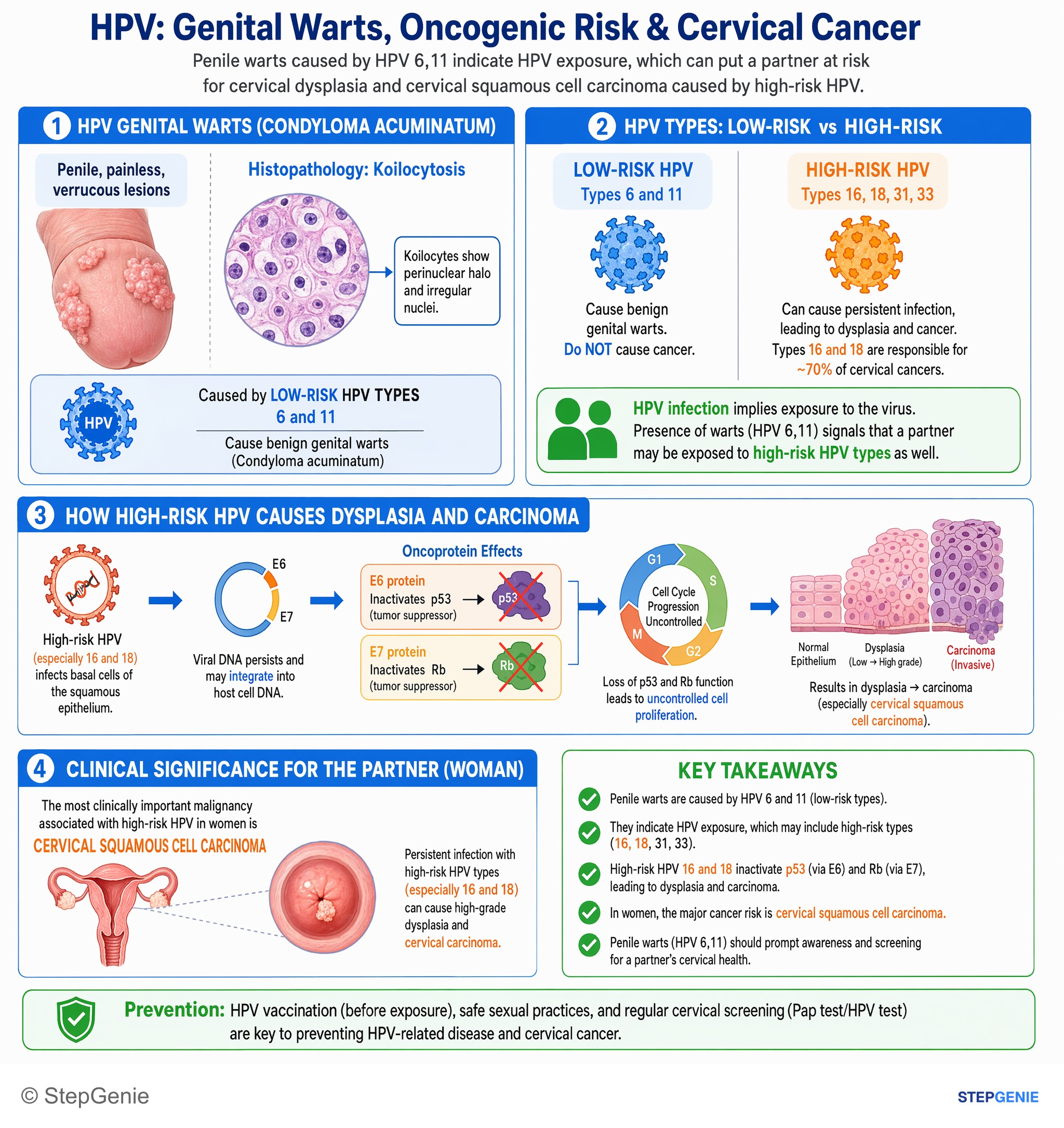
HPV types 16 and 18 cause high-grade dysplasia and cervical carcinoma; penile warts (HPV 6,11) signal HPV exposure, raising concern for…
USMLE Step 1Frequently Asked Questions
Why is the transformation zone the most common site of cervical cancer?
The transformation zone is the most common site of cervical cancer because it is an area of active metaplasia where cells are proliferating and more vulnerable to HPV-driven dysplasia. HPV infects basal cells at the squamocolumnar junction, and this can progress from cervical intraepithelial neoplasia to invasive squamous cell carcinoma over time.
How do HPV E6 and E7 lead to cervical cancer?
HPV promotes cervical cancer by using E6 to inhibit p53 and E7 to inhibit Rb. Loss of p53 reduces apoptosis after DNA damage, so mutations persist, while loss of Rb increases E2F activity and pushes cells into S phase. Together, these effects drive uncontrolled proliferation and progression from CIN toward invasive squamous cell carcinoma.
How do you tell CIN III from invasive cervical carcinoma on pathology?
CIN III shows full-thickness dysplasia without invasion, whereas invasive cervical carcinoma is defined by tumor cells breaching the basement membrane. The key distinction is not just how much of the epithelium looks abnormal, but whether the abnormal cells have crossed the basement membrane, which marks true invasion.
What are the classic cytology findings of HPV on a Pap smear?
The classic Pap smear finding of HPV is koilocytes. These cells show perinuclear clearing or a halo along with nuclear atypia, often described as wrinkled, raisin-like nuclei. This cytologic pattern reflects HPV effect and helps connect abnormal screening results to the underlying viral infection and dysplastic process.
What HPV types are high risk for cervical cancer, and which cause genital warts?
High-risk HPV types for cervical cancer are 16 and 18, with 31, 33, and 45 also listed as oncogenic. In contrast, low-risk types 6 and 11 are associated with condyloma acuminata and laryngeal papillomas. A useful way to separate them is that 16 and 18 point toward malignancy, while 6 and 11 point toward warts.