Placental bleeding questions love to bait you with timing, pain, and ultrasound clues. If you can quickly sort previa vs accreta vs abruption, you’ll get the diagnosis and the next best step without overthinking. Below is a step-by-step flowchart plus a shareable mnemonic so you can lock these down for USMLE Step 1/2.
The 10-second visual: “P-A-A” Placental Bleeding Ladder
Think P-A-A (in order of “how deep / how bad the attachment or separation is”):
- Placenta Previa = Placed Past the cervix (covers os)
- Accreta = Attaches too deep (invades placenta-to-uterus interface)
- Abruption = Away (premature separation)
One-liners
- Previa: Painless third-trimester bleeding + placenta near/over cervical os.
- Accreta spectrum: Placenta abnormally adherent/invasive → postpartum hemorrhage at delivery.
- Abruption: Painful bleeding + tender, hypertonic uterus ± fetal distress.
Step-by-step flowchart (USMLE style)
Step 0 — Pregnant patient with bleeding (2nd/3rd trimester)
First move on exams: assess maternal stability (ABC), vitals, fetal heart tracing.
Do NOT perform a digital vaginal exam until placenta previa is ruled out (risk of catastrophic hemorrhage).
Step 1 — Is the bleeding painful?
A) Painful bleeding + uterine tenderness/rigidity → Placental abruption
Clues:
- Painful vaginal bleeding (can be concealed, so bleeding may be minimal)
- Uterine hypertonicity (“board-like” uterus), frequent contractions
- Fetal distress common (late decels, bradycardia)
- Maternal risk: DIC (from tissue factor release)
Next best step (typical):
- Stabilize mom + continuous fetal monitoring
- Deliver if severe abruption, unstable mom, or nonreassuring fetal status
B) Painless bleeding → go to Step 2
Step 2 — What does ultrasound show?
Placenta overlies or is near internal os → Placenta previa
Clues:
- Painless, bright red bleeding in late 2nd/3rd trimester
- Soft, nontender uterus
- Often recurrent episodes
Next best step:
- Transvaginal ultrasound is safe and most accurate for placental location
- C-section if complete/major previa or persistent previa near term
- Avoid digital cervical exam until previa excluded
Placenta not covering os, but history screams “stuck placenta” risk → Placenta accreta spectrum
Usually not diagnosed because of antepartum bleeding pattern; it’s a risk-factor + imaging diagnosis and a delivery complication diagnosis.
Go to Step 3.
Step 3 — Are there risk factors for accreta + imaging signs?
High-yield risk factors (memorize):
- Prior C-section (biggest)
- Placenta previa + prior uterine surgery = classic setup
- Prior myomectomy, curettage, Asherman, endometrial damage
Pathophys:
- Defective decidua basalis (Nitabuch layer) → abnormal placental adherence/invasion.
Spectrum (increasing depth):
- Accreta: adheres to myometrium
- Increta: invades into myometrium
- Percreta: through serosa ± bladder involvement
Imaging clue:
- Ultrasound/MRI: placental lacunae, abnormal interface, hypervascularity
Presentation (testable):
- Often massive postpartum hemorrhage because placenta fails to separate after delivery.
Management (board-style):
- Plan delivery at tertiary center
- Often C-section hysterectomy with placenta left in situ (attempting removal can be fatal)
Ultra-high-yield comparison table
| Feature | Placenta previa | Placenta accreta spectrum | Placental abruption |
|---|---|---|---|
| Bleeding | Painless, bright red | Variable antepartum; massive postpartum common | Painful; can be concealed |
| Uterus | Soft, nontender | Usually nontender | Tender, hypertonic, “board-like” |
| Fetal status | Usually OK unless severe bleed | Depends; delivery complication | Fetal distress common |
| Key risk factors | Prior C-section, multiparity, smoking, advanced maternal age | Prior C-section + previa, uterine surgery | HTN, preeclampsia, trauma, cocaine, smoking, prior abruption |
| Diagnosis | Transvaginal US for placental location | US/MRI + risk factors | Mainly clinical (US may miss) |
| Big “don’t” | No digital vaginal exam | Don’t manually extract adherent placenta | Don’t delay delivery if unstable |
Mnemonic devices you can recall under pressure
1) “Previa is PREtty painless”
- PREvia → PREtty painless bleeding
2) “Abruption is A BRUISE”
Think trauma + pain + clotting problems:
- Away from wall (separates)
- Board-like uterus
- Risk: HTN/trauma/cocaine
- Uterine tenderness
- Intrauterine fetal distress
- Shock can be worse than visible bleeding (concealed)
- Elevated risk of DIC
3) “Accreta = Attached”
- Abnormal attachment due to decidual defect → postpartum hemorrhage
Classic USMLE vignettes (pattern recognition)
-
“Painless bright red bleeding at 32 weeks, uterus soft, fetal HR normal.”
→ Placenta previa (confirm with transvaginal US, no digital exam) -
“Severe abdominal pain after MVC, uterine rigidity, late decels; minimal vaginal bleeding.”
→ Placental abruption (concealed hemorrhage; manage aggressively, consider delivery) -
“History of 2 C-sections + placenta previa. At delivery placenta won’t detach, brisk hemorrhage.”
→ Placenta accreta spectrum (plan for C-section hysterectomy)
Exam-day “next step” checkpoints
- Bleeding in pregnancy? Stabilize mom first (maternal vitals > everything).
- Never do digital vaginal exam until previa ruled out.
- Abruption = pain + tender uterus + fetal distress ± DIC.
- Accreta = prior uterine surgery + previa risk + postpartum hemorrhage from retained placenta.
Visual explanations from the StepGenie QBank
Infographics StepGenie drew to explain questions in its own QBank, matched to this article's topic. Each caption is the takeaway of the question it explains.
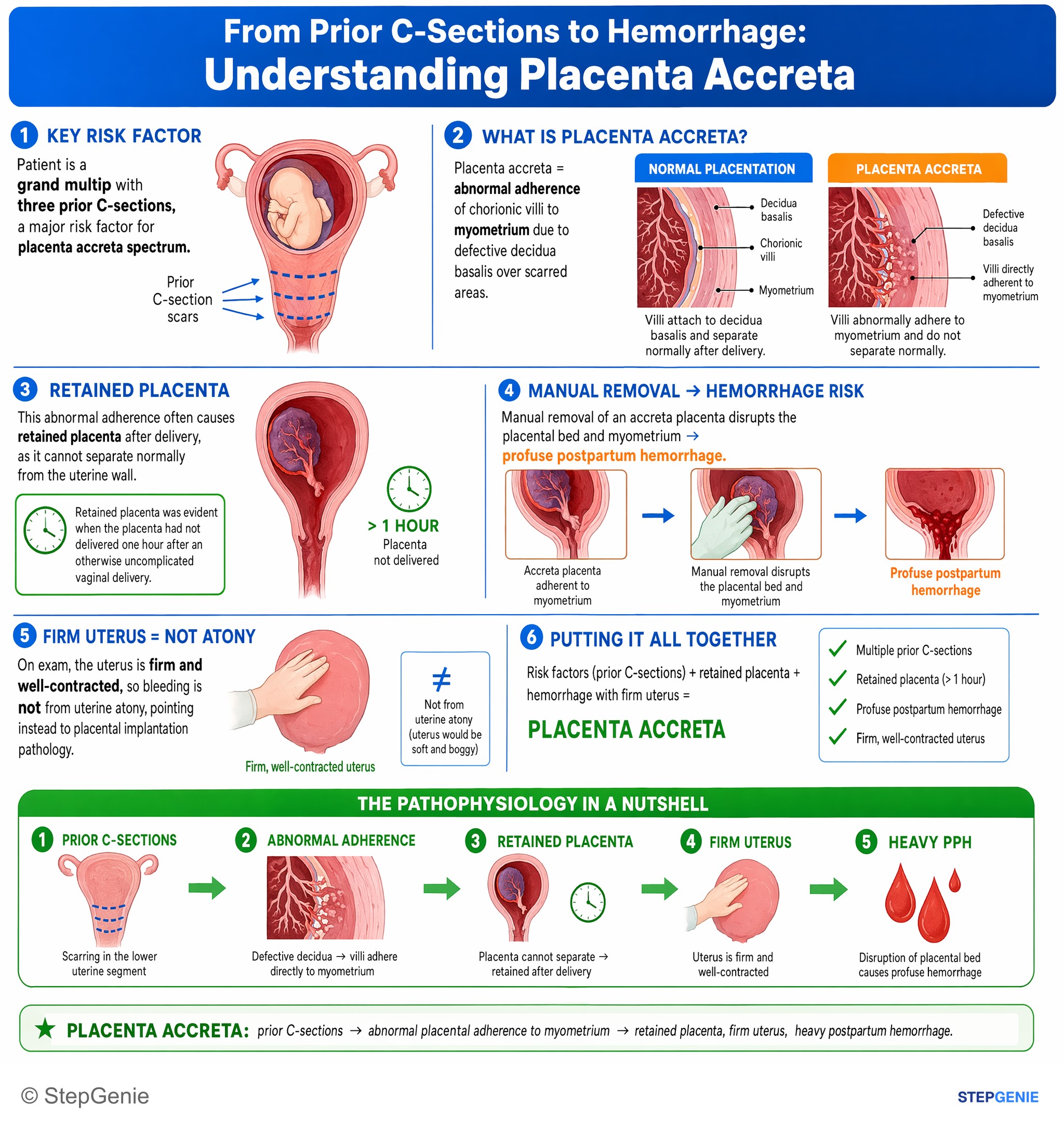
Placenta accreta: prior C-sections → abnormal placental adherence to myometrium → retained placenta, firm uterus, heavy postpartum…
USMLE Step 2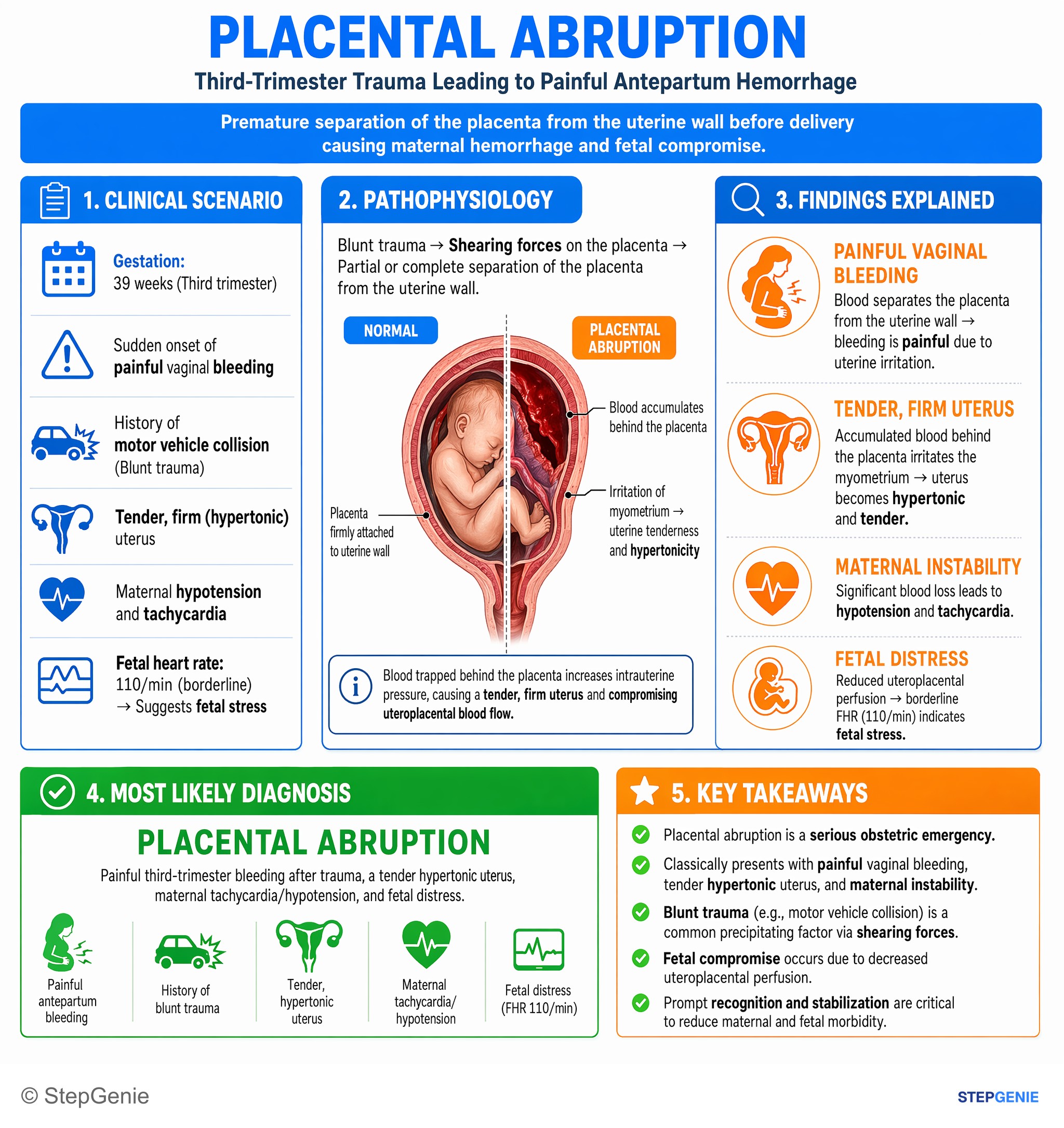
Placental abruption: painful third-trimester bleeding after trauma, tender hypertonic uterus, maternal tachycardia/hypotension, fetal…
USMLE Step 2Frequently Asked Questions
How do you tell placental abruption from placenta previa on a vignette?
Placental abruption is usually painful, while placenta previa is classically painless. Abruption presents with painful bleeding, uterine tenderness or rigidity, a hypertonic board-like uterus, and often fetal distress; bleeding can even be concealed. Previa causes painless, bright red bleeding in the late second or third trimester with a soft, nontender uterus, and ultrasound shows the placenta near or over the internal cervical os.
Why should you avoid a digital vaginal exam in a pregnant patient with bleeding?
You should avoid a digital vaginal exam until placenta previa is ruled out because it can trigger catastrophic hemorrhage. In a bleeding patient in the second or third trimester, the first exam move is to assess maternal stability, vital signs, and fetal heart tracing. Placental location should be evaluated first, since previa means the placenta may be covering the cervical os.
What ultrasound finding points to placenta previa, and what test is safest to confirm it?
The key ultrasound finding in placenta previa is that the placenta overlies or lies near the internal cervical os, and the safest, most accurate test is transvaginal ultrasound. This diagnosis fits painless, bright red bleeding in late pregnancy with a soft, nontender uterus. Transvaginal ultrasound is specifically described as safe for determining placental location in this setting.
What is the classic setup for placenta accreta, and why does it cause severe postpartum hemorrhage?
The classic setup for placenta accreta is prior C-section plus placenta previa, especially with prior uterine surgery or endometrial damage. It causes severe postpartum hemorrhage because the placenta is abnormally adherent or invasive and fails to separate after delivery. The underlying mechanism is a defective decidua basalis, leading to abnormal placental attachment that can range from accreta to increta to percreta.
What is the next best step when you suspect placental abruption?
The next best step in suspected placental abruption is to stabilize the mother and start continuous fetal monitoring, then deliver if the abruption is severe, the mother is unstable, or fetal status is nonreassuring. Abruption is mainly a clinical diagnosis marked by painful bleeding, uterine tenderness or rigidity, and frequent fetal distress. It can also lead to DIC, so delaying action in an unstable patient is dangerous.