PTSD questions are sneaky because they look like straightforward “trauma + nightmares” prompts—but the test writers are really checking whether you can time the symptoms, separate PTSD from close mimics, and justify why every distractor is wrong. Let’s do a classic Q-bank-style vignette and break down every answer choice like you’ll need to on test day.
Clinical Vignette (Q-Bank Style)
A 28-year-old woman comes to clinic because she “hasn’t felt like herself” since a serious motor vehicle collision 3 months ago in which her friend died. Since then, she has had recurrent intrusive memories of the crash, nightmares, and feels as if the accident is “happening again” when she hears screeching tires. She avoids driving and refuses to ride in cars. She is irritable, sleeps poorly, and startles easily. She feels detached from others and says, “I can’t feel happy anymore.” She denies substance use. No prior psychiatric history.
Question: What is the most likely diagnosis?
Answer choices:
- Posttraumatic stress disorder (PTSD)
- Acute stress disorder (ASD)
- Adjustment disorder
- Major depressive disorder (MDD)
- Generalized anxiety disorder (GAD)
- Panic disorder
- Dissociative amnesia
- Prolonged grief disorder
Correct Answer: Posttraumatic Stress Disorder (PTSD)
Why PTSD is correct here
This vignette hits the core PTSD architecture:
- Exposure to trauma (life-threatening event; death of friend)
- Intrusion symptoms: intrusive memories, nightmares, flashback-like re-experiencing
- Avoidance: won’t drive/ride in cars
- Negative alterations in cognition/mood: detachment, anhedonia (“can’t feel happy”), emotional numbing
- Arousal/reactivity: irritability, hypervigilance/startle, sleep disturbance
- Timing: symptoms persist > 1 month (she’s at 3 months)
- Impairment: clear functional avoidance and distress
High-yield PTSD clusters (USMLE-friendly)
A quick way to remember the 4 buckets:
| Cluster | What it looks like | Examples in vignette |
|---|---|---|
| Intrusion | Trauma replays | nightmares, intrusive memories, flashback-like episodes |
| Avoidance | Dodging reminders | won’t drive/ride in cars |
| Negative mood/cognition | Emotional/cognitive shift | detachment, inability to feel positive emotions |
| Arousal/reactivity | “On edge” physiology | poor sleep, irritability, exaggerated startle |
Key timing rule: PTSD requires duration > 1 month.
Why Each Distractor Is Wrong (and When It Would Be Right)
2) Acute Stress Disorder (ASD)
Why it’s wrong: ASD is the right symptom set but the wrong timeline.
- ASD occurs 3 days to 1 month after trauma.
- PTSD is > 1 month.
When ASD would be correct: same vignette, but symptoms started after the crash and she presents at 2 weeks.
USMLE pearl: ASD and PTSD can both include dissociative symptoms (eg, derealization), but duration is the cleanest discriminator.
3) Adjustment Disorder
Why it’s wrong: Adjustment disorder is a maladaptive response to a stressor that is not necessarily traumatic (and it lacks the full PTSD symptom constellation).
- PTSD requires a traumatic event plus intrusion/avoidance patterns.
- Adjustment disorder is typically milder, more nonspecific (sadness, anxiety), and does not require flashbacks/nightmares.
When it would be correct: failing a course, job loss, breakup → distress out of proportion + impaired functioning, but no trauma-linked intrusion symptoms.
4) Major Depressive Disorder (MDD)
Why it’s wrong: She has anhedonia and detachment, but the clinical center of gravity is trauma-linked re-experiencing and avoidance.
MDD requires ≥ 2 weeks of depressive symptoms with ≥ 5 SIGECAPS symptoms (including depressed mood or anhedonia) as the primary syndrome.
What would push toward MDD:
- Persistent depressed mood most of the day
- Neurovegetative symptoms (appetite/weight change, psychomotor change)
- Excessive guilt/worthlessness not specifically tied to trauma
- Suicidality
USMLE pitfall: PTSD commonly has comorbid depression, but if you see flashbacks + avoidance, don’t let “can’t feel happy” pull you away from PTSD.
5) Generalized Anxiety Disorder (GAD)
Why it’s wrong: GAD is excessive, hard-to-control worry about multiple domains for ≥ 6 months, with somatic symptoms.
- PTSD anxiety is trauma-cued (triggers/reminders) and includes intrusion/avoidance.
- Timeline: this vignette is 3 months, not 6.
When GAD would be correct: 8 months of uncontrollable worry about school, health, finances + restlessness, fatigue, poor concentration, irritability, muscle tension, sleep disturbance—without trauma re-experiencing.
6) Panic Disorder
Why it’s wrong: Panic disorder is defined by recurrent unexpected panic attacks plus ≥ 1 month of worry about attacks or maladaptive behavior change.
This vignette describes startle and hyperarousal, but not discrete surges of intense fear with classic panic symptoms (palpitations, chest pain, fear of dying/losing control) that are unexpected.
When panic disorder would be correct: repeated sudden panic attacks “out of the blue,” then avoidance of situations due to fear of more attacks.
Test nuance: PTSD can include panic attacks, but the hallmark remains trauma re-experiencing + avoidance.
7) Dissociative Amnesia
Why it’s wrong: Dissociative amnesia is an inability to recall important autobiographical information (often trauma-related), inconsistent with ordinary forgetting.
She recalls the accident and is actively re-experiencing it—this is the opposite pattern.
When it would be correct: after trauma, patient cannot recall key aspects of the event (localized amnesia) or identity/past (generalized), often with distress and sometimes wandering (fugue).
8) Prolonged Grief Disorder
Why it’s wrong: There is bereavement (friend died), but the dominant symptoms are fear-based trauma symptoms (flashbacks, avoidance, hyperarousal), not grief-focused yearning.
Prolonged grief disorder is characterized by:
- Persistent yearning/longing or preoccupation with the deceased
- Significant distress/impairment
- Duration typically ≥ 12 months in adults
When it would be correct: 14 months after the death, still daily yearning, identity disruption (“part of me died”), inability to move forward—without prominent trauma re-experiencing/avoidance patterns.
Quick “PTSD vs. The Usual Suspects” Cheat Table
| Diagnosis | Trigger | Signature features | Timing |
|---|---|---|---|
| PTSD | Trauma | intrusion + avoidance + negative mood/cognition + hyperarousal | > 1 month |
| ASD | Trauma | similar to PTSD, often dissociation | 3 days–1 month |
| Adjustment disorder | Stressor | emotional/behavioral symptoms out of proportion | within 3 months; resolves within 6 months after stressor ends |
| MDD | variable | SIGECAPS, pervasive depressive syndrome | ≥ 2 weeks |
| GAD | none specific | excessive worry across domains + somatic symptoms | ≥ 6 months |
| Panic disorder | none specific | unexpected panic attacks + anticipatory anxiety | ≥ 1 month after attacks |
| Prolonged grief disorder | bereavement | yearning/preoccupation with deceased | typically ≥ 12 months |
High-Yield USMLE Facts: PTSD Management & Associations
First-line treatments
Psychotherapy (core first-line):
- Trauma-focused CBT
- Prolonged exposure therapy
- EMDR (eye movement desensitization and reprocessing)
Medications (first-line pharmacotherapy):
- SSRIs/SNRIs (eg, sertraline, paroxetine, venlafaxine)
Nightmares/sleep (classic board favorite):
- Prazosin can be used for trauma-related nightmares (still commonly tested)
What not to do
- Benzodiazepines are not first-line in PTSD (risk of dependence, can worsen outcomes and interfere with trauma processing).
Common comorbidities (think screening)
- Depression
- Substance use disorders
- Suicidality
Risk factors you can name in an explanation
- Prior trauma, childhood adversity
- Lack of social support
- Pre-existing psychiatric illness
- Greater trauma severity/perceived threat
How to Approach PTSD Answer Choices on Test Day
- Confirm trauma exposure (real/threatened death, serious injury, sexual violence).
- Time it:
- < 3 days: not ASD/PTSD
- 3 days–1 month: ASD
- > 1 month: PTSD
- Look for intrusion + avoidance (if those are missing, consider other diagnoses).
- Use distractors as a checklist:
- Predominant worry (GAD)?
- Predominant depression (MDD)?
- Predominant panic attacks (panic disorder)?
- Predominant yearning for deceased (prolonged grief)?
Key Takeaways (What You Should Remember in 15 Seconds)
- PTSD = trauma + intrusion + avoidance + negative mood/cognition + hyperarousal for > 1 month.
- ASD is the same ballpark but 3 days–1 month.
- Prazosin is the classic add-on for nightmares.
- The wrong answers usually fail by timeline or by lacking intrusion/avoidance.
Visual explanations from the StepGenie QBank
Infographics StepGenie drew to explain questions in its own QBank, matched to this article's topic. Each caption is the takeaway of the question it explains.
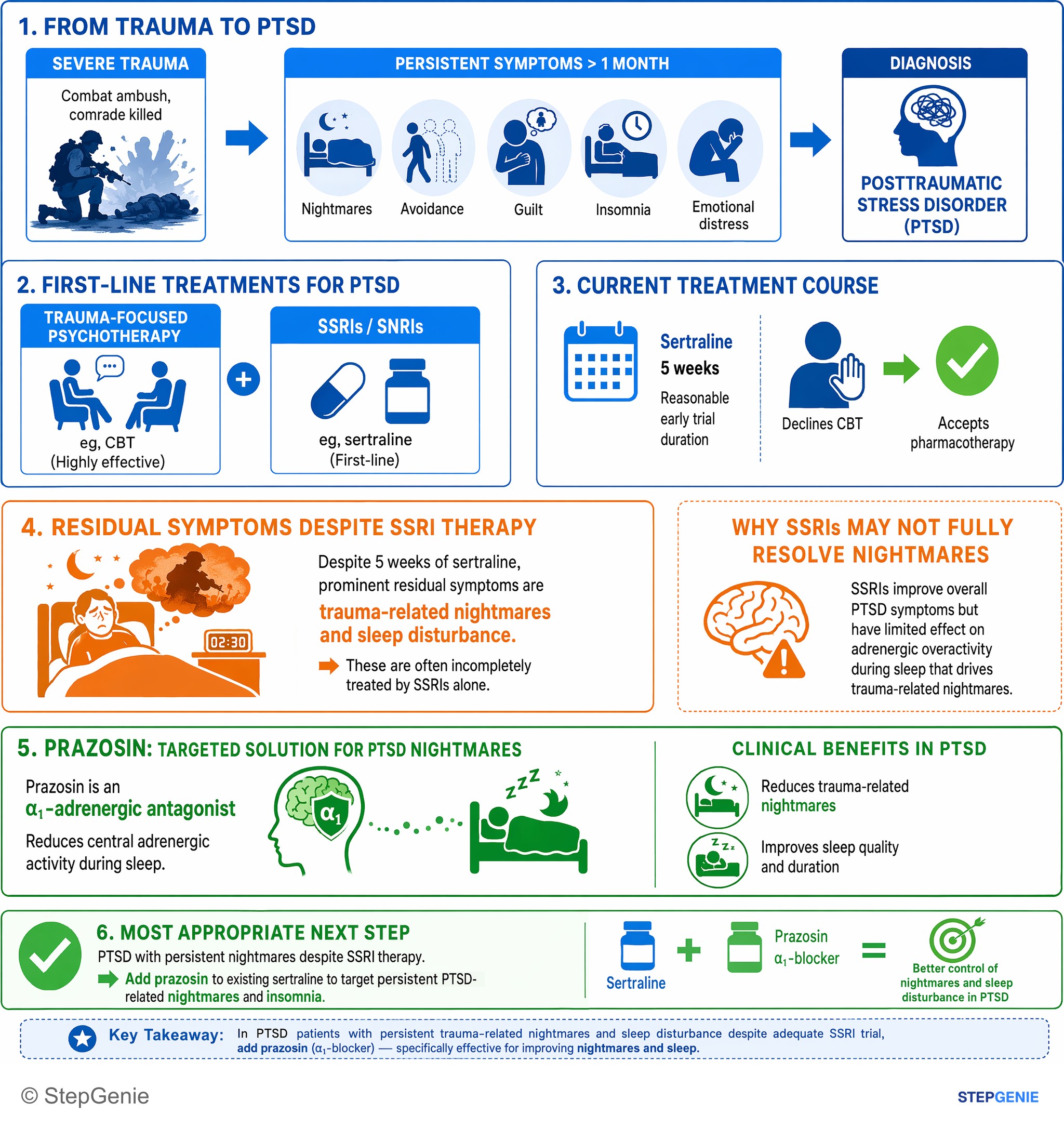
PTSD with persistent nightmares despite SSRI; add prazosin, an α₁-blocker effective for trauma-related nightmares and sleep disturbance in…
USMLE Step 2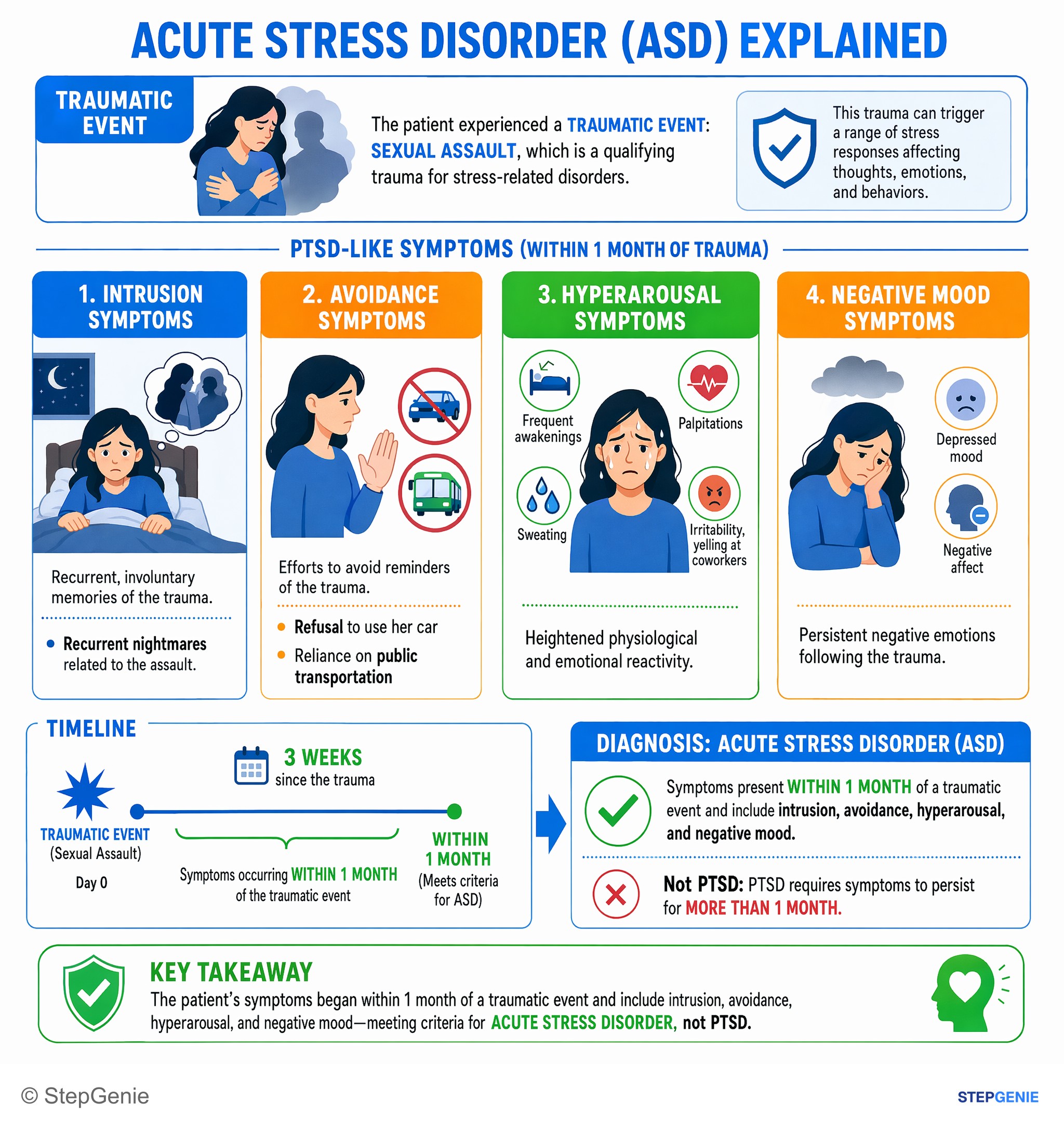
Acute stress disorder: PTSD-like symptoms (intrusion, avoidance, hyperarousal, negative mood) occurring within 1 month of a traumatic event.
USMLE Step 2Frequently Asked Questions
How do you tell PTSD from acute stress disorder on a vignette?
The cleanest way to distinguish PTSD from acute stress disorder is the duration of symptoms. Both can follow trauma and include intrusion, avoidance, and even dissociative symptoms, but acute stress disorder lasts from 3 days to 1 month after the event, whereas PTSD requires symptoms that persist for more than 1 month. A patient still having trauma-related symptoms at 3 months fits PTSD, not acute stress disorder.
What symptoms make a trauma vignette PTSD instead of just anxiety or sadness?
PTSD is suggested by a full trauma-linked symptom pattern: intrusion, avoidance, negative mood or cognition changes, and arousal or reactivity. Typical clues include intrusive memories, nightmares, flashback-like re-experiencing, avoiding reminders, emotional detachment, inability to feel positive emotions, irritability, poor sleep, and exaggerated startle. When these symptoms follow a traumatic event and persist longer than 1 month, PTSD is the best diagnosis.
How do you tell PTSD from major depressive disorder when the patient has anhedonia?
PTSD is more likely when anhedonia appears alongside trauma-linked re-experiencing and avoidance. Major depressive disorder centers on a primary depressive syndrome with at least 2 weeks of symptoms and at least 5 SIGECAPS features, including depressed mood or anhedonia. If the vignette emphasizes flashbacks, nightmares, and avoiding trauma reminders, those clues point to PTSD even if the patient also says she cannot feel happy.
How do you differentiate PTSD from generalized anxiety disorder on Step-style questions?
PTSD anxiety is tied to a specific trauma and usually includes re-experiencing and avoidance, while generalized anxiety disorder is excessive, hard-to-control worry across multiple life domains for at least 6 months. A patient who becomes distressed by trauma reminders, has nightmares or intrusive memories, and avoids cues related to the event fits PTSD. GAD would instead feature broad worry about things like school, health, and finances without trauma re-experiencing.
Why is adjustment disorder wrong when a patient is struggling after a stressful event?
Adjustment disorder is wrong when the vignette shows a true trauma response with intrusion and avoidance. Adjustment disorder describes a maladaptive response to a stressor that is not necessarily traumatic and is usually milder and more nonspecific, such as sadness or anxiety out of proportion to the situation. Flashbacks, nightmares, and trauma-linked avoidance are key clues that favor PTSD rather than adjustment disorder.