Acute stress disorder (ASD) is one of those “you either recognize it immediately or you talk yourself out of it” diagnoses—especially in Q-bank vignettes where the distractors are all plausible trauma-related or anxiety disorders. The key is to anchor yourself to timing, symptom clusters, and functional impairment, then use those anchors to eliminate every other answer choice with confidence.
The Clinical Vignette (Q-bank style)
A 27-year-old woman comes to the clinic because she “can’t calm down” since a serious motor vehicle collision 10 days ago in which she briefly thought she would die. She reports intrusive memories of the crash, feels like she’s “watching herself from outside her body,” avoids driving past the intersection where it happened, and has poor sleep with irritability and a strong startle response. She has missed several days of work because she feels overwhelmed and “on edge all the time.” She has no prior psychiatric history and denies substance use.
Question: What is the most likely diagnosis?
Correct answer: Acute stress disorder
Why the Correct Answer Is Acute Stress Disorder
ASD is essentially the “early window” trauma disorder and is defined by:
- Exposure to actual or threatened death, serious injury, or sexual violence
- Onset and duration: symptoms occur after trauma and last 3 days to 1 month
- Symptoms from multiple clusters, including:
- Intrusion: distressing memories, flashbacks, nightmares
- Negative mood
- Dissociation: depersonalization, derealization, amnesia
- Avoidance
- Arousal: hypervigilance, sleep disturbance, irritability, exaggerated startle
- Clinically significant distress/impairment (school, work, relationships)
In the vignette:
- Trauma occurred 10 days ago
- She has intrusion + avoidance + arousal
- She has a classic dissociative feature (“watching herself from outside her body” = depersonalization)
- She has impairment (missed work)
That combination (trauma + 3 days–1 month + dissociation/other clusters) is the bullseye for acute stress disorder.
High-Yield Timing: The Trauma Timeline (USMLE favorite)
| Diagnosis | Symptom duration after trauma | Key differentiator |
|---|---|---|
| Acute stress disorder | 3 days–1 month | Dissociative symptoms are common; same clusters as PTSD |
| PTSD | > 1 month | Same symptom clusters, but duration > 1 month |
| Adjustment disorder | Within 3 months of a stressor | Stressor does not have to be traumatic; symptoms are subthreshold for another disorder |
| Normal stress reaction | < 3 days (often hours–a couple days) | Distress but does not meet criteria / resolves quickly |
Step tip: The most common mistake is calling ASD “PTSD” because the symptoms look identical. When the stem gives you a clear timeline, it’s usually the main testing point.
“Why Every Answer Choice Matters”: Breaking Down Common Distractors
Below are the distractors Q-banks love to pair with ASD, and exactly how to rule them out.
Distractor 1: Posttraumatic Stress Disorder (PTSD)
Why it’s tempting: The symptom clusters overlap almost perfectly: intrusion, avoidance, negative mood/cognition, and arousal.
Why it’s wrong here: Timing. PTSD requires symptoms for more than 1 month.
How USMLE phrases it:
- If the trauma was “6 weeks ago” and symptoms persist → PTSD.
- If the trauma was “10 days ago” → ASD (if criteria met).
Extra high-yield PTSD points:
- PTSD often includes persistent negative beliefs, shame, guilt, emotional numbing.
- Comorbidities commonly tested: depression, substance use, suicidality.
Distractor 2: Adjustment Disorder
What it is: Emotional or behavioral symptoms in response to a stressor occurring within 3 months of the event, causing distress/impairment, but not meeting criteria for another disorder.
Why it’s tempting: “She’s stressed after a life event and can’t function at work.”
Why it’s wrong here:
- The stressor here is traumatic (threatened death) and the symptom profile is trauma-specific (intrusions, avoidance, hyperarousal, dissociation).
- If trauma-disorder criteria are met, you don’t call it adjustment disorder.
Clinchers for adjustment disorder on exams:
- Stressor is often non-traumatic (divorce, job loss, moving).
- Symptoms are more general (tearfulness, anxiety, acting out) without classic trauma phenomena like flashbacks.
Distractor 3: Generalized Anxiety Disorder (GAD)
Core of GAD: Excessive anxiety and worry about multiple domains, difficult to control, plus physical symptoms, for months.
Why it’s tempting: She’s anxious, can’t sleep, irritable.
Why it’s wrong here:
- GAD is not tied to a specific traumatic event in the way this vignette is.
- Timeline is too short and the symptoms are trauma-patterned (intrusive memories + avoidance).
Step clue: If the stem emphasizes worry about many things (finances, grades, health) for 6+ months → GAD.
Distractor 4: Panic Disorder
Core of panic disorder: Recurrent unexpected panic attacks plus ≥1 month of worry about more attacks or maladaptive behavior changes.
Why it’s tempting: Hyperarousal + “can’t calm down,” maybe palpitations in other stems.
Why it’s wrong here:
- The stem centers on trauma-related intrusions and avoidance, not discrete, unexpected surges of intense fear.
- Panic attacks can occur in many disorders, including PTSD/ASD, but the diagnosis is based on the broader syndrome.
How they trick you: They’ll toss in “heart racing” after a trigger—if it’s cued by trauma reminders, think ASD/PTSD first.
Distractor 5: Major Depressive Disorder (MDD)
Core of MDD: ≥2 weeks of depressed mood or anhedonia plus associated symptoms (sleep, guilt, energy, concentration, appetite, psychomotor changes, suicidal ideation).
Why it’s tempting: Sleep disturbance, poor concentration, missing work.
Why it’s wrong here:
- The hallmark features in this vignette are intrusion + avoidance + hyperarousal + dissociation following trauma.
- Mood symptoms can be present in ASD/PTSD but don’t define the syndrome.
USMLE tip: If the stem emphasizes pervasive anhedonia and neurovegetative symptoms without trauma-patterned symptoms, think MDD.
Distractor 6: Acute stress reaction / “normal response to trauma”
(Some Q-banks loosely use this concept, though DSM-5 focuses on ASD criteria.)
Why it’s tempting: After trauma, it’s normal to feel distressed.
Why it’s wrong here:
- Symptoms have clinical impairment (missed work).
- Symptom load is significant and includes dissociation and multiple trauma clusters.
- Duration is in the classic ASD window (>3 days, <1 month).
Practical exam framing: If symptoms are mild and resolve quickly (often within a day or two), “normal stress response” may fit. Once you have a cluster of trauma symptoms with impairment lasting days, ASD becomes much more likely.
Mini-Checklist: How to Nail ASD in 10 Seconds
When you see trauma + symptoms, run this:
- Was there a traumatic event (threatened death/serious injury/sexual violence)?
- Timing:
- <3 days → likely normal acute stress response
- 3 days–1 month → ASD
- >1 month → PTSD
- Look for dissociation (depersonalization, derealization, amnesia)—very “ASD-flavored.”
- Is there impairment? (work, school, relationships)
If all four line up, pick acute stress disorder and move on.
High-Yield Pearls (Step 1 + Step 2)
- ASD and PTSD share symptom clusters; time is the cleanest divider.
- Dissociation (depersonalization/derealization) is a classic ASD clue.
- Trauma disorders are not the same as stress from everyday life events → don’t default to adjustment disorder if the stressor is life-threatening and symptoms are trauma-specific.
- Vignettes often test avoidance (won’t drive, won’t discuss event) plus intrusion (flashbacks/nightmares) plus hyperarousal (startle, insomnia).
- ASD can be a risk factor for later PTSD, but not everyone with ASD progresses.
Quick Comparison Table (Common Exam Confusions)
| Feature | ASD | PTSD | Adjustment disorder |
|---|---|---|---|
| Trigger | Trauma | Trauma | Stressor (often non-traumatic) |
| Onset/duration | 3 days–1 month | >1 month | Within 3 months of stressor |
| Intrusions/flashbacks | Common | Common | Not typical |
| Avoidance | Common | Common | Not typical |
| Dissociation | Common | Can occur | Not typical |
| Diagnosis depends most on | Timing | Timing | Not meeting criteria for another disorder |
Takeaway
Acute stress disorder is a time-locked trauma syndrome: if the vignette screams trauma with intrusion/avoidance/arousal (often dissociation) and it’s been 3 days to 1 month, the correct answer is ASD—even if PTSD sounds tempting. Then, use the same anchors (trauma specificity + timeline + symptom pattern) to systematically eliminate every distractor.
Visual explanations from the StepGenie QBank
Infographics StepGenie drew to explain questions in its own QBank, matched to this article's topic. Each caption is the takeaway of the question it explains.
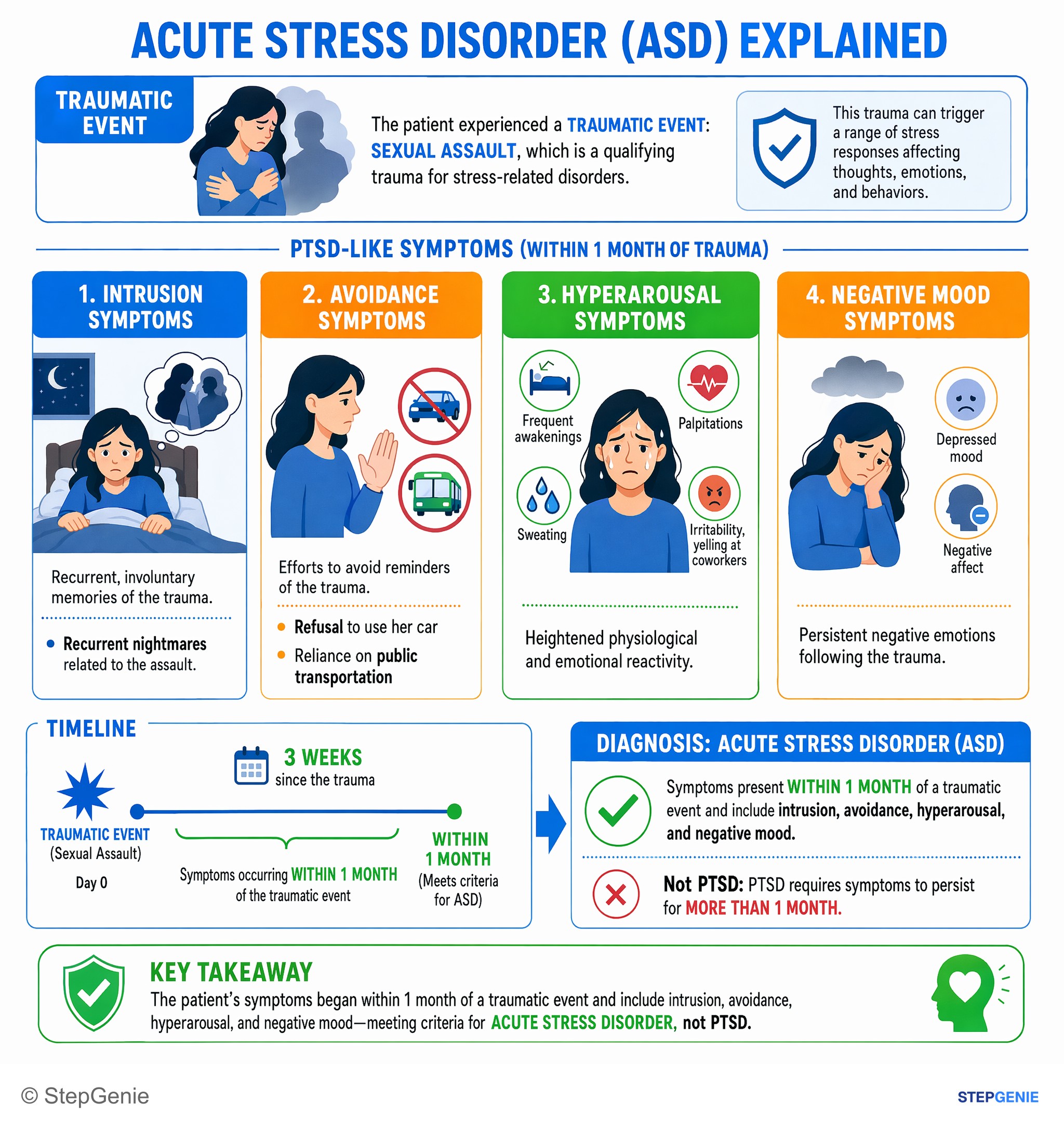
Acute stress disorder: PTSD-like symptoms (intrusion, avoidance, hyperarousal, negative mood) occurring within 1 month of a traumatic event.
USMLE Step 2Frequently Asked Questions
How do you tell acute stress disorder from PTSD on a vignette?
The main way to distinguish acute stress disorder from PTSD is the timeline. Acute stress disorder occurs after a trauma and lasts 3 days to 1 month, while PTSD requires symptoms that persist for more than 1 month. Both can have similar clusters such as intrusion, avoidance, negative mood or cognition, and arousal, so when the stem gives a clear duration, that is usually the key testing point.
What symptoms make acute stress disorder the best diagnosis after a recent trauma?
Acute stress disorder is most likely when a patient has trauma exposure, symptoms beginning after that trauma, and multiple trauma-related symptom clusters with functional impairment. High-yield clues include intrusive memories, avoidance, arousal symptoms like poor sleep or exaggerated startle, dissociation such as depersonalization, and missed work or other impairment. A traumatic event followed by these symptoms for 3 days to 1 month strongly points to acute stress disorder.
Why is adjustment disorder wrong when the patient is distressed after a traumatic event?
Adjustment disorder is wrong if the patient already meets criteria for a trauma-related disorder. Adjustment disorder involves emotional or behavioral symptoms within 3 months of a stressor, but the stressor does not have to be traumatic and the symptoms are more general. When the stem includes threatened death plus trauma-specific findings like intrusive memories, avoidance, hyperarousal, and dissociation, acute stress disorder fits better than adjustment disorder.
How do you tell acute stress disorder from generalized anxiety disorder or panic disorder?
Acute stress disorder is tied to a specific traumatic event and has trauma-patterned symptoms such as intrusive memories and avoidance. Generalized anxiety disorder instead involves excessive worry about multiple domains for at least 6 months, not a single trauma-focused syndrome. Panic disorder centers on recurrent unexpected panic attacks and persistent worry about more attacks, whereas trauma-cued fear with intrusions and avoidance points more strongly to acute stress disorder.
What dissociative clue is especially high-yield for acute stress disorder?
Depersonalization is a classic dissociative clue for acute stress disorder. If a patient says they feel like they are watching themselves from outside their body after a trauma, that supports dissociation within the acute stress disorder symptom clusters. On exams, this matters because dissociative symptoms are commonly associated with acute stress disorder and help distinguish it when paired with recent trauma, avoidance, arousal, and impairment.