Scurvy is vitamin C (ascorbic acid) deficiency, and the step it breaks is the hydroxylation of proline and lysine residues on newly made collagen (pro-α) chains, carried out in the rough endoplasmic reticulum by prolyl and lysyl hydroxylases, which need vitamin C as a cofactor. The resulting weak collagen explains the classic picture: perifollicular hemorrhages, corkscrew hairs, swollen bleeding gums, easy bruising and poor wound healing, with normal bleeding, coagulation and prothrombin times. Signs can appear within about 1 to 3 months of very low intake (below about 10 mg a day), and oral vitamin C clears them over 1 to 2 weeks.
The Q-bank vignette
A 58-year-old man with alcohol use disorder comes to the clinic with 2 months of fatigue, aching legs and bleeding when he brushes his teeth. He lives alone and eats mostly canned soup and white bread, with no fruit or vegetables. His gums are swollen, purple and friable. His legs show bruises, pinpoint hemorrhages around hair follicles and coiled, corkscrew-shaped hairs. A cut on his hand from 6 weeks ago has not healed. Hemoglobin is 10.9 g/dL; the platelet count, PT and aPTT are normal.
Which process is most directly impaired?
- A. γ-Carboxylation of glutamate residues on clotting factors
- B. Cross-linking of collagen fibrils by lysyl oxidase
- C. Hydroxylation of proline and lysine residues in pro-α collagen chains
- D. Synthesis of fibrillin-1
- E. Synthesis of type I collagen α chains
- F. Synthesis of type III collagen
Answer: C, hydroxylation of proline and lysine (vitamin C deficiency)
Vitamin C is the cofactor for prolyl and lysyl hydroxylases, which modify newly made pro-α chains inside the rough ER; it keeps the iron bound to these enzymes in its reduced (Fe²⁺) form. Without enough hydroxylation, collagen is structurally defective, with reduced tensile strength; capillaries weaken and bleed, and wounds heal poorly.
The clues in the stem:
- Risk: alcohol use disorder, living alone and no fruit or vegetables. Other risks include smoking, drug use, mental illness, food faddism, severe malabsorption and hemodialysis.
- Skin and hair: follicular hyperkeratosis with perifollicular hemorrhages (bleeding around hyperkeratotic hair follicles is almost pathognomonic), coiled corkscrew hairs and ecchymoses, especially on the legs.
- Gums: swollen, purple, spongy and bleeding; teeth can loosen and fall out.
- Joints and bone: painful bleeding into joints (hemarthroses) and subperiosteal hematomas.
- Anemia: from blood loss and from reduced absorption of nonheme iron, which vitamin C normally improves.
- Normal clotting tests, because the clotting factors themselves are intact.
Where each answer choice acts in collagen synthesis
| Step | Location | Enzyme or cofactor | What breaks it (answer choice) |
|---|---|---|---|
| Translation of pro-α chains | Rough ER | Collagen genes such as COL1A1, COL1A2 and COL3A1 | Osteogenesis imperfecta (E); vascular EDS (F) |
| Hydroxylation of proline and lysine | Rough ER | Prolyl and lysyl hydroxylases; vitamin C | Scurvy (C) |
| Glycosylation of hydroxylysine | Rough ER | Adds glucose and galactose | — |
| Triple helix (procollagen) | Rough ER | Three pro-α chains zip together | Glycine substitutions in osteogenesis imperfecta |
| Secretion | Golgi → extracellular space | Secretory vesicles | — |
| Propeptide cleavage → tropocollagen | Extracellular | Collagen peptidases | — |
| Cross-linking | Extracellular | Lysyl oxidase (copper-dependent) | Copper deficiency (B) |
To drill every step, see the collagen synthesis Q-bank breakdown.
Why every other answer choice is wrong
A. γ-Carboxylation (vitamin K deficiency). Vitamin K is the coenzyme for the carboxylase that makes factors II, VII, IX and X and proteins C and S functional. Deficiency causes bleeding with a prolonged PT, mainly in newborns, people with malabsorption and people taking drugs that interfere with vitamin K. This patient's PT is normal. The lab patterns are laid out in PT/INR vs PTT.
B. Lysyl oxidase cross-linking (copper deficiency). Lysyl oxidase is copper-dependent and works outside the cell, after collagen is secreted. Copper deficiency brings anemia, hypopigmentation, osteoporosis, ataxia and infections; suspect it with excess zinc supplements, celiac disease or Menkes disease, an X-linked disorder of copper handling. See the copper deficiency Q-bank breakdown.
D. Fibrillin-1 (Marfan syndrome). Autosomal dominant FBN1 variants give a tall, slender build, long fingers (arachnodactyly), lens dislocation (ectopia lentis) and aortic aneurysm or dissection. There is no gum bleeding or perifollicular hemorrhage.
E. Type I collagen (osteogenesis imperfecta). Mostly autosomal dominant COL1A1 or COL1A2 variants: fractures after mild trauma, blue or gray sclerae, hearing loss in adulthood in about half, and dentinogenesis imperfecta in severe types. It is inherited, not dietary. More in the osteogenesis imperfecta overview.
F. Type III collagen (vascular Ehlers-Danlos syndrome). Usually COL3A1 variants. Easy bruising overlaps with scurvy, but vascular EDS adds rupture of arteries, the intestine or the uterus, and it is inherited rather than acquired.
Diagnosis and treatment
- Diagnosis is usually clinical, in an at-risk patient with skin or gum signs.
- Plasma vitamin C below 0.2 mg/dL (11 µmol/L) indicates deficiency; below 0.6 mg/dL (34 µmol/L) is marginal.
- Bleeding, coagulation and prothrombin times are normal.
- Treatment: one reasonable adult regimen is 500 to 1,000 mg of oral vitamin C once daily for 1 to 2 weeks, until the signs disappear, followed by a nutritious diet. Therapeutic doses restore vitamin C's functions within a few days, and the signs usually clear over 1 to 2 weeks.
- Prevention: the RDA is 90 mg a day for men and 75 mg a day for women, and people who smoke need 35 mg a day more.
Scurvy in children
In infants and children, bone growth is impaired, and bleeding beneath the periosteum and into joints makes movement painful: infants are irritable and hurt when moved, and a child may refuse to walk. Skeletal x-rays help diagnose childhood (but not adult) scurvy; changes are most evident at the ends of long bones, particularly the knee, where the dense metaphyseal white line of Fraenkel may be visible. Infants fed boiled or evaporated cow's milk are at risk, because cow's milk has little vitamin C and heat destroys it.
Exam traps
- Bleeding with a normal PT and aPTT argues against a clotting factor deficiency such as vitamin K deficiency; add perifollicular hemorrhages and gum disease, and the vessel-wall problem is scurvy.
- Inside vs outside the cell: vitamin C works in the rough ER; copper-dependent lysyl oxidase works after secretion.
- Easy bruising alone doesn't separate scurvy from vascular EDS; perifollicular hemorrhages, corkscrew hairs and gum disease do.
- Anemia in scurvy can be iron deficiency, from bleeding plus poor nonheme iron absorption.
- Alcohol use disorder is itself a risk factor for scurvy, so let the skin, hair and gum findings choose the vitamin.
- Smokers need more vitamin C: an extra 35 mg a day.
Worked example: the pediatric version
Vignette. A 6-year-old boy with a developmental disability eats only crackers and milk. For 3 weeks he has refused to walk and cries when his legs are moved. His gums bleed, and his legs show bruises and perifollicular hemorrhages. Knee x-rays show dense white lines at the metaphyses. The platelet count, PT and aPTT are normal. What is the most likely diagnosis?
Answer: Scurvy. A very restricted diet, leg pain from subperiosteal bleeding, bleeding gums and skin, metaphyseal white lines and normal clotting tests all fit vitamin C deficiency.
Why not the distractors: vitamin K deficiency would prolong the PT, and osteogenesis imperfecta would cause fractures after minor trauma and blue-gray sclerae rather than gum and perifollicular bleeding.
Key takeaways
- Scurvy = vitamin C deficiency → failed prolyl and lysyl hydroxylation in the rough ER → weak collagen.
- Classic signs: perifollicular hemorrhages, corkscrew hairs, swollen bleeding gums, bruising, poor wound healing and hemarthroses.
- Clotting tests are normal; a plasma vitamin C below 0.2 mg/dL indicates deficiency.
- Risks: poor diet, alcohol or drug use, mental illness, smoking, malabsorption, dialysis and restricted diets in children.
- Treat with oral vitamin C; signs clear within 1 to 2 weeks.
- Distractors: vitamin K (prolonged PT), copper and lysyl oxidase (extracellular cross-links), fibrillin-1 (Marfan), type I collagen (osteogenesis imperfecta), type III collagen (vascular EDS).
Sources
- Vitamin C Deficiency — Merck Manual Professional Edition
- Vitamin C: Fact Sheet for Health Professionals — NIH Office of Dietary Supplements
- Vitamin C — Linus Pauling Institute Micronutrient Information Center, Oregon State University
- COL1A1 gene — MedlinePlus Genetics
- Copper — Linus Pauling Institute Micronutrient Information Center, Oregon State University
- Vitamin K: Fact Sheet for Health Professionals — NIH Office of Dietary Supplements
- Copper: Fact Sheet for Health Professionals — NIH Office of Dietary Supplements
- Osteogenesis imperfecta — MedlinePlus Genetics
- Marfan syndrome — MedlinePlus Genetics
- Ehlers-Danlos syndrome — MedlinePlus Genetics
Visual explanations from the StepGenie QBank
Infographics StepGenie drew to explain questions in its own QBank, matched to this article's topic. Each caption is the takeaway of the question it explains.
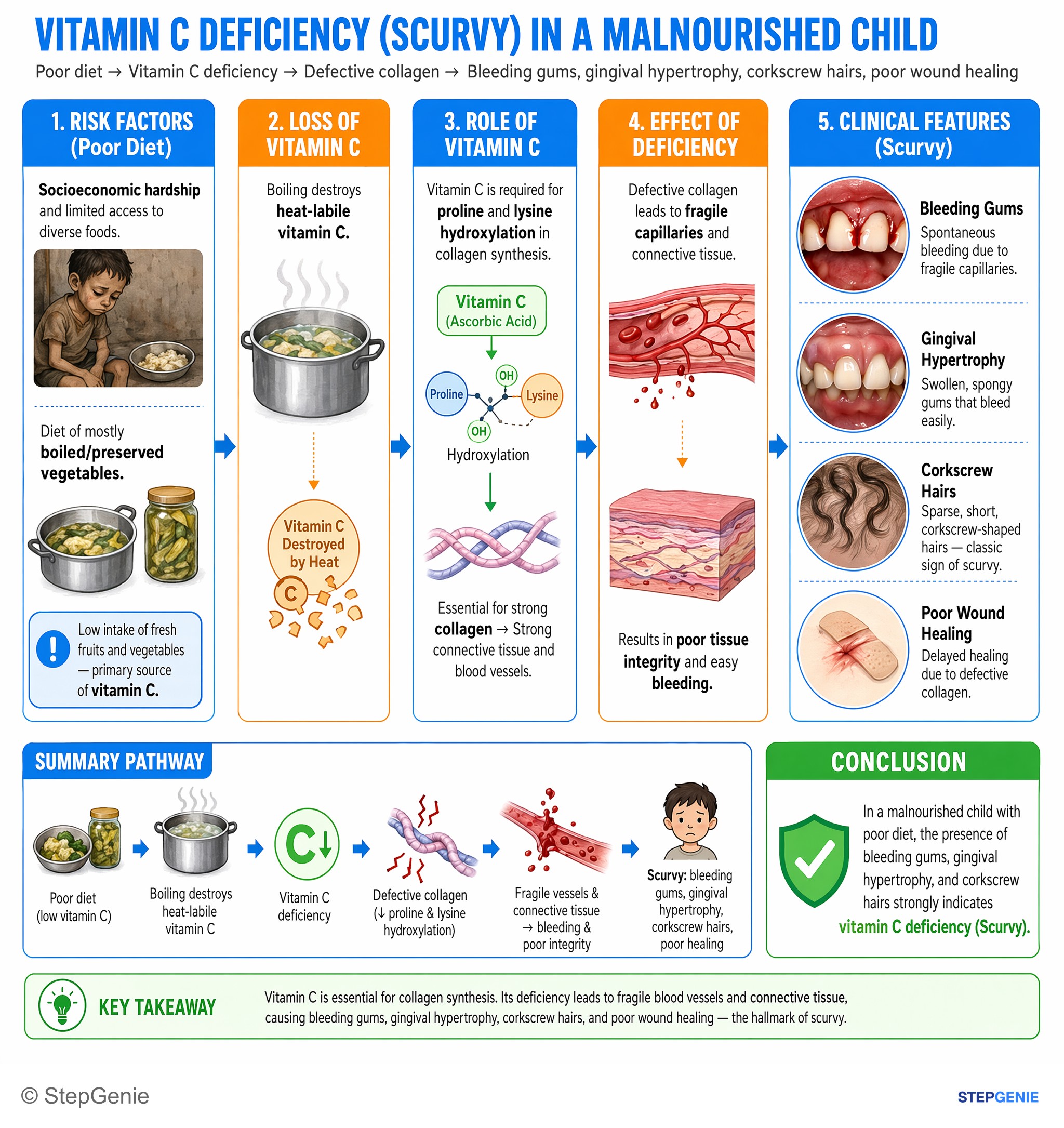
Scurvy from vitamin C deficiency → impaired collagen synthesis → bleeding gums, gingival hypertrophy, corkscrew hairs, poor wound healing…
USMLE Step 1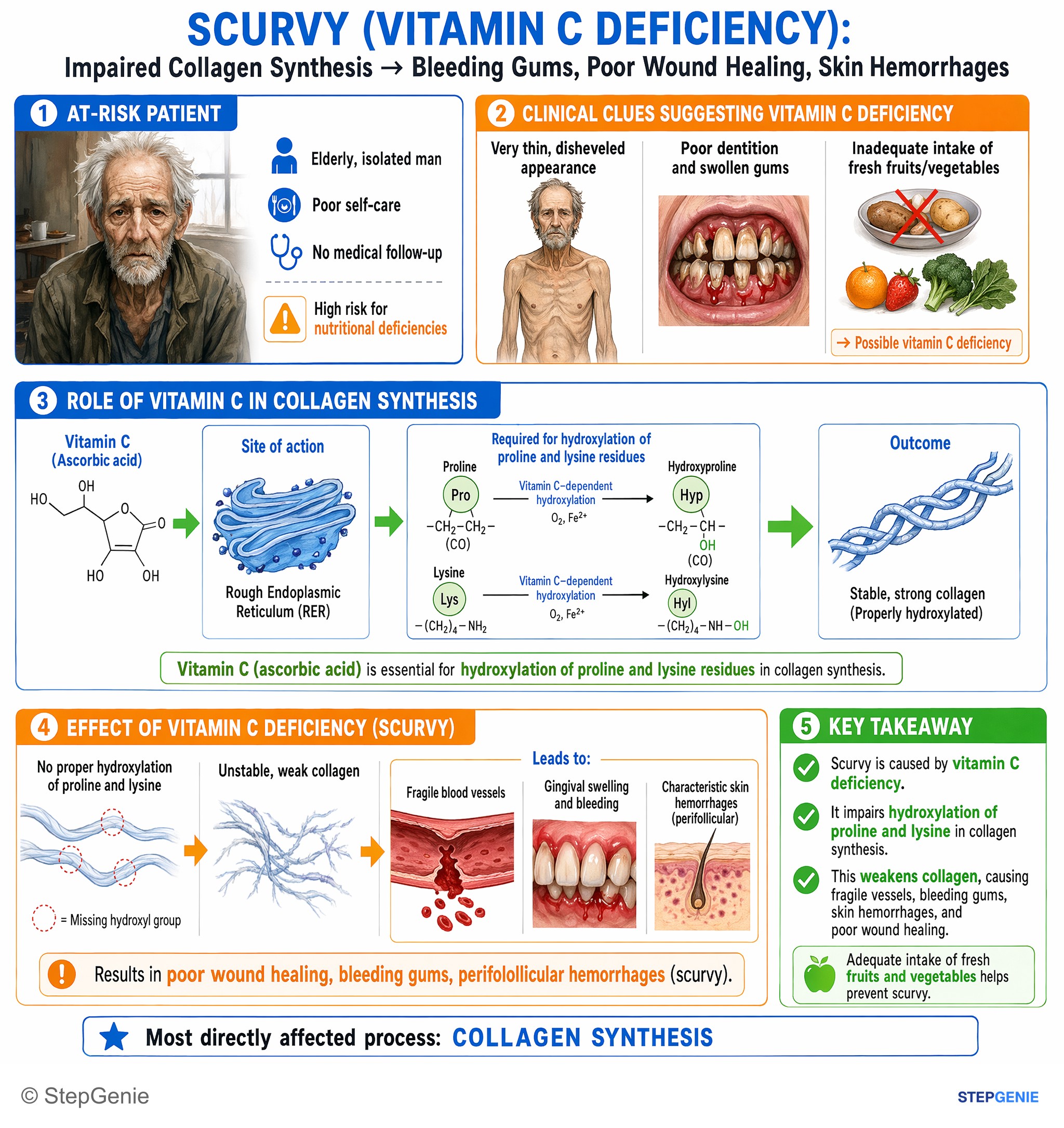
Scurvy (vitamin C deficiency) impairs hydroxylation of proline and lysine in collagen, causing poor wound healing, bleeding gums, and…
USMLE Step 1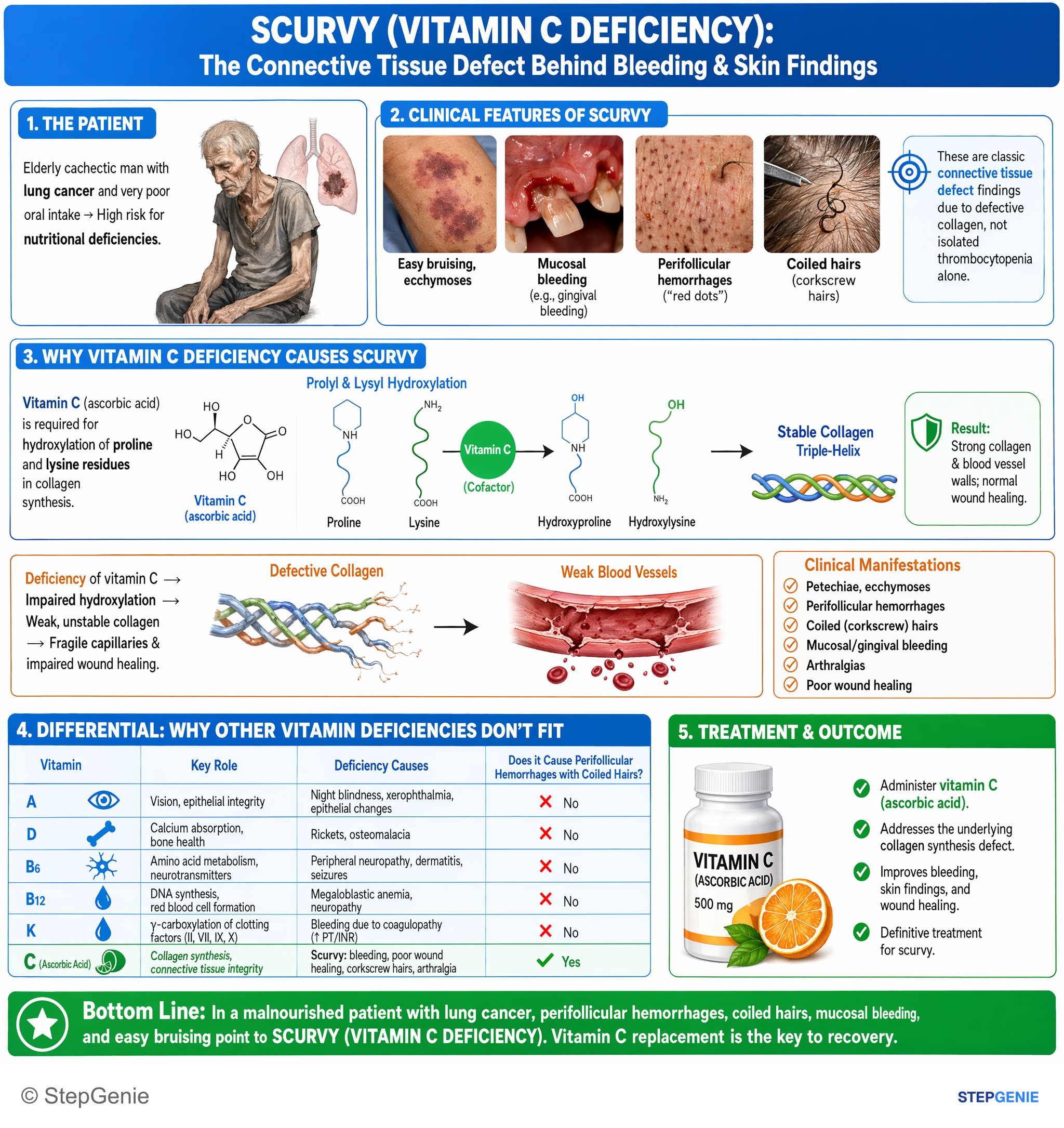
Scurvy from severe vitamin C deficiency → defective collagen cross-linking → perifollicular hemorrhages, coiled hairs, mucosal bleeding…
USMLE Step 1Frequently Asked Questions
What step of collagen synthesis is impaired in scurvy?
Scurvy impairs hydroxylation of proline and lysine residues on newly made pro-α chains in the rough endoplasmic reticulum. Prolyl and lysyl hydroxylases need vitamin C as a cofactor, so without it collagen is structurally defective, with reduced tensile strength. Later steps, such as secretion, propeptide cleavage and copper-dependent cross-linking by lysyl oxidase, are not the primary defect.
Why are coagulation tests normal in scurvy?
Scurvy bleeding comes from fragile capillaries with weak collagen, not from missing clotting factors or platelets, so bleeding, coagulation and prothrombin times are normal. That separates it from vitamin K deficiency, in which impaired carboxylation of factors II, VII, IX and X prolongs the PT. In a bleeding patient with normal clotting tests, look for perifollicular hemorrhages, corkscrew hairs and gum disease.
How is scurvy different from copper deficiency?
Both weaken collagen, but at different steps. Vitamin C is needed inside the cell, in the rough endoplasmic reticulum, for proline and lysine hydroxylation. Copper is needed outside the cell by lysyl oxidase, which cross-links collagen after secretion. Copper deficiency also causes anemia, hypopigmentation, osteoporosis and ataxia, and it is linked to excess zinc supplements, celiac disease and Menkes disease.
Who is at risk for scurvy?
Scurvy follows weeks to months of very low vitamin C intake, so it is seen in people with a very limited diet: some older adults who prepare their own food, people who misuse alcohol or drugs, food faddists, people with mental illness and occasionally children. Smoking, severe malabsorption and chronic hemodialysis also raise the risk, and infants fed boiled or evaporated milk are at risk. Affected children are irritable and hurt when moved because of bleeding beneath the periosteum.
How is scurvy treated?
Treatment is vitamin C replacement plus a better diet. One reasonable adult regimen is 500 to 1,000 mg of oral vitamin C once daily for 1 to 2 weeks, until the signs disappear, followed by a diet supplying one to two times the recommended daily intake. Therapeutic doses restore vitamin C's functions within a few days; the symptoms and signs usually clear over 1 to 2 weeks, though chronic gum disease can take longer.