Marfan questions are classic “you either see it instantly or you drown in distractors.” The trick is recognizing the pattern (tall, long limbs, lens subluxation, aortic root disease) and then using connective tissue biochemistry to explain why each answer choice is right or wrong—because the USMLE loves mixing Marfan with Ehlers-Danlos, osteogenesis imperfecta, homocystinuria, and scurvy.
Clinical Vignette (Q-bank style)
A 19-year-old man is evaluated after a near-syncope episode during basketball practice. He is 6'5" with long arms and fingers. Physical exam shows pectus excavatum and a high-arched palate. Cardiac auscultation reveals a midsystolic click. Ophthalmologic exam shows upward displacement of the lens. Echocardiography demonstrates dilation of the aortic root.
Which of the following is the most likely underlying defect?
A. Decreased hydroxylation of proline residues in collagen
B. Defective type III collagen synthesis
C. Mutation in fibrillin-1 leading to increased TGF-β signaling
D. Decreased lysyl oxidase activity due to copper deficiency
E. Deficiency of cystathionine β-synthase
The Correct Answer: C. Mutation in fibrillin-1 leading to increased TGF-β signaling
Why this is Marfan
This vignette stacks classic Marfan clues:
- Tall stature + arachnodactyly
- Pectus deformity, high-arched palate
- Mitral valve prolapse (midsystolic click)
- Aortic root dilation → risk of dissection
- Upward lens subluxation (superotemporal)
Core mechanism (what Step questions want)
Marfan syndrome is due to a mutation in FBN1 (fibrillin-1), an extracellular matrix glycoprotein that forms a scaffold for elastic fibers.
High-yield consequences:
- Weak elastic tissue → aortic root dilation, aneurysm/dissection
- Abnormal microfibrils in suspensory ligament (zonules) → upward lens displacement
- Increased TGF-β signaling (big board-relevant buzzphrase) contributes to abnormal connective tissue remodeling
Step pearl: In Marfan, the aorta shows cystic medial degeneration (fragmentation/loss of elastic fibers with mucoid material in the media).
Treatment tie-in (commonly tested)
- β-blockers reduce (shear stress) in the aorta
- ARBs (e.g., losartan) decrease TGF-β signaling (often emphasized in question explanations)
Why Every Other Answer Choice Is Wrong (and what it actually describes)
A. Decreased hydroxylation of proline residues in collagen
Diagnosis it’s pointing to: Scurvy (vitamin C deficiency)
Why it’s wrong here:
- Scurvy causes defective collagen triple-helix stability (impaired hydroxylation of proline/lysine)
- You’d expect:
- Bleeding gums, petechiae/ecchymoses
- Poor wound healing
- Corkscrew hairs
- Bone pain in kids
- It does not classically cause lens subluxation + aortic root dilation pattern like Marfan.
Biochem anchor: Vitamin C is a cofactor for prolyl and lysyl hydroxylase in the RER.
B. Defective type III collagen synthesis
Diagnosis it’s pointing to: Ehlers-Danlos syndrome (vascular type)
Why it’s wrong here:
- Type III collagen is prominent in blood vessels, uterus, skin
- Vascular EDS features:
- Thin, translucent skin
- Easy bruising
- Arterial/organ rupture
- Hypermobility (often less dramatic than classic type)
- Lens subluxation is not a hallmark, and the tall marfanoid habitus is not the typical stem.
High-yield contrast:
- Marfan: fibrillin-1 (elastic fibers), aortic root dilation, upward lens
- Vascular EDS: type III collagen, arterial rupture, fragile tissues
D. Decreased lysyl oxidase activity due to copper deficiency
Diagnosis it’s pointing to: Menkes disease (or copper deficiency states)
Why it’s wrong here:
- Lysyl oxidase cross-links collagen and elastin (extracellular, copper-dependent)
- Menkes disease features:
- Kinky/coarse hair (“steel wool”)
- Growth failure, neurodegeneration, hypotonia
- Due to impaired copper absorption/transport (ATP7A)
- A 19-year-old athlete with classic Marfan findings doesn’t fit.
Biochem anchor: Lysyl oxidase creates cross-links via oxidative deamination of lysine/hydroxylysine residues.
E. Deficiency of cystathionine β-synthase
Diagnosis it’s pointing to: Homocystinuria
Why it’s wrong here (but it’s the #1 trap): Homocystinuria can look very Marfan-like:
- Tall stature, long limbs, “marfanoid” habitus
- Osteoporosis
- Lens subluxation
So what separates them?
Key distinguishing clues
- Lens displacement:
- Marfan: upward (superotemporal)
- Homocystinuria: downward (inferonasal)
- Vascular pathology:
- Homocystinuria: thrombosis/emboli (hypercoagulable)
- Marfan: aortic aneurysm/dissection (elastic tissue weakness)
- Neuro/cognitive:
- Homocystinuria: often intellectual disability, seizures
- Marfan: normal intelligence (classically)
Biochem anchor (USMLE style):
- Cystathionine β-synthase requires vitamin B6 (pyridoxine)
- Labs: ↑ homocysteine, ↓ cysteine; methionine often ↑ (depending on defect)
- Some patients respond to B6, plus dietary methionine restriction and cysteine supplementation.
Rapid-Fire High-Yield Table: Marfan vs the Big Distractors
| Condition | Defect | Key findings | Lens | Vascular hallmark |
|---|---|---|---|---|
| Marfan | FBN1 (fibrillin-1) → ↑ TGF-β | Tall, arachnodactyly, pectus deformity, MVP | Up | Aortic root dilation/dissection |
| Homocystinuria | Cystathionine β-synthase (B6) | Marfanoid, osteoporosis, thrombosis, ID | Down | Thrombosis/embolism |
| Vascular EDS | Type III collagen | Fragile tissues, easy bruising, arterial/organ rupture | Usually normal | Arterial rupture |
| Scurvy | Vit C deficiency → ↓ hydroxylation | Bleeding gums, petechiae, poor wound healing | No | Hemorrhage (capillary fragility) |
| Menkes | Copper transport defect → ↓ lysyl oxidase | Kinky hair, neurodegeneration, growth failure | No | Connective tissue weakness (but different clinical picture) |
Exam-Day Takeaways (Biochemistry > Collagen & Connective Tissue)
- Marfan = fibrillin-1 (FBN1) → abnormal elastic fibers + ↑ TGF-β signaling
- Upward lens subluxation is a strong Marfan discriminator
- Aortic root dilation is the big lethal complication → think dissection risk
- Distractors usually test collagen processing steps:
- Hydroxylation (Vit C) → scurvy
- Cross-linking (lysyl oxidase, copper) → Menkes/copper deficiency
- Type III collagen → vascular EDS
- Homocysteine metabolism (B6/B12/folate) → homocystinuria with thrombosis + downward lens
Visual explanations from the StepGenie QBank
Infographics StepGenie drew to explain questions in its own QBank, matched to this article's topic. Each caption is the takeaway of the question it explains.
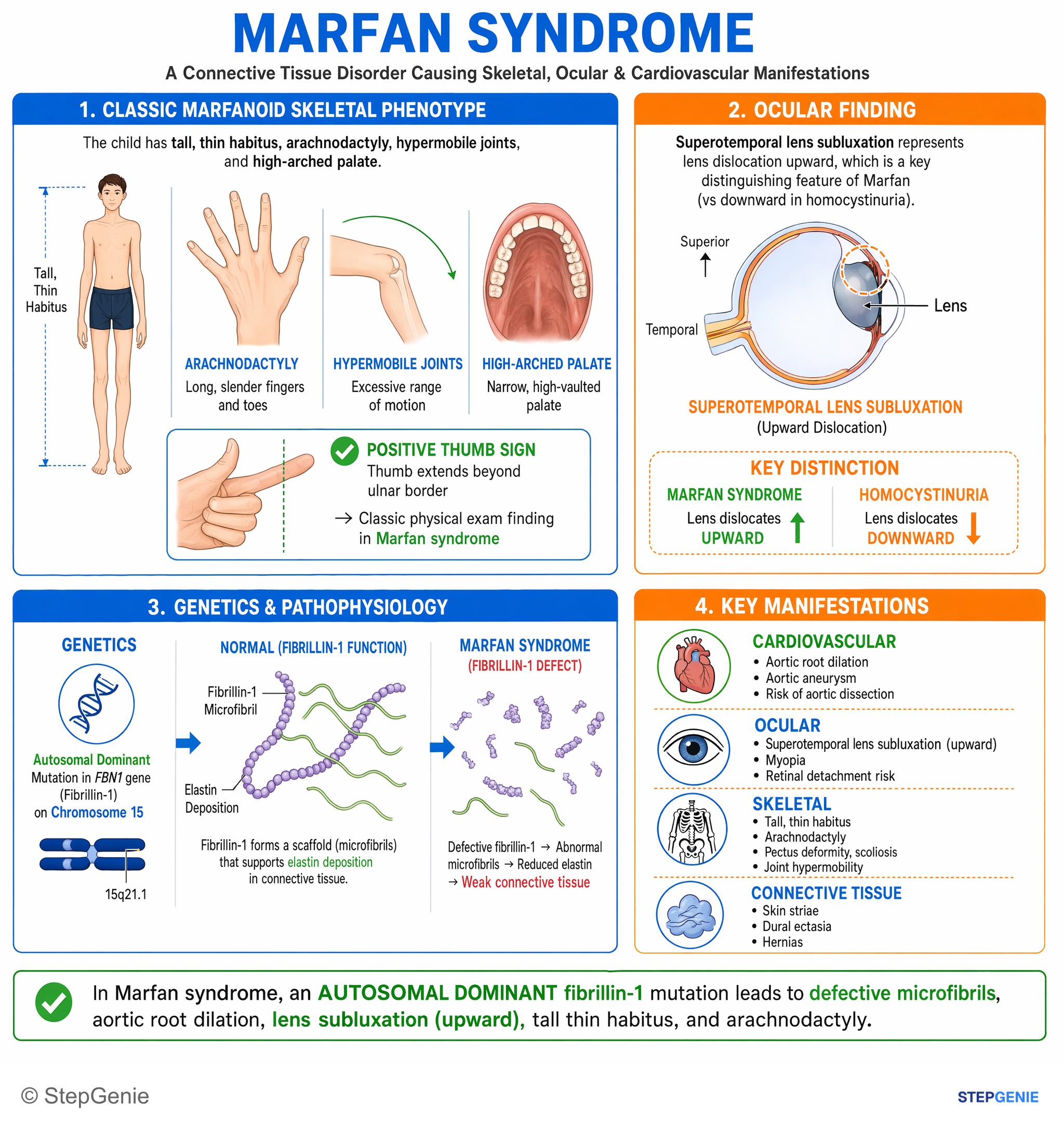
Marfan syndrome: autosomal dominant fibrillin-1 mutation → defective microfibrils, aortic root dilation, lens subluxation (upward), tall…
USMLE Step 1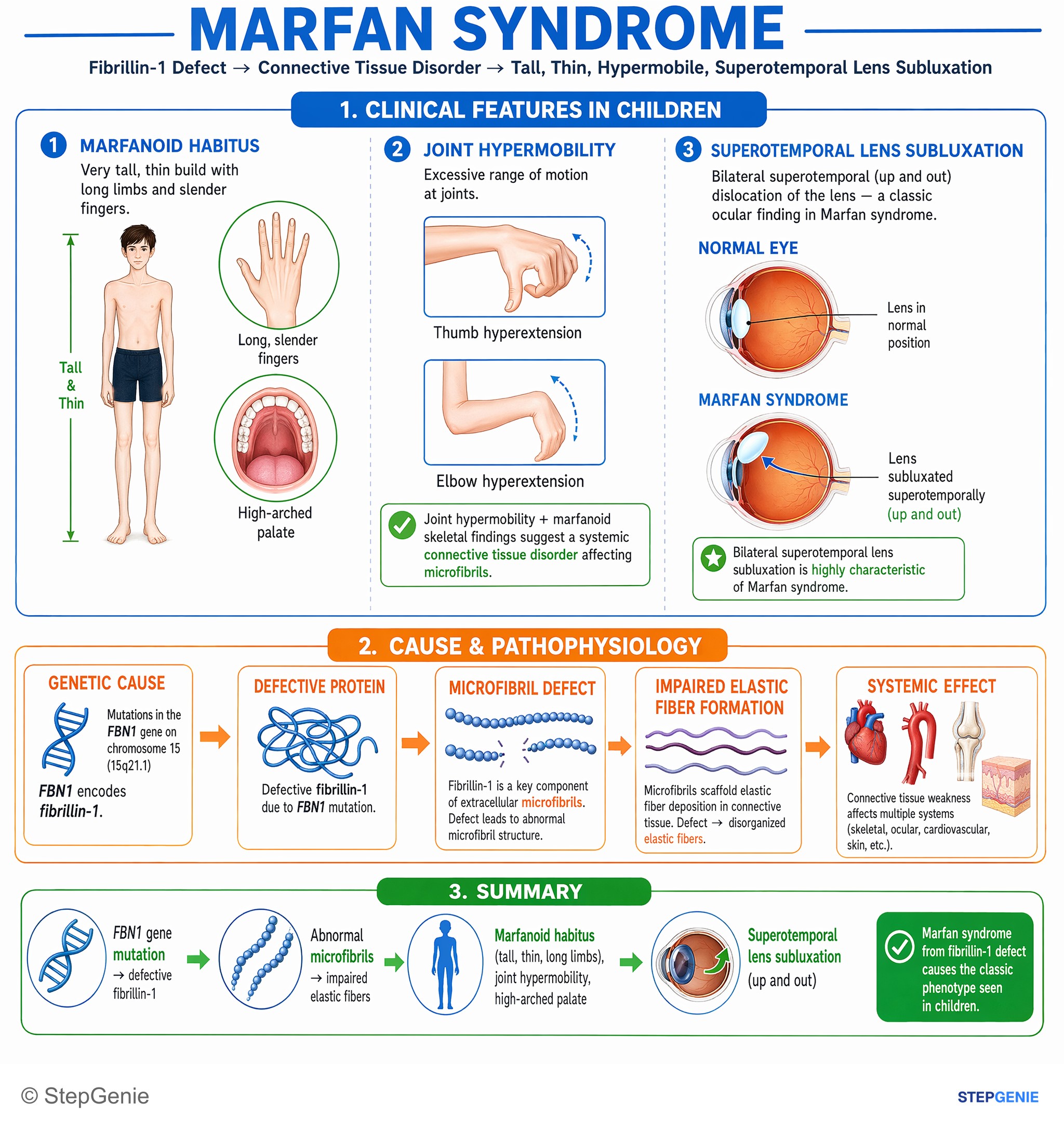
Marfan syndrome from fibrillin-1 defect causes tall, thin habitus, joint hypermobility, and superotemporal lens subluxation in children.
USMLE Step 1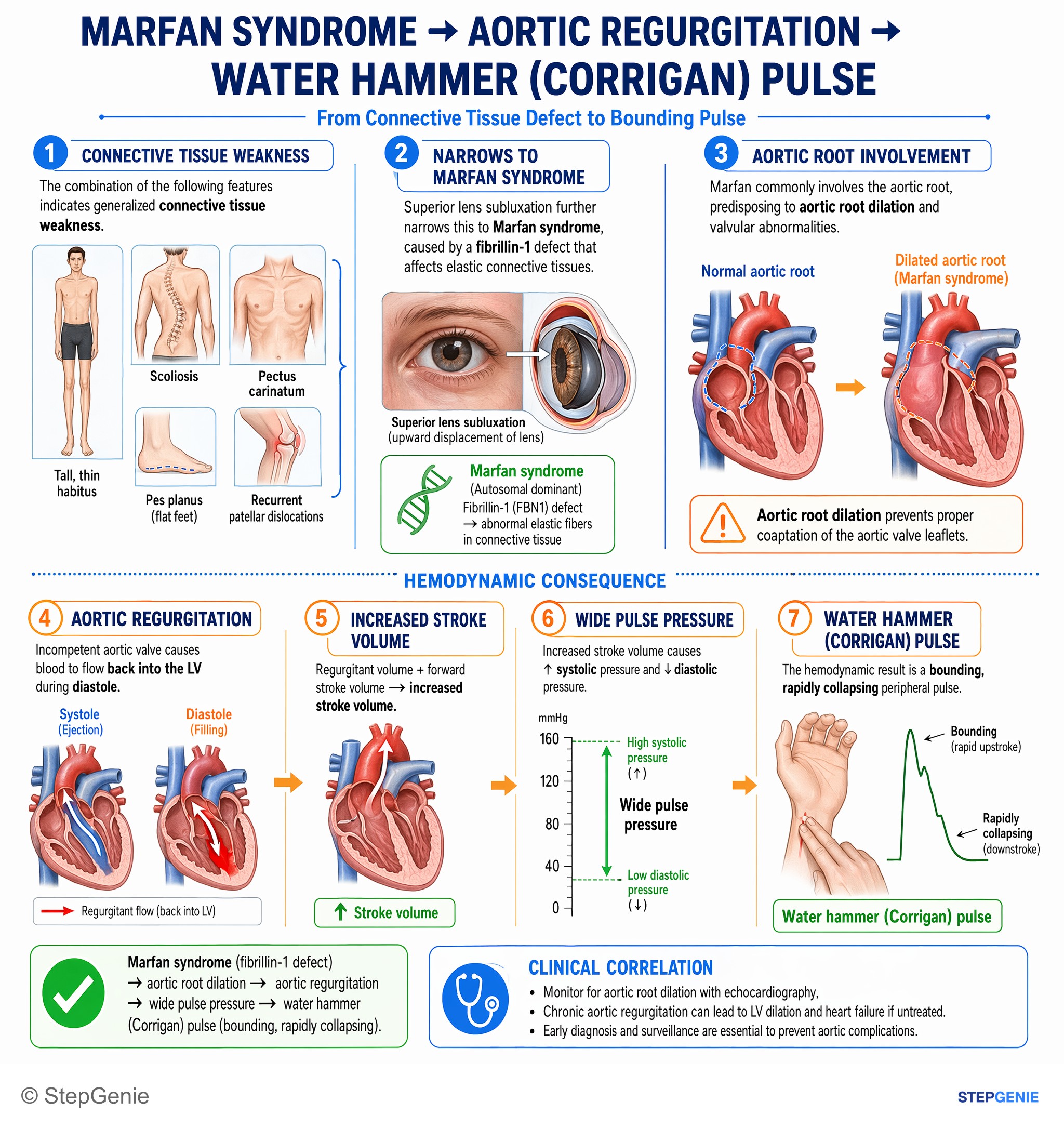
Marfan syndrome causing aortic root dilation → aortic regurgitation with wide pulse pressure and water hammer pulse (bounding, rapidly…
USMLE Step 1Frequently Asked Questions
Why does Marfan syndrome cause aortic root dilation and lens subluxation?
Marfan syndrome causes these findings because a mutation in FBN1 disrupts fibrillin-1, an extracellular matrix glycoprotein that forms a scaffold for elastic fibers. Weak elastic tissue predisposes to aortic root dilation and possible dissection, while abnormal microfibrils in the suspensory ligament of the lens lead to upward lens displacement. Increased TGF-β signaling also contributes to abnormal connective tissue remodeling.
How do you tell Marfan syndrome from homocystinuria on a vignette?
The most useful distinction is the direction of lens displacement and the type of vascular problem. Marfan syndrome causes upward lens subluxation and is associated with aortic root dilation or dissection from weak elastic tissue. Homocystinuria can also look marfanoid, but it classically causes downward lens subluxation, thrombosis or emboli, and often intellectual disability or seizures.
What is the underlying defect in Marfan syndrome?
The underlying defect is a mutation in fibrillin-1 that leads to increased TGF-β signaling. Fibrillin-1 is a structural component of the extracellular matrix and helps form the scaffold for elastic fibers. When it is abnormal, connective tissue remodeling becomes disrupted, producing classic Marfan findings such as tall stature, long limbs, mitral valve prolapse, aortic root disease, and upward lens displacement.
What treatments are commonly tested for Marfan syndrome?
The commonly tested treatments are β-blockers and ARBs such as losartan. β-blockers reduce dP/dt, which lowers shear stress on the aorta, an important issue in patients with aortic root dilation. ARBs are emphasized because they decrease TGF-β signaling, linking treatment back to the core pathophysiology of fibrillin-1 mutation and abnormal connective tissue remodeling.
How do you tell Marfan syndrome from vascular Ehlers-Danlos syndrome?
Marfan syndrome is linked to fibrillin-1 defects and presents with a tall marfanoid habitus, upward lens subluxation, and aortic root dilation. Vascular Ehlers-Danlos syndrome instead involves defective type III collagen synthesis and is characterized by thin translucent skin, easy bruising, fragile tissues, and arterial or organ rupture. Lens subluxation is not a hallmark of vascular Ehlers-Danlos, which helps separate it from Marfan.