Tumor markers are one of those Step “gotchas”: they feel like slam-dunk lab trivia, but the exam almost always tests how you use them in context—screening vs diagnosis vs prognosis vs recurrence monitoring—plus the classic distractors that sound right if you’ve only memorized a single association.
Tag: Pathology > General Pathology
The clinical vignette (Q-bank style)
A 62-year-old man with a 40-pack-year smoking history presents with progressive weight loss, jaundice, and epigastric pain radiating to the back. CT shows a 3.5-cm mass in the head of the pancreas with dilation of the common bile duct and pancreatic duct (“double duct sign”). Biopsy confirms pancreatic ductal adenocarcinoma. After a Whipple procedure and adjuvant chemotherapy, his oncologist wants to follow a serum marker that is most useful for monitoring response to therapy and detecting recurrence.
Which marker is most appropriate?
A. Alpha-fetoprotein (AFP)
B. Beta-hCG
C. CA 19-9
D. Carcinoembryonic antigen (CEA)
E. CA-125
Correct answer: C. CA 19-9
Why it’s correct
CA 19-9 is the classic tumor marker associated with pancreatic adenocarcinoma and is primarily used for:
- Monitoring treatment response
- Detecting recurrence
- Prognosis (higher levels often correlate with tumor burden)
The key Step nuance
Most tumor markers are not good screening tests because they tend to have limited sensitivity/specificity, especially in early disease. In pancreatic cancer, the diagnosis is established with imaging + histology, not a marker.
High-yield caveats they love to test
- False negatives: Patients who are Lewis antigen–negative (Le(a−b−)) can’t synthesize CA 19-9 → CA 19-9 may be low/undetectable even with advanced pancreatic cancer.
- False positives: CA 19-9 can rise with cholestasis/obstructive jaundice, pancreatitis, and other GI malignancies.
Takeaway: CA 19-9 is a monitoring/recurrence tool—useful after diagnosis.
Why every other answer choice matters (distractor autopsy)
A. Alpha-fetoprotein (AFP)
What it’s for
- Hepatocellular carcinoma (HCC)
- Yolk sac (endodermal sinus) tumor
- Sometimes elevated in chronic hepatitis/cirrhosis (not cancer-specific)
Why it’s wrong here
- The clinical picture is pancreatic head adenocarcinoma (painless jaundice, double duct sign). AFP doesn’t help you track pancreatic cancer.
USMLE pearl
- If you see liver mass + cirrhosis + high AFP, think HCC.
- Yolk sac tumor clue: Schiller-Duval bodies + AFP.
B. Beta-hCG
What it’s for
- Choriocarcinoma
- Germ cell tumors (especially testicular nonseminomatous, can be mixed)
- Can be ectopically produced by some tumors (rarely a board-style twist)
Why it’s wrong here
- Beta-hCG doesn’t track pancreatic adenocarcinoma. It’s a germ cell/gestational trophoblastic marker.
USMLE pearl
- A classic pairing:
- AFP → yolk sac tumor
- β-hCG → choriocarcinoma
- LDH → tumor burden in testicular cancer (esp seminoma)
D. Carcinoembryonic antigen (CEA)
What it’s for
- Classically colorectal carcinoma (monitoring recurrence)
- Also associated with pancreatic and gastric cancers and some lung/breast cancers (less specific)
Why it’s not the best answer
- Even though CEA can be elevated in pancreatic cancer, CA 19-9 is the preferred marker for monitoring pancreatic adenocarcinoma in most test-style contexts.
USMLE pearl
- CEA can be elevated in smokers and inflammatory states → don’t treat it like a clean diagnostic test.
- In a post-colectomy patient, rising CEA = think recurrence/metastasis.
E. CA-125
What it’s for
- Epithelial ovarian cancer (especially serous)
- Monitoring treatment response and recurrence
- Can be elevated in benign conditions (endometriosis, menstruation, pregnancy, pelvic inflammatory disease)
Why it’s wrong here
- The vignette is pancreatic adenocarcinoma, not ovarian malignancy.
USMLE pearl
- A common trap is confusing CA-125 with CA 19-9. Anchor them:
- CA-125 = ovarian
- CA 19-9 = pancreatic
The “what are tumor markers actually for?” framework (high yield)
Tumor markers are best thought of as clinical tools—not diagnoses.
What they do well
- Monitor response to therapy (trend down = good sign)
- Detect recurrence (trend up after remission = concerning)
- Sometimes help with prognosis (higher = more tumor burden)
What they usually don’t do well
- Screening average-risk populations
(Too many false positives/negatives; low prevalence makes PPV poor.)
Testable epidemiology principle: even a “pretty good” test performs badly as a screening test when the disease prevalence is low.
Rapid-reference table: high-yield tumor markers
| Tumor marker | Classic association | Best use on exams | Common confounders |
|---|---|---|---|
| CA 19-9 | Pancreatic adenocarcinoma (also cholangiocarcinoma) | Monitor treatment/recurrence | Cholestasis, pancreatitis; Lewis antigen–negative patients |
| CEA | Colorectal cancer (also pancreatic/gastric) | Monitor recurrence | Smoking, inflammation |
| AFP | HCC, yolk sac tumor | Support dx + monitoring | Hepatitis/cirrhosis can elevate |
| β-hCG | Choriocarcinoma, germ cell tumors | Diagnosis support + monitoring | Can be produced by some non-germ tumors |
| CA-125 | Epithelial ovarian cancer | Monitor/recurrence | Endometriosis, pregnancy, PID |
| PSA | Prostate adenocarcinoma | Screening with shared decision-making + monitoring | Prostatitis, BPH, manipulation |
| Calcitonin | Medullary thyroid carcinoma | Diagnosis support + monitoring | MEN2 association |
| Thyroglobulin | Papillary/follicular thyroid cancer | Monitor recurrence after thyroidectomy | Not useful if thyroid tissue remains |
| BCR-ABL (t(9;22)) | CML, some ALL | Diagnosis + treatment monitoring | Molecular marker (not serum) |
| CA 15-3 / CA 27-29 | Breast cancer | Monitor metastatic disease | Not for screening |
Quick “distractor decoding” tips for test day
When the question asks for a marker, first identify what the marker is being used for:
- Screening? Usually the answer is “not appropriate” unless the test is explicitly used in a screening program (and even then, Step often wants you to critique it).
- Diagnosis confirmation? Often not—most markers are supportive, not definitive.
- Monitoring therapy or recurrence? This is the sweet spot for tumor markers.
Then match the clinical context:
- Pancreas → CA 19-9
- Colon → CEA
- Ovary (epithelial) → CA-125
- HCC/yolk sac → AFP
- Choriocarcinoma → β-hCG
Bottom line
In pancreatic ductal adenocarcinoma, CA 19-9 is the go-to marker for monitoring treatment response and recurrence, not for making the diagnosis. And the distractors aren’t random—they’re testing whether you can separate “association I memorized” from “clinical use that actually fits the vignette.”
Visual explanations from the StepGenie QBank
Infographics StepGenie drew to explain questions in its own QBank, matched to this article's topic. Each caption is the takeaway of the question it explains.
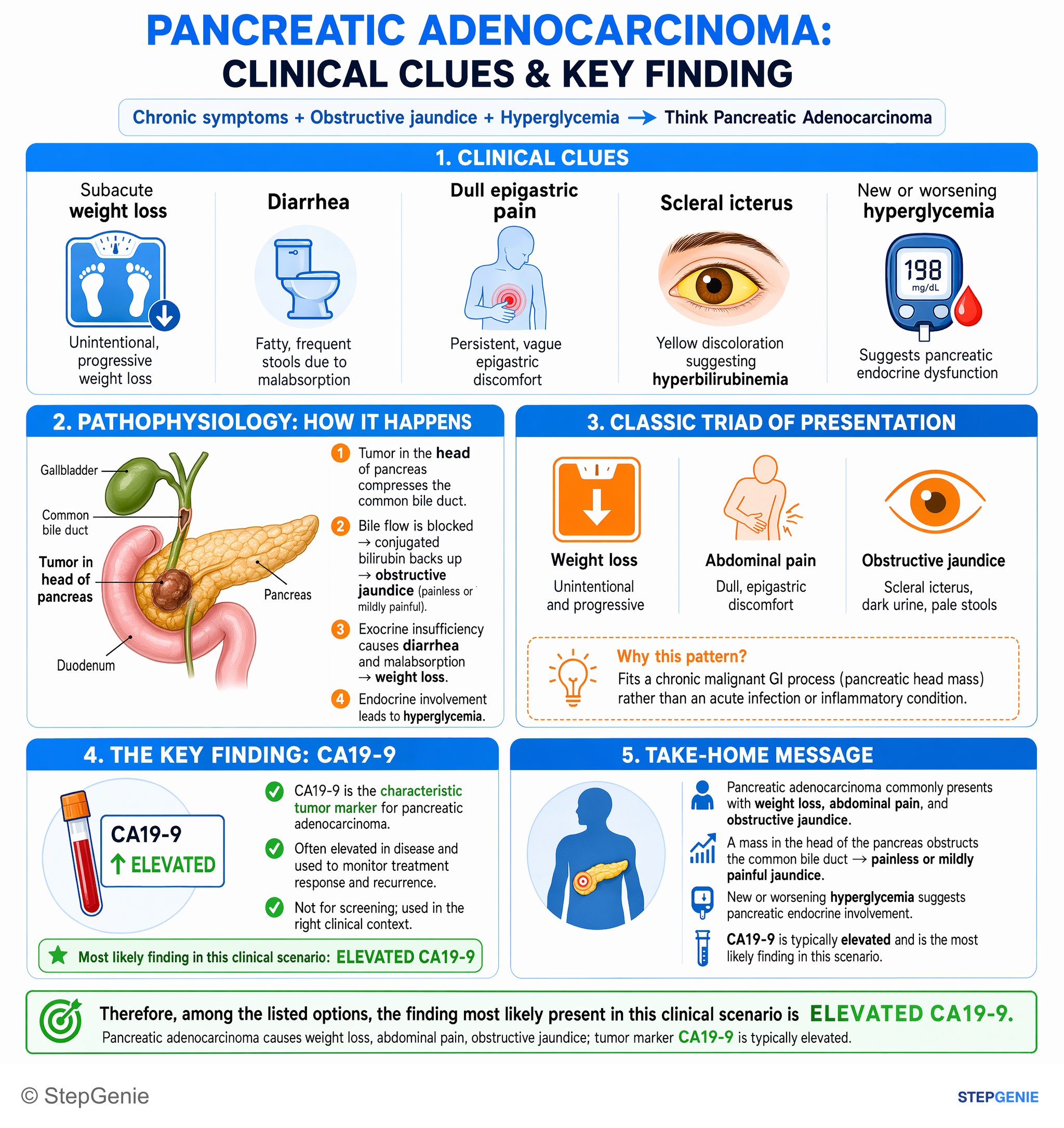
Pancreatic adenocarcinoma causes weight loss, abdominal pain, obstructive jaundice; tumor marker CA19-9 is typically elevated.
USMLE Step 1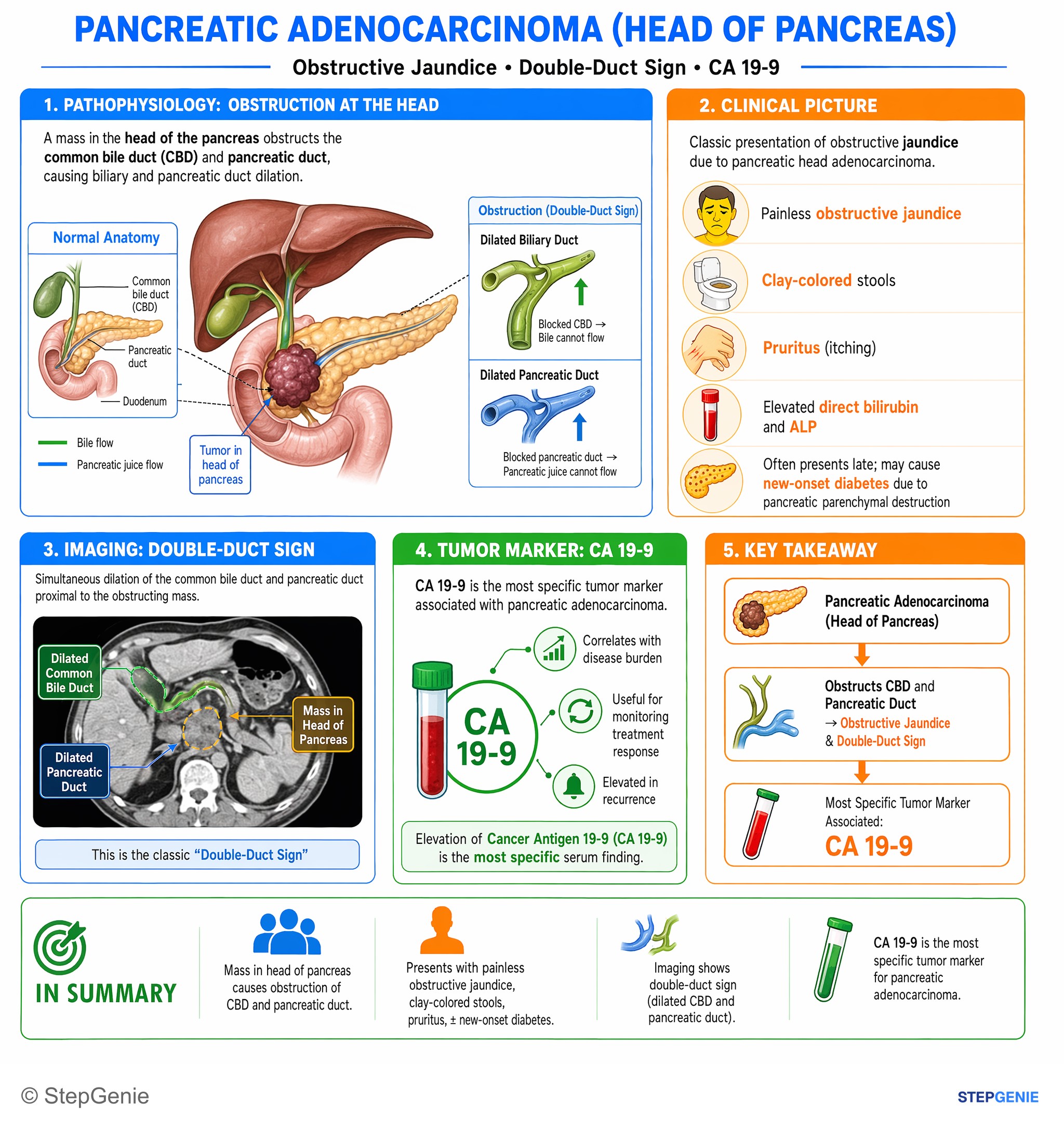
Pancreatic adenocarcinoma (head of pancreas) → obstructive jaundice, double-duct sign; most specific associated tumor marker is CA 19-9.
USMLE Step 1Frequently Asked Questions
What is the best tumor marker to follow after treatment of pancreatic adenocarcinoma?
CA 19-9 is the best marker to follow after treatment of pancreatic adenocarcinoma. It is primarily used to monitor response to therapy, detect recurrence, and sometimes help with prognosis because higher levels often correlate with tumor burden. It is most useful after the diagnosis has already been established, rather than as a standalone way to identify the cancer initially.
Why isn’t CA 19-9 used to diagnose or screen for pancreatic cancer?
CA 19-9 is not a good screening or diagnostic test for pancreatic cancer because tumor markers generally have limited sensitivity and specificity, especially in early disease. Pancreatic cancer is diagnosed with imaging and histology, not with a serum marker alone. CA 19-9 is more useful once the cancer is already known, especially for monitoring treatment response and recurrence.
What can cause a false positive or false negative CA 19-9 level?
CA 19-9 can be falsely elevated in cholestasis or obstructive jaundice, pancreatitis, and other gastrointestinal malignancies, so a high value is not specific for pancreatic adenocarcinoma. It can also be falsely low or undetectable in patients who are Lewis antigen–negative because they cannot synthesize CA 19-9, even when advanced pancreatic cancer is present.
How do you tell CA 19-9 from CEA on exam questions?
CA 19-9 is the preferred marker for monitoring pancreatic adenocarcinoma, whereas CEA is classically associated with colorectal carcinoma and is used to monitor recurrence there. Although CEA can also be elevated in pancreatic cancer, it is less specific and is not the best answer in a pancreatic adenocarcinoma vignette. CEA can also rise in smokers and inflammatory states, which makes it a less clean marker.
What are tumor markers actually useful for on exams?
Tumor markers are most useful as clinical tools for monitoring response to therapy, detecting recurrence, and sometimes providing prognostic information. They are usually not good screening tests for average-risk populations because false positives and false negatives are common, and low disease prevalence worsens test performance. On exams, the key is recognizing when a marker is being used after diagnosis rather than as the primary diagnostic test.