On test day, oncogenes and tumor suppressors are free points if you keep two ideas straight: oncogenes are “stuck ON” growth signals (gain-of-function), while tumor suppressors are “lost brakes” (loss-of-function). This one-page cheat sheet gives you the fastest way to classify genes, predict inheritance patterns, and recognize the classic USMLE pairings.
The 10-second framework (the whole game)
Oncogenes = gas pedal stuck down
- Mutation type: Gain-of-function
- Alleles needed: 1 hit (single allele activation is enough)
- Typical mechanism: Point mutation, amplification, translocation → overactive pro-growth
- Inheritance pattern (familial cancer): Autosomal dominant at the cellular level
- Buzzwords: “constitutively active,” “increased expression,” “tyrosine kinase”
Tumor suppressors = brakes cut
- Mutation type: Loss-of-function
- Alleles needed: 2 hits (both alleles must be inactivated in a cell)
- Typical mechanism: Deletion, nonsense/frameshift, promoter hypermethylation → loss of restraint
- Inheritance pattern (familial cancer): Autosomal dominant inheritance of a predisposition but recessive at the cellular level (second hit acquired)
- Buzzwords: “two-hit hypothesis,” “loss of heterozygosity (LOH),” “gatekeeper/caretaker”
Visual mnemonic device: “Car cancer model”
Picture a car headed downhill:
- Oncogene = gas pedal glued down (GO!)
One jammed pedal is enough to speed up the car. - Tumor suppressor = brakes cut (STOP!)
Usually both brakes have to fail before you lose control.
One-liner you can write on scratch paper:
Oncogenes: 1 hit = GO. Tumor suppressors: 2 hits = STOP.
Rapid comparison table (memorize this)
| Feature | Oncogenes | Tumor suppressor genes |
|---|---|---|
| Normal role | Promote growth/survival when appropriate | Restrain growth, repair DNA, induce apoptosis |
| Mutation effect | Gain-of-function | Loss-of-function |
| Hits required | 1 | 2 (classically) |
| Cellular behavior | Dominant | Recessive |
| Common mutation types | Point mutation, amplification, translocation | Deletion, truncation, promoter hypermethylation, LOH |
| Classic USMLE phrase | “Constitutively active” | “Two-hit hypothesis” |
High-yield oncogenes (GO genes) — quick hits + one-liners
RAS
- Mechanism: GTPase signal transduction
- High-yield mutation: Loss of GTPase activity → RAS stuck in GTP-bound active state
- One-liner: RAS can’t turn itself off → constant proliferation signals.
MYC
- Mechanism: Transcription factor → drives cell cycle progression
- Classic association: Burkitt lymphoma
- Translocation: t(8;14) (MYC to Ig heavy chain)
- One-liner: MYC moved next to Ig promoter → B cells overexpress MYC.
BCR-ABL
- Mechanism: Constitutively active tyrosine kinase
- Classic association: CML, some ALL
- Translocation: t(9;22) Philadelphia chromosome
- One-liner: BCR-ABL = always-on TK → uncontrolled myeloid proliferation.
HER2/neu (ERBB2)
- Mechanism: Receptor tyrosine kinase
- Classic association: Breast cancer, gastric cancer
- Often via amplification
- One-liner: More HER2 receptors → more growth signaling.
ALK
- Mechanism: Tyrosine kinase fusion proteins
- Classic association: Some NSCLC, anaplastic large cell lymphoma
- One-liner: ALK fusion = new always-on growth driver.
High-yield tumor suppressors (STOP genes) — quick hits + one-liners
TP53
- Role: “Guardian of the genome” — halts cell cycle, activates DNA repair, triggers apoptosis
- Checkpoint: G1/S via p21 (inhibits cyclin-CDK)
- Syndrome: Li-Fraumeni (multiple cancers at young age)
- One-liner: If p53 is gone, DNA-damaged cells don’t stop or die.
RB (retinoblastoma gene)
- Role: Brakes the G1 → S transition by binding E2F
- Hypophosphorylated RB binds E2F (brake on)
- Phosphorylation releases E2F (brake off)
- Classic association: Retinoblastoma, osteosarcoma
- One-liner: Loss of RB → E2F always free → constant S-phase entry.
APC
- Role: Downregulates β-catenin (Wnt pathway brake)
- Classic association: FAP → colon cancer
- One-liner: Loss of APC → β-catenin accumulates → transcription of pro-growth genes.
BRCA1/BRCA2
- Role: Homologous recombination DNA repair (double-strand break repair)
- Classic association: Breast/ovarian cancer risk (also others)
- Therapy tie-in: PARP inhibitors (synthetic lethality concept)
- One-liner: Lose BRCA → double-strand breaks persist → genomic instability.
PTEN
- Role: Tumor suppressor phosphatase that inhibits PI3K/AKT signaling
- Classic association: Endometrial cancer, Cowden syndrome
- One-liner: Loss of PTEN removes the brake on survival signaling.
NF1 / NF2
- NF1: Negative regulator of RAS (a “RAS-GAP”) → loss increases RAS signaling
- NF2: Merlin; loss linked with schwannomas/meningiomas
- One-liner: NF genes normally restrain growth pathways—loss promotes tumors.
The “two-hit” nuance USMLE loves
Tumor suppressors: inherited cancer predisposition
If a patient inherits one bad allele of a tumor suppressor, they’re one step away from tumor formation.
- First hit: germline mutation (present in all cells)
- Second hit: somatic loss (deletion, mutation, methylation) in a specific cell
- Result: early-onset tumors, often multiple/bilateral (classic for RB)
Key phrase: Autosomal dominant predisposition + recessive at cellular level.
What about mismatch repair genes? (the “caretakers”)
MLH1, MSH2, MSH6, PMS2 (DNA mismatch repair) are tumor suppressors that maintain genome integrity.
- Syndrome: Lynch syndrome (HNPCC)
- Mechanism: Microsatellite instability
- One-liner: Lose mismatch repair → replication errors accumulate fast, especially in microsatellites.
Mini drill: classify in seconds
If you see…
- Translocation creating a fusion kinase → think oncogene (e.g., BCR-ABL)
- Amplification of a receptor → think oncogene (e.g., HER2)
- “Two-hit hypothesis,” LOH → think tumor suppressor (e.g., RB, TP53, APC)
- DNA repair gene loss → still tumor suppressor (caretaker) (e.g., BRCA, MMR genes)
One-page recap (copy/paste ready)
- Oncogenes: Gain-of-function, 1 hit, “gas pedal,” dominant at cellular level
- Examples: RAS, MYC, BCR-ABL, HER2, ALK
- Tumor suppressors: Loss-of-function, 2 hits, “brakes,” recessive at cellular level
- Examples: TP53, RB, APC, BRCA1/2, PTEN, MMR genes
- Exam trap to avoid: Familial tumor suppressor syndromes can look “dominant” in pedigrees, but cells still need both alleles knocked out.
Visual explanations from the StepGenie QBank
Infographics StepGenie drew to explain questions in its own QBank, matched to this article's topic. Each caption is the takeaway of the question it explains.
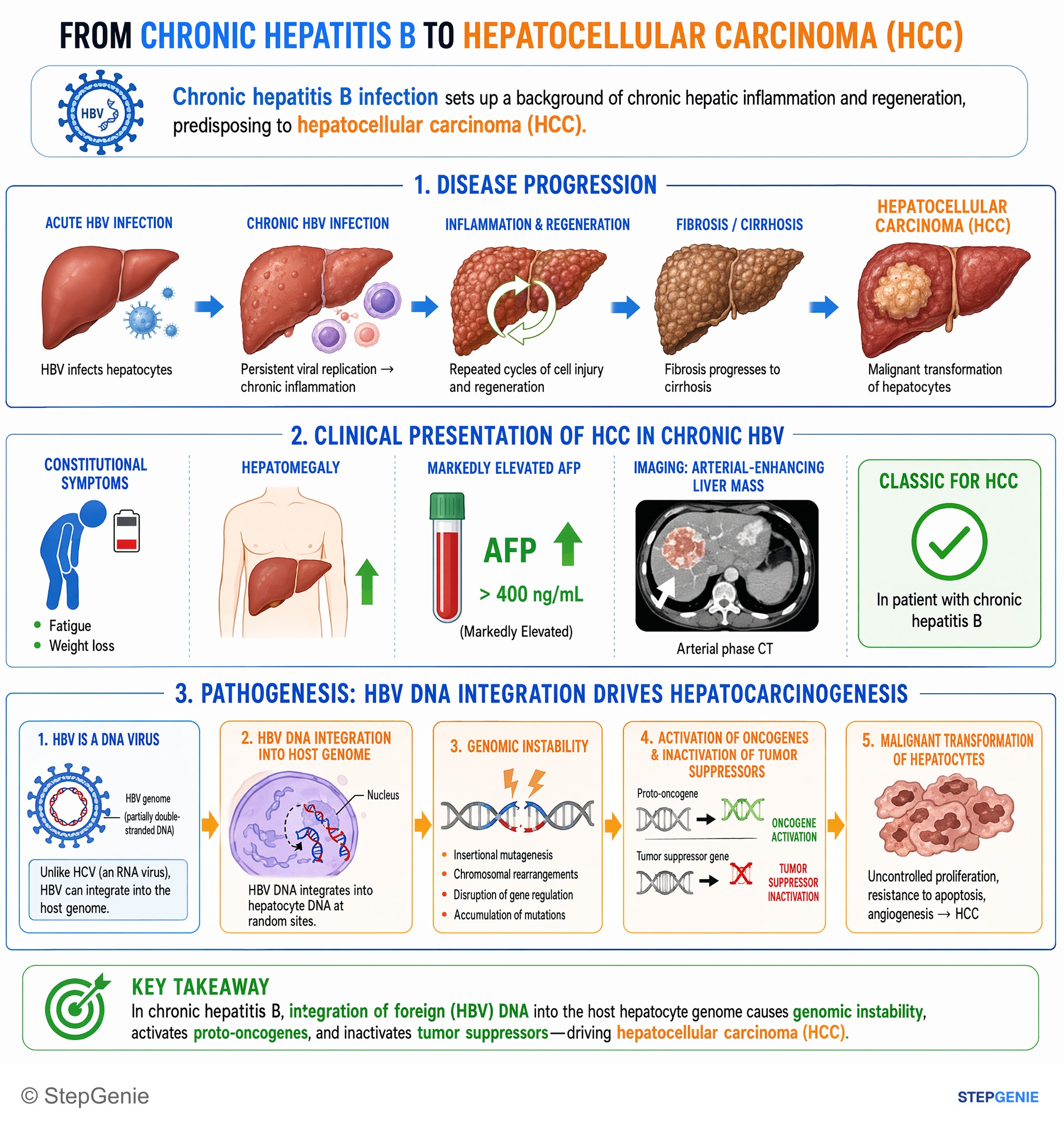
Hepatocellular carcinoma in chronic hepatitis B arises via HBV DNA integration causing genomic instability and oncogene activation in…
USMLE Step 1Frequently Asked Questions
How do you quickly tell an oncogene from a tumor suppressor on exam day?
The fastest rule is that oncogenes are gain-of-function genes with 1 hit, while tumor suppressors are loss-of-function genes with 2 hits. Oncogenes act like a gas pedal stuck down, so a single activated allele can drive growth. Tumor suppressors act like lost brakes, so both alleles usually must be inactivated before a cell loses growth restraint.
Why are oncogenes considered dominant but tumor suppressors considered recessive at the cellular level?
Oncogenes are dominant at the cellular level because one activated allele is enough to create an overactive growth signal. Tumor suppressors are recessive at the cellular level because both alleles generally need to be lost before the brake on growth is removed. That is why the classic memory aid is "1 hit = GO" for oncogenes and "2 hits = STOP" for tumor suppressors.
Why does a RAS mutation cause constant proliferation signaling?
A RAS mutation causes constant proliferation signaling because loss of its GTPase activity leaves RAS stuck in the GTP-bound active state. Normally, RAS participates in signal transduction and can turn itself off. When that shutoff is lost, RAS stays active and continuously sends pro-growth signals, making it a classic oncogene mechanism.
How does loss of RB push cells into S phase?
Loss of RB pushes cells into S phase because RB normally restrains the G1-to-S transition by binding E2F. In its hypophosphorylated state, RB keeps the brake on by holding E2F. When RB is lost, E2F is effectively always free, so the cell is driven toward constant S-phase entry and uncontrolled proliferation.
Why do inherited tumor suppressor syndromes cause early-onset or multiple tumors?
Inherited tumor suppressor syndromes cause early-onset or multiple tumors because the patient already has the first hit in the germline and is only one additional somatic hit away from tumor formation. The second hit can occur by deletion, mutation, or methylation in a specific cell. This explains the classic pattern of early tumors and often multiple or bilateral disease, especially with RB.