You just opened a q-bank question that looks deceptively simple: a guy with infertility and “bag of worms.” Easy—varicocele. But Step-style questions aren’t testing whether you can recognize the buzzword; they’re testing whether you understand why it happens, what it causes, and how to distinguish it from the look-alikes in the answer choices.
This post walks through a classic clinical vignette, nails the correct answer, and then explains each distractor the way the NBME wants you to think.
Tag: Reproductive > Male Reproductive
The Clinical Vignette (Classic Q-Bank Style)
A 24-year-old man presents for evaluation of infertility. He and his partner have been trying to conceive for 18 months. He has no history of STIs and no prior surgeries. On exam, the left hemiscrotum feels like a “bag of worms,” which becomes more prominent when he stands and improves when he lies down. Testes are otherwise normal in size. Semen analysis shows decreased sperm motility.
Question: What is the most likely diagnosis (or mechanism), and what is the best next step?
The Correct Answer: Varicocele
What it is
A varicocele is dilation of the pampiniform plexus (a venous network draining the testis).
Why it happens (mechanism)
- Most commonly due to incompetent valves in the internal spermatic (testicular) vein
- Leads to venous pooling → increased scrotal temperature
- Heat impairs spermatogenesis (testes are supposed to be cooler than core body temperature)
Why it’s usually on the left
- The left testicular vein drains into the left renal vein (at a right angle), which has higher venous pressure
- The right testicular vein drains directly into the IVC (typically lower pressure)
- Nutcracker phenomenon (compression of the left renal vein, classically between the SMA and aorta) can worsen left-sided venous congestion
Key clinical clues (high yield)
- “Bag of worms” on palpation
- Worse with standing/Valsalva, improves supine (gravity-dependent venous distention)
- Often associated with male infertility
- Semen analysis: classically oligospermia and/or decreased motility (quality issues)
Why Varicocele Affects Fertility (Step-1/2 High Yield)
The pampiniform plexus acts like a countercurrent heat exchanger to cool arterial blood before it reaches the testis. Venous dilation disrupts that cooling, increasing intratesticular temperature and impairing sperm production and function.
Commonly tested association:
- Varicocele → subfertility
- It’s one of the most common correctable causes of male infertility.
Management (What Step 2 Often Wants)
When to treat
Treatment is generally considered when there is:
- Infertility with abnormal semen parameters and
- A palpable varicocele (not just seen on imaging) and
- A partner with reasonable fertility potential / no absolute contraindications
How to treat
- Varicocelectomy or percutaneous embolization can improve semen parameters in selected patients.
Practical exam tip: For a symptomatic/palpable varicocele in an infertile man with abnormal semen analysis, the “next best step” may be urology referral for possible repair.
The Answer Choices: Why Every Distractor Matters
Below are common distractors paired with exactly how they differ from a varicocele.
Distractor 1: Hydrocele
What they’ll say: “Scrotal swelling” or “fluid around the testis.”
Why it’s wrong here
- Hydrocele is fluid accumulation in the tunica vaginalis
- Typically transilluminates with light
- Often feels like a smooth, nontender swelling, not a “bag of worms”
- Doesn’t classically worsen with standing and improve supine the same way a varicocele does
High-yield association
- In adults: can be due to trauma, infection, tumor
- In infants: often due to patent processus vaginalis
| Feature | Varicocele | Hydrocele |
|---|---|---|
| Feel | “Bag of worms” | Smooth/fluid-filled |
| Transillumination | No | Yes |
| Worse standing | Yes | Not a classic feature |
| Infertility link | Yes | Not typical |
Distractor 2: Indirect Inguinal Hernia
What they’ll say: “Mass extends into scrotum” or “bulge with coughing.”
Why it’s wrong here
- Indirect hernia = patent processus vaginalis; passes lateral to inferior epigastric vessels
- Often reducible and may have bowel sounds
- It’s a mass that may increase with Valsalva—but it’s not the venous “wormy” texture
Key differentiator
- Hernia often presents as a groin/scrotal bulge more than a scrotal “bag of worms,” and it may be reduced manually.
Distractor 3: Testicular Torsion
What they’ll say: “Acute scrotal pain,” “absent cremasteric reflex.”
Why it’s wrong here
- Torsion is acute onset, severe unilateral pain
- Often high-riding testis, transverse lie
- Absent cremasteric reflex
- This vignette is chronic and infertility-focused, with positional changes typical of venous dilation
High-yield pearl
- Torsion is a surgical emergency: do not delay detorsion for imaging if clinical suspicion is high.
Distractor 4: Epididymitis
What they’ll say: “Scrotal pain, dysuria, relief with elevation (Prehn sign).”
Why it’s wrong here
- Epididymitis is usually painful, with possible urinary symptoms
- Prehn sign may be positive (pain relief with elevation), though not perfectly reliable
- May be associated with:
- Chlamydia/gonorrhea in younger sexually active men
- E. coli in older men / urinary tract pathology
- Does not classically create a “bag of worms”
Distractor 5: Testicular Cancer
What they’ll say: “Painless testicular mass.”
Why it’s wrong here
- Testicular cancer is typically a firm, nontransilluminating intratesticular mass
- Not described as compressible “worms”
- Varicocele is extratesticular (venous plexus), not a discrete intratesticular lesion
Critical Step warning
- A new right-sided varicocele or a varicocele that does not reduce when supine raises concern for retroperitoneal mass/renal cell carcinoma causing venous obstruction (classically involving the renal vein/IVC).
Distractor 6: “Renal cell carcinoma causing varicocele”
This one can be a trick within the trick.
When it’s actually correct
- Acute onset, especially in an older man
- Right-sided varicocele
- Varicocele that does not decompress when supine
- +/- hematuria, flank pain, weight loss
Why it’s wrong in the classic vignette
- Young patient, chronic symptoms, left-sided that improves supine → typical benign varicocele due to valve incompetence
High-Yield Varicocele One-Liners (USMLE Gold)
- Most common side: left (left testicular vein → left renal vein)
- Classic exam: “bag of worms,” worse standing/Valsalva, improves supine
- Fertility: associated with low sperm count and decreased motility due to increased temperature
- Red flag: sudden onset, right-sided, or non-reducible varicocele → consider retroperitoneal mass/RCC
- Treatment consideration: palpable varicocele + infertility + abnormal semen → consider repair (varicocelectomy/embolization)
Quick “Pick the Diagnosis” Table
| Condition | Key Clue | Transilluminates? | Pain? | Positional change? |
|---|---|---|---|---|
| Varicocele | “Bag of worms,” infertility | No | Usually no | Worse standing, better supine |
| Hydrocele | Smooth fluid around testis | Yes | Usually no | Minimal |
| Indirect hernia | Reducible mass, cough impulse | No | Variable | Often worsens with Valsalva |
| Torsion | Acute pain, absent cremasteric reflex | No | Yes | Not the key feature |
| Epididymitis | Pain + urinary/STI symptoms | No | Yes | Sometimes improved with elevation |
| Testicular cancer | Firm intratesticular mass | No | Usually no | No |
Takeaway: The “Bag of Worms” Isn’t the Point—The Pattern Is
If you recognize the pattern—left-sided compressible venous mass that worsens with standing and is linked to infertility—you can eliminate distractors quickly. Then you earn the extra points by knowing the exceptions (non-reducible, right-sided, older patient → think obstruction/malignancy).
Visual explanations from the StepGenie QBank
Infographics StepGenie drew to explain questions in its own QBank, matched to this article's topic. Each caption is the takeaway of the question it explains.
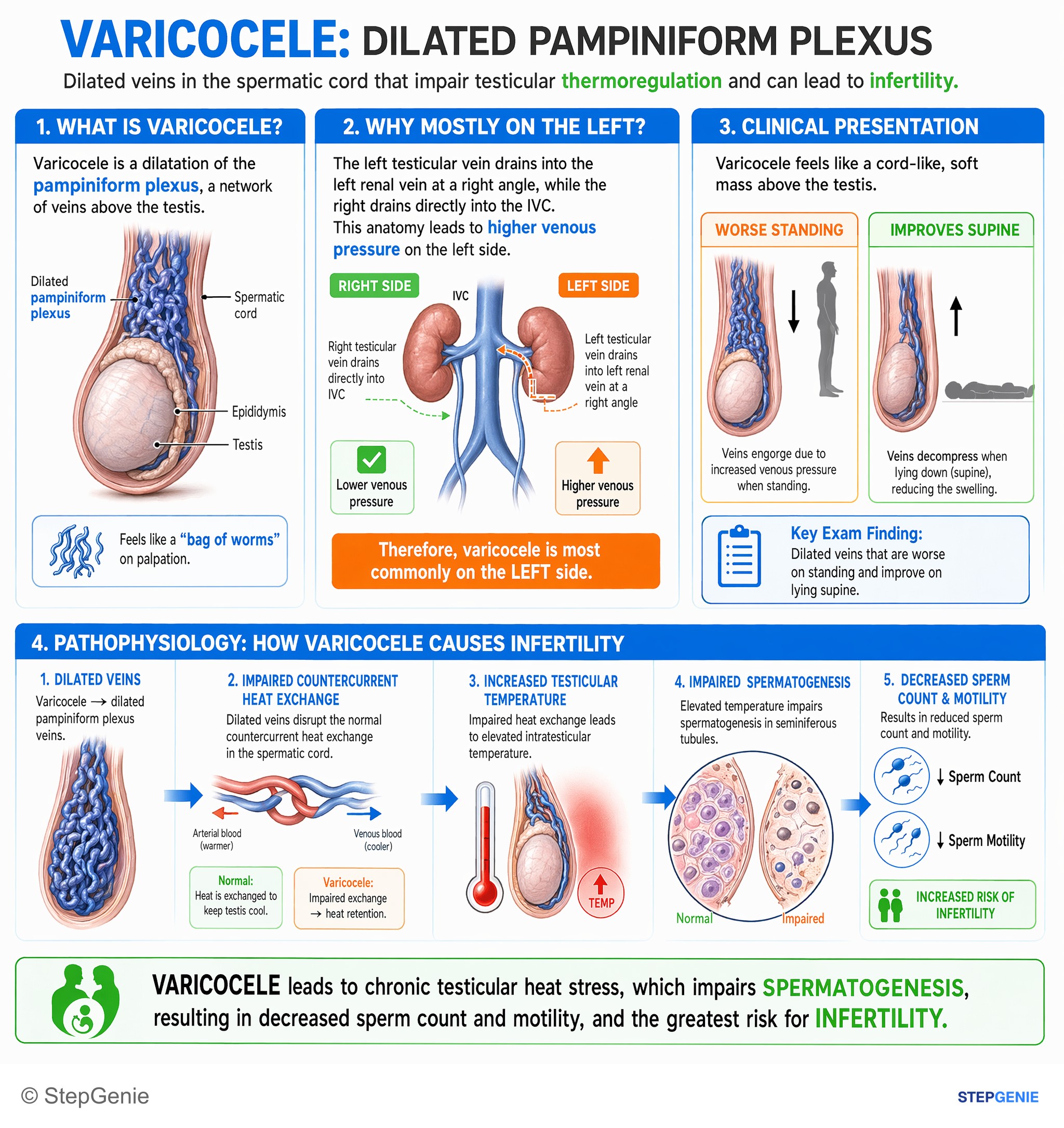
Varicocele from dilated pampiniform plexus (bag of worms, worse standing, better supine) impairs testicular thermoregulation → decreased…
USMLE Step 2Frequently Asked Questions
Why is a varicocele usually on the left side?
A varicocele is usually left-sided because the left testicular vein drains into the left renal vein at a right angle, which creates higher venous pressure than the right side. The right testicular vein drains directly into the IVC, where pressure is typically lower. Compression of the left renal vein, called the nutcracker phenomenon, can further worsen left-sided venous congestion.
How does a varicocele cause infertility?
A varicocele causes infertility by impairing the testis’s cooling system. The pampiniform plexus normally acts as a countercurrent heat exchanger to cool arterial blood before it reaches the testis. When this venous plexus becomes dilated, cooling is disrupted, intratesticular temperature rises, and sperm production and function are impaired, leading to findings such as oligospermia or decreased sperm motility.
How do you tell a varicocele from a hydrocele on exam?
A varicocele feels like a “bag of worms,” becomes more prominent with standing or Valsalva, improves when the patient lies down, and is linked to infertility. A hydrocele, by contrast, is fluid in the tunica vaginalis that usually feels smooth and nontender and classically transilluminates with light. Hydroceles do not typically show the same gravity-dependent positional changes as a varicocele.
How do you distinguish varicocele from an indirect inguinal hernia in a scrotal mass question?
A varicocele is an extratesticular venous dilation with a characteristic wormy texture and positional change, becoming worse with standing and better when supine. An indirect inguinal hernia is due to a patent processus vaginalis and usually presents as a groin or scrotal bulge rather than a bag of worms. Hernias are often reducible manually and may have bowel sounds.
What is the next best step for an infertile man with a palpable varicocele and abnormal semen analysis?
The next best step is urology referral for possible repair. Treatment is generally considered when an infertile man has abnormal semen parameters and a palpable varicocele, especially if the partner has reasonable fertility potential and no absolute contraindications. The repair options named are varicocelectomy or percutaneous embolization, which can improve semen parameters in selected patients.