A teenage boy rolls into the ED with sudden, severe unilateral scrotal pain and nausea. You already know this is a “don’t-miss” scenario—but on USMLE-style questions, the real points come from recognizing torsion fast and proving you can eliminate the distractors just as fast. Let’s walk through a classic vignette and then dissect why every answer choice matters.
The Clinical Vignette (USMLE Style)
A 16-year-old boy presents with acute onset left testicular pain that started 2 hours ago while he was sitting in class. He feels nauseated and vomited once. He denies dysuria or urethral discharge. On exam, the left testis is high-riding and horizontally oriented. The scrotum is swollen and exquisitely tender. Cremasteric reflex is absent on the left. Elevation of the testis does not relieve pain.
Question: What is the best next step in management?
Answer choices (example set):
A. Manual detorsion and outpatient follow-up
B. Color Doppler ultrasound of the scrotum
C. Immediate surgical exploration and detorsion
D. Treat with ceftriaxone and doxycycline
E. Reassure the patient; pain will resolve spontaneously
The Correct Answer: Immediate Surgical Exploration and Detorsion (C)
Why this is torsion
This stem is loaded with high-yield torsion clues:
- Sudden onset, severe unilateral pain
- Nausea/vomiting (very common in torsion; think visceral pain response)
- High-riding, transverse/horizontal testis
- Absent cremasteric reflex (one of the most testable findings)
- No urinary symptoms (doesn’t rule out epididymitis, but pushes you toward torsion)
- No relief with elevation (negative Prehn sign)
What you do next (the algorithm USMLE expects)
- If suspicion is high, do not delay for imaging → immediate surgical exploration
- Goal: restore blood flow and fix both testes (orchiopexy bilaterally)
Time is testis
Ischemic injury risk rises fast. Common teaching thresholds:
- < 6 hours: highest salvage rates
- 6–12 hours: rapidly falling salvage
- > 12–24 hours: often nonviable
What the surgeon actually does
- Detorsion + assess viability
- Orchiopexy of affected testis (if viable)
- Contralateral orchiopexy always (the anatomic predisposition is usually bilateral)
Classic predisposing anatomy: Bell-clapper deformity (failure of normal posterior anchoring of the testis → increased mobility → torsion risk)
Why the Other Answer Choices Are Wrong (and What They’re Trying to Teach)
A. Manual detorsion and outpatient follow-up
Why it’s tempting: You may remember “open-book detorsion” as an emergency maneuver.
Why it’s not the best answer here:
- Manual detorsion is a bridge, not definitive care.
- It can fail, only partially detorse, or detorse the wrong direction.
- Even if pain improves, the patient still needs urgent surgical exploration and bilateral orchiopexy.
High-yield detail:
- Typical maneuver: rotate the testis laterally (“opening a book”), because torsion often twists medially. But don’t bet the testicle on guessing direction.
B. Color Doppler ultrasound of the scrotum
Why it’s tempting: Doppler is commonly used to evaluate acute scrotum.
When it’s correct:
- When suspicion is intermediate or unclear, and ultrasound will not delay care.
Why it’s wrong in this stem:
- This vignette screams torsion. With high pretest probability, imaging risks delay and testicular loss.
- USMLE loves the principle: treat first when the diagnosis is clinically clear and time-sensitive.
What Doppler would show in torsion:
- Decreased or absent blood flow to affected testis
- Sometimes “whirlpool sign” (twisted spermatic cord)
C. Immediate surgical exploration and detorsion ✅
This is the move when the exam is classic and the clock is ticking.
D. Treat with ceftriaxone and doxycycline
This is the “epididymitis/orchitis” management answer.
Why it’s wrong here:
- Epididymitis tends to be more gradual onset, often with:
- Dysuria, frequency
- Urethral discharge
- Sometimes fever
- Exam more often shows:
- Tenderness localized to epididymis (posterior testis)
- Cremasteric reflex preserved
- Pain may improve with elevation (positive Prehn sign)—not perfectly reliable, but classic teaching
Step-relevant treatment patterns:
- Age < 35 or STI risk: ceftriaxone + doxycycline
- Older men / urinary pathogens: fluoroquinolone (e.g., levofloxacin) depending on resistance/local guidance
Key takeaway: Don’t let “acute scrotal pain” auto-trigger antibiotics. Torsion is the diagnosis you must rule out first.
E. Reassure the patient; pain will resolve spontaneously
Why it’s wrong:
- Torsion is a surgical emergency. Waiting risks infarction, loss of testis, infertility, and antisperm antibody formation.
USMLE framing: Any option that implies “watchful waiting” in a classic torsion vignette is essentially a trap.
Rapid-Fire Differentials: How USMLE Separates Them
| Diagnosis | Onset | Key Exam Findings | Reflex | Other Clues | Next Step |
|---|---|---|---|---|---|
| Testicular torsion | Sudden | High-riding, transverse testis; diffuse tenderness | Absent cremasteric | N/V common; adolescent | Immediate surgery if high suspicion |
| Epididymitis | Gradual | Epididymal tenderness (posterior), swelling | Usually present | Dysuria/discharge, fever | Antibiotics (after ruling out torsion) |
| Torsion of appendix testis | Subacute | Localized upper pole tenderness | Present | “Blue dot” sign | Supportive (NSAIDs) |
| Incarcerated hernia | Acute | Scrotal mass, groin bulge | Variable | Bowel obstruction sx | Surgical eval |
| Testicular trauma/hematoma | After injury | Ecchymosis, swelling | Present | History gives it away | US/surgery depending |
High-Yield USMLE Pearls (Memorize These)
- Absent cremasteric reflex = highly suggestive of torsion.
- Cremasteric reflex pathway: L1–L2 (genitofemoral nerve).
- Bell-clapper deformity predisposes to torsion (often bilateral) → bilateral orchiopexy.
- Do not delay definitive management for imaging when torsion is obvious.
- Nausea/vomiting with acute scrotal pain should raise your torsion suspicion.
- Manual detorsion can be attempted while preparing for surgery, not instead of surgery.
How This Shows Up on Step (Pattern Recognition)
USMLE often tests torsion in one of three ways:
- Classic adolescent with sudden pain + absent cremasteric reflex → OR now
- “Should we get Doppler?” → Only if suspicion is equivocal and it won’t delay
- Distractor battle (epididymitis vs torsion) → onset, urinary symptoms, reflex
If you can confidently say: sudden + high-riding + absent cremasteric = torsion until proven otherwise, you’ll pick up points even when the vignette is dressed up.
Visual explanations from the StepGenie QBank
Infographics StepGenie drew to explain questions in its own QBank, matched to this article's topic. Each caption is the takeaway of the question it explains.
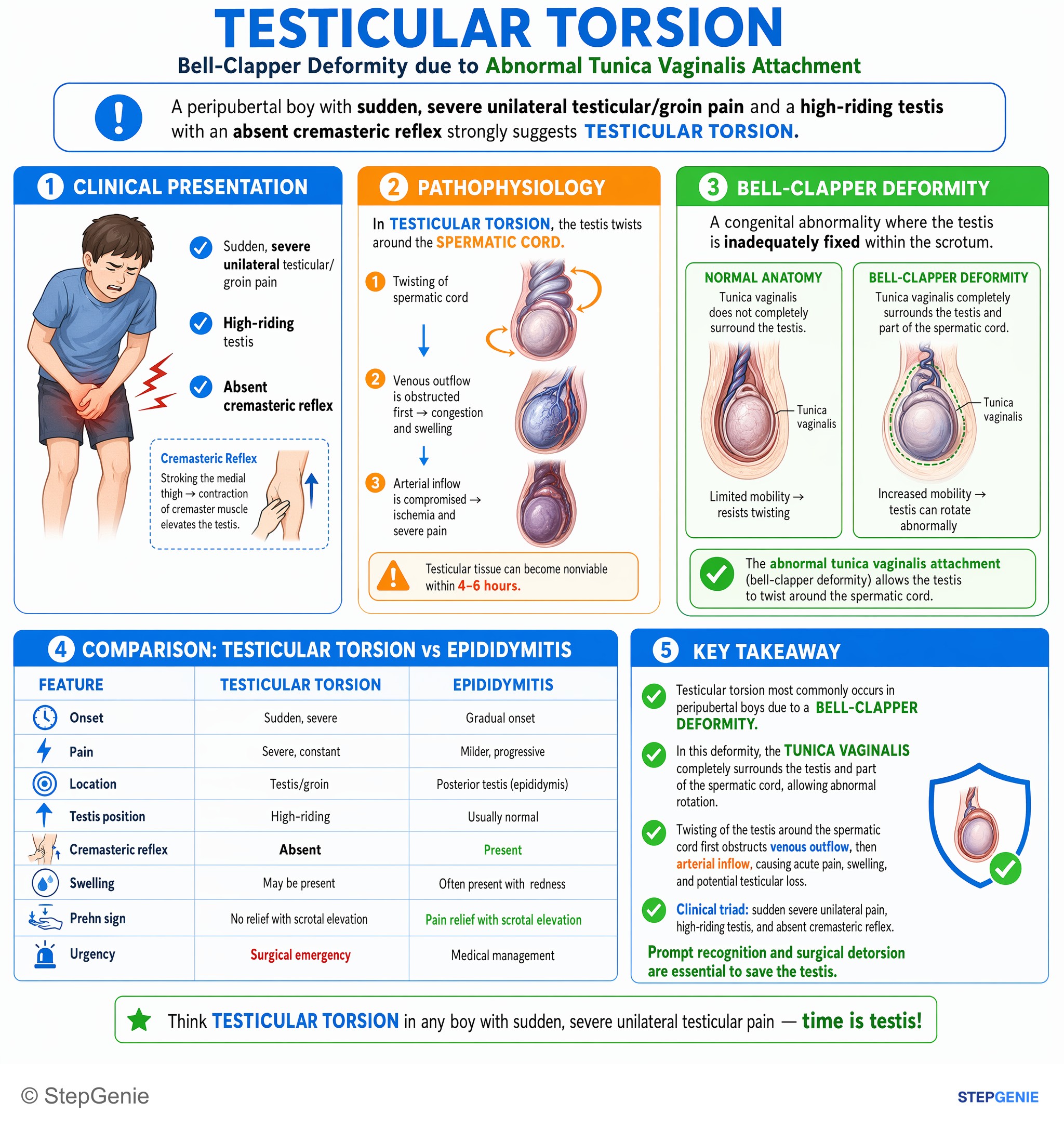
Testicular torsion from a bell-clapper deformity due to abnormal tunica vaginalis attachment → sudden severe testicular pain, high-riding…
USMLE Step 1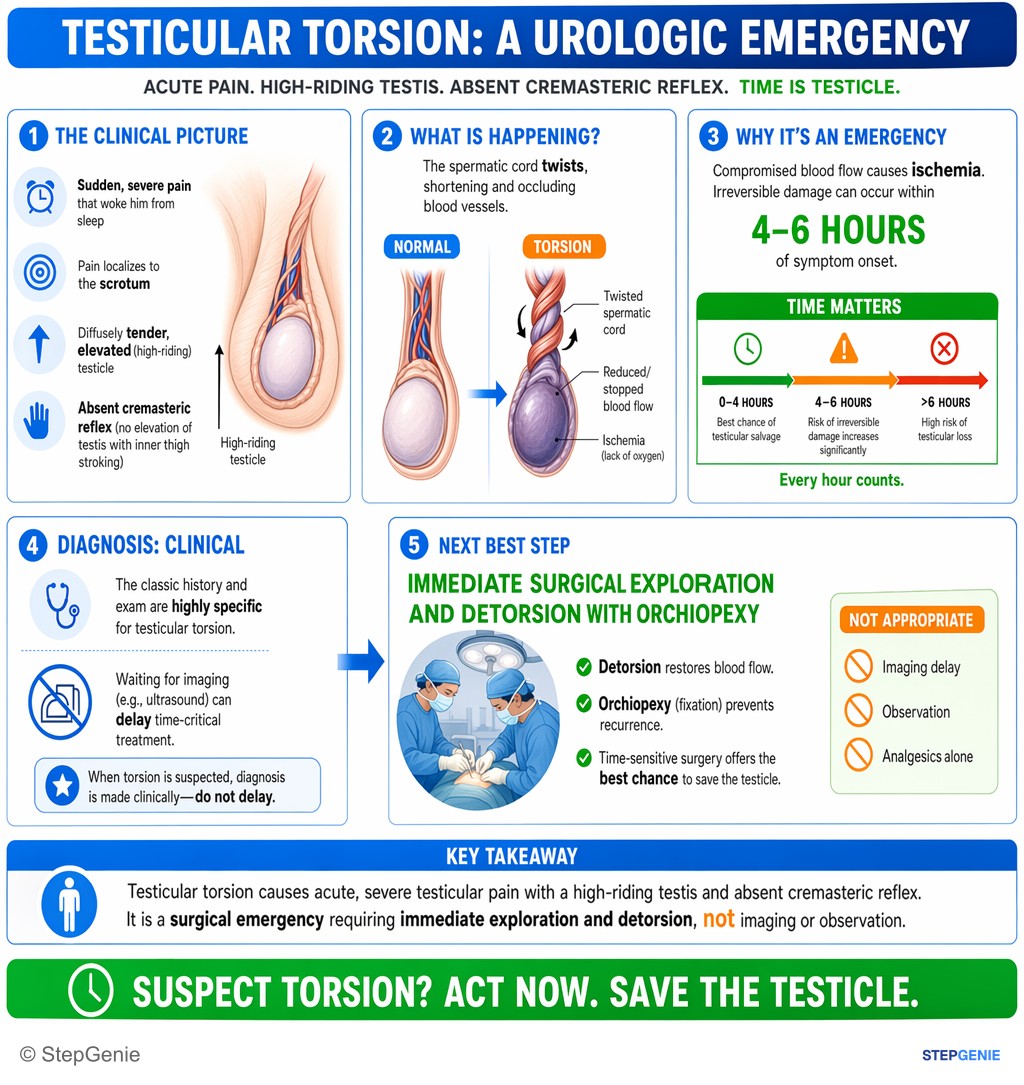
Testicular torsion causes acute severe testicular pain with high-riding testis and absent cremasteric reflex; requires immediate surgical…
USMLE Step 2Frequently Asked Questions
What is the best next step when a patient has classic signs of testicular torsion?
Immediate surgical exploration and detorsion is the best next step when the presentation is classic for testicular torsion. A patient with sudden severe unilateral testicular pain, nausea or vomiting, a high-riding horizontally oriented testis, and an absent cremasteric reflex has a high pretest probability of torsion. In that setting, imaging should not delay treatment because ischemic injury risk rises quickly and testicular salvage falls with time.
When should you get a Doppler ultrasound instead of going straight to surgery for suspected testicular torsion?
Color Doppler ultrasound is appropriate when suspicion is intermediate or the diagnosis is unclear and imaging will not delay care. It is not the best next step when the vignette strongly suggests torsion, because waiting for imaging can delay detorsion and increase the risk of testicular loss. In torsion, Doppler typically shows decreased or absent blood flow, and sometimes a whirlpool sign from a twisted spermatic cord.
How do you tell testicular torsion from epididymitis on exam?
Testicular torsion usually has sudden onset pain with a high-riding transverse testis, diffuse tenderness, an absent cremasteric reflex, nausea or vomiting, and no pain relief with elevation. Epididymitis is usually more gradual and often comes with dysuria, frequency, urethral discharge, or fever. On exam, epididymitis more often causes tenderness localized to the epididymis, preserves the cremasteric reflex, and may improve with testicular elevation.
Why isn’t manual detorsion with outpatient follow-up enough for testicular torsion?
Manual detorsion is not enough because it is only a bridge, not definitive treatment. It can fail, only partially untwist the spermatic cord, or even be attempted in the wrong direction. Even if pain improves after manual detorsion, the patient still needs urgent surgical exploration and bilateral orchiopexy. Definitive management is surgery because the goal is to restore blood flow and prevent recurrence.
Why do both testes get fixed during surgery for testicular torsion?
Both testes are fixed because the anatomic predisposition to torsion is usually bilateral. The classic underlying problem is a bell-clapper deformity, where normal posterior anchoring of the testis fails, making the testis excessively mobile and prone to twisting. During surgery, the affected testis is detorsed and assessed for viability, and contralateral orchiopexy is performed as well to reduce future torsion risk.