You’re cruising through a Q-bank block when a “painful scrotum” vignette pops up—and suddenly every option sounds plausible: torsion, orchitis, hernia, cancer. The key to crushing these questions isn’t just knowing epididymitis; it’s knowing why the other answer choices are wrong. That’s what separates a lucky guess from a repeatable strategy on test day.
Tag: Reproductive > Male Reproductive
The Vignette (Classic Q-Bank Style)
A 22-year-old man presents with 2 days of progressively worsening unilateral scrotal pain and swelling. He is sexually active with multiple partners and inconsistently uses condoms. He has dysuria and urethral discharge. On exam, the posterior scrotum is tender and swollen; pain improves when the scrotum is elevated. Temperature is 38.3°C (101°F).
Question: What is the most likely diagnosis?
Correct Answer: Acute Epididymitis
Why it’s epididymitis
This vignette hits multiple high-yield clues:
- Gradual onset (hours → days), progressive pain
- Urinary symptoms (dysuria) and/or urethral discharge
- Posterior testicular tenderness (epididymis sits posterolateral)
- Fever suggests inflammation/infection
- Prehn sign: pain improves with elevation (supportive—not perfect)
- Age/sexual history points to STI etiology
High-yield etiologies by age/risk
| Patient group | Common organisms | Key association |
|---|---|---|
| Sexually active men <35 | Chlamydia trachomatis, Neisseria gonorrhoeae | Urethritis, discharge |
| Older men / BPH / urinary stasis | E. coli and other coliforms | LUTS, instrumentation |
| Anal intercourse (any age) | Enteric organisms (e.g., E. coli) | Rectal exposure |
| Amiodarone use | Noninfectious epididymitis | Dose-related inflammation |
Diagnosis: what exams/tests matter on USMLE
- Physical: localized epididymal tenderness; may progress to involve testis (epididymo-orchitis)
- UA: may show pyuria
- NAAT for gonorrhea/chlamydia when STI suspected
- Color Doppler ultrasound if torsion is a concern
- Epididymitis: increased blood flow (hyperemia)
- Torsion: decreased/absent flow
Treatment (know the board-style regimens)
Treatment depends on suspected pathogen:
- Likely STI (younger, discharge):
- Ceftriaxone + doxycycline
- Enteric organisms likely (anal intercourse):
- Ceftriaxone + levofloxacin (or ofloxacin)
- Older men/UTI source (low STI suspicion):
- Levofloxacin (or other appropriate fluoroquinolone per local guidance)
Supportive:
- NSAIDs, scrotal elevation, rest
- Treat sexual partners if STI is suspected/confirmed
Why Every Distractor Matters (and How to Kill Them Fast)
Below are the common “painful scrotum” distractors and the exact clues that separate them from epididymitis.
Distractor 1: Testicular Torsion (The One You Must Not Miss)
How it tries to trick you
Torsion also causes acute scrotal pain and can present with nausea/vomiting. But it’s a surgical emergency—you never want to “watch and wait.”
Key features vs epididymitis
| Feature | Torsion | Epididymitis |
|---|---|---|
| Onset | Sudden, severe | Gradual, progressive |
| Reflex | Absent cremasteric reflex | Usually present |
| Position | High-riding, horizontal lie | Normal lie |
| Urinary symptoms | Usually absent | Often present |
| Doppler US | Decreased flow | Increased flow |
| Prehn sign | Not reliable; classically no relief | Classically relief |
Highest-yield move: If the stem screams torsion (sudden onset, absent cremasteric reflex), do not delay—urgent detorsion/orchiopexy.
Distractor 2: Orchitis (Usually Viral—Think Mumps)
Orchitis is inflammation of the testis itself. In real life, epididymitis and orchitis often coexist (epididymo-orchitis), but Q-banks love “mumps orchitis” as a distinct entity.
Clues that point away from epididymitis
- Parotitis or viral prodrome
- Unvaccinated or outbreak exposure
- Testicular tenderness more diffuse rather than posterior epididymal focus
High-yield association:
- Mumps can cause orchitis → risk of testicular atrophy and impaired fertility (classically postpubertal males).
Distractor 3: Incarcerated Inguinal Hernia (Groin Problem, Not a Gonad Problem)
Hernias can radiate pain into the scrotum and cause swelling that looks alarming.
How to spot it
- Groin/scrotal bulge that may increase with Valsalva
- Signs of obstruction if incarcerated/strangulated: nausea, vomiting, abdominal pain
- Exam may reveal a mass separate from the testis
Key differentiator: In epididymitis, tenderness localizes to the epididymis; in hernia, you’re chasing a bulge through the inguinal canal.
Distractor 4: Testicular Cancer (Usually Painless)
This distractor shows up because “scrotal mass” triggers anxiety, but cancer is classically not a “painful scrotum” story.
Typical presentation
- Painless testicular mass or heaviness
- May have dull ache, but acute tenderness + fever is atypical
- Risk factors: cryptorchidism, family history
High-yield rule:
- Any solid intratesticular mass on ultrasound is cancer until proven otherwise.
- Tumor markers:
- AFP: yolk sac tumor (and embryonal carcinoma can elevate AFP)
- β-hCG: choriocarcinoma, some seminomas
- LDH: tumor burden
Distractor 5: Varicocele (Bag of Worms, Not Infectious)
Varicocele can cause scrotal “discomfort,” but it’s not an acute febrile picture.
What it looks like
- “Bag of worms” above the testis
- Worse standing, better supine
- Typically left-sided (left gonadal vein drains into left renal vein)
Board-relevant pearl:
- Sudden-onset right-sided varicocele or one that doesn’t decompress when supine → consider obstruction (e.g., renal cell carcinoma).
Distractor 6: Hydrocele (Transillumination Classic)
Hydrocele is a fluid collection around the testis.
Clues
- Painless swelling
- Transilluminates
- Exam: can’t “get above” the mass if large, but it feels fluid-filled rather than focal posterior tenderness
Compare: epididymitis is tender + inflammatory; hydrocele is typically just “big and not tender.”
Rapid-Fire: High-Yield “Painful Scrotum” Algorithm
When you see scrotal pain, run this mental checklist:
- Sudden onset + absent cremasteric reflex? → Torsion until proven otherwise
- Gradual onset + dysuria/discharge + fever? → Epididymitis
- Parotitis/viral symptoms? → Orchitis (mumps)
- Bulge from groin, bowel symptoms? → Hernia
And if the exam is ambiguous: Doppler ultrasound (but don’t delay torsion management when clinical suspicion is high).
Micro & Pharm You’re Expected to Know
Epididymitis organisms (fast recall)
- <35, STI risk: Chlamydia, Gonorrhea
- Older/BPH/instrumentation: E. coli
- Anal intercourse: Enteric bugs
Treatment (testable pairings)
- Ceftriaxone + doxycycline → suspected gonorrhea/chlamydia
- Add fluoroquinolone coverage when enteric organisms are likely (especially anal intercourse)
Extra high-yield: If gonorrhea is suspected, treat empirically (rising resistance; ceftriaxone-based therapy is standard in exam world).
Takeaway: What the Question Writer Wanted
The vignette is built to reward recognition of:
- Gradual pain + urinary/STI symptoms + posterior tenderness + fever → epididymitis
And it’s built to punish missing torsion: - If it’s sudden with absent cremasteric reflex, you pivot hard to torsion.
If you train yourself to interrogate the distractors, you’ll stop losing points to “painful scrotum” questions—even when the stem is intentionally messy.
Visual explanations from the StepGenie QBank
Infographics StepGenie drew to explain questions in its own QBank, matched to this article's topic. Each caption is the takeaway of the question it explains.
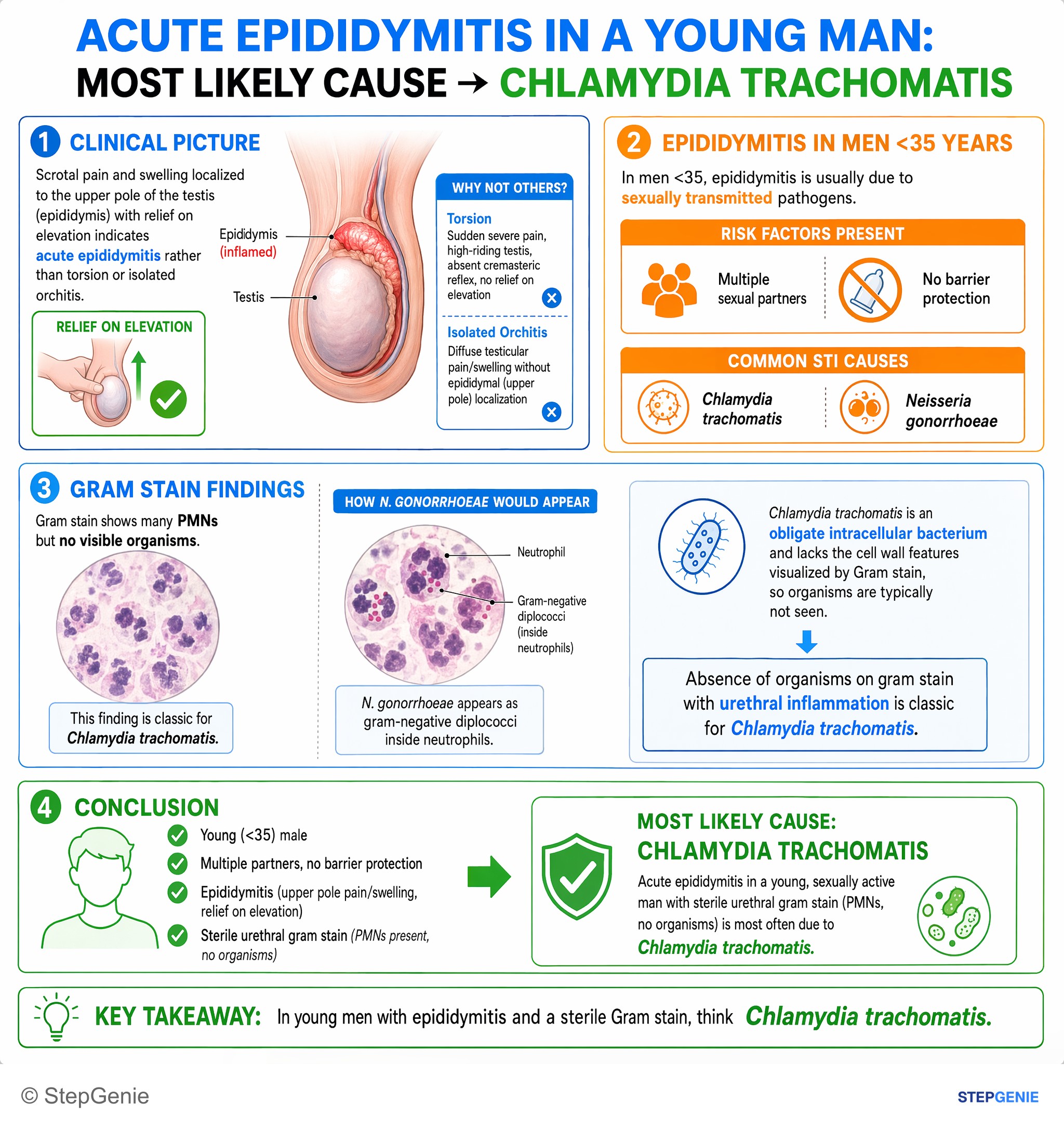
Acute epididymitis in a young, sexually active man with sterile urethral gram stain (PMNs, no organisms) is most often due to Chlamydia…
USMLE Step 1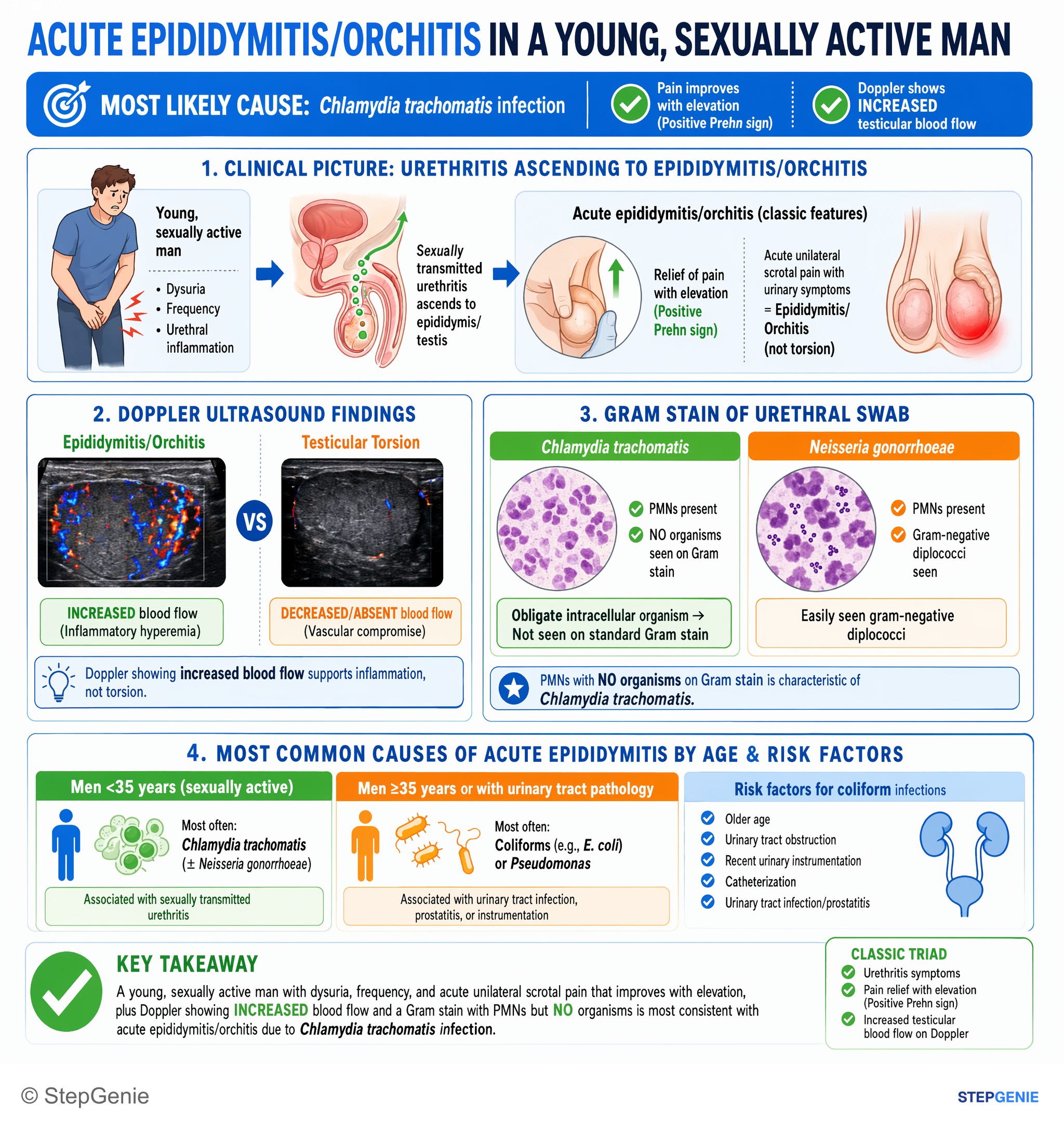
Acute epididymitis in a sexually active young man is most commonly due to Chlamydia trachomatis; pain improves with elevation and Doppler…
USMLE Step 2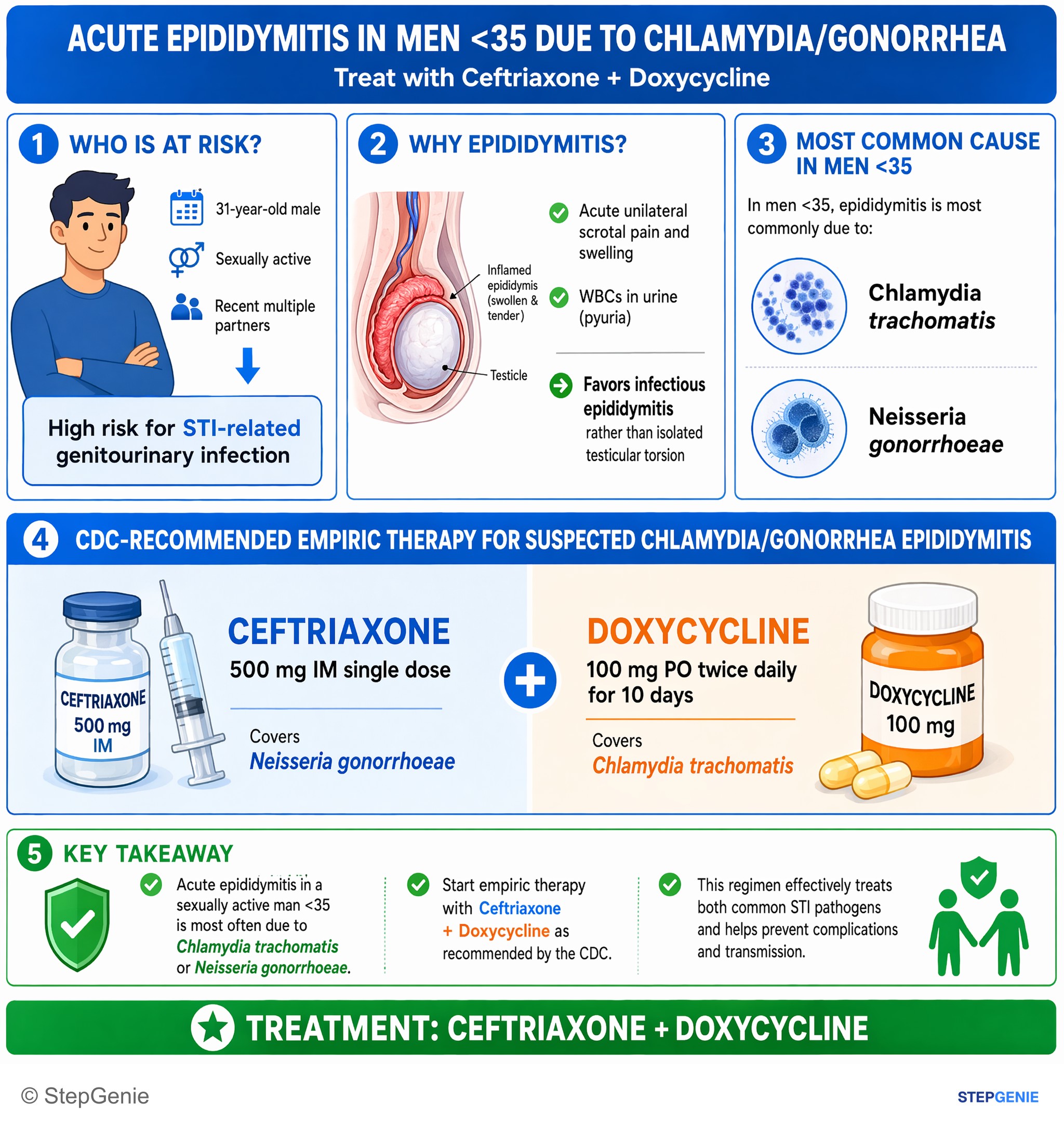
Acute epididymitis in a sexually active man <35 due to chlamydia/gonorrhea → treat with ceftriaxone + doxycycline.
USMLE Step 2Frequently Asked Questions
How do you tell epididymitis from testicular torsion on a scrotal pain question?
Epididymitis usually has gradual, progressive pain with urinary symptoms, while testicular torsion classically causes sudden, severe pain. Epididymitis often has dysuria or urethral discharge, localized posterior tenderness, and pain that improves with scrotal elevation. Torsion is more associated with an absent cremasteric reflex, a high-riding testis with horizontal lie, and decreased or absent blood flow on Doppler ultrasound.
What is the first-line treatment for acute epididymitis?
The treatment depends on the likely organism. In younger sexually active patients with discharge or suspected STI, the board-style regimen is ceftriaxone plus doxycycline. If enteric organisms are likely, such as with anal intercourse, ceftriaxone plus levofloxacin or ofloxacin is used. In older men with a urinary source and low STI suspicion, levofloxacin is appropriate, along with NSAIDs, rest, and scrotal elevation.
What clues point to epididymitis caused by an STI?
STI-related epididymitis is suggested by a younger sexually active patient with dysuria, urethral discharge, fever, and gradually worsening unilateral scrotal pain. Common causes in sexually active men under 35 are Chlamydia trachomatis and Neisseria gonorrhoeae. A sexual history with multiple partners or inconsistent condom use also supports an STI etiology, especially when posterior scrotal tenderness is present.
Why does pain improve with scrotal elevation in epididymitis?
Pain improvement with scrotal elevation, called Prehn sign, is a supportive clue for epididymitis. It is presented as a classic finding that helps point toward epididymal inflammation rather than torsion, although it is not perfect or fully reliable. When combined with gradual onset, urinary symptoms, fever, and posterior tenderness, it strengthens the diagnosis of epididymitis.
When should Doppler ultrasound be used in suspected epididymitis?
Color Doppler ultrasound is especially useful when testicular torsion is still a concern. In epididymitis, Doppler typically shows increased blood flow from hyperemia, whereas torsion shows decreased or absent flow. This makes ultrasound an important test when the history or exam does not clearly separate a surgical emergency from an infectious or inflammatory cause of scrotal pain.