A surprising number of “easy” reproductive questions on USMLE turn into point-losers because the stem screams one diagnosis…but the answer choices are packed with nearby concepts (inguinal hernia, torsion, hypospadias, infertility workups). Cryptorchidism is the classic example: you need the core concept and a quick mental checklist for the common distractors.
The Clinical Vignette (Q-bank style)
A 2-month-old boy is brought for a well-child visit. He was born at 34 weeks’ gestation. Physical exam shows an underdeveloped right hemiscrotum and an empty right scrotal sac. The right testis is not palpable in the inguinal canal. The left testis is normal. Which of the following is the most appropriate next step in management?
Correct answer: Observe and re-examine; if not descended by 6 months (corrected age), perform orchiopexy.
Why Cryptorchidism Fits Best (and what Step expects you to say)
Key definition
Cryptorchidism = failure of testicular descent into the scrotum.
- Often unilateral
- More common in premature infants
- Can be palpable (usually in inguinal canal) or nonpalpable (intra-abdominal, absent/atrophic, or rarely ectopic)
High-yield timeline (testable)
- Many testes descend spontaneously in the first months of life
- Orchiopexy is recommended between 6–18 months (commonly “by 1 year” in Q-banks)
- In a premature infant, use corrected age when thinking about the 6-month checkpoint
Why early correction matters
Undescended testes are exposed to higher temperatures, impairing germ cell development. Consequences:
- Subfertility/infertility risk increases over time
- Testicular cancer risk is increased (especially seminoma)
- Orchiopexy reduces risk and improves exam surveillance, but does not eliminate the cancer risk
Imaging?
For a nonpalpable undescended testis:
- Do not order ultrasound as the first step in the routine workup
- Definitive evaluation is typically diagnostic laparoscopy (often combined with surgical management), but timing still follows the 6-month rule unless there are red flags
The “Correct Answer” Explained in One Breath
Because this is a (corrected) young infant—especially premature—spontaneous descent is still possible. The Step-appropriate move is watchful waiting with repeat exams, then orchiopexy if not descended by 6 months (corrected age), ideally completed by 12–18 months.
Distractor Autopsy: Why Every Wrong Choice Is Wrong (and what it’s trying to test)
Below are common answer choices that appear with cryptorchidism stems. Learn the “why not” once, and you’ll stop missing these.
1) “Order a scrotal/inguinal ultrasound now”
Why it’s tempting: “Nonpalpable testis = image it.”
Why it’s wrong (USMLE logic):
- Ultrasound has limited sensitivity for locating nonpalpable testes and often does not change management
- First-line is serial physical exams, then surgery if persistent after the appropriate age threshold
When imaging might come up: Rarely, imaging can be used in atypical cases, but USMLE tends to test the guideline-style approach: don’t chase it with ultrasound.
2) “Start hCG (or GnRH) therapy to induce descent”
Why it’s tempting: Hormones relate to descent physiology.
Why it’s wrong (in most USMLE contexts):
- Hormonal therapy has lower success rates and higher recurrence than surgery
- Standard of care in most US-based algorithms: orchiopexy if persistent at 6 months
USMLE pearl: If you see “hCG to induce descent,” it’s usually a distractor unless the question is explicitly testing outdated/less common approaches.
3) “Immediate orchiopexy today / at 2 months”
Why it’s tempting: Early surgery prevents infertility and malignancy.
Why it’s wrong:
- Many will descend spontaneously before 6 months
- Operating too early increases unnecessary procedures without improving outcomes compared with the recommended window
Best test-day phrasing: Reassess until 6 months (corrected age), then orchiopexy.
4) “Reassure only; no follow-up needed”
Why it’s tempting: “It’ll descend eventually.”
Why it’s wrong:
- Persistent cryptorchidism is associated with:
- Impaired spermatogenesis
- Testicular malignancy
- Higher risk of torsion and associated inguinal hernia
- You must commit to follow-up and timely orchiopexy
5) “This is a retractile testis—no intervention”
Why it’s tempting: Retractile testes can make the scrotum seem empty.
How to distinguish (high yield):
- Retractile testis: due to strong cremasteric reflex; testis can be milked into scrotum and stays there temporarily
- Undescended testis: cannot be brought down into dependent scrotal position or won’t remain
Clinical consequence:
Retractile testes typically do not carry the same malignancy/subfertility risk and are managed with observation, but they need periodic exams because some can become ascending/undescended later.
6) “This is testicular torsion—emergent detorsion”
Why it’s tempting: “Testis problem = torsion emergency.”
Why it’s wrong here:
- Torsion presentation is acute: sudden severe pain, high-riding testis, absent cremasteric reflex, nausea/vomiting
- Cryptorchidism stems are usually painless and discovered on routine exam
- (Nuance) Undescended testes can torsion intra-abdominally, but you’d expect acute abdominal/groin pain, not a well-child visit finding
7) “This is an inguinal hernia—schedule hernia repair”
Why it’s tempting: Cryptorchidism and hernias travel together.
What’s true:
- Cryptorchidism is associated with patent processus vaginalis, increasing risk of indirect inguinal hernia
Why it’s wrong as the primary answer:
- An inguinal hernia would typically show a reducible groin mass, bulge with crying/straining
- Management focus in the stem is undescended testis, not hernia symptoms
Step connection: Orchiopexy often addresses associated processus vaginalis issues during the same operation.
8) “Hypospadias / ambiguous genitalia workup is needed”
Why it’s tempting: Genital anomaly = endocrine/genetic workup.
When it is the right move:
- Bilateral nonpalpable testes (especially with undervirilized genitalia) raises concern for:
- Disorders of sex development (DSD)
- Congenital adrenal hyperplasia in genetic females (could present with virilization)
- Androgen insensitivity / defects in testosterone synthesis/action
Why it’s wrong in this stem:
- This is unilateral cryptorchidism with otherwise normal exam
- Unilateral cases usually do not require a DSD workup
High-Yield Cryptorchidism: What USMLE Loves to Test
Key associations & risks (memorize)
| Feature | Cryptorchidism takeaway |
|---|---|
| Prematurity | Higher incidence; consider corrected age for timing |
| Cancer risk | Increased risk (classically seminoma). Orchiopexy reduces but does not eliminate risk |
| Fertility | Impaired spermatogenesis, worse with delayed correction and bilateral cases |
| Torsion | Increased risk |
| Inguinal hernia | Increased risk via patent processus vaginalis |
Management algorithm (Step-friendly)
- Palpable undescended testis: observe until 6 months → orchiopexy
- Nonpalpable: observe until 6 months → diagnostic laparoscopy/surgical management (don’t default to ultrasound)
- Bilateral nonpalpable: evaluate for DSD/endocrine issues (karyotype, hormones) before assuming simple cryptorchidism
One-liner differentiation
- Cryptorchid: can’t reliably bring into scrotum → orchiopexy by 6–18 months
- Retractile: can bring down and it stays → observe
Rapid-Fire Board-Style Mini Check
- The single most testable management detail: orchiopexy if not descended by 6 months (corrected age)
- The single most testable “don’t do”: don’t order ultrasound routinely for nonpalpable testis
- The single most testable complication: increased testicular cancer risk (seminoma) + subfertility
Wrap-Up: How to Stop Missing These Questions
When you see “empty scrotum,” force yourself to answer three things before you click:
- Age (and prematurity → corrected age)
- Palpable vs nonpalpable
- Unilateral vs bilateral (DSD workup if bilateral nonpalpable)
That’s how you choose the right answer and swat away the distractors.
Visual explanations from the StepGenie QBank
Infographics StepGenie drew to explain questions in its own QBank, matched to this article's topic. Each caption is the takeaway of the question it explains.
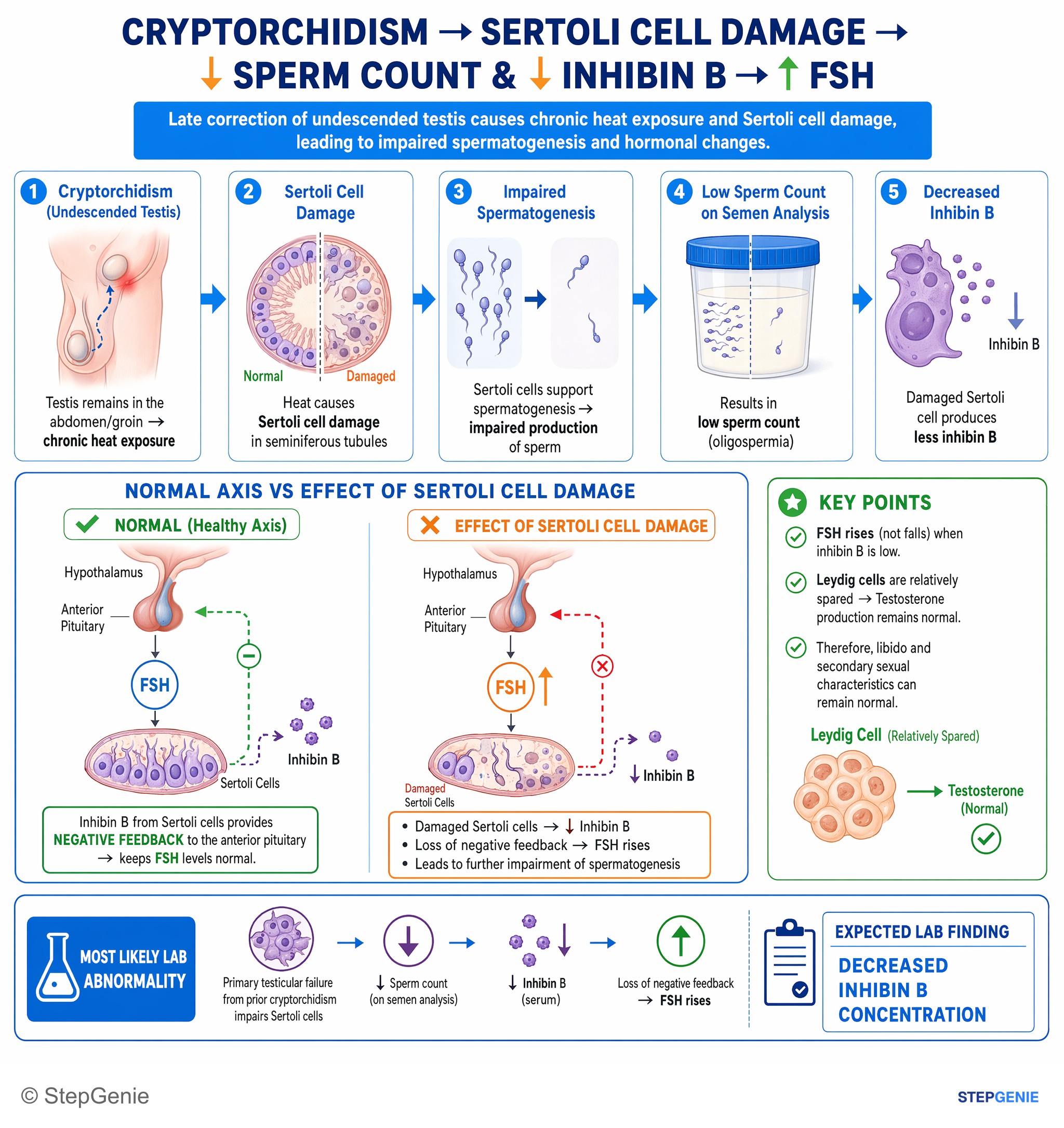
Primary testicular failure from prior cryptorchidism impairs Sertoli cells → ↓ sperm count and ↓ inhibin B → loss of FSH negative…
USMLE Step 1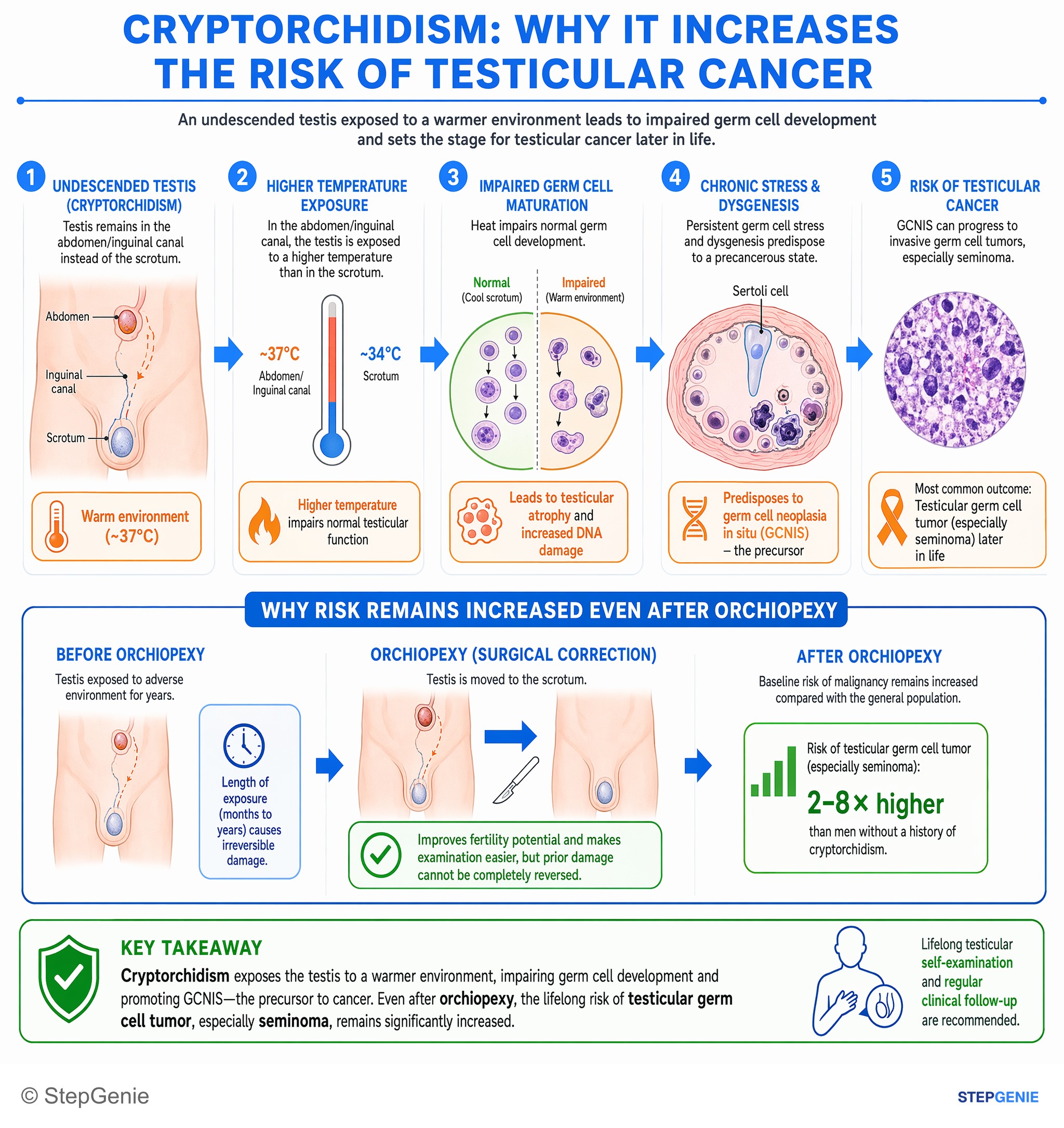
Cryptorchidism (even after orchiopexy) greatly increases risk of testicular germ cell tumor, especially seminoma, later in life.
USMLE Step 1Frequently Asked Questions
What is the next step for a 2-month-old premature infant with a nonpalpable undescended testis?
The next step is observation with repeat physical exams, then orchiopexy if the testis has not descended by 6 months corrected age. Many testes descend spontaneously in the first months of life, especially in young infants. In premature infants, the timing is based on corrected age, and surgery is recommended if cryptorchidism persists, ideally completed within the usual 6 to 18 month window.
Why don’t you order an ultrasound first for a nonpalpable undescended testis?
You usually do not order ultrasound first because it has limited sensitivity for locating nonpalpable testes and often does not change management. The routine approach is serial physical exams early on, followed by surgery if the testis remains undescended after the appropriate age threshold. Definitive evaluation is typically diagnostic laparoscopy, but timing still follows the 6-month rule unless red flags are present.
Why does cryptorchidism increase infertility and testicular cancer risk?
Cryptorchidism increases infertility and testicular cancer risk because undescended testes are exposed to higher temperatures outside the scrotum, which impairs germ cell development. Over time, this raises the risk of subfertility or infertility and increases the risk of testicular malignancy, especially seminoma. Orchiopexy reduces risk and improves exam surveillance, but it does not completely eliminate the cancer risk.
How do you tell a retractile testis from an undescended testis?
A retractile testis can be milked into the scrotum and will stay there temporarily, whereas an undescended testis cannot be brought down into a dependent scrotal position or will not remain there. Retractile testes are caused by a strong cremasteric reflex and are generally observed with periodic exams. They do not usually carry the same malignancy and subfertility risk as true cryptorchidism.
How do you tell cryptorchidism from testicular torsion or an inguinal hernia in a question stem?
Cryptorchidism is usually a painless finding on routine exam, often noted as an empty scrotal sac or underdeveloped hemiscrotum. Testicular torsion presents acutely with sudden severe pain, a high-riding testis, absent cremasteric reflex, and often nausea or vomiting. An inguinal hernia more typically causes a reducible groin mass or a bulge that appears with crying or straining rather than an isolated empty scrotum.