You’re cruising through a heme q-bank, you see thrombocytopenia + hemolytic anemia, and your brain immediately goes: “TTP vs HUS.” Perfect instinct—because these are high-yield, high-stakes, and full of distractors designed to punish pattern recognition without understanding. Let’s break it down the way test writers do: one best answer, and then why every other choice is wrong.
Tag
Heme/Onc > Hemostasis & Coagulation
The Vignette (Classic Board Style)
A 29-year-old woman comes to the ED for confusion and headache. She has scattered petechiae on her lower extremities. Vitals: T 37.2°C, HR 104, BP 128/78. Labs show:
- Hemoglobin: 8.6 g/dL
- Platelets: 18,000/µL
- Creatinine: 1.3 mg/dL
- LDH: elevated
- Indirect bilirubin: elevated
- Haptoglobin: low
- PT/aPTT: normal
- Peripheral smear: schistocytes
Which of the following is the most appropriate next step in management?
A. Platelet transfusion
B. Plasma exchange (plasmapheresis)
C. Heparin infusion
D. Supportive care and hydration
E. High-dose corticosteroids only
Step-by-Step: Identify the Syndrome
This patient has microangiopathic hemolytic anemia (MAHA) and thrombocytopenia, supported by:
- Schistocytes (RBC fragmentation from shearing in small vessels)
- ↑ LDH, ↑ indirect bilirubin, ↓ haptoglobin
- Normal PT/aPTT (key clue against DIC)
Now decide: TTP vs HUS.
The clincher features
- Prominent neurologic symptoms (confusion, headache) → points strongly to TTP
- Creatinine is only mildly elevated → renal involvement can occur in TTP, but severe renal failure is more typical of HUS
- Adult woman, no diarrheal prodrome given → again favors TTP
Correct Answer: B. Plasma exchange (plasmapheresis)
Why it’s correct (TTP path + treatment)
Thrombotic thrombocytopenic purpura (TTP) is usually due to ↓ ADAMTS13 activity, most commonly from an autoantibody.
- ADAMTS13 normally cleaves ultra-large von Willebrand factor (vWF) multimers
- Without it → large vWF multimers persist → platelet adhesion/aggregation → widespread platelet-rich microthrombi
- Result: MAHA + thrombocytopenia + organ ischemia (especially CNS)
Plasma exchange works because it:
- Removes the autoantibody
- Replaces functional ADAMTS13
High-yield: Don’t delay treatment
If TTP is suspected, start plasma exchange immediately—don’t wait for ADAMTS13 testing to come back. Mortality is high without urgent treatment.
High-Yield Table: TTP vs HUS (Boards Favorite)
| Feature | TTP | HUS |
|---|---|---|
| Typical trigger | Autoantibody against ADAMTS13 (often idiopathic) | Shiga toxin (EHEC O157:H7), classically after bloody diarrhea; also atypical complement-mediated |
| Key path | Large vWF multimers → platelet microthrombi | Endothelial injury (toxin/complement) → platelet activation + microthrombi |
| Classic organ involvement | Neuro > renal | Renal > neuro |
| PT/aPTT | Normal | Normal |
| Platelets | Low | Low |
| Smear | Schistocytes | Schistocytes |
| First-line treatment | Plasma exchange (± steroids, rituximab, caplacizumab) | Supportive care (fluids, dialysis); eculizumab for atypical |
Now the Money: Why Each Distractor Is Wrong
A. Platelet transfusion — tempting but dangerous in TTP
Platelets are low, so the impulse is to transfuse. But in TTP, platelet transfusion can worsen thrombosis because the core problem is platelet-rich microthrombi.
When can you give platelets?
- Only for life-threatening bleeding (rare in TTP)
- Not just “low number = transfuse”
USMLE phrasing clue: “Thrombocytopenia + schistocytes + neuro symptoms” → platelet transfusion is usually a trap.
C. Heparin infusion — this is more “DIC-thinking”
Heparin may be used in DIC in select situations (especially chronic DIC or predominant thrombosis), but this vignette is not DIC.
Why not DIC here?
- PT and aPTT are normal (DIC typically prolongs both)
- DIC is a consumptive coagulopathy: platelets + clotting factors get used up
- Expect ↓ fibrinogen and ↑ D-dimer in DIC (not provided, but the normal PT/aPTT is a strong negative)
Board shortcut:
- MAHA + thrombocytopenia + normal PT/aPTT → think TTP/HUS
- MAHA + thrombocytopenia + ↑ PT/aPTT → think DIC
D. Supportive care and hydration — correct for typical HUS, not this patient
Supportive care is the cornerstone of typical (diarrhea-associated) HUS, especially in kids:
- IV fluids
- RBC transfusion as needed
- Dialysis if severe renal failure
But this patient’s presentation leans TTP because:
- Prominent neurologic symptoms
- No diarrheal prodrome
- Not a “kid with bloody diarrhea + renal failure” story
Test nuance: adults can get HUS, and TTP can cause renal injury—so the exam forces you to pick the best fit. Here, neuro symptoms are the highest-yield discriminator.
E. High-dose corticosteroids only — incomplete initial management
Steroids can be part of immune-mediated TTP treatment, but they are not sufficient alone when TTP is suspected.
Core therapy is plasma exchange.
Steroids are adjunctive (plus newer/add-on therapies in many settings):
- Rituximab: for refractory/relapsing or severe immune TTP
- Caplacizumab: anti-vWF; helps reduce microthrombi formation (increasingly tested conceptually)
USMLE framing: if they ask “most appropriate next step,” choose the intervention that most rapidly reduces mortality—plasmapheresis.
Rapid-Fire High-Yield Pearls (USMLE-Style)
- Schistocytes + thrombocytopenia + normal PT/aPTT → TTP/HUS (not ITP, not DIC).
- TTP = Neuro symptoms (confusion, headache, seizures).
- HUS = Kidney injury (often severe AKI), classically after bloody diarrhea (EHEC Shiga-like toxin).
- In TTP, do not transfuse platelets unless life-threatening bleeding.
- Treat suspected TTP immediately with plasma exchange—don’t wait for confirmatory testing.
- ITP is isolated thrombocytopenia (no schistocytes, no MAHA).
- HIT causes thrombocytopenia + thrombosis, but MAHA/schistocytes aren’t the core finding; timing is 5–10 days after heparin (or sooner with prior exposure).
Quick Differential: “Thrombocytopenia + Anemia” Mini-Map
| Condition | Smear | PT/aPTT | Key clue |
|---|---|---|---|
| TTP/HUS | Schistocytes | Normal | MAHA + thrombocytopenia |
| DIC | Schistocytes possible | ↑ PT, ↑ aPTT | Bleeding + clotting, ↓ fibrinogen, ↑ D-dimer |
| ITP | Normal RBCs | Normal | Isolated thrombocytopenia, mucocutaneous bleeding |
| AIHA | Spherocytes (often) | Normal | Positive Coombs (DAT) |
| HIT | Normal RBCs | Normal | Thrombosis after heparin exposure |
Takeaway: How to Win This Question Every Time
When you see MAHA + thrombocytopenia, your job is to:
- Confirm it’s not DIC: check PT/aPTT (often normal in TTP/HUS).
- Decide between TTP vs HUS:
- Neuro symptoms → TTP
- Severe renal failure + diarrheal prodrome → HUS
- Treat TTP like the emergency it is: plasma exchange now.
Visual explanations from the StepGenie QBank
Infographics StepGenie drew to explain questions in its own QBank, matched to this article's topic. Each caption is the takeaway of the question it explains.
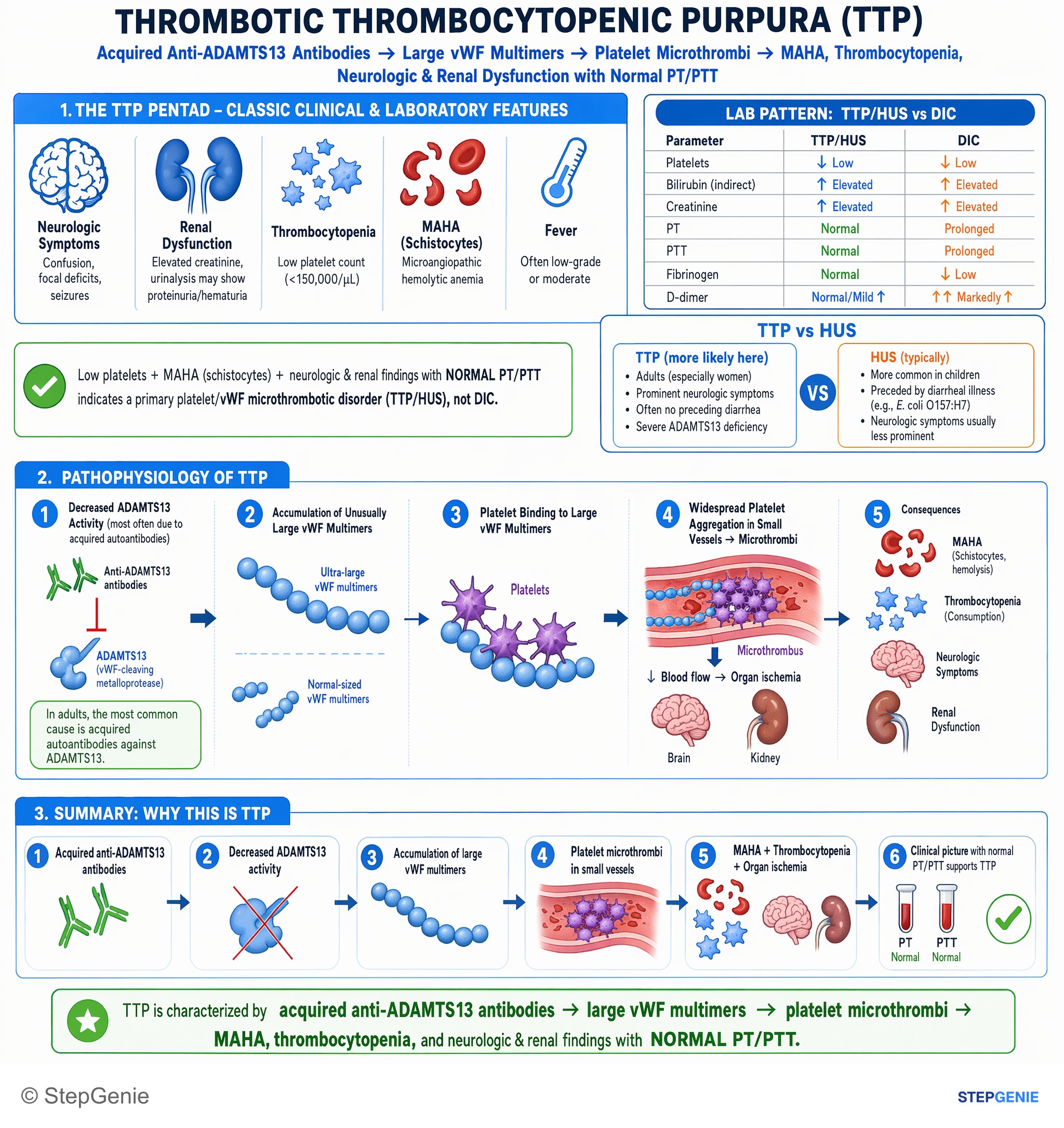
Thrombotic thrombocytopenic purpura (TTP): acquired anti‑ADAMTS13 antibodies → large vWF multimers → platelet microthrombi → MAHA…
USMLE Step 1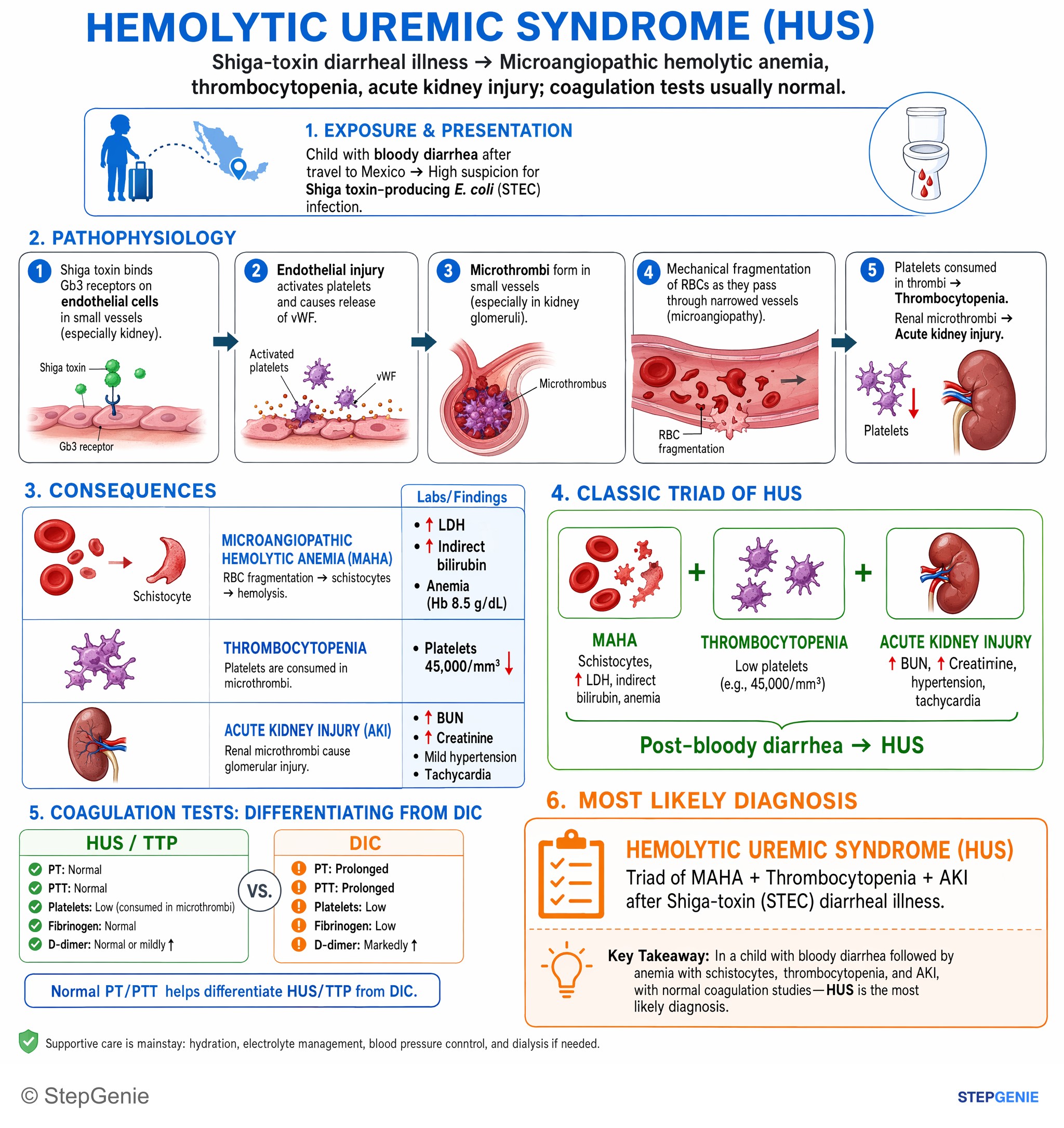
Hemolytic uremic syndrome (HUS): shiga-toxin diarrheal illness → microangiopathic hemolytic anemia, thrombocytopenia, acute kidney injury…
USMLE Step 2Frequently Asked Questions
What is the next step when schistocytes, thrombocytopenia, normal PT/aPTT, and neuro symptoms suggest TTP?
The next step is immediate plasma exchange. This presentation strongly suggests thrombotic thrombocytopenic purpura because microangiopathic hemolytic anemia and thrombocytopenia are paired with schistocytes, normal PT/aPTT, and prominent neurologic symptoms such as confusion or headache. Plasma exchange removes the autoantibody and replaces functional ADAMTS13, and treatment should begin without waiting for ADAMTS13 test results.
How do you tell TTP from HUS on a board-style vignette?
The best way to distinguish them is by the dominant organ involvement and clinical context. TTP is favored by prominent neurologic symptoms such as confusion and headache, especially in an adult without a diarrheal prodrome. HUS is more associated with severe renal injury and classically follows bloody diarrhea from Shiga toxin, particularly in the typical diarrhea-associated form.
Why are PT and aPTT normal in TTP and HUS but abnormal in DIC?
Normal PT and aPTT push you toward TTP or HUS rather than DIC. In these microangiopathic processes, the key problem is platelet-rich microthrombi causing red cell shearing and thrombocytopenia. DIC, by contrast, is a consumptive coagulopathy in which clotting factors are used up, so both PT and aPTT are typically prolonged, often with low fibrinogen and elevated D-dimer.
Why is platelet transfusion usually a bad answer choice in TTP?
Platelet transfusion is usually avoided in TTP because it can worsen thrombosis. The underlying problem is widespread platelet-rich microthrombi, so adding platelets may feed the process rather than help it. Platelets are generally reserved only for life-threatening bleeding, making transfusion a classic trap answer when thrombocytopenia appears alongside schistocytes and neurologic symptoms.
Why does decreased ADAMTS13 activity cause TTP?
Decreased ADAMTS13 activity causes TTP because ADAMTS13 normally cleaves ultra-large von Willebrand factor multimers. When ADAMTS13 is reduced, usually due to an autoantibody, those large vWF multimers persist and promote platelet adhesion and aggregation. That leads to widespread platelet-rich microthrombi, which cause microangiopathic hemolytic anemia, thrombocytopenia, and organ ischemia, especially in the central nervous system.