You’re doing a Q-bank question, you spot a DVT/PE vignette in a young patient, and your brain instantly jumps to “Factor V Leiden.” That’s good—but Step questions aren’t just asking if you recognize the buzzword. They’re testing whether you understand the mechanism, the lab pattern, the inheritance, and how to eliminate distractors that sound clotty but don’t fit. Let’s break it down the way the exam writes it: one best answer, and every other option is there to trap a specific misconception.
Tag: Heme/Onc > Hemostasis & Coagulation
The Vignette (Classic Board Style)
A 28-year-old woman presents with unilateral leg swelling and pain 1 week after a long-haul flight. She has no prior medical problems but reports that her father had a “blood clot” in his 30s. She is not pregnant and is not taking oral contraceptives. Ultrasound confirms a proximal DVT. Coagulation studies show normal PT and normal aPTT. Which of the following best explains her predisposition?
The Correct Answer: Factor V Leiden
What it is
Factor V Leiden is a point mutation in the factor V gene that makes factor V resistant to cleavage (inactivation) by activated protein C (APC).
Why that causes thrombosis
Normally:
- Thrombin converts factor V → factor Va
- Factor Va is a cofactor for factor Xa in the prothrombinase complex, which generates more thrombin
- Activated protein C (APC) (with protein S) turns the system off by inactivating factor Va and factor VIIIa
With Factor V Leiden:
- APC can’t inactivate factor Va effectively
- Prothrombinase complex stays “on”
- More thrombin → more fibrin → hypercoagulability
- Clinical phenotype: venous thrombosis (DVT/PE), not platelet-type arterial clots
Step/USMLE high-yield facts
- Most common inherited thrombophilia in Caucasians
- Autosomal dominant with variable penetrance (heterozygotes are common; homozygotes have higher risk)
- Typical presentation: unprovoked or recurrent DVT/PE, often young, sometimes triggered (surgery, pregnancy, OCPs, immobility)
- Labs: PT and aPTT are typically normal
(The problem is regulatory—inactivation—not baseline factor deficiency.) - Testing clue: “APC resistance” assay abnormal; confirm with genetic testing
How to Think Like the Test Writer: Why Each Distractor Is Wrong
Below are common answer choices that orbit the same concept (hypercoagulability) but differ in mechanism, labs, and clinical pattern.
Distractor 1: Protein C Deficiency
Tempting because: Protein C is in the same pathway as Factor V Leiden and causes venous thrombosis.
Key mechanism:
- Low protein C → less inactivation of Va and VIIIa → hypercoagulable
How to distinguish from Factor V Leiden:
- History may include:
- Warfarin-induced skin necrosis (classic board pearl)
- Family history of thrombosis
- Labs: PT/aPTT often normal at baseline (so you need clinical clues)
- Big board hook: Warfarin knocks out vitamin K–dependent factors (II, VII, IX, X) and proteins C/S, and protein C drops first due to short half-life → transient hypercoagulability early in therapy.
Exam tip: If the stem mentions starting warfarin without heparin bridging and then skin necrosis → think protein C deficiency, not Factor V Leiden.
Distractor 2: Protein S Deficiency
Tempting because: Also a venous thrombophilia; also relates to APC.
Key mechanism:
- Protein S is the cofactor for APC
- Low protein S → APC can’t effectively inactivate Va/VIIIa
Distinguishers:
- Can be hereditary or acquired
- Acquired causes are frequently tested:
- Pregnancy
- Estrogen therapy
- Liver disease
- Nephrotic syndrome (loss of proteins)
- Labs: Often normal PT/aPTT at baseline
Exam tip: If the question leans into pregnancy/OCPs with thrombosis and asks for a decreased anticoagulant factor → protein S is a favorite.
Distractor 3: Antithrombin (ATIII) Deficiency
Tempting because: Another classic inherited thrombophilia with venous clots.
Key mechanism:
- Antithrombin inhibits thrombin (IIa) and factor Xa (and others)
- Deficiency → too much thrombin activity → thrombosis
The giveaway detail: Heparin resistance
- Heparin works by potentiating antithrombin
- If antithrombin is deficient, heparin has less effect → “heparin resistance” (need higher doses; anti-Xa levels won’t respond as expected)
Exam tip: DVT + poor response to heparin → think ATIII deficiency.
Distractor 4: Antiphospholipid Syndrome (APS)
Tempting because: It’s hypercoagulable and common in question banks—and it messes with coag labs.
Key mechanism:
- Autoantibodies against phospholipid-binding proteins (e.g., anti–β2 glycoprotein I, anticardiolipin, lupus anticoagulant)
- Causes thrombosis + pregnancy morbidity (recurrent miscarriages)
The lab paradox:
- Prolonged aPTT due to interference with phospholipid-dependent assays
- But in vivo thrombosis occurs
Distinguishers:
- History of:
- Recurrent miscarriages
- Livedo reticularis
- Stroke/DVT in young person
- Confirmatory testing:
- Lupus anticoagulant tests (e.g., dilute Russell viper venom time) that do not correct with mixing
- Anticardiolipin/anti–β2 glycoprotein I antibodies
Exam tip: If the stem says “prolonged aPTT” plus clots → APS beats Factor V Leiden.
Distractor 5: Prothrombin Gene Mutation (G20210A)
Tempting because: Common inherited thrombophilia with venous thrombosis.
Key mechanism:
- Mutation increases prothrombin (factor II) levels → increased thrombin generation
Distinguishers:
- Similar clinical phenotype to Factor V Leiden: venous clots, often young, normal PT/aPTT
- You usually need the stem to specify “increased prothrombin levels” or the gene mutation.
Exam tip: If answer choices include both Factor V Leiden and prothrombin mutation, the question typically gives one extra hint—either APC resistance (FVL) or elevated prothrombin (G20210A).
Distractor 6: von Willebrand Disease
Tempting because: It’s very common and tied to coagulation, but it’s a bleeding disorder.
Key mechanism:
- Impaired platelet adhesion (vWF binds platelets to exposed collagen via GpIb)
- Also stabilizes factor VIII → mild factor VIII deficiency
Clinical/labs:
- Mucocutaneous bleeding (epistaxis, menorrhagia, easy bruising)
- Prolonged bleeding time (or abnormal platelet function testing)
- aPTT may be prolonged (due to ↓ factor VIII), PT normal
Exam tip: If the patient is clotting (DVT/PE), vWD should feel wrong immediately.
Distractor 7: Hemophilia A or B
Tempting because: Students memorize the intrinsic pathway and see “aPTT,” but hemophilia causes bleeding, not clots.
Key mechanism:
- Hemophilia A: factor VIII deficiency
- Hemophilia B: factor IX deficiency
Clinical/labs:
- Hemarthroses, deep tissue bleeding, delayed bleeding after procedures
- Prolonged aPTT, normal PT and bleeding time
Exam tip: DVT + normal aPTT should steer you away from hemophilia.
Distractor 8: Disseminated Intravascular Coagulation (DIC)
Tempting because: It involves clotting and bleeding—but it’s an acute consumptive coagulopathy.
Key mechanism:
- Widespread coagulation activation → consumption of platelets and clotting factors
Clinical/labs:
- Sick patient (sepsis, trauma, malignancy, obstetric catastrophe)
- Prolonged PT and prolonged aPTT
- Low fibrinogen
- Elevated D-dimer
- Thrombocytopenia
- Schistocytes may be present
Exam tip: DIC is systemic illness + abnormal labs everywhere. Factor V Leiden is often a relatively well patient with a clot and normal PT/aPTT.
Rapid Comparison Table (High-Yield)
| Condition | Main issue | PT | aPTT | Bleeding vs clotting | Board-famous clue |
|---|---|---|---|---|---|
| Factor V Leiden | Factor V resistant to APC | N | N | Clotting (venous) | APC resistance |
| Protein C deficiency | ↓ inactivation of Va/VIIIa | N | N | Clotting (venous) | Warfarin skin necrosis |
| Protein S deficiency | ↓ APC cofactor | N | N | Clotting (venous) | Pregnancy/OCP association |
| Antithrombin deficiency | ↓ inhibition of IIa, Xa | N | N | Clotting (venous) | Heparin resistance |
| APS | Autoantibodies (LA, aCL) | N | ↑ | Clotting + pregnancy loss | aPTT prolonged but thrombosis |
| vWD | ↓ platelet adhesion, ↓ VIII stability | N | ±↑ | Bleeding | Mucosal bleeding, menorrhagia |
| Hemophilia A/B | ↓ VIII or IX | N | ↑ | Bleeding | Hemarthroses |
| DIC | Consumption of factors/plt | ↑ | ↑ | Bleeding + microthrombi | ↑ D-dimer, ↓ fibrinogen, low plt |
N = normal; ± = sometimes
What USMLE Actually Wants You to Say Out Loud
When you see: young patient + venous thrombosis + family history + normal PT/aPTT, your internal script should be:
- “This is an inherited thrombophilia.”
- “Normal PT/aPTT means not a factor deficiency in the classic pathways.”
- “Most common inherited thrombophilia is Factor V Leiden.”
- “Mechanism: APC can’t inactivate factor V → increased thrombin generation.”
Quick Memory Hooks (No Fluff, Just Useful)
- Factor V Leiden: “V won’t Leave (be cleaved) by APC.”
- APS: “Lupus anticoagulant prolongs aPTT but causes clots.”
- Antithrombin deficiency: “Heparin needs AT—no AT, no heparin effect.”
- Protein C deficiency: “Warfarin skin necrosis = protein C problem until proven otherwise.”
Visual explanations from the StepGenie QBank
Infographics StepGenie drew to explain questions in its own QBank, matched to this article's topic. Each caption is the takeaway of the question it explains.
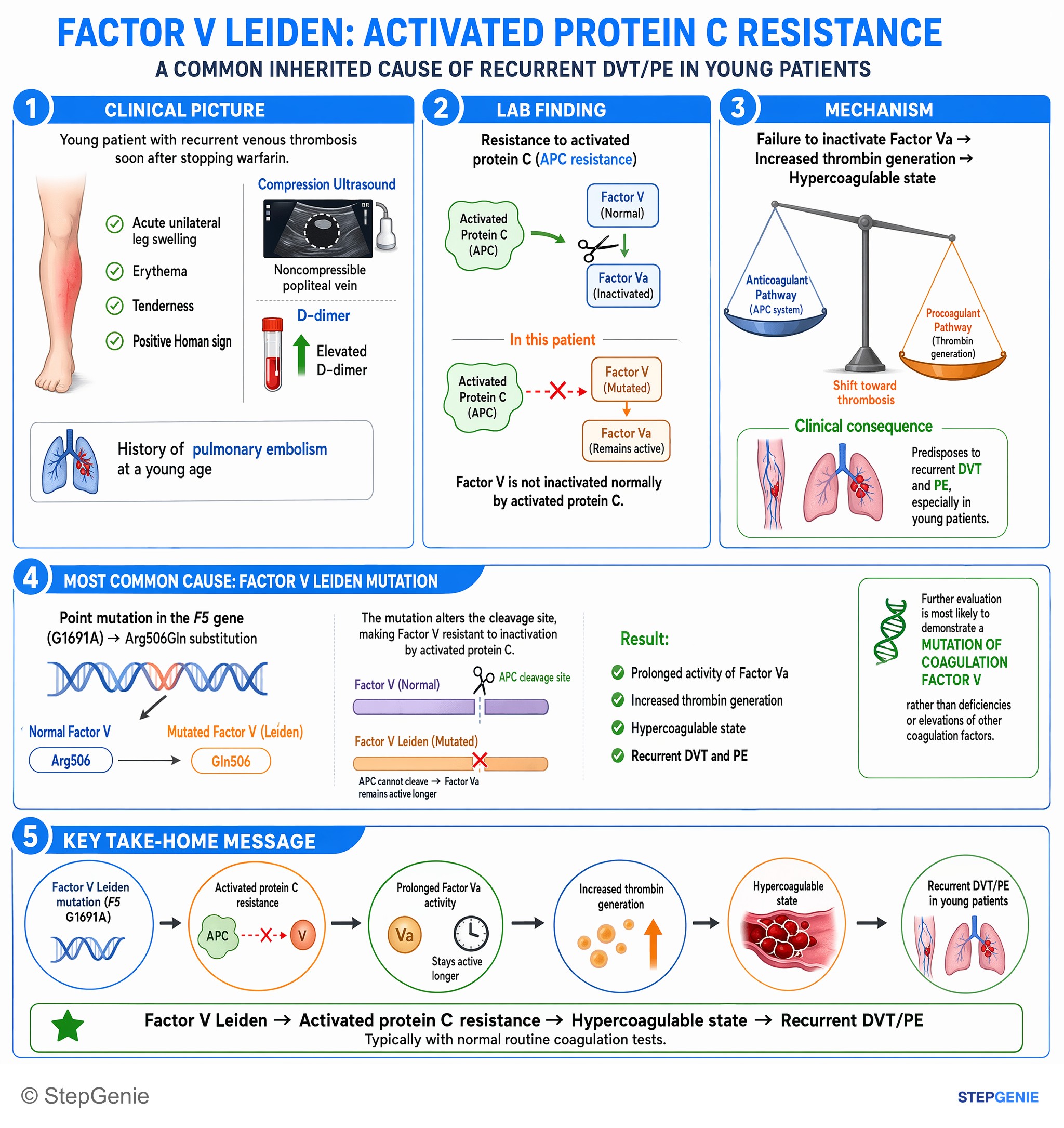
Factor V Leiden causes activated protein C resistance → hypercoagulable state → recurrent DVT/PE in young patients with normal routine…
USMLE Step 1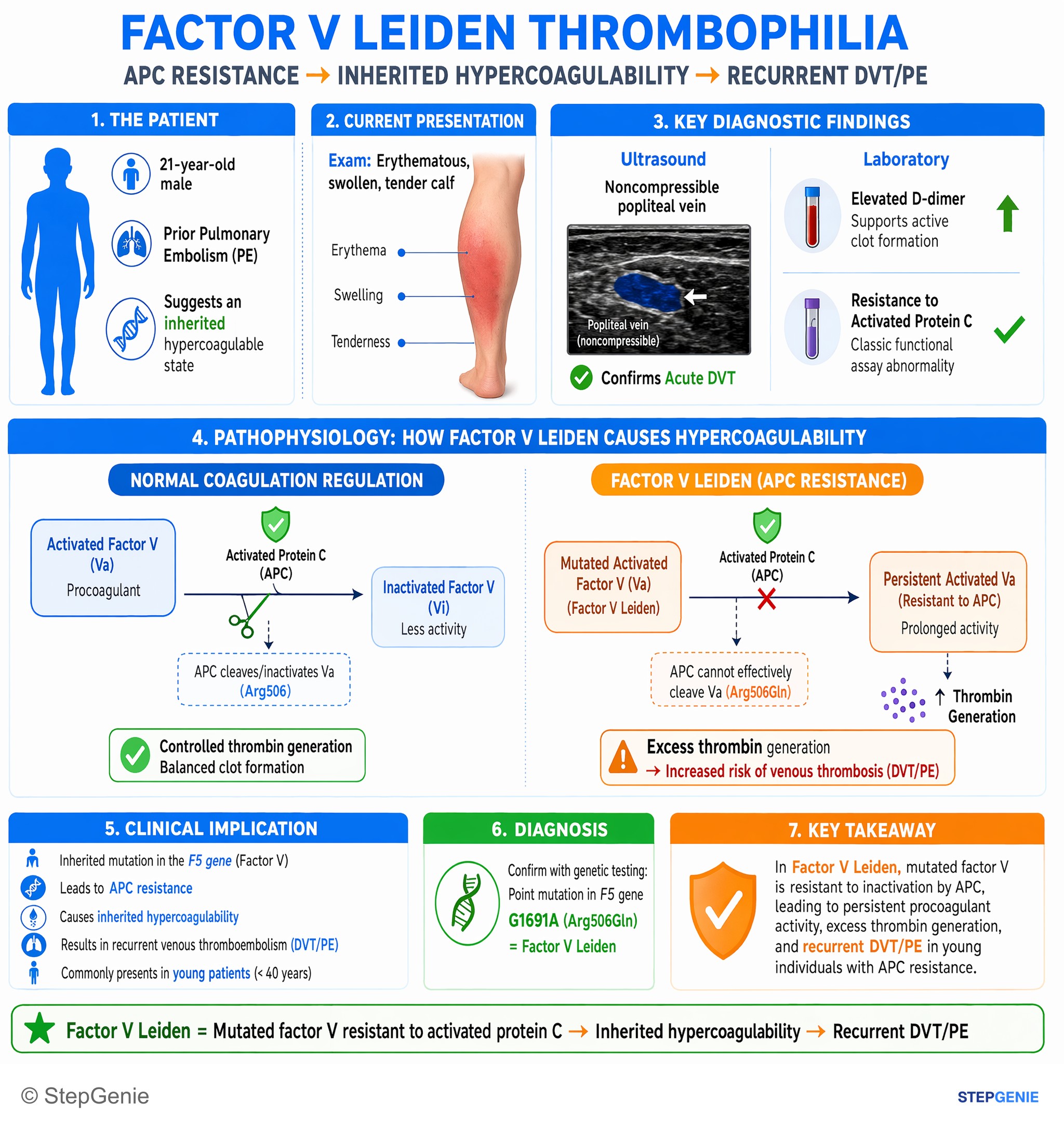
Factor V Leiden: mutated factor V is resistant to activated protein C → inherited hypercoagulability → recurrent DVT/PE in young patients…
USMLE Step 1Frequently Asked Questions
Why does Factor V Leiden cause venous thrombosis?
Factor V Leiden causes venous thrombosis because factor V becomes resistant to inactivation by activated protein C. Normally, activated protein C with protein S turns off coagulation by inactivating factors Va and VIIIa. In Factor V Leiden, factor Va is not cleaved effectively, so the prothrombinase complex stays active, thrombin generation increases, more fibrin forms, and the result is a hypercoagulable state that classically produces DVT or PE.
What are the coagulation lab findings in Factor V Leiden?
Factor V Leiden typically has normal PT and normal aPTT. The reason is that the problem is not a baseline deficiency of a clotting factor but a failure of normal regulation, specifically impaired inactivation of factor Va by activated protein C. A board-style testing clue is an abnormal activated protein C resistance assay, with confirmation by genetic testing.
How do you tell Factor V Leiden from antiphospholipid syndrome in a clotting question?
The key distinction is that antiphospholipid syndrome often causes thrombosis with a prolonged aPTT, whereas Factor V Leiden usually has normal PT and normal aPTT. Antiphospholipid syndrome is also suggested by recurrent miscarriages, livedo reticularis, or stroke and DVT in a young person. In contrast, Factor V Leiden is a common inherited thrombophilia causing venous clots through activated protein C resistance.
How do you distinguish Factor V Leiden from protein C deficiency on exams?
Factor V Leiden and protein C deficiency can both cause venous thrombosis with normal baseline PT and aPTT, so the clinical clue matters. Protein C deficiency is classically associated with warfarin-induced skin necrosis, especially when warfarin is started without heparin bridging. Factor V Leiden instead points to activated protein C resistance due to a factor V mutation, without that classic early-warfarin clue.
What inheritance pattern and presentation should make you think of Factor V Leiden?
Factor V Leiden is inherited in an autosomal dominant pattern with variable penetrance. It commonly presents as unprovoked or recurrent DVT or PE in a young patient, sometimes after a trigger such as surgery, pregnancy, oral contraceptive use, or immobility. It is also the most common inherited thrombophilia in Caucasians, and homozygotes have higher risk than heterozygotes.