Eating disorder questions love to “hide the ball”: they’ll give you a normal BMI with scary behaviors, a low BMI with no weight fear, or electrolyte clues without saying “purging.” The fastest way to stop missing these is to force yourself to justify every answer choice, not just pick the right one. Let’s do that with a classic vignette and a full distractor breakdown.
The Vignette (Q-bank style)
A 19-year-old college student is brought to clinic by her roommate because she has been “acting strange around food.” Over the past 6 months, she has had episodes where she eats large amounts of food in a short period of time and later goes to the bathroom “for a while.” She exercises daily and is very distressed about gaining weight. BMI is 21. Vitals are normal. Exam shows enamel erosion and parotid enlargement. Labs show K⁺ 2.9 mEq/L, Cl⁻ 92 mEq/L, and HCO₃⁻ 34 mEq/L.
Question: What is the most likely diagnosis?
Answer choices:
A. Anorexia nervosa
B. Bulimia nervosa
C. Binge-eating disorder
D. Avoidant/restrictive food intake disorder (ARFID)
E. Rumination disorder
Correct Answer: B. Bulimia nervosa
Why it’s bulimia
This vignette is loaded with bulimia “tells”:
- Recurrent binge episodes: “large amounts…in a short period,” loss of control implied
- Compensatory behavior: prolonged bathroom time, daily exercise
- Overvaluation of weight/shape: distressed about gaining weight
- Physical signs of self-induced vomiting
- Enamel erosion
- Parotid enlargement (sialadenosis)
- Electrolytes consistent with vomiting
- Hypokalemia
- Hypochloremic metabolic alkalosis (high , low Cl⁻)
High-yield diagnostic anchor
Bulimia nervosa = binge eating + compensatory behaviors ≥ 1x/week for 3 months with self-evaluation overly influenced by body shape/weight.
Weight can be normal (and often is), which is why BMI 21 is a trap.
High-yield treatment
- First-line psychotherapy: CBT
- Medication with strongest evidence: fluoxetine
- Medical stabilization matters if severe electrolyte derangements/arrhythmia risk.
Why the Other Answer Choices Are Wrong (and what would make them right)
A. Anorexia nervosa — Close, but the BMI and pattern don’t fit
Anorexia nervosa (AN) requires:
- Restriction of energy intake → significantly low body weight
- Intense fear of gaining weight or persistent behavior interfering with weight gain
- Disturbance in body image/lack of recognition of seriousness
Why not AN here:
- BMI is normal (21).
- The dominant pattern described is bingeing + purging, but without low body weight.
How AN could appear as a distractor:
- If BMI were significantly low (often <18.5 in adults, but “significantly low” is clinical judgment)
- If the vignette emphasized restriction, amenorrhea (not required anymore), bradycardia, hypothermia, lanugo, or osteopenia
USMLE pearl: AN subtypes
- Restricting type
- Binge-eating/purging type (still underweight)
C. Binge-eating disorder (BED) — No compensatory behaviors
BED = binge eating with no compensatory behaviors.
Why not BED here:
- The vignette strongly suggests vomiting (bathroom time, enamel erosion, parotid enlargement)
- Labs show metabolic alkalosis, classic for vomiting
- Patient exercises daily as compensatory behavior
What would support BED instead:
- Binge eating with marked distress, plus ≥3 of:
- Eating rapidly
- Eating until uncomfortably full
- Eating when not physically hungry
- Eating alone due to embarrassment
- Feeling disgusted/depressed/guilty afterward
- Often associated with overweight/obesity (not required, but common)
- No purging, laxatives, diuretics, fasting, or excessive exercise
High-yield comorbidities (Step 2 vibe):
- Depression/anxiety
- Metabolic syndrome, type 2 diabetes, OSA
D. ARFID — No body-image disturbance, and not driven by weight fear
Avoidant/restrictive food intake disorder (ARFID):
- Restriction/avoidance causing:
- Weight loss or failure to gain
- Nutritional deficiency
- Dependence on supplements/enteral feeds
- Psychosocial impairment
- Not due to body-image concerns
Why not ARFID here:
- Patient is distressed specifically about weight gain (body-image component)
- Pattern is binge + purge, not avoidance due to sensory issues or fear of choking/vomiting
What ARFID vignettes look like:
- Child with extreme “picky eating,” sensory aversions
- Fear after choking episode → refuses solids
- Weight loss and nutritional deficiencies without “I feel fat”
E. Rumination disorder — Regurgitation without the binge/purge psychology
Rumination disorder:
- Repeated regurgitation of food after eating (may rechew/reswallow/spit out)
- Typically effortless, not preceded by nausea/retching
- Not explained by GI disease
- Not occurring exclusively during AN/BN/BED
Why not rumination here:
- There’s binge eating and compensatory behaviors
- Findings (enamel erosion, parotid enlargement, alkalosis, hypokalemia) point to self-induced vomiting, not effortless regurgitation
Rumination clues:
- Regurgitation begins soon after meals, often in children or those with developmental disabilities (can occur in adults too)
- Less “secretive purging,” less weight/shape psychopathology
Pattern Recognition: The “One-Liner” Differentiators
| Disorder | Core behavior | Weight/body image focus? | Weight status | Classic clue |
|---|---|---|---|---|
| Anorexia nervosa | Restriction (± binge/purge) | Yes | Low | Bradycardia, lanugo, osteoporosis |
| Bulimia nervosa | Binge + compensate | Yes | Often normal | Enamel erosion, parotid swelling, metabolic alkalosis |
| Binge-eating disorder | Binge only | Often distress, may have body dissatisfaction | Often ↑ | No purging; metabolic syndrome risk |
| ARFID | Restrict/avoid | No | Often ↓/poor growth | Sensory issues or fear of choking/vomiting |
| Rumination disorder | Regurgitation | Not necessarily | Variable | Effortless regurg after meals |
High-Yield Labs & Complications (testable)
Vomiting (purging) physiology
Loss of gastric acid () → metabolic alkalosis:
- (hypochloremia)
- (hypokalemia) via renal mechanisms and aldosterone
Bulimia complications:
- Dental enamel erosion
- Parotid gland enlargement
- Mallory-Weiss tears
- Arrhythmias from hypokalemia (Step 2: sudden death risk)
Laxative abuse (another common distractor)
Often causes non-anion gap metabolic acidosis from diarrhea (loss of bicarbonate), not alkalosis.
Mini “Distractor-Proofing” Checklist for Eating Disorder Stems
Ask yourself:
- Is there binge eating? (large amount + loss of control)
- Any compensatory behavior? (vomiting, laxatives, diuretics, fasting, excessive exercise)
- What’s the weight status? (significantly low vs normal vs high)
- Is there body-image/weight fear driving it?
- Do labs match the story?
- Vomiting → hypokalemic, hypochloremic metabolic alkalosis
- Diarrhea/laxatives → metabolic acidosis
If you can answer those five, you won’t just “recognize bulimia”—you’ll eliminate everything else on purpose, which is exactly what NBME-style questions reward.
Quick Takeaways (what to remember on test day)
- Normal BMI does not rule out bulimia.
- Bulimia = binge + compensatory behaviors + weight/shape overvaluation.
- Vomiting → hypokalemic hypochloremic metabolic alkalosis + dental/parotid findings.
- BED has no compensatory behaviors.
- ARFID lacks body-image disturbance.
- Rumination is effortless regurgitation, not secretive purging.
Visual explanations from the StepGenie QBank
Infographics StepGenie drew to explain questions in its own QBank, matched to this article's topic. Each caption is the takeaway of the question it explains.
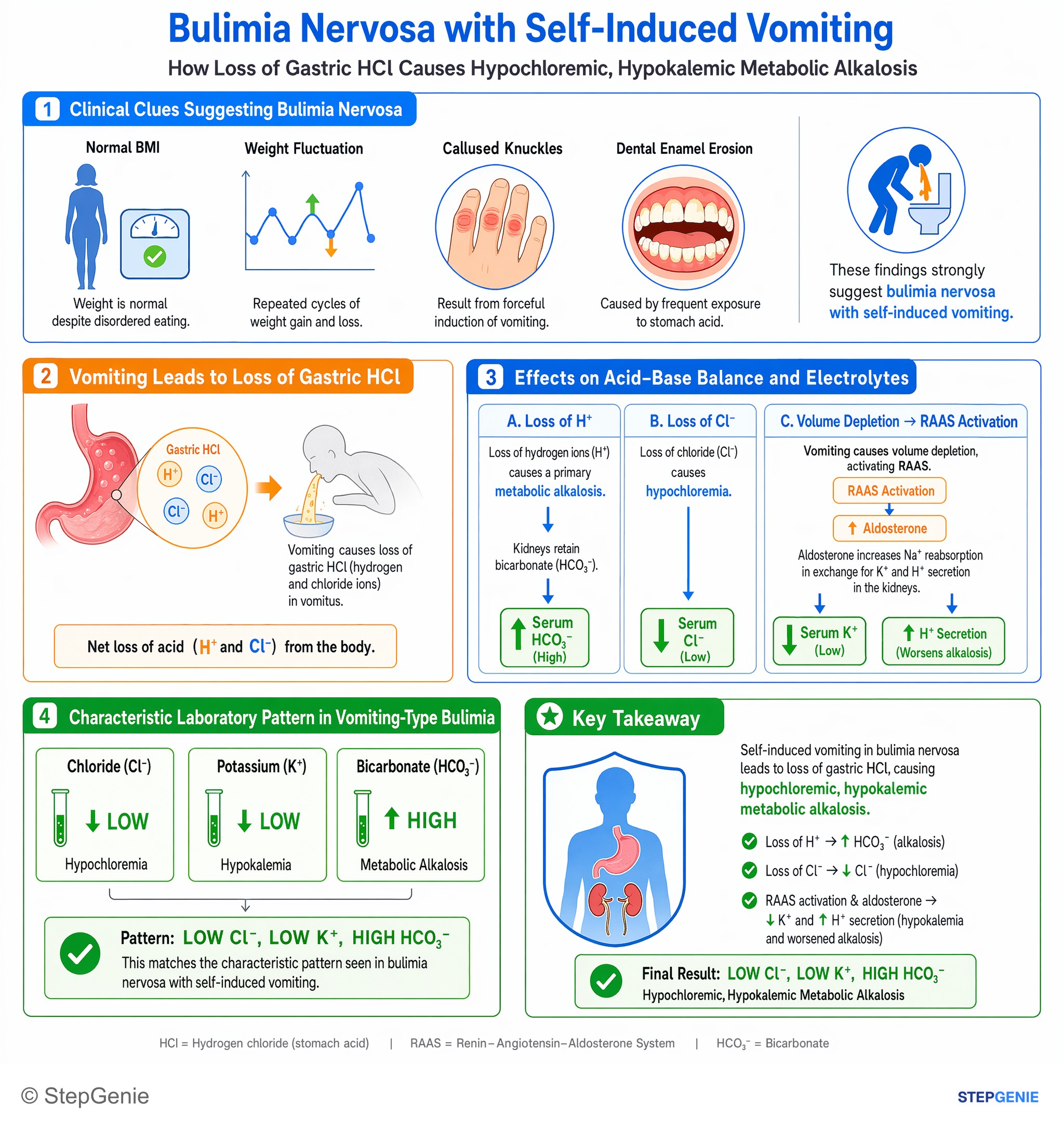
Bulimia nervosa with self-induced vomiting causes hypochloremic, hypokalemic metabolic alkalosis from loss of gastric HCl and secondary…
USMLE Step 1Frequently Asked Questions
How do you tell bulimia nervosa from anorexia nervosa when both can involve purging?
The key difference is body weight and the dominant pattern. Bulimia nervosa is binge eating plus compensatory behaviors with self-evaluation overly influenced by body shape or weight, and weight is often normal. Anorexia nervosa requires restriction leading to significantly low body weight, even if the patient has a binge-eating or purging subtype. A normal BMI with bingeing and purging points toward bulimia, not anorexia.
Why can a patient with bulimia nervosa have a normal BMI?
A normal BMI does not rule out bulimia nervosa because bulimia is defined by recurrent binge episodes, compensatory behaviors, and overvaluation of weight or shape, not by being underweight. That is why BMI can be normal and is often normal in bulimia. In contrast, anorexia nervosa requires significantly low body weight, so a normal BMI is a common exam trap favoring bulimia.
What lab pattern suggests self-induced vomiting in bulimia nervosa?
Self-induced vomiting in bulimia nervosa classically causes hypokalemia with hypochloremic metabolic alkalosis. A vignette showing low potassium, low chloride, and elevated bicarbonate strongly supports vomiting as the compensatory behavior. Physical clues like enamel erosion and parotid enlargement reinforce the diagnosis because they are classic signs of repeated vomiting rather than binge eating alone.
How do you tell bulimia nervosa from binge-eating disorder on a vignette?
Bulimia nervosa has binge eating plus compensatory behaviors, while binge-eating disorder has binge eating without compensation. Clues for bulimia include secretive bathroom time, daily excessive exercise, enamel erosion, parotid enlargement, and labs consistent with vomiting. Binge-eating disorder is marked by distress around bingeing, but there is no purging, laxative use, diuretics, fasting, or excessive exercise.
What is the first-line treatment for bulimia nervosa?
The first-line psychotherapy for bulimia nervosa is CBT, and fluoxetine is the medication with the strongest evidence. Treatment questions may also test medical stabilization, because severe electrolyte derangements increase arrhythmia risk. So the best initial management framework is psychotherapy first, medication support when appropriate, and urgent stabilization when the medical consequences of purging are severe.