You’re in the Q-bank, you see a “defiant kid” vignette, and suddenly every answer choice looks plausible: ODD, conduct disorder, intermittent explosive disorder, ADHD, DMDD… and maybe someone throws in substance use just to spice it up. The trick isn’t memorizing one-liners—it’s learning to map the vignette to criteria and then actively eliminate distractors based on what’s missing.
Tag: Psychiatry > Substance Use & Development
The Clinical Vignette (Q-bank style)
A 15-year-old boy is brought to clinic by his mother for “behavior problems.” Over the past year, he has repeatedly skipped school, stolen money from family members, and was recently caught breaking into a neighbor’s garage. He has been in physical fights and once threatened another student with a knife. His mother says he “doesn’t feel bad afterward” and often blames others. He has started smoking cigarettes and occasionally drinks alcohol on weekends. No history of manic episodes. No hallucinations or delusions.
Question: What is the most likely diagnosis?
Correct Answer: Conduct Disorder
Why it’s conduct disorder
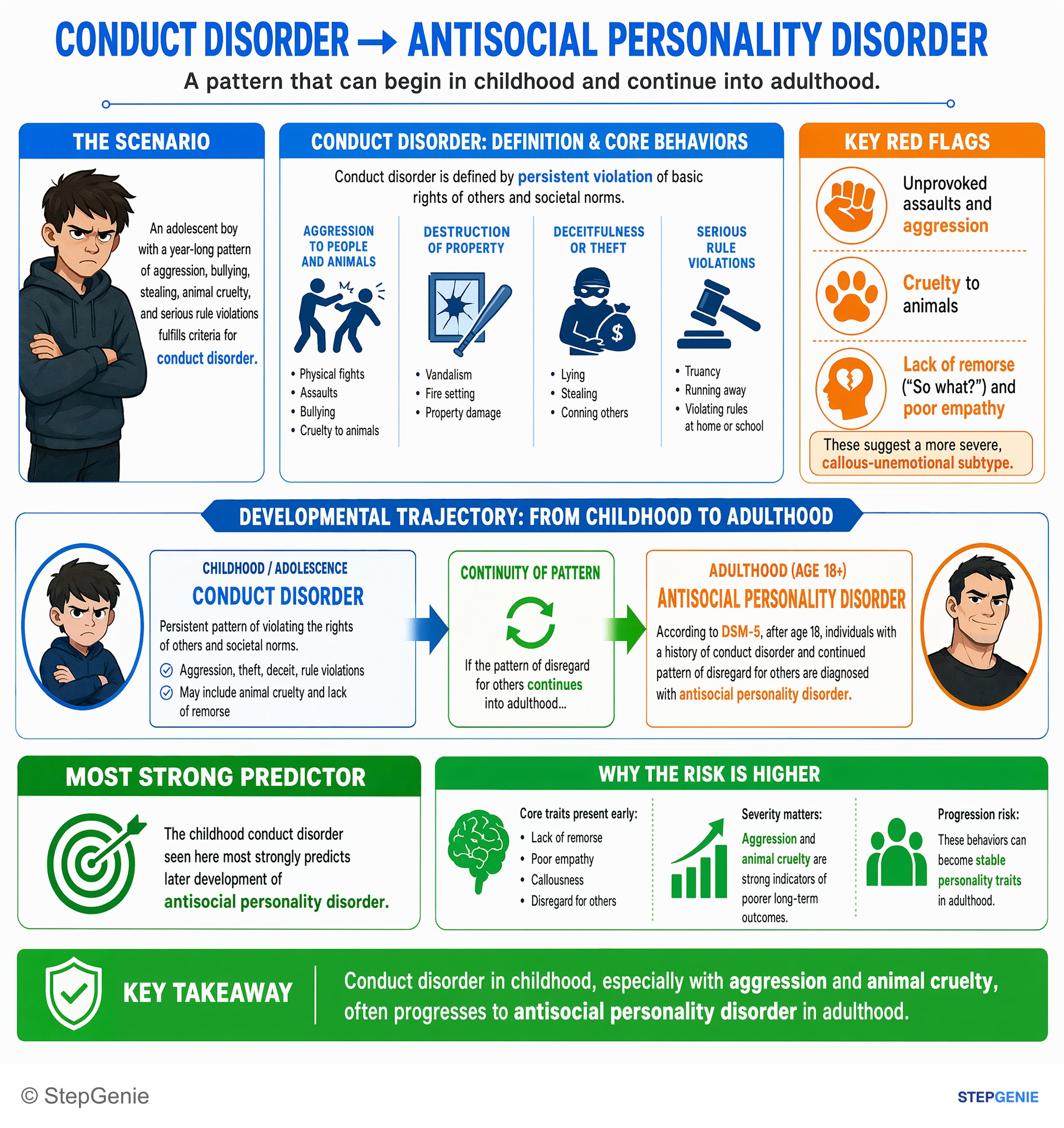
Conduct disorder (CD) is defined by a persistent pattern of behavior that violates the rights of others or major age-appropriate norms/rules, with ≥3 symptoms in the last 12 months and ≥1 in the last 6 months.
In the vignette, you have multiple CD-domain behaviors:
- Aggression to people/animals: physical fights; threat with a knife
- Destruction of property: breaking into a garage (often paired with vandalism/arson in questions)
- Deceitfulness/theft: stealing money; breaking in
- Serious rule violations: truancy/skipping school
Also high-yield: lack of remorse (“doesn’t feel bad”) strongly points toward limited prosocial emotions specifier, which is associated with:
- more severe and persistent course
- higher risk of adult antisocial personality disorder
- poorer response to typical interventions
Step-relevant facts you should know
- Conduct disorder before age 15 is a risk factor for antisocial personality disorder later (ASPD requires age ≥18 plus evidence of CD before 15).
- CD is strongly associated with substance use (nicotine/alcohol/cannabis) and risky behaviors; substance use may be comorbid but does not explain the core pattern here.
- Management is primarily psychosocial:
- parent management training
- multisystemic therapy
- treat comorbidities (ADHD, SUD, depression)
- meds are not first-line for CD itself; may use atypical antipsychotics short-term for severe aggression in select cases (testable nuance)
Why Every Distractor Matters (Systematic Elimination)
Below is how to eliminate the usual suspects quickly and confidently.
Distractor 1: Oppositional Defiant Disorder (ODD)
Why it’s tempting: Defiance, arguing, blaming others—these show up in both.
Why it’s wrong here: ODD is angry/irritable mood, argumentative/defiant behavior, or vindictiveness for ≥6 months, but it does NOT include the severe rights-violating behaviors of CD.
Key differentiator:
- ODD: “I refuse, I argue, you can’t make me”
- CD: “I stole, I hurt, I broke in, I threatened”
High-yield: If the vignette includes theft, physical cruelty/aggression, weapon use, forced sex, breaking and entering, fire-setting, think conduct disorder, not ODD.
Distractor 2: Intermittent Explosive Disorder (IED)
Why it’s tempting: Fighting, aggression.
Why it’s wrong here: IED is impulsive, disproportionate aggression (verbal or physical) that is not premeditated and not used to achieve tangible objectives (money, power, intimidation).
In the vignette:
- breaking in and stealing are goal-directed
- pattern is persistent and rule-violating, not isolated outbursts
High-yield: IED = episodic “short fuse,” remorse may occur, and there’s no sustained pattern of rights violations like theft and serious rule-breaking.
Distractor 3: ADHD
Why it’s tempting: School problems, impulsivity, poor judgment.
Why it’s wrong here: ADHD is inattention and/or hyperactivity-impulsivity across settings, present before age 12, causing functional impairment. ADHD can contribute to risky behavior, but it does not explain:
- theft
- breaking and entering
- weapon threats
- lack of remorse
Testable connection: ADHD commonly coexists with CD/ODD. If both are present, treat ADHD (stimulants/nonstimulants) because improved impulse control can reduce behavioral escalation.
Distractor 4: Disruptive Mood Dysregulation Disorder (DMDD)
Why it’s tempting: Irritability and behavioral outbursts in kids.
Why it’s wrong here: DMDD is defined by:
- severe recurrent temper outbursts (≥3/week)
- persistently irritable/angry mood between outbursts
- duration ≥12 months
- onset before age 10 (diagnosed ages 6–18)
The vignette emphasizes rights violations (stealing, breaking in, weapon threats), not mood dysregulation as the core issue.
High-yield: DMDD is often a “bipolar misdiagnosis preventer” in pediatrics. It’s about chronic irritability, not criminal/antisocial behavior.
Distractor 5: Adjustment Disorder
Why it’s tempting: New behavior problems could follow stress.
Why it’s wrong here: Adjustment disorder is an emotional/behavioral response to an identifiable stressor, beginning within 3 months of the stressor, and does not typically present with this level of pervasive rights-violating behavior unless you’re missing a bigger diagnosis.
Ask yourself:
- Is there a clear stressor driving symptoms?
- Do symptoms resolve within 6 months after the stressor ends?
Not supported.
Distractor 6: Substance-Induced Behavioral Changes / Substance Use Disorder
Why it’s tempting: The vignette mentions cigarettes and alcohol.
Why it’s wrong here: The behavior pattern predates and extends beyond substance use and includes a broad, persistent conduct pattern. Substance use may be:
- a comorbidity
- a consequence of CD
- a risk amplifier
But it does not best explain the clinical picture.
High-yield: CD is associated with early substance initiation. On test day, when you see both, pick the diagnosis that best explains the core, pervasive pattern—here, CD.
Conduct Disorder vs ODD: The “Rights Violation” Rule
| Feature | Oppositional Defiant Disorder (ODD) | Conduct Disorder (CD) |
|---|---|---|
| Core theme | Defiant/argumentative, irritable, vindictive | Violates rights of others / major rules |
| Aggression | Not a defining feature (may be oppositional) | Common (fights, weapon use, cruelty) |
| Theft/deceit | No | Yes |
| Property destruction | No | Yes |
| Serious rule violations (truancy/running away) | Can be present but not central | Central domain |
| Remorse/empathy | Variable | May have limited prosocial emotions |
| Prognosis | Often less severe; may progress to CD | Risk of ASPD and substance use problems |
Quick heuristic:
If you see stealing, breaking in, threats, weapon use, cruelty, forced sex, fire-setting → Conduct disorder.
How Q-banks Like to Test This
1) Severity and specifiers
- Childhood-onset type (<10 years) → worse prognosis
- Adolescent-onset (≥10 years) → still serious, but comparatively better
- Limited prosocial emotions: lacks remorse, callous, unconcerned about performance, shallow affect
2) The “future diagnosis” trap
If the patient is ≥18 and has a pervasive pattern of violating others’ rights:
- consider antisocial personality disorder, but only if there’s evidence of conduct disorder before age 15
3) Comorbidity bait
Common coexisting conditions include:
- ADHD
- learning disorders
- substance use disorders
- depression/anxiety (especially when consequences accumulate)
Treating comorbidities is frequently part of the “next best step” question set.
Takeaway: A Step-Style Answer Strategy
- Circle rights violations (theft, aggression, destruction, serious rule-breaking).
- If present and persistent → Conduct disorder.
- If mostly arguing/defiance/irritability without rights violations → ODD.
- If aggression is episodic and disproportionate without goal-directed rule-breaking → IED.
- Don’t let minor substance use mentions distract you from the primary developmental/behavioral diagnosis.
Visual explanations from the StepGenie QBank
Infographics StepGenie drew to explain questions in its own QBank, matched to this article's topic. Each caption is the takeaway of the question it explains.
Conduct disorder in childhood, especially with aggression and animal cruelty, often progresses to antisocial personality disorder in…
USMLE Step 2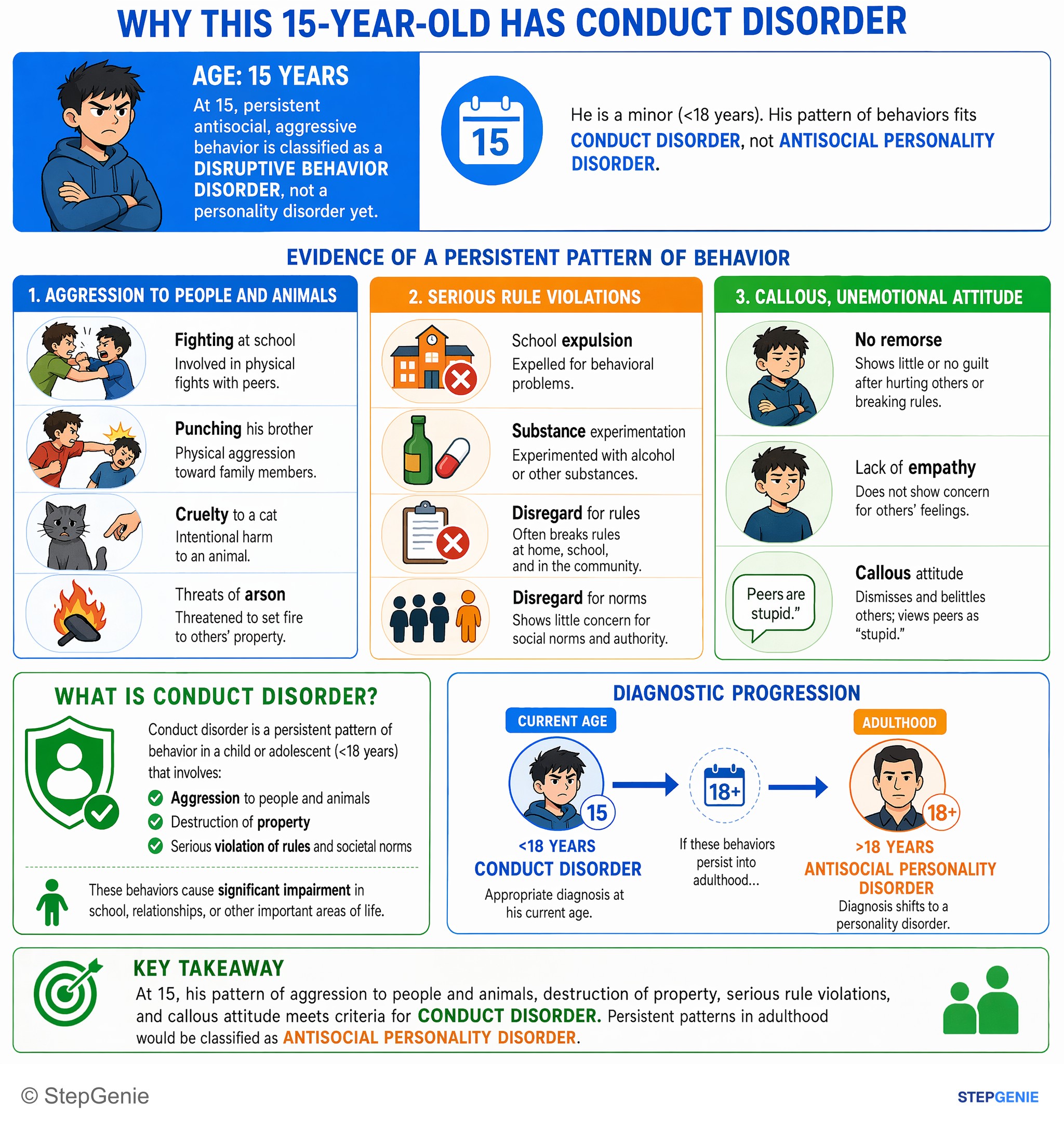
Conduct disorder: persistent violation of others' rights and societal norms (aggression, cruelty to animals, serious rule violation) in a…
USMLE Step 2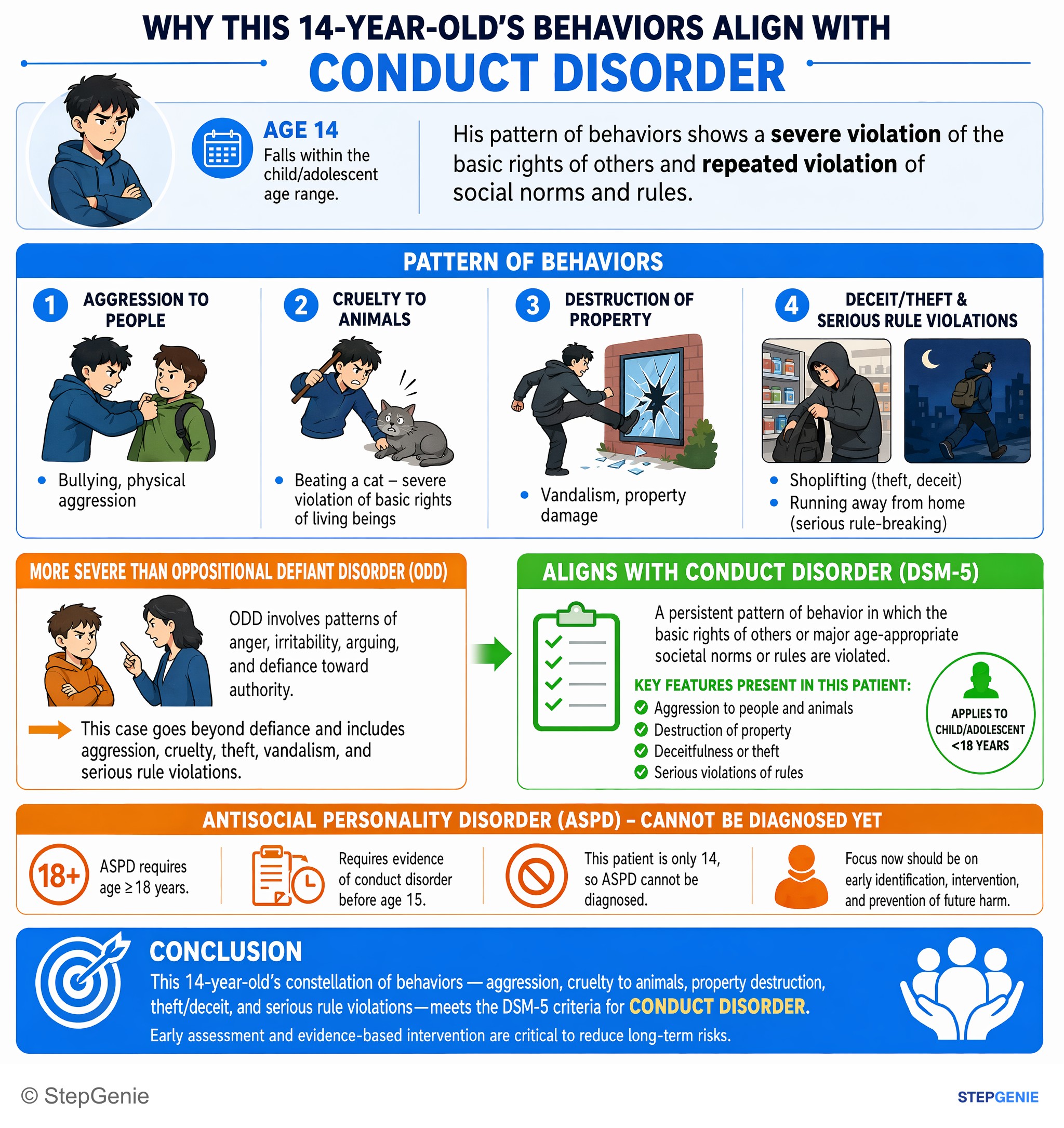
Conduct disorder = persistent violation of basic rights/social norms (aggression, cruelty to animals, property destruction) in a…
USMLE Step 2Frequently Asked Questions
How do you tell conduct disorder from oppositional defiant disorder in a vignette?
Conduct disorder is distinguished by behaviors that violate the rights of others or major rules, such as theft, breaking and entering, physical aggression, weapon threats, and truancy. Oppositional defiant disorder involves angry or irritable mood, argumentative or defiant behavior, and vindictiveness, but it does not include those severe rights-violating acts. If a vignette includes stealing, hurting others, or breaking in, conduct disorder is the better diagnosis.
Why is this vignette conduct disorder instead of intermittent explosive disorder?
It is conduct disorder because the aggression and misconduct are persistent and goal-directed, not isolated impulsive outbursts. Intermittent explosive disorder features disproportionate aggression that is not premeditated and not used to obtain money, power, or intimidation. In this vignette, stealing money and breaking into a garage are purposeful acts, and the overall pattern includes repeated rule violations rather than a short-fuse episodic problem.
What clue in conduct disorder suggests limited prosocial emotions?
Lack of remorse is a key clue suggesting the limited prosocial emotions specifier in conduct disorder. A statement like “he doesn’t feel bad afterward” points to this pattern. That specifier is associated with a more severe and persistent course, higher risk of later antisocial personality disorder, and poorer response to typical interventions, making it an especially important detail to notice in a psychiatry question stem.
Does substance use explain the behavior in conduct disorder?
No, the substance use may be comorbid, but it does not explain the core pattern of conduct disorder. Conduct disorder is strongly associated with nicotine, alcohol, and cannabis use, as well as other risky behaviors. However, the defining issue is the persistent pattern of theft, aggression, breaking rules, and violating others’ rights, which remains the primary diagnosis in this kind of vignette.
What is the first-line management for conduct disorder?
First-line management for conduct disorder is primarily psychosocial treatment. Recommended approaches include parent management training and multisystemic therapy, along with treatment of comorbid conditions such as ADHD, substance use disorder, or depression. Medications are not first-line for conduct disorder itself, although atypical antipsychotics may be used short-term in select cases of severe aggression.