Cubital tunnel syndrome is one of those USMLE-friendly diagnoses that shows up as a “why is the ring + pinky numb?” question—and it’s easy points if you can instantly map where the nerve is, what it innervates, and what exam findings you expect. Let’s lock it in with a fast memory palace you can recall during a timed block.
The 10‑second definition (one-liner)
Cubital tunnel syndrome = ulnar nerve compression at the elbow (behind the medial epicondyle) → numbness/tingling in the 4th–5th digits + weak intrinsic hand muscles (interossei) with ↓ grip and possible clawing.
Memory Palace: “The Cubital Tunnel is a Club Bouncer at the Funny Bone”
Picture walking through a hallway in a nightclub called “CUBITAL TUNNEL”. At the door is a bouncer shaped like a MEDIAL EPICONDYLE. Behind him is a neon sign: “FUNNY BONE”. Every time the door swings (elbow flexion), it slams the ULNAR nerve.
Inside the club, there are 5 vivid stations—walk through them in order:
1) The Door Sign: “U‑TURN only for 4 & 5”
A glowing “U” sign arrows straight to digits 4 and 5.
- Sensory: numbness/paresthesias of pinky + ulnar half of ring finger
- Often includes ulnar palm and dorsoulnar hand (distribution depends on exact site)
2) The Dance Floor: INTEROSSEI doing “finger spreads”
On the floor, dancers are dramatically abducting/adducting fingers.
- Motor: weak interossei → impaired finger abduction/adduction
- Classic vignette: “can’t hold paper between fingers,” “weak grip”
3) The Bartender: Froment serving a “Paper Pinch”
At the bar, Froment hands you a receipt (paper). When you try to pinch it between thumb and index finger, your thumb flexes at the IP joint (cheating).
- Froment sign: ulnar nerve palsy → weak adductor pollicis
- Compensation: flexor pollicis longus (median/AIN) flexes thumb IP to maintain pinch
4) The VIP Room: “Claw Hands Only” (but not full claw)
A velvet rope separates the ring and pinky doing a partial “claw” pose.
- Ulnar claw: MCP hyperextension + IP flexion (more prominent in 4th/5th)
- Pearl: Proximal ulnar lesions (at elbow) can produce less clawing than wrist lesions because FDP (digits 4/5) may be weakened too → less IP flexion (“ulnar paradox”)
5) The Exit: A tight doorway labeled “ELBOW FLEXION = WORSE”
To leave, you have to squeeze through a narrow doorway that gets tighter when you bend your elbow.
- Symptoms often worsen with elbow flexion (increases pressure in cubital tunnel)
- Provocative maneuvers: Tinel at cubital tunnel, elbow flexion test
Instant takeaway from the palace:
Elbow “funny bone” compression → 4th/5th numbness + interossei weakness + Froment + (possible) ulnar claw.
High-yield anatomy snapshot (Step 1 friendly)
Where the ulnar nerve gets trapped
- Cubital tunnel: behind the medial epicondyle at the elbow
- Ulnar nerve passes through Guyon canal at the wrist (different syndrome)
Key ulnar nerve actions to remember
- Interossei: finger abduction/adduction (DAB/PAD)
- Adductor pollicis: pinch strength (Froment sign when weak)
- Medial lumbricals (4th/5th): contribute to MCP flexion + IP extension
- FCU + medial FDP (digits 4/5) may be affected if lesion is proximal (elbow)
Cubital tunnel vs Guyon canal (USMLE comparison table)
| Feature | Cubital Tunnel (Elbow) | Guyon Canal (Wrist) |
|---|---|---|
| Common cause | Elbow flexion/compression, leaning on elbows | Cyclist “handlebar palsy,” ganglion cyst |
| Sensory loss | 4th/5th digits ± ulnar dorsal hand | 4th/5th digits; dorsal ulnar hand often spared (dorsal cutaneous branch leaves proximal to canal) |
| Motor findings | Intrinsic hand weakness; may also hit FCU + medial FDP | Intrinsic hand weakness; forearm muscles spared |
| Clawing | Variable; may be less dramatic (ulnar paradox) | Often more “pure” ulnar claw |
Classic vignette patterns (Step 2 friendly)
You’ll commonly see:
- Numbness in ring/pinky + symptoms worse when sleeping with flexed elbows
- A student who rests elbows on desk for long periods
- Weakness with finger abduction/adduction
- Froment sign during pinch testing
Quick exam & testable maneuvers
- Tinel sign at cubital tunnel: tapping behind medial epicondyle reproduces tingling
- Elbow flexion test: prolonged flexion worsens symptoms
- Finger abduction/adduction weakness (interossei)
- Paper pinch → Froment sign
Micro-mnemonic (shareable)
“CUBITAL = CLUB at the ELBOW: U‑turn to 4&5, Interossei can’t spread, Froment cheats, claw may appear.”
Common pitfalls USMLE likes
- Not radial nerve: radial neuropathy = wrist drop + dorsal hand sensory changes (not isolated 4th/5th paresthesia)
- Not carpal tunnel: median nerve = digits 1–3 + thenar weakness
- Elbow vs wrist ulnar lesion: dorsal ulnar hand sensation helps localize (often spared in Guyon canal)
Bottom line
If the stem screams “funny bone” + ring/pinky tingling, walk your mind through the club: 4&5 sensory → interossei weakness → Froment sign → possible ulnar claw → worse with elbow flexion. That’s cubital tunnel—fast, accurate, and high yield.
Visual explanations from the StepGenie QBank
Infographics StepGenie drew to explain questions in its own QBank, matched to this article's topic. Each caption is the takeaway of the question it explains.
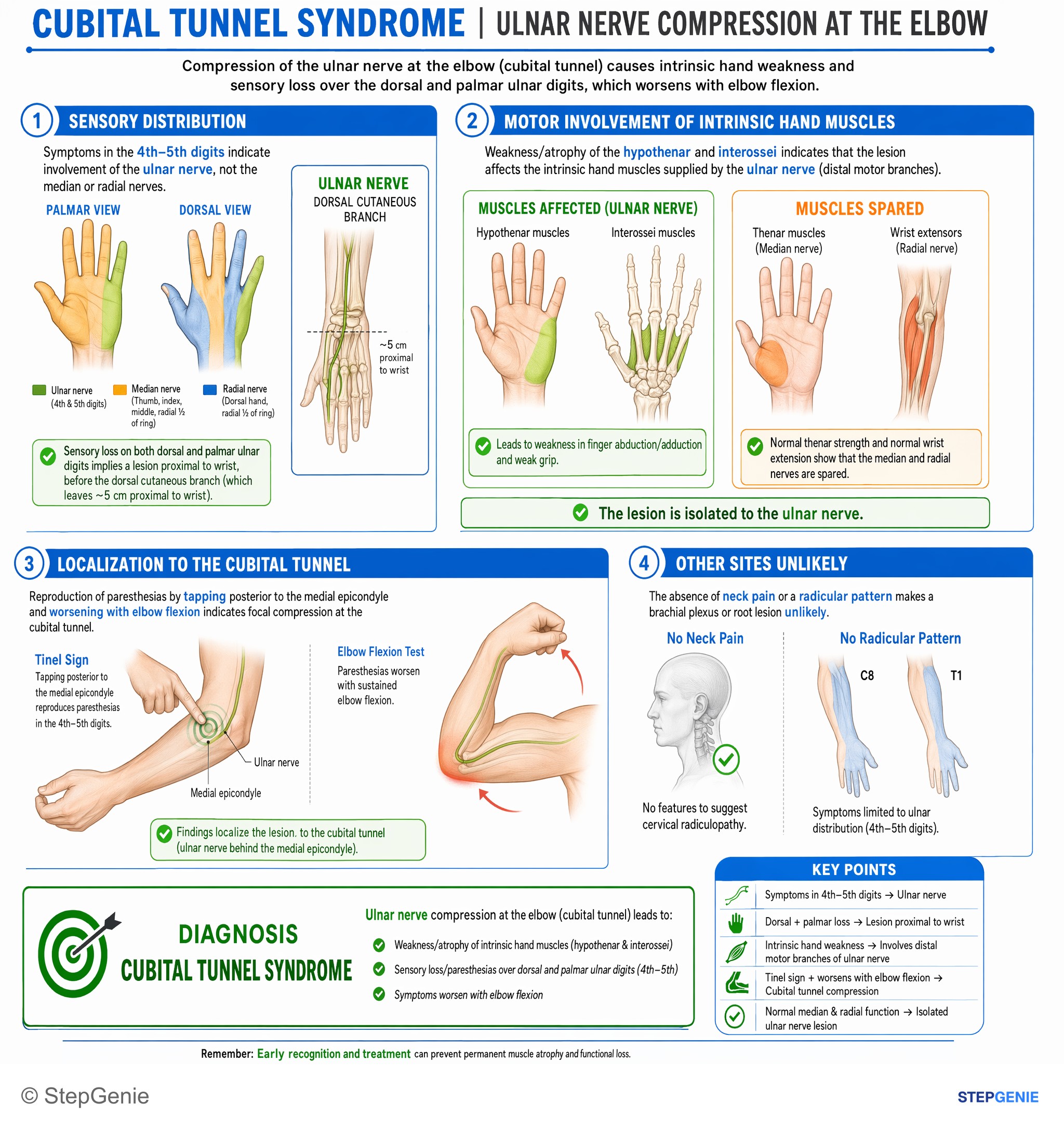
Cubital tunnel syndrome: ulnar nerve compression at elbow → intrinsic hand weakness + sensory loss over dorsal and palmar ulnar digits…
USMLE Step 1Frequently Asked Questions
What are the classic findings in cubital tunnel syndrome?
Cubital tunnel syndrome classically causes ulnar nerve symptoms at the elbow: numbness or tingling in the 4th and 5th digits plus weakness of intrinsic hand muscles. Patients often have interossei weakness with impaired finger abduction and adduction, decreased grip strength, and possible ulnar clawing that is more prominent in the ring and pinky fingers.
Why do cubital tunnel syndrome symptoms get worse with elbow flexion?
Symptoms worsen with elbow flexion because bending the elbow increases pressure in the cubital tunnel and further compresses the ulnar nerve behind the medial epicondyle. This is why patients may notice worse tingling when sleeping with flexed elbows or after prolonged elbow positioning, and why the elbow flexion test can reproduce symptoms.
How do you tell cubital tunnel syndrome from Guyon canal syndrome?
Cubital tunnel syndrome localizes to the elbow, while Guyon canal syndrome localizes to the wrist. Cubital tunnel can cause 4th and 5th digit sensory loss with possible involvement of the dorsal ulnar hand and may also affect FCU and medial FDP because the lesion is proximal. In Guyon canal syndrome, the dorsal ulnar hand is often spared and forearm muscles are spared.
What is Froment sign and why does it happen in ulnar nerve palsy?
Froment sign is flexion of the thumb at the IP joint during a paper pinch, and it happens because ulnar nerve palsy weakens the adductor pollicis. To maintain pinch strength, the patient compensates by using flexor pollicis longus, which is supplied by the median nerve via the anterior interosseous branch, causing thumb IP flexion.
Why can an elbow ulnar lesion cause less clawing than a wrist lesion?
An ulnar lesion at the elbow can produce less clawing than a wrist lesion because a proximal lesion may also weaken the medial FDP to digits 4 and 5. With less FDP function, there is less flexion at the interphalangeal joints, so the claw posture is less dramatic. This is the classic ulnar paradox described with more proximal lesions.