McArdle disease (glycogen storage disease type V) is an autosomal recessive deficiency of muscle glycogen phosphorylase (myophosphorylase), caused by variants in both copies of PYGM. Skeletal muscle can't break glycogen down to glucose-1-phosphate, so the first minutes of intense exercise bring pain, cramps and fatigue, and a short rest followed by slower activity brings a "second wind" as blood glucose and fatty acids take over. Expect a high CK even at rest, episodes of rhabdomyolysis with myoglobinuria, and on forearm exercise testing a flat lactate with a normal or exaggerated ammonia rise. Genetic testing confirms it. Management is regular moderate aerobic exercise, avoiding intense or isometric effort, and sometimes sucrose just before planned exercise. The liver, fasting glucose and red cells are normal, which is how you beat the distractors.
The vignette
A 21-year-old man has had leg pain, stiffness and fatigue within the first few minutes of sprinting or climbing stairs since his early teens. If he slows down for several minutes and then continues at an easy pace, he can keep going with much less discomfort, and his heart rate drops at that point. After a weightlifting session last month he passed cola-colored urine. Examination at rest is normal, with no hepatomegaly or muscle wasting. Serum creatine kinase at rest is 2,800 U/L. Fasting glucose, hemoglobin, reticulocyte count and bilirubin are normal. During a non-ischemic forearm exercise test, venous lactate does not rise, while ammonia rises fivefold.
Deficiency of which enzyme is most likely?
- A. Acid α-glucosidase
- B. Carnitine palmitoyltransferase II
- C. Glycogen debranching enzyme
- D. Glucose-6-phosphatase
- E. Liver glycogen phosphorylase
- F. Muscle glycogen phosphorylase
- G. Muscle phosphofructokinase
Answer: F, muscle glycogen phosphorylase (McArdle disease, GSD V). Every clue points to a block at the first step of muscle glycogen breakdown: symptoms within minutes of intense exercise, a second wind with a falling heart rate, rhabdomyolysis after weightlifting, a high resting CK, and a flat lactate with a brisk ammonia rise. Normal glucose and no hepatomegaly mean the liver is spared; normal hemoglobin, reticulocytes and bilirubin rule out hemolysis.
Sneaky variant: add reticulocytosis, a raised bilirubin and gout, and have a sugary drink before exercise make him worse. The answer becomes G, muscle phosphofructokinase (Tarui disease).
Why every other choice is wrong
- A. Acid α-glucosidase (Pompe disease, GSD II). A lysosomal glycogen disorder, so cytosolic glycogen breakdown still works. Infantile Pompe means cardiomyopathy with heart failure, severe hypotonia and macroglossia; later-onset forms bring progressive limb-girdle and respiratory weakness, not cramps that ease with a second wind. Drill it with the Pompe mnemonic.
- B. Carnitine palmitoyltransferase II (myopathic CPT II deficiency). A fatty acid oxidation defect, so short bursts are usually fine. Attacks of muscle pain and myoglobinuria follow prolonged exercise, especially with fasting, or illness, cold or stress, and most people are symptom-free between episodes. The enzyme sits in the carnitine shuttle.
- C. Debranching enzyme (Cori disease, GSD III). Hepatomegaly and fasting hypoglycemia milder than von Gierke, with abnormal, short-branched glycogen (limit dextrin); type IIIa adds a myopathy. The liver signs are missing here. Compare in the Cori disease breakdown.
- D. Glucose-6-phosphatase (von Gierke disease, GSD Ia). The liver can't release free glucose: severe fasting hypoglycemia, lactic acidosis, hyperuricemia, hypertriglyceridemia, hepatomegaly and renomegaly, usually before age 1. Details in the von Gierke guide.
- E. Liver glycogen phosphorylase (Hers disease, GSD VI). The classic "wrong phosphorylase": hepatomegaly, growth retardation, hypoglycemia and ketosis, with a benign course that eases with age. Muscle is unaffected.
- G. Muscle phosphofructokinase (Tarui disease, GSD VII). The closest look-alike, with the same exercise cramps, rhabdomyolysis and flat lactate. But PFK deficiency also affects red cells, so look for compensated hemolysis (reticulocytosis, raised bilirubin, jaundice) and hyperuricemia. Carbohydrate before exercise makes it worse (the "out-of-wind" phenomenon), and the McArdle-style second wind does not occur.
What goes wrong in the muscle
Myophosphorylase removes glucose units from glycogen as glucose-1-phosphate, the fuel for the glycolysis that powers intense, early exercise. Without it:
- Energy crisis in the first minutes: ATP falls, causing pain, cramps, stiffness and fatigue.
- Muscle damage: pushing through pain causes rhabdomyolysis, which about half of patients have had, with red or brown urine (myoglobinuria). Acute kidney failure occurred in 6-11% of patients in large cohorts and is almost always reversible with prompt treatment; see rhabdomyolysis-induced AKI.
- The second wind (about 90% of patients): typically 6-10 minutes into activity, delivery of blood-borne glucose and free fatty acids rises, oxidative metabolism takes over, and heart rate drops, often by 20-50 beats/min.
- High CK at rest: median 2,643 IU/L in a cohort of 256 patients, with normal values in only about 7%; attacks can push CK above 100,000 IU/L.
- Severity varies: in the Spanish registry, 21% reported recurrent myoglobinuria and fixed weakness, mostly of the upper body, and were severely limited in daily activities, while 8% had no symptoms in normal daily life.
- What stays normal: liver size, fasting glucose and red cells.
Symptoms usually begin in childhood (MedlinePlus says the teens or twenties are typical), yet diagnosis is often delayed for decades: in one cohort the median age at correct diagnosis was 33, and 90% had first been misdiagnosed. Prevalence is about 1 in 100,000 (Dallas-Fort Worth; about 1 in 140,000 diagnosed cases in Spain), and sequencing data suggest the disease is underdiagnosed.
Diagnosis
| Test | Result in McArdle disease | Why |
|---|---|---|
| Genetic testing (first line) | Two pathogenic PYGM variants confirm it | p.Arg50Ter makes up about 60% of variant alleles in European and US White patients |
| Serum CK | High even at rest in about 93% | Ongoing muscle damage |
| Forearm exercise test (non-ischemic) | Flat lactate; normal or exaggerated ammonia rise | No glycogen breakdown means no glycolytic flux to lactate. As ATP falls, AMP deaminase turns AMP into IMP and ammonia, and the ammonia rise shows the muscle really worked |
| Muscle biopsy (if genetics are inconclusive) | Subsarcolemmal glycogen 3-5 times normal; absent or very low myophosphorylase activity | Direct proof of the block |
The 2021 international guideline prefers the non-ischemic forearm test, because the ischemic version (exercising with a blood pressure cuff inflated) provokes painful cramps and risks rhabdomyolysis.
Management
From the 2021 international clinical practice guideline (Lucia et al.):
- Regular aerobic exercise at low to moderate intensity, ideally at least 20 minutes, 2-4 times a week, to raise fitness. Avoid a completely inactive lifestyle.
- Avoid isometric and maximal efforts (heavy lifting, sprinting, sustained contraction of one muscle group), and slow down or pause when symptoms start, then resume.
- Pre-exercise sucrose: about 37 g (roughly one 330-mL can of soda) 5-10 minutes before planned exercise improves exercise tolerance; older advice (NORD's 2015 summary) used 75 g 30-40 minutes before. Plan it because of weight gain, and supervise it closely in diabetes.
- Diet: a carbohydrate-rich diet did better than a protein-rich one; ketogenic diets look promising in a pilot study but the evidence is too limited for a recommendation, and triheptanoin was ineffective.
- Statins: check a baseline CK before starting; with any new drug, "start low and go slow."
- Anesthesia: follow malignant hyperthermia precautions even though no events have been reported; avoid succinylcholine, halogenated agents and tourniquets.
- Rhabdomyolysis is an emergency: early treatment protects the kidneys.
Glycogen storage diseases and look-alikes
| Disorder | Enzyme (gene) | Main tissue | Signature clues | Exercise clue |
|---|---|---|---|---|
| McArdle (GSD V) | Muscle glycogen phosphorylase (PYGM) | Skeletal muscle | Cramps in the first minutes, myoglobinuria, high resting CK; normal glucose | Second wind; sucrose helps |
| Tarui (GSD VII) | Muscle phosphofructokinase (PFKM) | Muscle and red cells | Same cramps plus hemolysis, hyperuricemia, jaundice | Out-of-wind: carbohydrate worsens it |
| CPT II deficiency (myopathic) | Carnitine palmitoyltransferase II (CPT2) | Muscle mitochondria | Myoglobinuria after prolonged exercise, fasting, illness or cold; well between attacks | Short bursts tolerated |
| Pompe (GSD II) | Lysosomal acid α-glucosidase (acid maltase) | Heart and skeletal muscle | Infant: cardiomyopathy, hypotonia, macroglossia; later onset: limb-girdle and respiratory weakness | Progressive weakness rather than early-exercise cramps |
| Cori (GSD III) | Debranching enzyme | Liver, plus muscle in IIIa | Hepatomegaly, milder fasting hypoglycemia, limit dextrin | Myopathy in IIIa |
| von Gierke (GSD Ia) | Glucose-6-phosphatase | Liver and kidney | Severe fasting hypoglycemia, lactic acidosis, hyperuricemia, hypertriglyceridemia, hepatomegaly | None |
| Hers (GSD VI) | Liver glycogen phosphorylase | Liver | Hepatomegaly, growth retardation, hypoglycemia, ketosis; benign | None |
| Andersen (GSD IV) | Branching enzyme | Liver (rarer neuromuscular forms) | Hepatomegaly with progressive cirrhosis, failure to thrive; liver transplant | None in the classic hepatic form |
More on the branching defect in the Andersen disease guide.
How USMLE tests McArdle disease
- Timing is the tell. Trouble in the first minutes of intense exercise points to a glycogen breakdown or glycolysis block (McArdle, Tarui). Trouble after long exercise or fasting points to fatty acid oxidation (CPT II).
- Second wind = McArdle; carbohydrate making things worse = Tarui.
- Exercise cramps plus hemolysis = Tarui, because red cells also need PFK.
- Hepatomegaly or fasting hypoglycemia = a liver GSD, not McArdle.
- The phosphorylase trap: muscle phosphorylase is McArdle (type V); liver phosphorylase is Hers (type VI).
- Lab pattern: flat lactate with a rising ammonia on forearm testing, and a CK that is high even at rest.
Key takeaways
- McArdle disease (GSD V) = myophosphorylase deficiency (PYGM), autosomal recessive, about 1 in 100,000.
- Cramps in the first minutes of intense exercise, a second wind at 6-10 minutes, and myoglobinuria after intense or isometric effort.
- CK high even at rest; forearm testing shows flat lactate with an ammonia rise; genetic testing confirms it.
- Manage with regular moderate aerobic exercise, avoid intense and isometric effort, consider pre-exercise sucrose, and treat rhabdomyolysis early.
- Separate it from Tarui (hemolysis, out-of-wind), CPT II (prolonged exercise or fasting) and the liver GSDs (hepatomegaly, hypoglycemia).
Sources
- Clinical practice guidelines for glycogen storage disease V & VII (McArdle disease and Tarui disease) from an international study group — Neuromuscular Disorders (2021)
- Glycogen storage disease type V — MedlinePlus Genetics
- Glycogen Storage Disease Type V — National Organization for Rare Disorders (NORD) (2015)
- Glycogen Storage Diseases — Merck Manual Professional Edition (2024)
- Diagnostic power of the non-ischemic forearm exercise test in glycogenosis type V (van den Bogaart et al., abstract) — Neuromuscular Disorders (2014)
- Acid maltase deficiency (Pompe disease) — Muscular Dystrophy Association
- Glycogen storage disease type VII — MedlinePlus Genetics
- Phosphofructokinase deficiency (Tarui disease) — Muscular Dystrophy Association
- Carnitine palmitoyltransferase II deficiency — MedlinePlus Genetics
- Carnitine palmityl transferase deficiency — Muscular Dystrophy Association
- Fatty Acid and Glycerol Metabolism Disorders — Merck Manual Professional Edition
Visual explanations from the StepGenie QBank
Infographics StepGenie drew to explain questions in its own QBank, matched to this article's topic. Each caption is the takeaway of the question it explains.
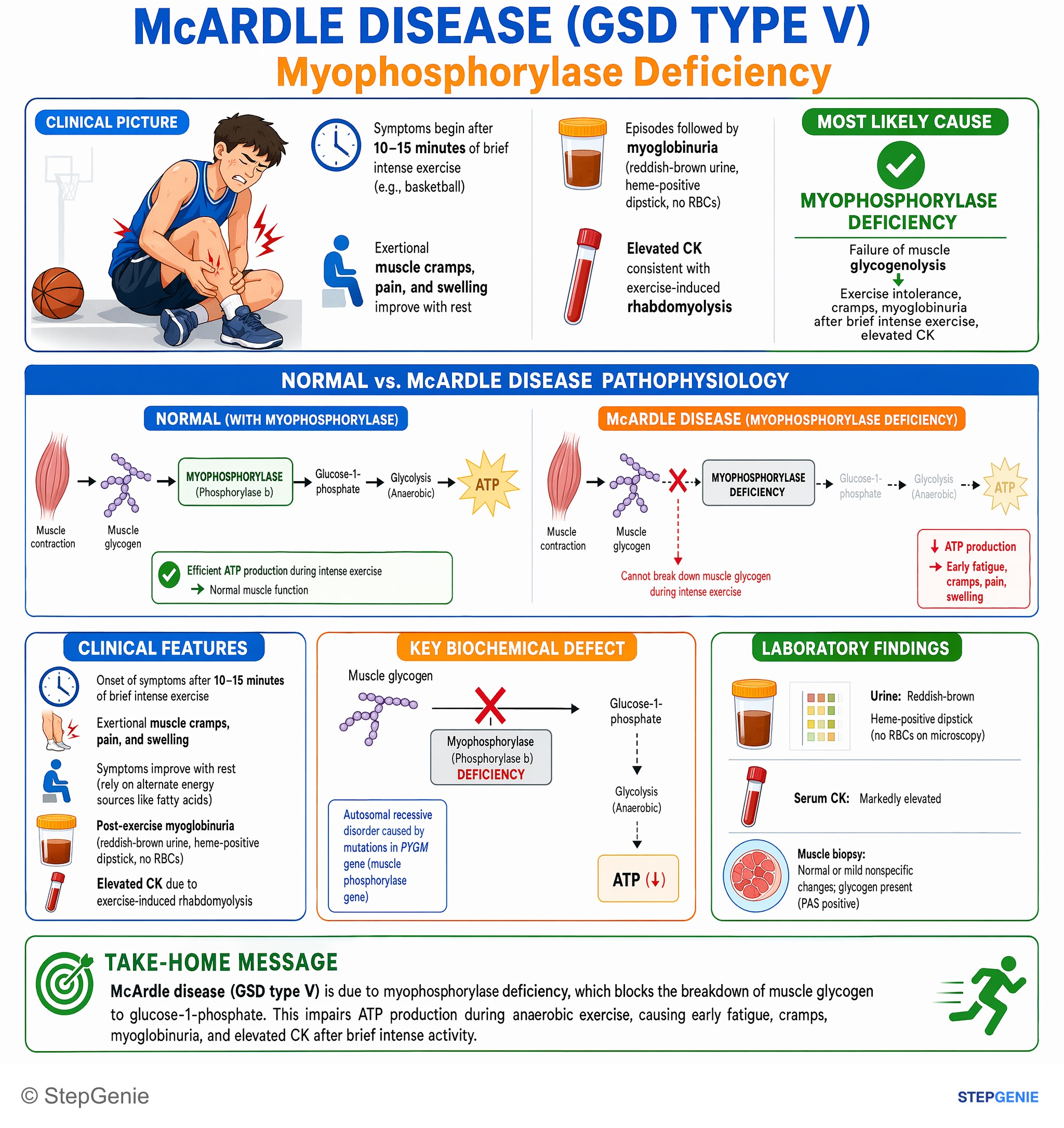
McArdle disease (myophosphorylase deficiency) → failure of muscle glycogenolysis → exercise intolerance, cramps, myoglobinuria after brief…
USMLE Step 1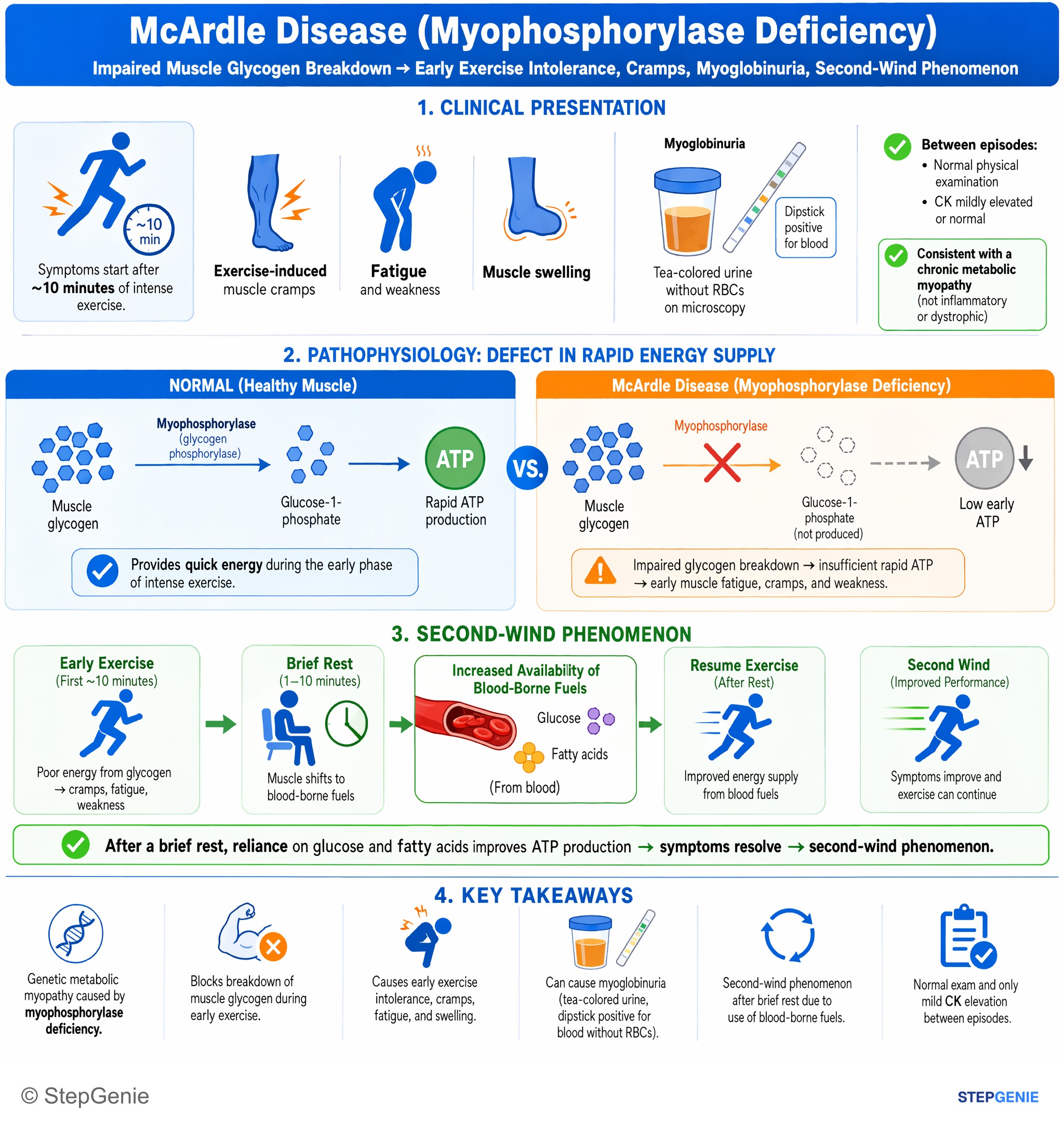
McArdle disease (myophosphorylase deficiency): impaired muscle glycogen breakdown → early exercise intolerance, muscle cramps…
USMLE Step 1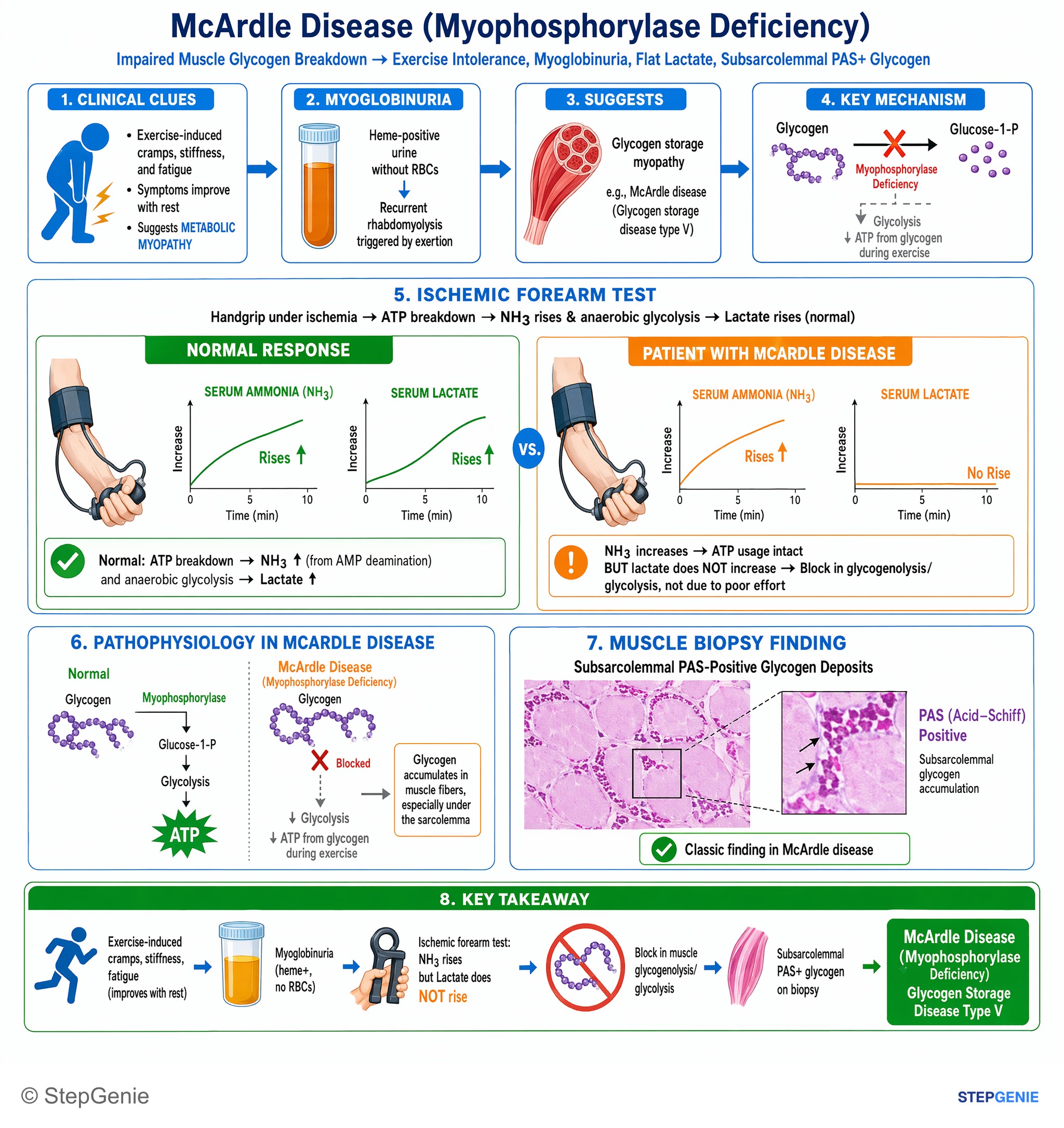
McArdle disease (myophosphorylase deficiency) → impaired glycogen breakdown → exercise intolerance, myoglobinuria, flat lactate on…
USMLE Step 1Frequently Asked Questions
What enzyme is deficient in McArdle disease?
McArdle disease, or glycogen storage disease type V, is caused by deficiency of muscle glycogen phosphorylase, also called myophosphorylase. Variants in both copies of the PYGM gene (autosomal recessive inheritance) stop skeletal muscle from breaking glycogen down to glucose-1-phosphate, so muscle cannot fuel the glycolysis needed for intense, early exercise. The liver enzyme is normal, so fasting glucose and liver size are normal; liver phosphorylase deficiency is a different disorder, Hers disease (type VI).
What is the second wind phenomenon in McArdle disease?
The second wind is the marked improvement in exercise tolerance that about 90% of people with McArdle disease notice if they slow down or rest briefly when symptoms start and then continue at a moderate pace. It typically appears about 6 to 10 minutes into activity, when more blood-borne glucose and free fatty acids reach the muscle and oxidative metabolism takes over, and heart rate often falls by 20 to 50 beats per minute. It does not occur in Tarui disease.
What does the forearm exercise test show in McArdle disease?
Venous lactate fails to rise after forearm exercise, because muscle cannot break down glycogen to feed glycolysis, while ammonia rises normally or even exaggeratedly as AMP is deaminated when ATP falls. The ammonia rise shows the muscle was worked hard enough. Current guidelines prefer a non-ischemic version of the test, because exercising under an inflated cuff provokes cramps and can cause rhabdomyolysis. Tarui disease gives a similar flat lactate, and genetic testing of PYGM confirms McArdle disease.
How do you tell McArdle disease from Tarui disease?
Both cause cramps early in intense exercise, rhabdomyolysis and a flat lactate on forearm testing. Tarui disease (muscle phosphofructokinase deficiency, GSD VII) also affects red cells, so it adds compensated hemolysis with reticulocytosis, raised bilirubin or jaundice, and hyperuricemia. Carbohydrate before exercise helps in McArdle disease but worsens Tarui disease, the out-of-wind phenomenon, and the typical McArdle second wind does not occur in Tarui disease.
How is McArdle disease diagnosed?
Suspect it in someone with cramps and fatigue in the first minutes of intense exercise, a second wind, episodes of dark urine and a CK that is high even at rest, as it is in about 93% of patients. Genetic testing that finds two pathogenic PYGM variants confirms the diagnosis. A non-ischemic forearm exercise test with a flat lactate and rising ammonia supports it, and a muscle biopsy showing excess glycogen and absent myophosphorylase activity is used when genetic results are inconclusive.
How is McArdle disease managed?
The 2021 international guideline recommends regular low- to moderate-intensity aerobic exercise, ideally at least 20 minutes two to four times a week, and avoiding isometric or maximal efforts such as heavy lifting and sprinting, slowing down or pausing when symptoms start. About 37 grams of sucrose, roughly one can of soda, taken 5 to 10 minutes before planned exercise improves tolerance but should be planned because of weight gain. Rhabdomyolysis needs prompt emergency treatment to protect the kidneys.