You’re doing a stroke question and it feels “too easy”… until the answer choices are all plausible. That’s exactly how the USMLE tests stroke risk: not just what increases risk, but which mechanism, which stroke subtype, and how to prioritize modifiable vs nonmodifiable factors. Let’s walk through a classic vignette and then dissect every distractor like you would in a high-quality Q-bank review.
Tag: Neurology > Stroke & Cerebrovascular
The Vignette (Q-bank style)
A 67-year-old man comes to clinic for follow-up. He has hypertension, type 2 diabetes mellitus, hyperlipidemia, and smokes 1 pack/day. He drinks alcohol socially. Medications include hydrochlorothiazide and metformin, but he admits he “often forgets” his BP meds. BP is 168/96 mm Hg. BMI is 31. Labs show LDL 162 mg/dL and HbA1c 7.8%. He asks what change would most reduce his risk of stroke.
Which is the most important modifiable risk factor for ischemic stroke to target?
A. Tight glycemic control
B. Smoking cessation
C. Start aspirin for primary prevention
D. Control blood pressure
E. Reduce dietary sodium only
The Correct Answer: D. Control blood pressure
Why it’s right
Hypertension is the single most important modifiable risk factor for stroke—for both ischemic and hemorrhagic stroke.
High BP damages cerebrovascular endothelium over time, accelerating:
- Large artery atherosclerosis (carotids, circle of Willis)
- Small vessel lipohyalinosis → lacunar infarcts
- Charcot-Bouchard microaneurysms → deep intracerebral hemorrhage (basal ganglia, thalamus, pons, cerebellum)
High-yield associations to remember
- Lacunar strokes (small vessel disease) classically tied to:
- Hypertension
- Diabetes
- Hypertensive hemorrhage: deep brain structures due to small penetrating arteries.
- Amyloid angiopathy hemorrhage: lobar hemorrhage in older adults (different mechanism).
Test-taker move: When the stem screams “multiple risk factors,” don’t spread your attention evenly. The exam wants prioritization: BP control beats “tweaks” like sodium alone or glycemic micromanagement when the question is most important modifiable risk factor.
Why Each Distractor Matters (and when it would be correct)
A. Tight glycemic control
Diabetes is a major vascular risk factor, but tight glycemic control does not reduce stroke risk as strongly as BP control in the short-to-medium term.
What diabetes does increase:
- Atherosclerosis risk (large vessel disease)
- Small vessel disease contribution (along with HTN)
- Worse outcomes post-stroke
USMLE nuance: Diabetes is a big deal, but for stroke prevention, BP control and statins generally outperform “tight A1c” as first-line risk reducers—especially when BP is clearly uncontrolled.
B. Smoking cessation
Smoking is absolutely a modifiable stroke risk factor and is high-yield for:
- Accelerating atherosclerosis
- Increasing thrombosis risk (endothelial dysfunction, platelet activation)
- Increasing risk of subarachnoid hemorrhage via aneurysm formation/rupture (risk factor: smoking + HTN)
So why not B? Because on Step exams, the hierarchy for “most important modifiable risk factor for stroke” is typically:
- Hypertension
- (Close runners-up depending on framing) Atrial fibrillation, diabetes, smoking, hyperlipidemia
If the question were phrased as “most effective lifestyle change,” smoking cessation might rise. But the vignette is about overall stroke risk reduction—and his BP is severely uncontrolled.
C. Start aspirin for primary prevention
Aspirin is a trap answer in primary prevention.
Key principle: Aspirin reduces platelet aggregation and can prevent arterial thrombosis, but in primary prevention it:
- Provides modest benefit at best for ischemic events
- Increases bleeding risk (GI, intracranial)
- Is no longer a “default yes” without careful risk stratification
When aspirin is high-yield and correct:
- Secondary prevention after TIA/ischemic stroke (unless anticoagulation indicated, e.g., afib)
- Acute ischemic stroke (after hemorrhage excluded) per protocols
- Certain high-risk primary prevention scenarios—but this is nuanced and guideline-dependent
USMLE framing tip: If the question asks “most important modifiable risk factor,” aspirin is rarely the best answer.
E. Reduce dietary sodium only
Dietary sodium reduction helps, but it’s an incomplete intervention when the patient already has established, uncontrolled hypertension.
What the exam is probing:
- Lifestyle measures are supportive, but the core target is blood pressure control (often requiring meds + adherence).
- “Sodium reduction only” is too narrow and doesn’t directly address his poor medication adherence and dangerously high BP.
Better real-world bundle:
- Antihypertensive adherence + intensification
- DASH-style diet, weight loss, exercise
- Smoking cessation
- Statin therapy
But on the USMLE, the “best next” or “most important modifiable factor” remains BP control.
Mini-Framework: Match Risk Factors to Stroke Subtypes (High-yield)
| Stroke subtype | Key mechanism | Classic risk factors | Exam clues |
|---|---|---|---|
| Large artery (atherothrombotic) | Carotid/cerebral atherosclerosis → thrombosis/embolus | HTN, smoking, hyperlipidemia, diabetes | Bruit, carotid stenosis, cortical deficits |
| Cardioembolic | Embolus from heart (often left atrium/ventricle) | Atrial fibrillation, recent MI, dilated cardiomyopathy, valvular disease | Sudden onset, cortical signs, multiple vascular territories |
| Lacunar (small vessel) | Lipohyalinosis of penetrating arteries | HTN, diabetes | Pure motor, pure sensory, ataxic hemiparesis, dysarthria–clumsy hand |
| Intracerebral hemorrhage (deep) | Rupture of small penetrating vessels | HTN (Charcot-Bouchard) | Basal ganglia/thalamus/pons/cerebellum |
| Lobar hemorrhage | Amyloid in vessel walls | Cerebral amyloid angiopathy (older adults) | Lobar bleed, recurrent |
| Subarachnoid hemorrhage | Ruptured berry aneurysm | Smoking, HTN, ADPKD, Ehlers-Danlos | “Worst headache of my life,” nuchal rigidity |
Rapid-Fire USMLE Pearls (the ones you’ll actually use)
- #1 modifiable stroke risk factor = hypertension.
- #1 cause of cardioembolic stroke = atrial fibrillation → anticoagulate when indicated (e.g., CHA₂DS₂-VASc; exam often simplifies).
- Lacunar stroke = small vessel disease from HTN/DM; presents with no cortical signs (no aphasia, neglect, visual field cuts).
- Hypertensive hemorrhage hits deep structures; amyloid angiopathy causes lobar hemorrhage.
- Aspirin is strongest as secondary prevention, not automatic primary prevention.
- Smoking is high-yield for both ischemic risk (atherosclerosis) and SAH risk (aneurysm rupture).
How to Answer These Fast on Test Day
When asked “most important modifiable risk factor for stroke,” scan for:
- Blood pressure status (uncontrolled HTN = your anchor)
- Atrial fibrillation (if present, often becomes the most actionable cause of embolic stroke)
- Secondary modifiers: smoking, lipids, diabetes, obesity
In this vignette, the BP is severely elevated and poorly treated → control blood pressure is the best answer.
Visual explanations from the StepGenie QBank
Infographics StepGenie drew to explain questions in its own QBank, matched to this article's topic. Each caption is the takeaway of the question it explains.
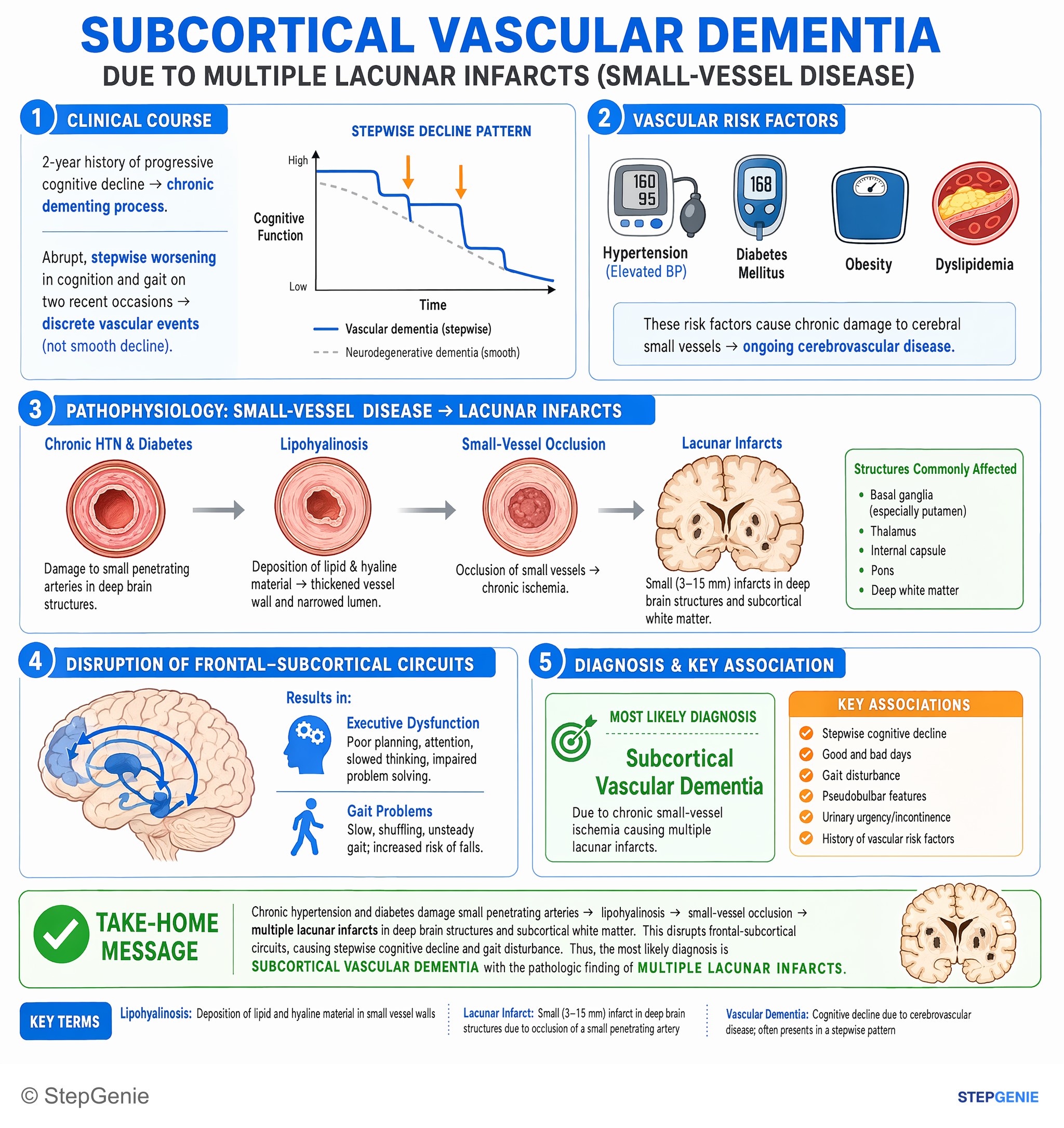
Vascular dementia presents with stepwise cognitive decline and gait disturbance, associated with multiple lacunar infarcts from chronic…
USMLE Step 2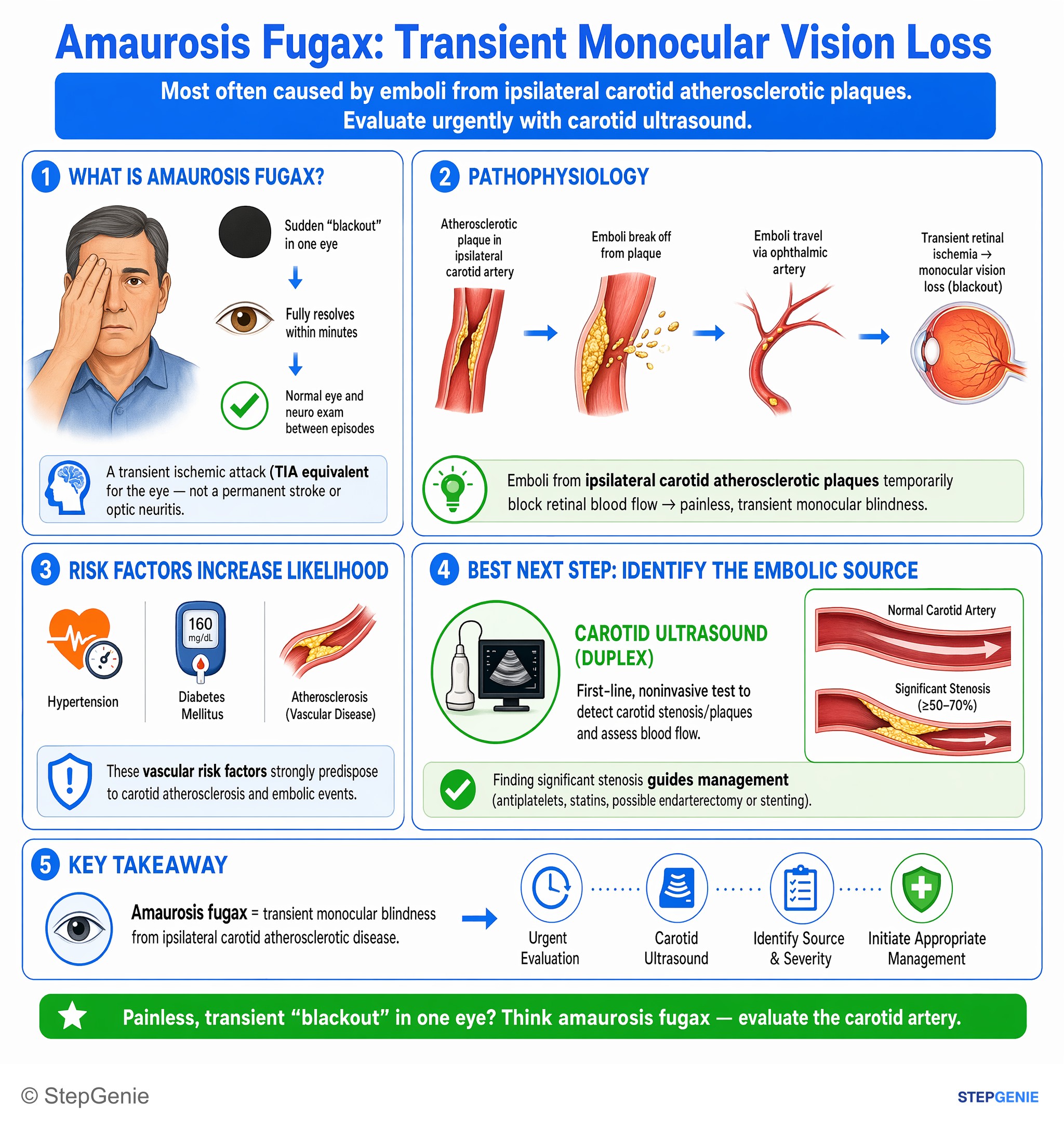
Amaurosis fugax from ipsilateral carotid atherosclerotic disease causes transient monocular blindness; evaluate urgently with carotid…
USMLE Step 2Frequently Asked Questions
What is the most important modifiable risk factor for ischemic stroke to target?
Control of blood pressure is the most important modifiable risk factor to target for ischemic stroke. Hypertension is the single most important modifiable risk factor for both ischemic and hemorrhagic stroke because it damages cerebrovascular endothelium over time, promoting large artery atherosclerosis, small vessel lipohyalinosis that causes lacunar infarcts, and Charcot-Bouchard microaneurysms that can lead to deep intracerebral hemorrhage.
Why does hypertension increase the risk of both ischemic and hemorrhagic stroke?
Hypertension raises the risk of both ischemic and hemorrhagic stroke because chronic high blood pressure injures the cerebrovascular endothelium. That injury accelerates large artery atherosclerosis, contributes to small vessel lipohyalinosis causing lacunar infarcts, and promotes Charcot-Bouchard microaneurysm formation, which can rupture and cause deep intracerebral hemorrhage in structures like the basal ganglia, thalamus, pons, and cerebellum.
How do you tell hypertensive intracerebral hemorrhage from amyloid angiopathy hemorrhage?
Hypertensive intracerebral hemorrhage classically affects deep brain structures because it involves rupture of small penetrating arteries. Amyloid angiopathy hemorrhage, in contrast, causes lobar hemorrhage in older adults and has a different mechanism. A vignette pointing to basal ganglia, thalamus, pons, or cerebellum supports hypertensive hemorrhage, whereas a lobar bleed in an older patient suggests amyloid angiopathy.
Why isn’t tight glycemic control the best answer for stroke prevention in a patient with diabetes and hypertension?
Tight glycemic control is not the best answer because blood pressure control reduces stroke risk more strongly in the short-to-medium term when hypertension is clearly uncontrolled. Diabetes is still a major vascular risk factor and contributes to atherosclerosis, small vessel disease, and worse post-stroke outcomes, but for stroke prevention, blood pressure control and statins generally outperform tight A1c control as first-line risk reducers.
Why is aspirin usually a trap answer for primary prevention of stroke?
Aspirin is often a trap in primary prevention because it is not a default choice for overall stroke risk reduction. It can modestly reduce arterial thrombosis, but in primary prevention that benefit is limited and comes with increased bleeding risk, including gastrointestinal and intracranial bleeding. It is more clearly high-yield for secondary prevention after TIA or ischemic stroke, or in acute ischemic stroke after hemorrhage is excluded.