Influenza questions love to look simple and then punish you for mixing up antigenic drift and antigenic shift. This is your one-page, quick-hit, shareable cheat sheet—built for those “patient has fever + myalgias in winter” stems and the “why do we need new vaccines?” concepts that show up on Step 1 and Step 2.
Influenza in 15 seconds (high-yield core)
Influenza virus = Orthomyxovirus
- Enveloped, (-)ssRNA, segmented genome (think: segmented = can reassort)
- Replicates in nucleus (high-yield exception for RNA viruses)
- Surface proteins: HA (hemagglutinin) and NA (neuraminidase)
- Major human strains: Influenza A and B
- A: causes epidemics + pandemics (shift + drift)
- B: causes epidemics (drift only; no animal reservoir)
The one-liner you should memorize
- Antigenic drift = point mutations in HA/NA → seasonal flu epidemics (A and B)
- Antigenic shift = reassortment of RNA segments → new subtype → pandemics (A only)
Drift vs Shift (Step-friendly table)
| Feature | Antigenic Drift | Antigenic Shift |
|---|---|---|
| Mechanism | Point mutations (RNA polymerase lacks proofreading) | Reassortment of segmented genome |
| Result | Minor antigen change | Major antigen change (new HA ± NA) |
| Who gets it? | Influenza A and B | Influenza A only |
| Epidemiology | Seasonal epidemics | Pandemics |
| Speed | Gradual/continuous | Sudden |
| Key prerequisite | None beyond replication | Co-infection with 2 different influenza A strains (often human + animal) |
| Classic board phrase | “Vaccine mismatch this year” | “Novel strain; little/no population immunity” |
Mnemonic + visual device (shareable)
DRIFT = “DRip”
DRIFT happens from small errors that drip in over time:
- D = Daily/seasonal changes
- R = RNA point mutations
- I = Influenza A & B
- F = Flu epidemics
- T = Tiny changes in HA/NA
SHIFT = “SHIFT gears”
SHIFT is a big jump—like shifting gears into a new category:
- S = Segment reassortment
- H = Huge change (new subtype)
- I = Influenza A only
- F = From animals (often birds/pigs as mixing vessels)
- T = Time for a pandemic
Quick sketch in words: what’s actually changing?
Antigenic drift (small edits)
- Think: HA/NA genes acquire single-nucleotide changes → amino acid substitutions
- Enough change = antibodies from last year bind worse → repeat infections and new vaccine each season
Antigenic shift (gene segment swap)
- Influenza A’s genome is segmented (classically 8 segments)
- If a host (often pig) gets infected by two different influenza A strains at once:
- segments can reassort → progeny virus with a new HA/NA combination
- Humans have low preexisting immunity → pandemic potential
HA vs NA: exam-relevant functions
- HA (hemagglutinin): binds sialic acid on respiratory epithelial cells → entry/fusion
- Big changes in HA are especially important for immune escape
- NA (neuraminidase): cleaves sialic acid → release of new virions from infected cells
- Target of oseltamivir/zanamivir (neuraminidase inhibitors)
High-yield clinical correlations (what Step stems want)
Classic flu presentation
- Abrupt onset fever, chills, myalgias, headache, fatigue
- Often ± dry cough, sore throat
- Complications you should recall:
- Primary viral pneumonia
- Secondary bacterial pneumonia (esp. S. aureus, S. pneumoniae, H. influenzae)
- Reye syndrome association classically tested with influenza + aspirin use in children (historical but board-relevant concept)
Vaccine angle (how they test drift)
- “Why is the influenza vaccine updated yearly?” → antigenic drift
- “Why can influenza cause pandemics?” → antigenic shift (A only)
Micro “rapid-fire” pearls
- Orthomyxovirus = segmented (-)ssRNA → shift possible
- Paramyxovirus (RSV, measles, mumps) = nonsegmented (-)ssRNA → no shift
- Influenza replicates in the nucleus (exception among RNA viruses; another classic exception is retroviruses—also nucleus but different reason)
Mini self-test (30 seconds)
-
A new HxNy strain appears after co-infection of avian and human influenza strains. Epidemic or pandemic?
Pandemic → antigenic shift -
Seasonal vaccine needs updating because circulating strains have accumulated small HA mutations. Drift or shift?
Drift -
Which influenza type can undergo shift?
Type A
Final takeaway (the line to write on your scratch paper)
Drift = point mutations → seasonal epidemics (A & B).
Shift = reassortment of segments → new subtype → pandemics (A only).
Visual explanations from the StepGenie QBank
Infographics StepGenie drew to explain questions in its own QBank, matched to this article's topic. Each caption is the takeaway of the question it explains.
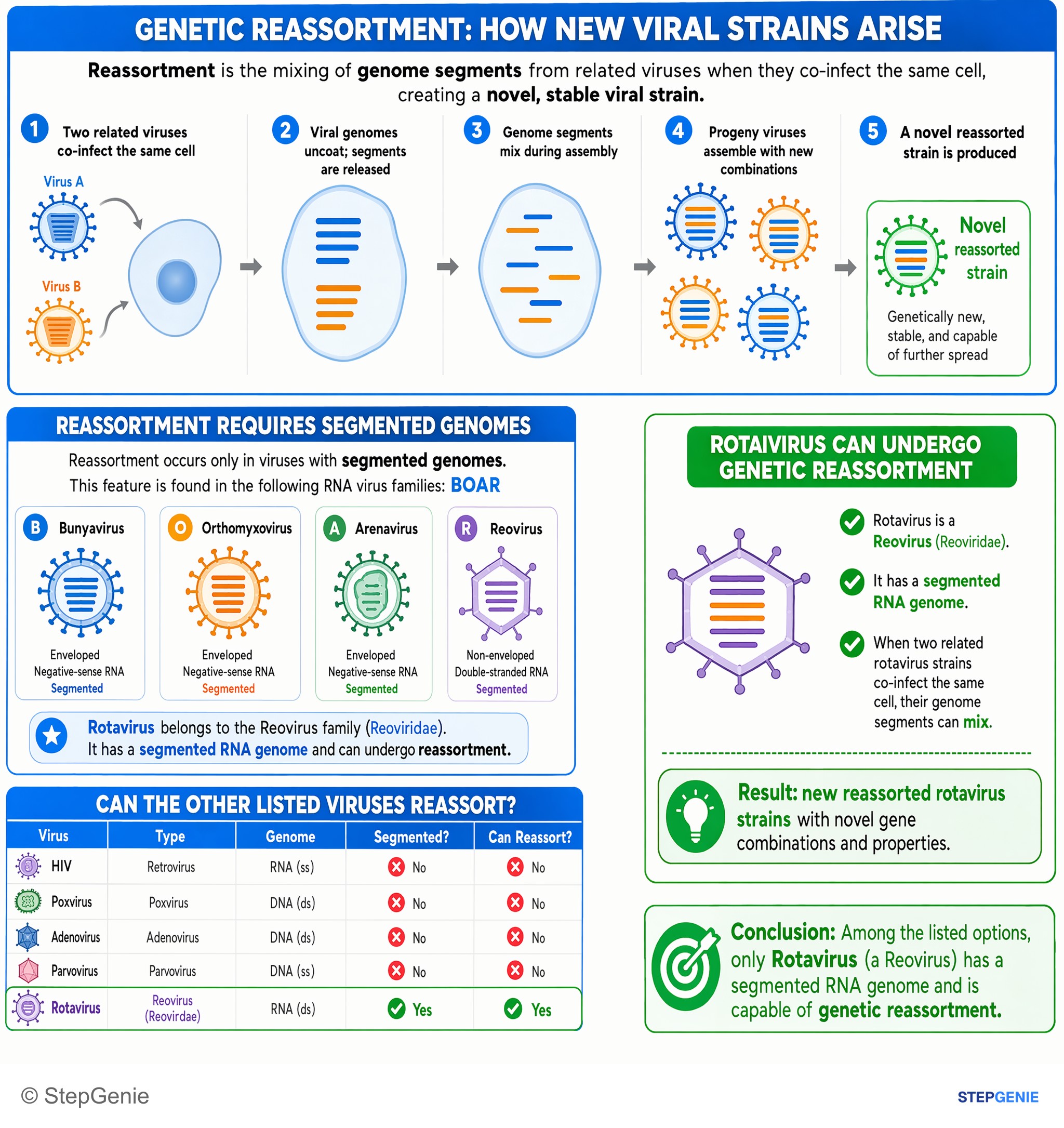
Rotavirus, a segmented RNA virus (Reoviridae), can undergo genetic reassortment when two related strains co-infect the same cell, creating…
USMLE Step 1Frequently Asked Questions
What is the difference between antigenic drift and antigenic shift in influenza?
Antigenic drift is caused by point mutations in the HA and NA proteins, while antigenic shift is caused by reassortment of influenza RNA segments. Drift produces minor antigen changes that lead to seasonal epidemics in influenza A and B. Shift produces a major change, often a new HA with or without a new NA, and is associated with pandemics in influenza A only.
Why does the influenza vaccine need to be updated every year?
The influenza vaccine is updated yearly because antigenic drift gradually changes circulating strains. Small point mutations accumulate in the HA and NA genes, causing enough antigenic change that antibodies from prior seasons bind less effectively. This ongoing seasonal evolution explains vaccine mismatch language in questions and why repeat vaccination is needed.
Why can influenza A cause pandemics but influenza B cannot?
Influenza A can cause pandemics because it can undergo antigenic shift, whereas influenza B undergoes drift only. Shift requires reassortment of a segmented genome during co-infection with two different influenza A strains, often involving human and animal strains. That process can create a novel subtype with little preexisting population immunity, giving influenza A pandemic potential.
How does antigenic shift actually happen in influenza?
Antigenic shift happens through reassortment of influenza A RNA segments during co-infection with two different strains. Because influenza has a segmented genome, a host infected with both strains can produce progeny viruses that mix segments from each parent. This can create a new HA and/or NA combination, leading to a sudden major antigenic change and pandemic risk.
What are the key influenza facts that are high-yield for exam questions?
The highest-yield influenza facts are that it is an enveloped orthomyxovirus with a segmented negative-sense single-stranded RNA genome and that it replicates in the nucleus. HA binds sialic acid to mediate entry, while NA cleaves sialic acid to release new virions. Influenza A and B both drift, but only influenza A shifts and causes pandemics.