Measles, mumps, and rubella are the “MMR” viruses you’ll see over and over on USMLE—because they’re classic, testable, and heavily pattern-based. This post uses a draw-it-out method: a simple sketch you can recreate in 20 seconds to lock in virus family, key clinical clues, and buzzword complications.
The 20-second “Draw-it-out” MMR sketch (one page)
Draw three vertical columns labeled Measles | Mumps | Rubella. Then add these icons:
1) Measles (Rubeola) — draw a face + spots + a tiny “K” in the mouth
- Draw:
- A face with conjunctivitis eyes
- Cough lines + coryza nose drip
- A mouth with a small “K” on the buccal mucosa (Koplik)
- A body with a descending maculopapular rash (head → toe)
One-liner: Measles = “3 C’s + Koplik + descending rash” (and it’s the one that can cause SSPE later).
2) Mumps — draw chipmunk cheeks + a swollen testis
- Draw:
- Puffy parotid glands (chipmunk cheeks)
- A small pancreas squiggle
- A testis with an inflamed outline (orchitis)
One-liner: Mumps = parotitis + orchitis + aseptic meningitis (think “swollen glands and gonads”).
3) Rubella — draw a pink rash + behind-the-ear nodes + a pregnant belly with “CATARACT”
- Draw:
- Light pink maculopapular rash
- Big circles behind the ear = posterior auricular/posterior cervical LAD
- A pregnant belly with C-A-T: Cataracts, Arteriosus (PDA), “Tooth”/hearing loss (sensorineural deafness)
One-liner: Rubella = “post-auricular nodes + mild rash”; congenital rubella = cataracts + PDA + deafness.
Rapid ID table (what Step loves to test)
| Feature | Measles (Rubeola) | Mumps | Rubella |
|---|---|---|---|
| Family | Paramyxovirus | Paramyxovirus | Togavirus |
| Genome | (-) ssRNA, enveloped | (-) ssRNA, enveloped | (+) ssRNA, enveloped |
| Classic clue | 3 C’s + Koplik spots | Parotitis | Posterior auricular/cervical LAD |
| Rash | Confluent, descends | No typical rash | Pink, mild, can look like measles but usually “softer” |
| Big complications | Pneumonia, otitis media, SSPE, encephalitis | Orchitis, aseptic meningitis, pancreatitis | Congenital rubella syndrome |
| Vaccine | Live attenuated (MMR) | Live attenuated (MMR) | Live attenuated (MMR) |
High-yield “micro hooks” you can say out loud
Measles (Rubeola): the immunosuppressive rash virus
- Prodrome: fever + cough, coryza, conjunctivitis
- Enanthem: Koplik spots (bluish-white on buccal mucosa) = very testable
- Rash: maculopapular, starts at face then spreads down
- Complications to remember
- Giant cell pneumonia (especially in immunocompromised)
- SSPE (subacute sclerosing panencephalitis): delayed, progressive neuro decline years after infection
- Vitamin A: classically given in severe measles (kids) to reduce morbidity
Mini-mnemonic: “MeaSLes = Spots + Lateral (face) then spreads” + SSPE (S = “sclerosing,” “subacute,” “spots”)
Mumps: the salivary + gonadal paramyxovirus
- Parotitis: jaw/cheek swelling, pain with chewing
- Orchitis: can lead to testicular atrophy (infertility is less common than students fear, but still a classic association)
- Aseptic meningitis: common USMLE add-on
- Pancreatitis: think abdominal pain + elevated amylase/lipase
Mini-mnemonic: “MUmps = Mouth (parotid) + Manhood (orchitis) + Meningitis”
Rubella: the “mild in mom, catastrophic in fetus” virus
- Postauricular/posterior cervical LAD is the giveaway
- Rash: generally milder than measles; can have arthralgias/arthritis (more in adults)
- Congenital rubella syndrome (first trimester is highest risk):
- Cataracts
- PDA (or other cardiac defects)
- Sensorineural deafness
- Often also: “blueberry muffin” rash (extramedullary hematopoiesis) + growth retardation
Mini-mnemonic: Rubella = “Ru-behind-the-ear” nodes + “Ruins the fetus” (Cataracts, PDA, Deafness)
A single “MMR” memory anchor (works well under time pressure)
Think Measles = Mouth “K” + Many C’s
Think Mumps = Massive Mandible glands + Male gonads
Think Rubella = Rear (posterior) nodes + Risky pregnancy
USMLE-style quick checks (classic prompts)
- “Child with cough, coryza, conjunctivitis + Koplik spots” → Measles
- “Teen with parotid swelling + testicular pain” → Mumps
- “Pregnant patient exposed; baby with cataracts + PDA + deafness” → Congenital rubella
Bottom line (what to reproduce on your scratch paper)
If you can redraw the three icons—Koplik mouth (measles), chipmunk cheeks + orchitis (mumps), posterior auricular nodes + congenital triad (rubella)—you’ll capture most of what MMR questions are really asking.
Visual explanations from the StepGenie QBank
Infographics StepGenie drew to explain questions in its own QBank, matched to this article's topic. Each caption is the takeaway of the question it explains.
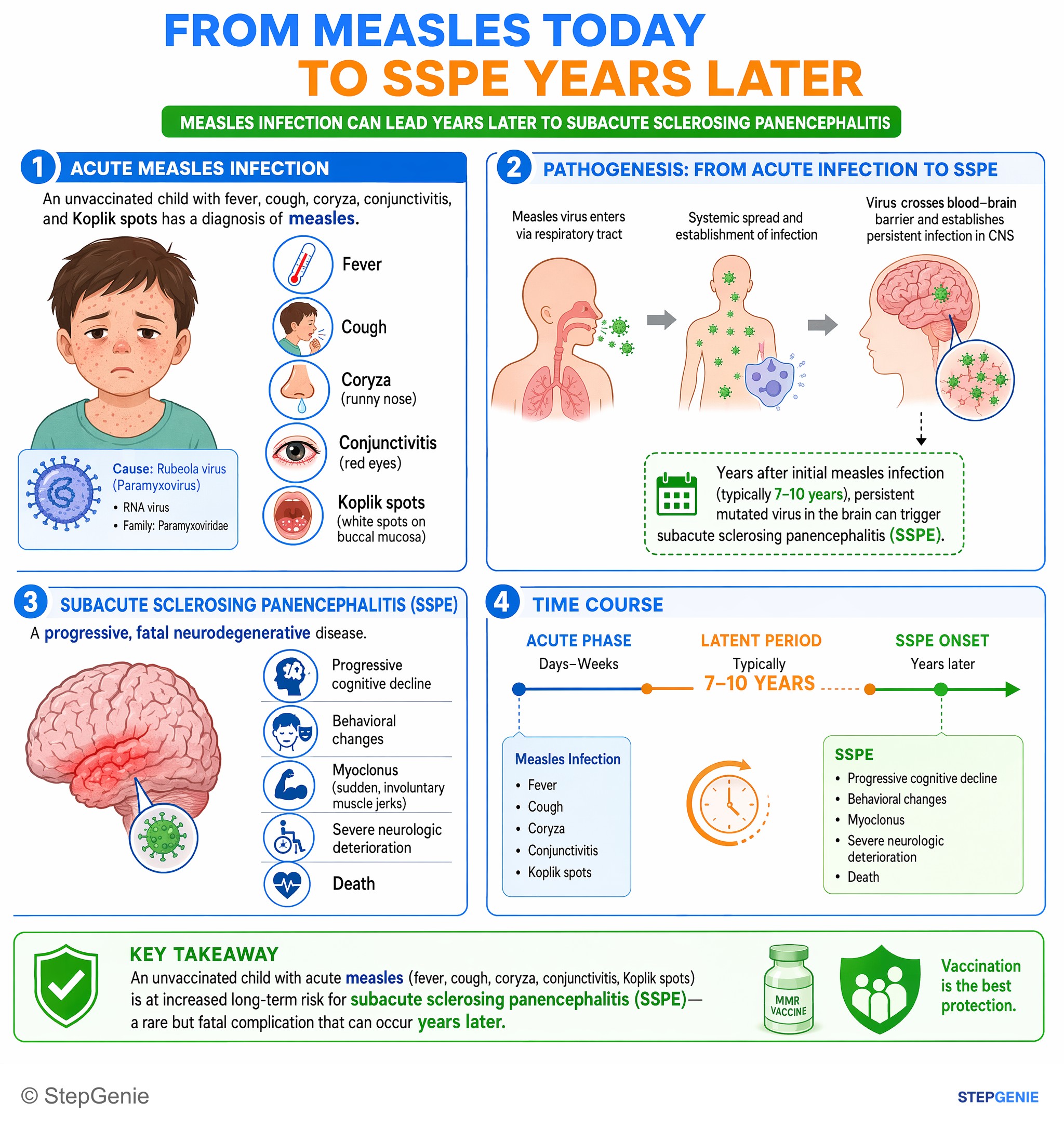
Measles infection (fever, cough, coryza, conjunctivitis, Koplik spots) can lead years later to subacute sclerosing panencephalitis…
USMLE Step 1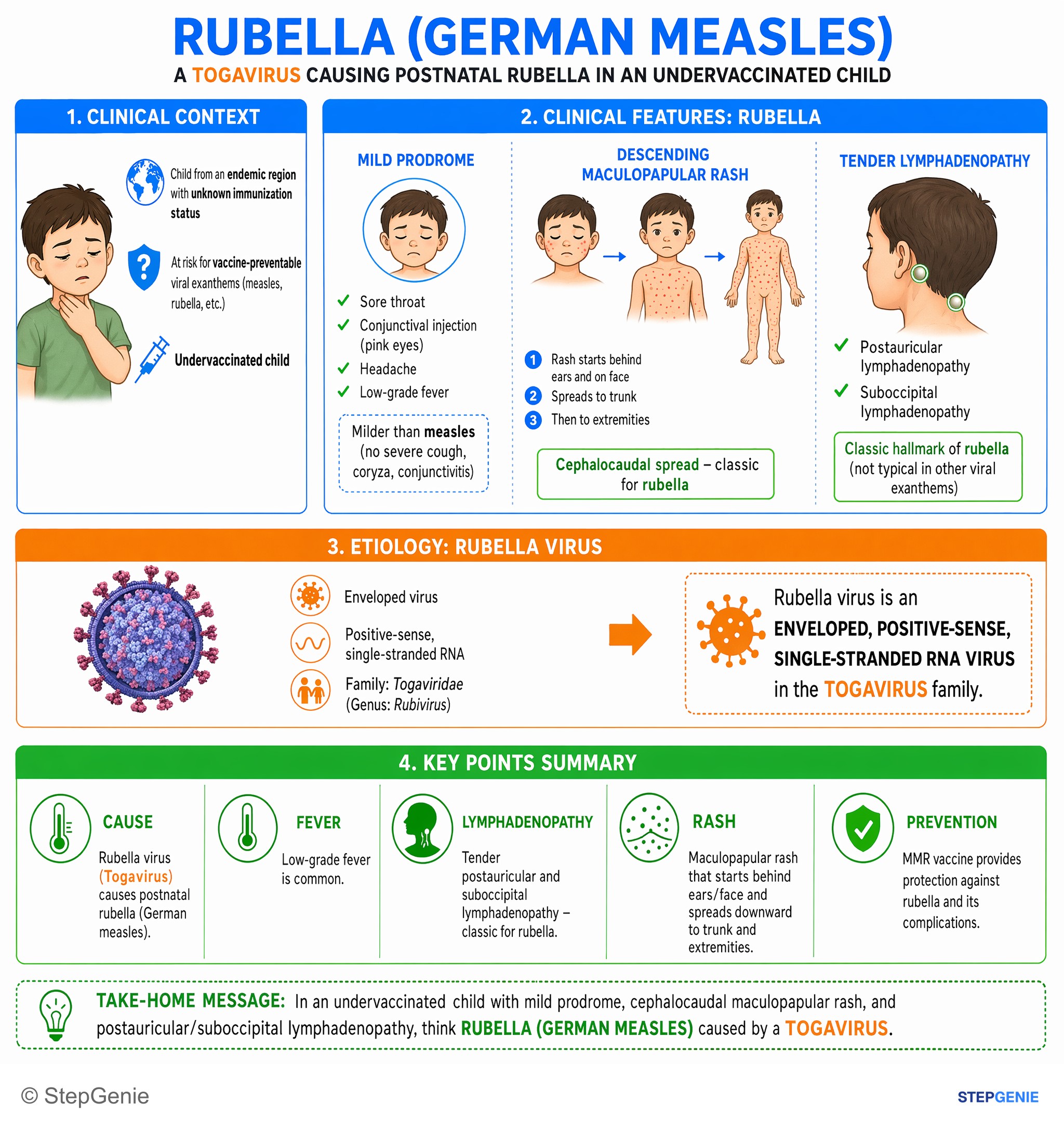
Rubella (German measles) from a Togavirus causes fever, postauricular/suboccipital lymphadenopathy, and descending maculopapular rash in…
USMLE Step 1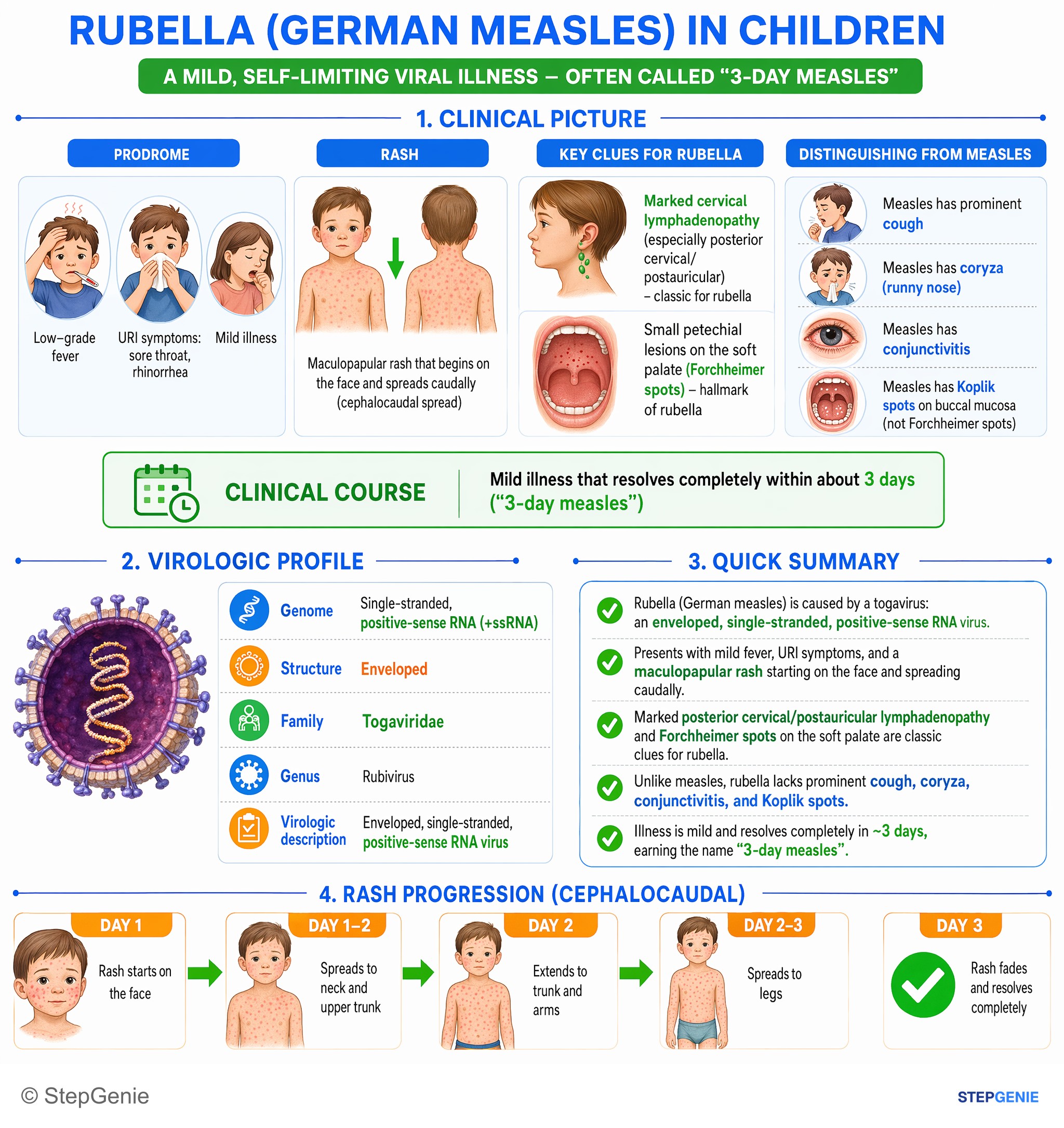
Rubella (German measles) from togavirus: +ssRNA enveloped virus causing mild fever, cephalocaudal rash, lymphadenopathy, and Forchheimer…
USMLE Step 1Frequently Asked Questions
How do you tell measles from rubella on a vignette?
Measles is suggested by the 3 C’s, Koplik spots, and a descending rash, while rubella is suggested by posterior auricular or posterior cervical lymphadenopathy with a milder pink rash. Measles classically presents with cough, coryza, conjunctivitis, bluish-white Koplik spots on the buccal mucosa, and a rash that starts on the face and spreads downward. Rubella is typically softer clinically and is known for the behind-the-ear node finding.
What are the classic buzzwords for measles on Step 1?
The classic measles buzzwords are cough, coryza, conjunctivitis, Koplik spots, and a descending maculopapular rash. Measles is the rubeola virus and is repeatedly identified by the “3 C’s + Koplik + descending rash” pattern. The rash starts at the face and spreads down the body, and the buccal mucosa enanthem with bluish-white Koplik spots is especially testable.
What complications should you remember for mumps?
The key mumps complications to remember are orchitis, aseptic meningitis, and pancreatitis. Mumps is classically associated with parotitis causing jaw or cheek swelling and pain with chewing, along with gonadal involvement. Orchitis can lead to testicular atrophy, and pancreatitis may present with abdominal pain and elevated amylase or lipase.
Why is rubella such a big deal in pregnancy?
Rubella matters in pregnancy because congenital rubella syndrome can cause major fetal abnormalities, especially with first-trimester infection. The classic congenital triad is cataracts, patent ductus arteriosus, and sensorineural deafness. Rubella may be relatively mild in the mother, but the fetus is at high risk, which is why vignettes often focus on maternal exposure followed by a baby with cataracts, PDA, and hearing loss.
What virus families and genomes do measles, mumps, and rubella belong to?
Measles and mumps are enveloped negative-sense single-stranded RNA paramyxoviruses, whereas rubella is an enveloped positive-sense single-stranded RNA togavirus. This is a common rapid identification point because measles and mumps group together by both family and genome type, while rubella stands apart as a togavirus with a positive-sense RNA genome.