You’re in the middle of a Q-bank block, you see “cohort vs case-control”, and you think: “Easy.” Then you miss it—because the vignette was really testing direction of inquiry, how subjects are selected, and what measure of association actually makes sense. On USMLE, the correct answer is often only half the game; the other half is knowing exactly why every distractor is wrong.
Tag: Biostatistics > Study Design & Probability
The Clinical Vignette (Q-bank style)
A public health team wants to investigate whether long-term exposure to asbestos increases the risk of mesothelioma. They identify 300 patients with newly diagnosed mesothelioma from a state cancer registry and 600 patients without mesothelioma matched by age and sex. All participants are interviewed about prior asbestos exposure and occupational history.
Which study design is being used?
A. Prospective cohort study
B. Retrospective cohort study
C. Case-control study
D. Cross-sectional study
E. Randomized controlled trial
Correct Answer: C. Case-control study
Why it’s case-control
This vignette screams case-control because the investigators:
- Start with the outcome
- Cases = mesothelioma patients
- Controls = non-mesothelioma patients
- Then look backward to assess prior exposure (asbestos)
What you can calculate (high-yield)
- Primary measure: Odds ratio (OR)
- In classic case-control sampling, you cannot directly compute incidence or relative risk because the number of cases/controls is chosen by the investigator, not observed as a natural incidence process.
USMLE key line: “Start with disease, look back for exposure” → case-control → odds ratio
The Power Move: Destroy Every Distractor
A. Prospective cohort study — Wrong
A prospective cohort study would:
- Start with exposure status (asbestos-exposed vs not exposed)
- Follow participants forward in time
- Observe who develops mesothelioma
What you’d be able to calculate
- Incidence
- Relative risk (RR)
- Attributable risk (risk difference)
Vignette mismatch: Here, subjects were selected because they already had the disease (cases) or didn’t (controls). No forward follow-up.
B. Retrospective cohort study — Wrong (but tempting)
A retrospective cohort study:
- Still starts with exposure, just measured from past records
- Then determines outcomes from records (e.g., registry follow-up)
How it would look instead
- Identify a cohort of workers from employment records (exposed vs unexposed)
- Use registries to see who later developed mesothelioma
Key distinction
- Cohort (prospective or retrospective): selected by exposure
- Case-control: selected by outcome
Why this vignette isn’t retro cohort: They didn’t define a cohort based on asbestos exposure; they pulled mesothelioma cases first.
D. Cross-sectional study — Wrong
Cross-sectional studies measure exposure and outcome at the same time (a snapshot).
Typical USMLE phrasing
- “Surveyed participants and assessed current smoking status and current COPD diagnosis”
- Calculates prevalence, prevalence ratio, sometimes odds of prevalent disease
Why it doesn’t fit
- Mesothelioma cases were identified from a registry (already diagnosed), and exposure was assessed historically. That’s not a simultaneous snapshot.
High-yield pitfall: Cross-sectional = prevalence; weak for temporality.
E. Randomized controlled trial — Wrong (and unethical here)
RCTs assign exposure randomly.
Why impossible
- You can’t ethically randomize asbestos exposure.
- Also, vignette describes observational interviewing, not randomization.
USMLE shortcut
- If the exposure is harmful (smoking, asbestos, lead), it’s almost never an RCT.
High-Yield Table: Cohort vs Case-Control vs Cross-Sectional (USMLE-ready)
| Feature | Cohort (Prospective/Retrospective) | Case-Control | Cross-Sectional |
|---|---|---|---|
| Selection based on | Exposure | Outcome | Neither (sample population) |
| Direction of inquiry | Exposure → Outcome | Outcome → prior Exposure | Exposure and outcome measured together |
| Best for | Rare exposures | Rare diseases, long latency | Prevalence, hypothesis generation |
| Can calculate | Incidence, RR, AR | OR (≈ RR if disease rare) | Prevalence |
| Temporality | Yes | Sometimes (depends on data quality) | Usually no |
| Main bias risk | Loss to follow-up | Recall + selection bias | Survival bias, temporality issues |
Probability + Study Design: The “Why Every Answer Choice Matters” Add-On
1) When does OR approximate RR?
When the disease is rare.
If , then odds probability, so OR ≈ RR.
- Classic pairing: case-control study + rare disease → OR is a good estimate of RR.
2) Bias patterns that love case-control questions
Recall bias
- Cases may over-report exposures (“Yes, I was around asbestos all the time!”)
Selection bias
- Controls must represent the population that produced the cases.
- Bad control selection can create a fake association.
Confounding
- Occupational exposures cluster (shipyard work → asbestos + other toxins). Matching helps but doesn’t fix everything.
How USMLE “Hides” the Study Design in Plain Sight
Look for these cues:
Case-control trigger phrases
- “Patients with X were identified… compared with patients without X”
- “Researchers enrolled cases and controls”
- “Prior exposure assessed by interview/questionnaire”
- “Rare disease” or “long latency period”
Cohort trigger phrases
- “Group with exposure and group without exposure were followed”
- “Incidence of disease compared”
- “Relative risk reported”
- “Retrospective: using records to define exposure first”
Mini Rapid-Fire: If the Stem Changes, the Answer Changes
- If they started with asbestos-exposed shipyard workers from 1980 employment records and checked cancer registry outcomes in 2020 → Retrospective cohort
- If they enrolled asbestos-exposed and unexposed people today and followed for 30 years → Prospective cohort
- If they surveyed a town once about asbestos exposure and current mesothelioma status → Cross-sectional
- If they assigned asbestos exposure → “Call ethics” (and it would be an RCT only in fantasy land)
Takeaway: Your Step-Score Rule
Don’t memorize labels—interrogate the selection method.
- Selected by outcome? → Case-control → OR
- Selected by exposure? → Cohort → RR/incidence
- Single time point? → Cross-sectional → prevalence
- Random assignment? → RCT → strongest causal inference
If you train yourself to explain why each distractor is wrong, you stop falling for “retrospective cohort” traps and start owning these questions.
Visual explanations from the StepGenie QBank
Infographics StepGenie drew to explain questions in its own QBank, matched to this article's topic. Each caption is the takeaway of the question it explains.
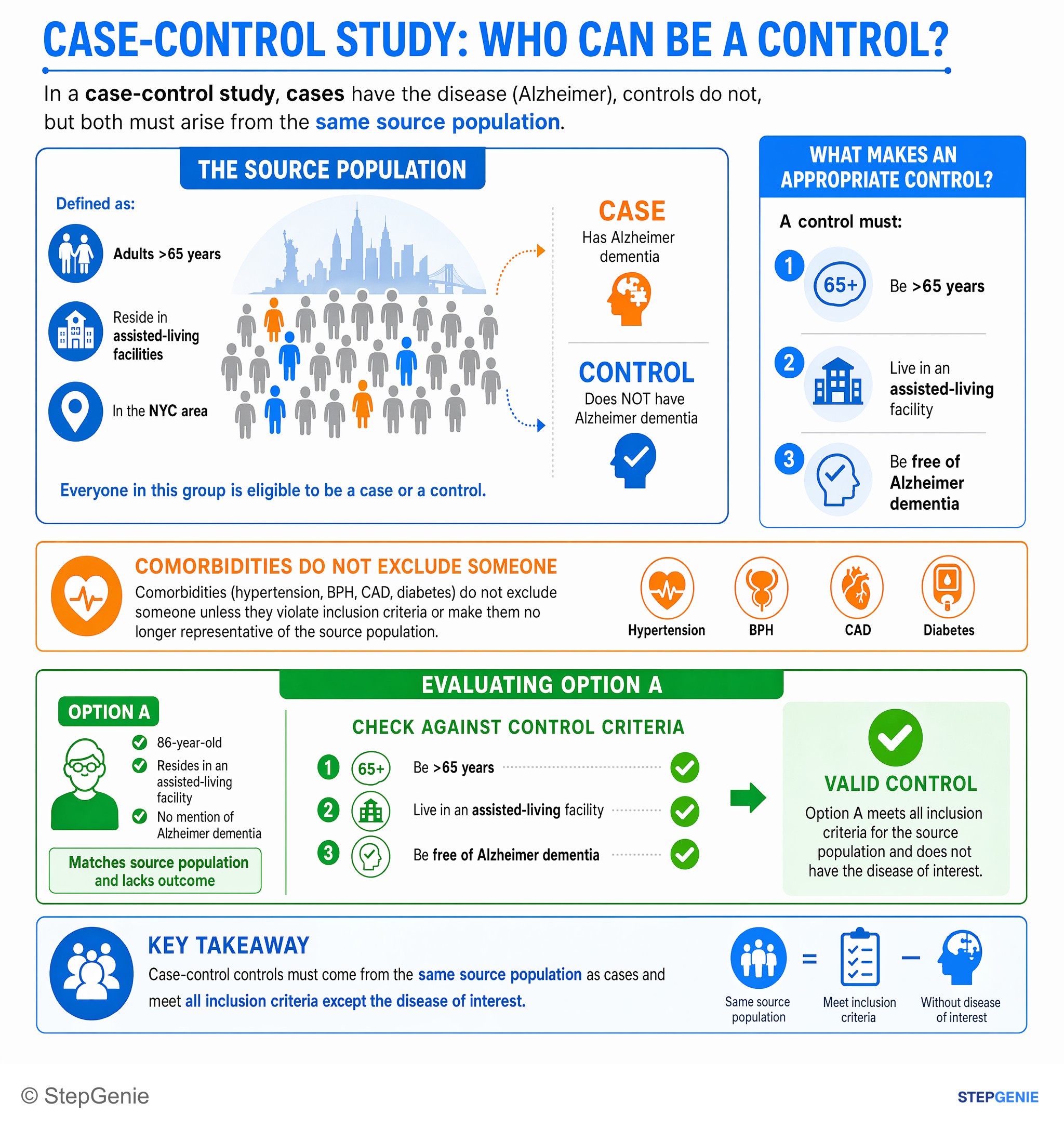
Case-control controls must come from the same source population as cases and meet all inclusion criteria except the disease of interest.
USMLE Step 1Frequently Asked Questions
How do you tell a case-control study from a cohort study on a USMLE vignette?
The key difference is how subjects are selected. A case-control study starts with the outcome, meaning investigators identify patients with the disease and controls without it, then look backward for prior exposure. A cohort study starts with exposure status and follows exposed versus unexposed groups to see who develops the outcome, whether the follow-up is prospective or based on past records.
Why is the asbestos and mesothelioma vignette a case-control study instead of a retrospective cohort study?
It is a case-control study because the investigators selected subjects based on outcome first. They identified patients with mesothelioma and matched controls without mesothelioma, then assessed prior asbestos exposure by interview. A retrospective cohort study would still begin with exposure, such as asbestos-exposed and unexposed workers from records, and then determine who later developed mesothelioma.
What measure of association do you calculate in a case-control study?
The main measure of association in a case-control study is the odds ratio. This is because classic case-control sampling starts with a chosen number of cases and controls rather than observing disease occurrence naturally over time. Since the investigator determines how many diseased and nondiseased subjects are included, you cannot directly calculate incidence or relative risk from that design.
When does the odds ratio approximate the relative risk?
The odds ratio approximates the relative risk when the disease is rare. In that setting, odds are close to probability, so the odds ratio becomes a good estimate of the relative risk. This is a classic high-yield pairing for exam questions, especially when a case-control study is used to evaluate a rare disease or one with a long latency period.
Why is a randomized controlled trial wrong for harmful exposures like asbestos?
A randomized controlled trial is wrong because the exposure would have to be assigned randomly, which is not ethical for a harmful substance like asbestos. The vignette also describes an observational setup in which participants were interviewed about prior exposure rather than being assigned to exposure groups. On exam questions, smoking, asbestos, and lead usually point away from randomized trials for this reason.