PPV and NPV are the “what do I do with my patient’s test result?” numbers—super high-yield on USMLE because they’re clinically intuitive and exam writers love flipping prevalence on you. Here’s a fast, shareable way to never mix them up again.
The Acronym Trick: PPV = Postive Predicts (it’s real), NPV = Negative Predicts (it’s not)
One-liner you can memorize
- PPV: Given a Positive test, what’s the Probability they truly have the disease?
- NPV: Given a Negative test, what’s the probability they truly Not have the disease?
If you remember nothing else: PPV answers “positive → disease?” and NPV answers “negative → no disease?”
The Visual/Mnemonic Device: “Pairs” and “No Disease”
Think in two columns (test result) and ask: Which column am I living in right now?
PPV lives in the Positive column
“Positive test? Only look at positives.”
NPV lives in the Negative column
“Negative test? Only look at negatives.”
The 2×2 Table (where people get lost—don’t)
| Disease + | Disease − | |
|---|---|---|
| Test + | TP | FP |
| Test − | FN | TN |
Column rule (the whole trick)
- PPV = “Among Test+ people, who’s truly sick?” → Top row only
- NPV = “Among Test− people, who’s truly well?” → Bottom row only
Ultra-High-Yield USMLE Facts (the part they test)
1) PPV & NPV change with prevalence
- If prevalence increases:
- PPV increases (more true disease among positives)
- NPV decreases (negatives are less reassuring)
- If prevalence decreases:
- PPV decreases
- NPV increases
Classic stem: “Same test used in a high-risk clinic vs general population—what changes?”
Answer: PPV/NPV change; sensitivity/specificity do not.
2) Sensitivity/specificity are test properties; PPV/NPV are population-dependent
- Sensitivity/Specificity: fixed for a given cutoff (in theory)
- PPV/NPV: shift as the pre-test probability (prevalence) shifts
3) Quick mental check: does the direction make sense?
If the disease is rare, most positives are false positives → PPV drops.
If the disease is rare, a negative is almost always true → NPV rises.
Mini “Shareable” Summary (screenshot-worthy)
- PPV = Positive → Probability of disease
- NPV = Negative → No disease probability
- Prevalence ↑ → PPV ↑, NPV ↓
- Prevalence ↓ → PPV ↓, NPV ↑
Visual explanations from the StepGenie QBank
Infographics StepGenie drew to explain questions in its own QBank, matched to this article's topic. Each caption is the takeaway of the question it explains.
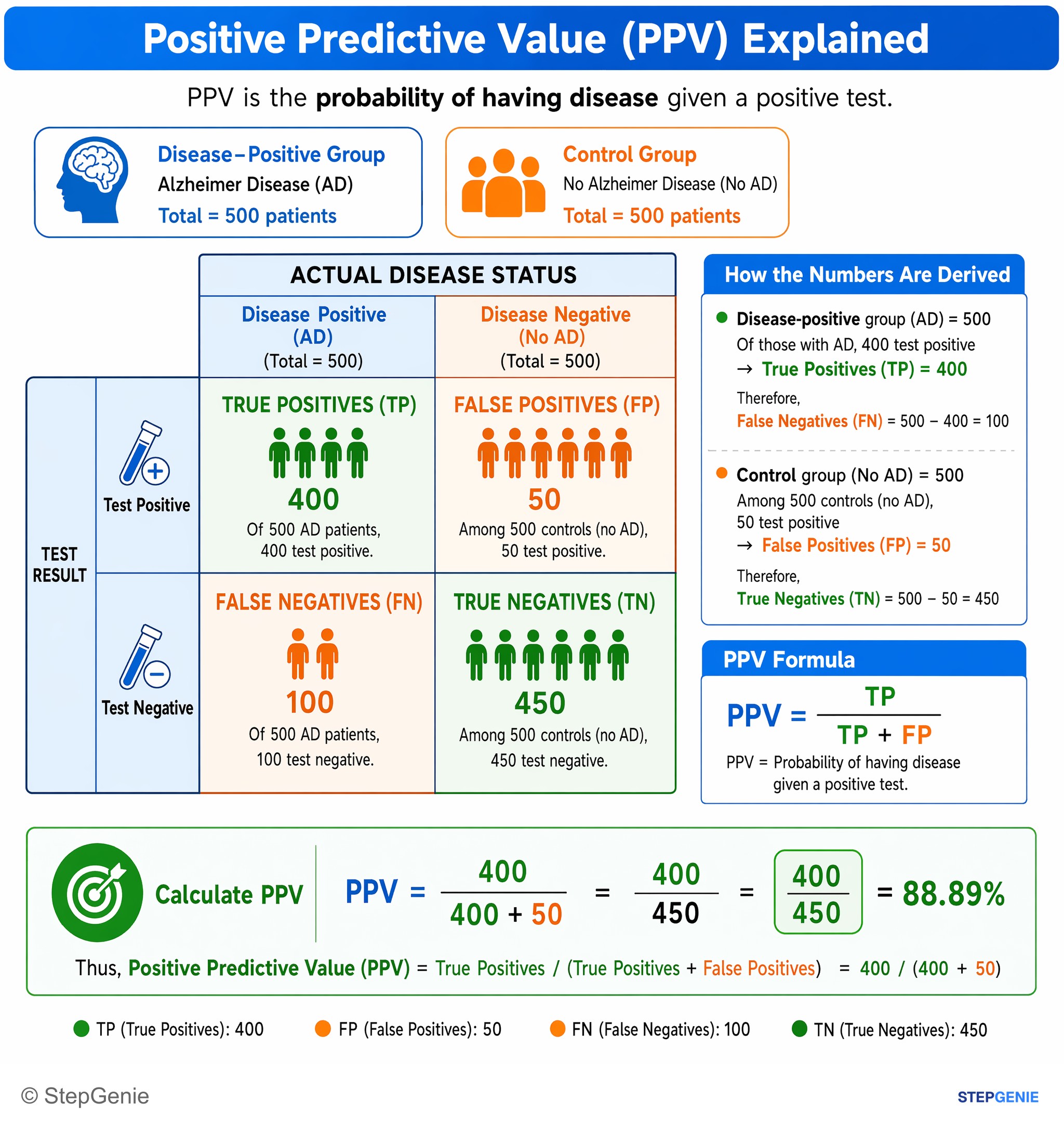
Positive predictive value (PPV) = true positives / (true positives + false positives). Here: 400 / (400 + 50).
USMLE Step 1Frequently Asked Questions
How do I remember the difference between PPV and NPV on exam day?
PPV means a positive test predicts real disease, and NPV means a negative test predicts no disease. A simple way to remember it is: given a positive test, PPV asks the probability the patient truly has the disease, while given a negative test, NPV asks the probability the patient truly does not have the disease.
What formulas should I use for PPV and NPV from a 2×2 table?
PPV is TP divided by TP plus FP, and NPV is TN divided by TN plus FN. The easiest way to avoid mistakes is to stay in the test-result row you are given. For PPV, only look at people with positive tests. For NPV, only look at people with negative tests.
How do you tell whether to use PPV or NPV in a question stem?
Use PPV when the question starts with a positive test result and asks whether the patient truly has disease. Use NPV when the question starts with a negative test result and asks whether the patient truly does not have disease. A helpful shortcut is to ask which test-result column or row you are living in before calculating anything.
How does prevalence affect PPV and NPV?
As prevalence increases, PPV increases and NPV decreases; as prevalence decreases, PPV decreases and NPV increases. The reason is that when disease is more common, a positive result is more likely to represent true disease, while a negative result becomes less reassuring. When disease is rare, many positives are false positives, but negatives are usually true negatives.
Do sensitivity and specificity change with prevalence the way PPV and NPV do?
No, sensitivity and specificity are treated as test properties, while PPV and NPV depend on the population being tested. If the same test is used in a high-risk clinic versus the general population, PPV and NPV change because pre-test probability changes, but sensitivity and specificity do not.