Methimazole and propylthiouracil (PTU) are thionamides: both block thyroid peroxidase (TPO), so the thyroid can't iodinate tyrosine residues or couple them into new T4 and T3, and PTU also blocks peripheral 5'-deiodinase, which cuts T4-to-T3 conversion. Methimazole is first-line for nearly everyone (ATA 2016). PTU is kept for pregnancy planning and the first trimester, thyroid storm, and minor methimazole reactions when radioiodine or surgery isn't wanted, because PTU carries a boxed warning for severe liver injury. Fever or sore throat on either drug means stop it and check a CBC with differential for agranulocytosis; after agranulocytosis, don't switch to the other thionamide.
How thionamides work (and what they can't do)
- They block synthesis, not release. TPO iodinates tyrosines on thyroglobulin (organification) and couples them into T3 and T4; thionamides inhibit both steps (Merck).
- PTU's extra action: it also inhibits conversion of T4 to T3 in peripheral tissues (FDA label; Merck says at high doses). That is why it is favored in thyroid storm.
- Onset is slow. The gland is full of stored hormone, and methimazole does not inactivate T4 and T3 that are already made (FDA label). Merck: control generally takes 2-3 months, so a beta-blocker covers symptoms meanwhile.
- Carbimazole, used outside the US, is rapidly converted to methimazole (Merck); treat it as the same drug.
| Drug | Main action | Speed | Classic use |
|---|---|---|---|
| Methimazole | Blocks TPO | Weeks | Graves disease, toxic nodular goiter |
| PTU | Blocks TPO + peripheral T4-to-T3 conversion | Weeks | First trimester, thyroid storm |
| Iodide (SSKI, Lugol solution) | Blocks hormone release within hours; brief block of organification | Hours | Thyroid storm; before thyroidectomy (less vascular gland) |
| Beta-blocker (propranolol) | Blocks adrenergic symptoms; propranolol may block T4-to-T3 at high doses | Hours | Any symptomatic thyrotoxicosis |
| Radioiodine (I-131) | Destroys thyroid tissue | Slow | Definitive therapy |
The step-by-step flowchart
Step 1: Is the gland making too much hormone, or leaking it?
Thionamides help only when synthesis is increased: Graves disease, toxic adenoma, toxic multinodular goiter. In thyroiditis, damaged follicles leak stored hormone; Merck calls antithyroid drugs, surgery and radioiodine contraindicated in silent thyroiditis and uses a beta-blocker instead (see subacute thyroiditis). In pregnancy, the 2026 ATA guideline says to treat overt hyperthyroidism from Graves disease or a toxic nodule, but not gestational transient thyrotoxicosis (hCG-driven) or subclinical hyperthyroidism. Sorting the causes starts with the thyroid function tests.
Step 2: Control symptoms now
Beta-blockade is recommended in all patients with symptomatic thyrotoxicosis, especially older patients and those with a resting heart rate above 90/min or cardiovascular disease (ATA 2016, recommendation 2). Propranolol has the longest track record and may block T4-to-T3 conversion at high doses (ATA 2016); a calcium channel blocker (verapamil or diltiazem) can control rate when beta-blockers are contraindicated (Merck, ATA).
Step 3: Is this thyroid storm?
Storm is life-threatening thyrotoxicosis, often triggered by infection, trauma or surgery (Merck). Merck's regimen, in order; the sequence rule that gets tested is thionamide before iodine (thyroid storm Q-bank):
- PTU first, in high doses: ATA lists storm as one of the few PTU indications.
- Iodine only after the thionamide (SSKI, Lugol solution or IV sodium iodide) to block hormone release. Given first, the iodine load becomes fuel for new hormone.
- Propranolol (oral or IV) or esmolol.
- Glucocorticoids (hydrocortisone or dexamethasone).
- Supportive care: IV dextrose, fluids, electrolytes, cooling, and treatment of the trigger; radioiodine or thyroidectomy once the crisis is controlled.
Step 4: Is the patient pregnant or planning pregnancy?
- First trimester: PTU. Methimazole in the first trimester has been linked to rare methimazole embryopathy: aplasia cutis (scalp defects), facial dysmorphism and choanal atresia, esophageal atresia with or without tracheoesophageal fistula, omphalocele and omphalomesenteric duct anomalies (FDA label). Defects with PTU are less frequent and less severe, but neither drug is risk-free (ATA).
- 2026 ATA pregnancy guideline (Thyroid, May 2026): switch methimazole to PTU when planning pregnancy (if PTU is available); PTU is preferred up to 16 weeks (fetal skin closure). If she is euthyroid on a low dose (methimazole under 5-10 mg/day or PTU under 100-200 mg/day) taken for over 6 months, consider stopping the drug once pregnancy is confirmed, with close thyroid testing.
- After 16 weeks: ATA 2026 makes no recommendation on keeping PTU versus switching. The FDA labels for both drugs say it may be preferable to switch to methimazole for the second and third trimesters because of PTU's liver toxicity, and that remains the classic exam answer.
- Lowest effective dose: both drugs cross the placenta and can cause fetal goiter and hypothyroidism (Merck; FDA labels); ATA 2026 aims for a free T4 at or slightly above the upper third of the reference range.
- Radioiodine is contraindicated in pregnancy and breastfeeding. Thyroidectomy in pregnancy is for exceptional cases; when it can be timed, the second trimester is preferred (ATA).
- Breastfeeding: methimazole up to 20 mg/day or PTU up to 450 mg/day does not affect the infant's thyroid function, and methimazole is generally preferred during lactation (ATA 2026).
Step 5: Everyone else gets methimazole
ATA 2016 (recommendation 13): use methimazole in virtually every patient who chooses drug therapy for Graves disease. It is given once daily and has fewer major side effects than PTU. Children get methimazole too: the PTU label advises against pediatric use unless methimazole isn't tolerated and other treatment isn't appropriate, and children are more susceptible to PTU liver injury (ATA).
Step 6: Before the first dose
- Baseline CBC with differential and a liver profile (bilirubin, transaminases) (ATA recommendation 15).
- Tell the patient to call promptly for rash, jaundice, pale stools or dark urine, joint pain, abdominal pain, nausea, fatigue, fever or sore throat (ATA recommendation 14).
Step 7: Dosing concepts and follow-up
- Methimazole: once daily. ATA describes starting doses of 10-30 mg/day, titrated down to maintenance, generally 5-10 mg/day.
- PTU: three equal doses about 8 hours apart (FDA label).
- Recheck thyroid function and keep the lowest dose that holds the patient euthyroid, to avoid iatrogenic hypothyroidism (Merck).
- Graves disease: continue methimazole for about 12-18 months, then stop if TSH and TSH receptor antibodies (TRAb) are normal (ATA recommendation 22). About 20-50% stay in remission after a 1- to 2-year course (Merck).
- No routine WBC schedule: ATA found insufficient evidence for or against it, but a differential count is required with any fever or pharyngitis (recommendations 16 and 17).
Step 8: Relapse, intolerance or a major reaction
Move to radioiodine or thyroidectomy (below).
Methimazole vs PTU at a glance
| Feature | Methimazole | PTU |
|---|---|---|
| Mechanism | TPO inhibition | TPO inhibition + peripheral T4-to-T3 block |
| Dosing | Once daily | Every 8 hours |
| When to choose | Nearly all patients | First trimester, thyroid storm, methimazole intolerance |
| Liver | Typically cholestatic; hepatocellular injury possible | Boxed warning: severe liver injury and acute liver failure, sometimes fatal |
| Agranulocytosis | Yes; risk lower at low doses | Yes, at any dose |
| ANCA vasculitis | Rare | Classic association |
| Pregnancy | Avoid in first trimester (embryopathy) | Preferred when planning pregnancy and in the first trimester (to 16 weeks, ATA 2026) |
| Children | Preferred | Not recommended |
| Other label items | Insulin autoimmune syndrome (hypoglycemia), acute pancreatitis; hypoprothrombinemia (check PT before surgery) | Hypoprothrombinemia and bleeding (check PT before surgery) |
Adverse effects and what to do
| Problem | Clues | Action |
|---|---|---|
| Minor rash, pruritus | 6% on methimazole, 3% on PTU (ATA) | Antihistamine without stopping; persistent minor reactions: radioiodine, surgery, or the other drug |
| Agranulocytosis | Fever, sore throat, mouth ulcers; about 0.1-0.5% of patients (Merck; PTU label); 85% of cases within 90 days (ATA) | Stop the drug, CBC with differential. The other thionamide is contraindicated because of cross-reactivity (ATA exception: life-threatening thyroid storm); use radioiodine or surgery |
| Hepatotoxicity | Jaundice, dark urine, abdominal pain, fatigue | Stop if transaminases exceed 3 times the upper limit of normal (ATA; methimazole label); PTU can cause acute liver failure needing transplant (boxed warning) |
| ANCA-positive vasculitis | p-ANCA small-vessel vasculitis: glomerulonephritis, pulmonary hemorrhage, skin vasculitis | Stop the drug; severe cases need steroids, immunosuppressants or plasmapheresis (PTU label) |
| Aplastic anemia, pancreatitis | Rare; aplastic anemia is on both labels, acute pancreatitis on the methimazole label | Stop the drug |
The vasculitis is typically p-ANCA positive (ATA), unlike the c-ANCA (PR3) pattern of granulomatosis with polyangiitis.
Definitive options: radioiodine vs surgery
| Radioiodine (I-131) | Thyroidectomy | |
|---|---|---|
| Favored when | Planning pregnancy more than 6 months later, high surgical risk, previous neck surgery, failure or contraindication of drugs (ATA) | Large or compressive goiter, suspected cancer, pregnancy planned within 6 months; also favored (with drugs) in moderate-to-severe active orbitopathy (ATA) |
| Avoid | Pregnancy, lactation, known or suspected thyroid cancer, inability to follow radiation safety; caution if pregnancy is planned within 4-6 months (ATA) | Harder after previous thyroid surgery or radioiodine because of scar tissue (Merck) |
| Preparation | Stop methimazole 2-3 days before (ATA) | Euthyroid on a drug, with or without a beta-blocker; potassium iodide just before surgery to reduce gland vascularity (ATA, Merck) |
| Outcome | Most patients eventually become hypothyroid; may worsen active ophthalmopathy (Merck) | Hypothyroidism depends on extent; vocal fold paralysis and hypoparathyroidism are uncommon (Merck) |
More Graves workup and treatment choices are in the Graves disease Q-bank.
How USMLE tests it: the traps
- Fever and sore throat on a thionamide: stop the drug and get a CBC with differential, not "continue and add an antibiotic."
- After agranulocytosis, don't switch to the other thionamide: cross-reactivity. The next step is radioiodine or surgery.
- PTU for a nonpregnant adult or a child with routine Graves disease is wrong because of the boxed warning.
- Iodine before the thionamide in storm is the wrong order.
- Thyroiditis (tender gland, postpartum or painless thyroiditis) gets a beta-blocker, not a thionamide.
- Scalp defect in a newborn after first-trimester methimazole: aplasia cutis.
- Hematuria and hemoptysis on PTU: think ANCA vasculitis.
Practice question
A 27-year-old woman with Graves disease started methimazole 5 weeks ago. She now has a temperature of 39.1°C (102.4°F), severe sore throat and painful oral ulcers. The pharynx is red without exudate. She is not pregnant. Which is the most appropriate next step?
A. Continue methimazole and start oral penicillin B. Stop methimazole and obtain a CBC with differential C. Switch to propylthiouracil D. Reduce the methimazole dose and recheck in 2 weeks E. Send a throat culture and continue methimazole until it returns
Answer: B. Fever, pharyngitis and mouth ulcers in the first months of a thionamide mean agranulocytosis until proven otherwise. ATA asks for a differential WBC count at the onset of fever or pharyngitis, and the drug must stop.
- A: an antibiotic without stopping the drug misses the cause; a very low neutrophil count needs urgent infection workup off methimazole.
- C: PTU cross-reacts; after agranulocytosis the other thionamide is contraindicated. If agranulocytosis is confirmed, definitive therapy (radioiodine or surgery) comes next.
- D: a lower dose does not address possible agranulocytosis; the drug must stop until the count is known.
- E: waiting on a culture while continuing the drug delays the one test that matters.
Key takeaways
- Both thionamides block TPO (organification and coupling); PTU also blocks peripheral T4-to-T3 conversion.
- Methimazole is the default; PTU is for the first trimester, thyroid storm, and methimazole intolerance when radioiodine or surgery isn't wanted.
- PTU boxed warning: severe liver injury and liver failure; avoid it in children.
- Methimazole embryopathy: aplasia cutis, choanal and esophageal atresia. PTU from preconception to 16 weeks (ATA 2026); the FDA labels suggest methimazole after the first trimester.
- Fever or sore throat = stop the drug + CBC with differential; don't switch thionamides after agranulocytosis.
- Baseline CBC and liver tests; treat Graves for 12-18 months, then stop if TSH and TRAb are normal.
- In storm, thionamide before iodine, plus a beta-blocker and glucocorticoids.
Sources
- 2016 American Thyroid Association Guidelines for Diagnosis and Management of Hyperthyroidism and Other Causes of Thyrotoxicosis — Thyroid (2016)
- American Thyroid Association 2026 Guidelines for Thyroid Disease in Preconception, Pregnancy, and Postpartum — Thyroid (2026)
- Hyperthyroidism — Merck Manual Professional Edition (2026)
- Propylthiouracil Tablets Prescribing Information — DailyMed, NLM (2023)
- Methimazole Tablets Prescribing Information — DailyMed, NLM (2024)
- Hyperthyroidism in Pregnancy — American Thyroid Association
- American Thyroid Association Releases New Guidelines on Thyroid Disease in Pregnancy — Graves' Disease and Thyroid Foundation (2026)
- Thyroid Disorders in Pregnancy — Merck Manual Professional Edition (2023)
- Silent Lymphocytic Thyroiditis — Merck Manual Professional Edition (2026)
Visual explanations from the StepGenie QBank
Infographics StepGenie drew to explain questions in its own QBank, matched to this article's topic. Each caption is the takeaway of the question it explains.
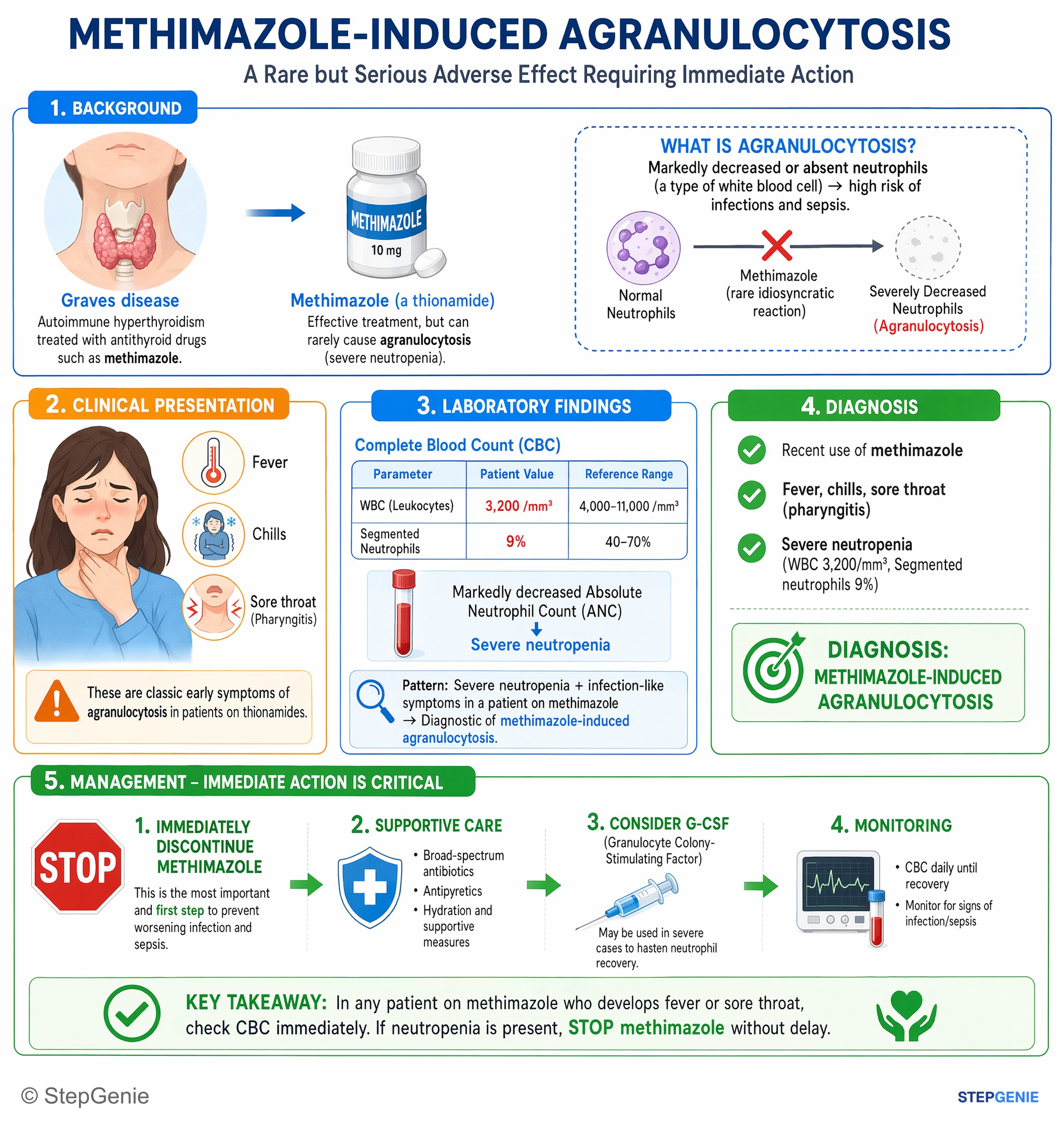
Methimazole-induced agranulocytosis causes fever, sore throat, and severe neutropenia; management is immediate discontinuation of…
USMLE Step 2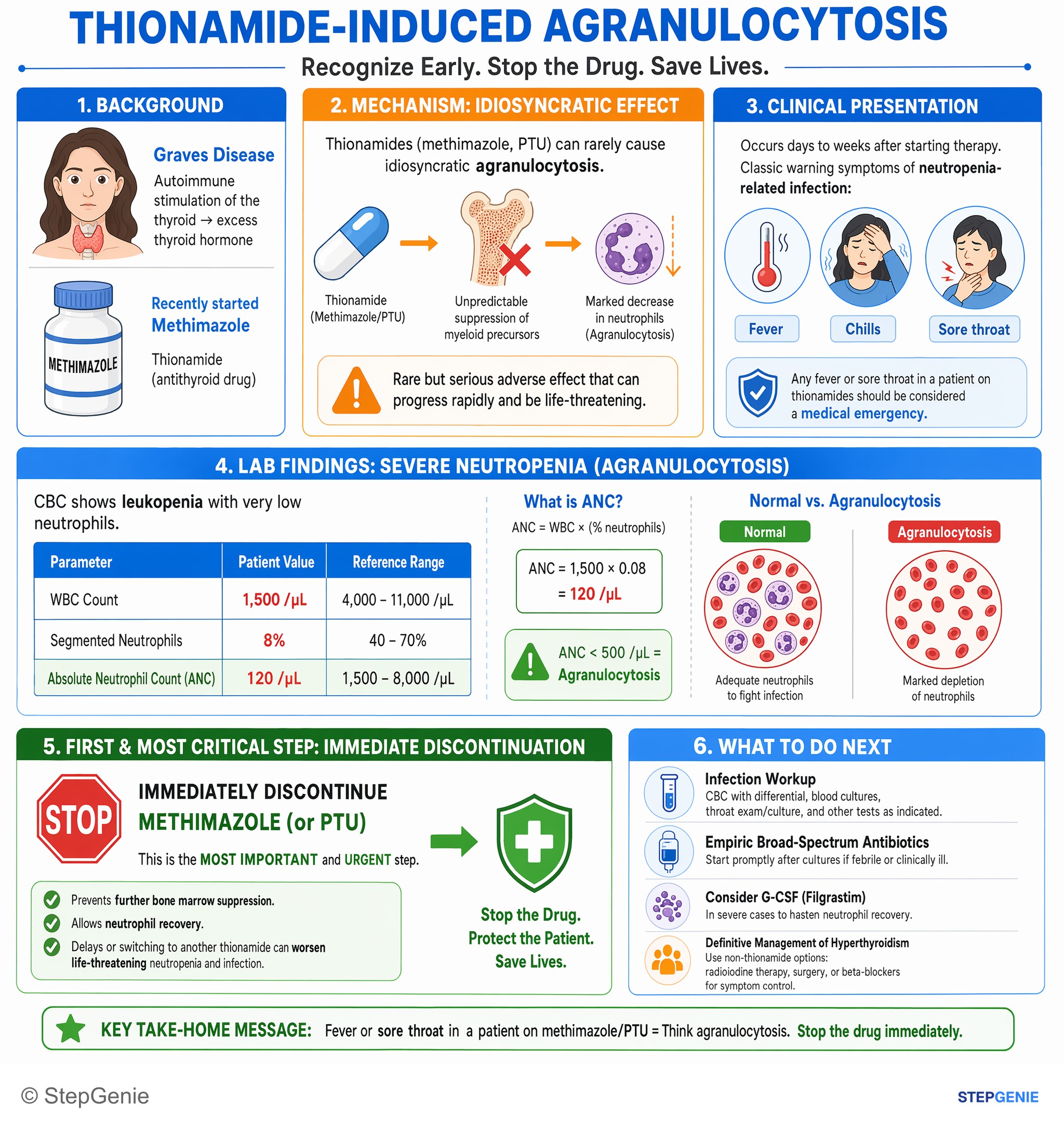
Thionamide-induced agranulocytosis presents with fever/sore throat and severe neutropenia; management is immediate discontinuation of…
USMLE Step 2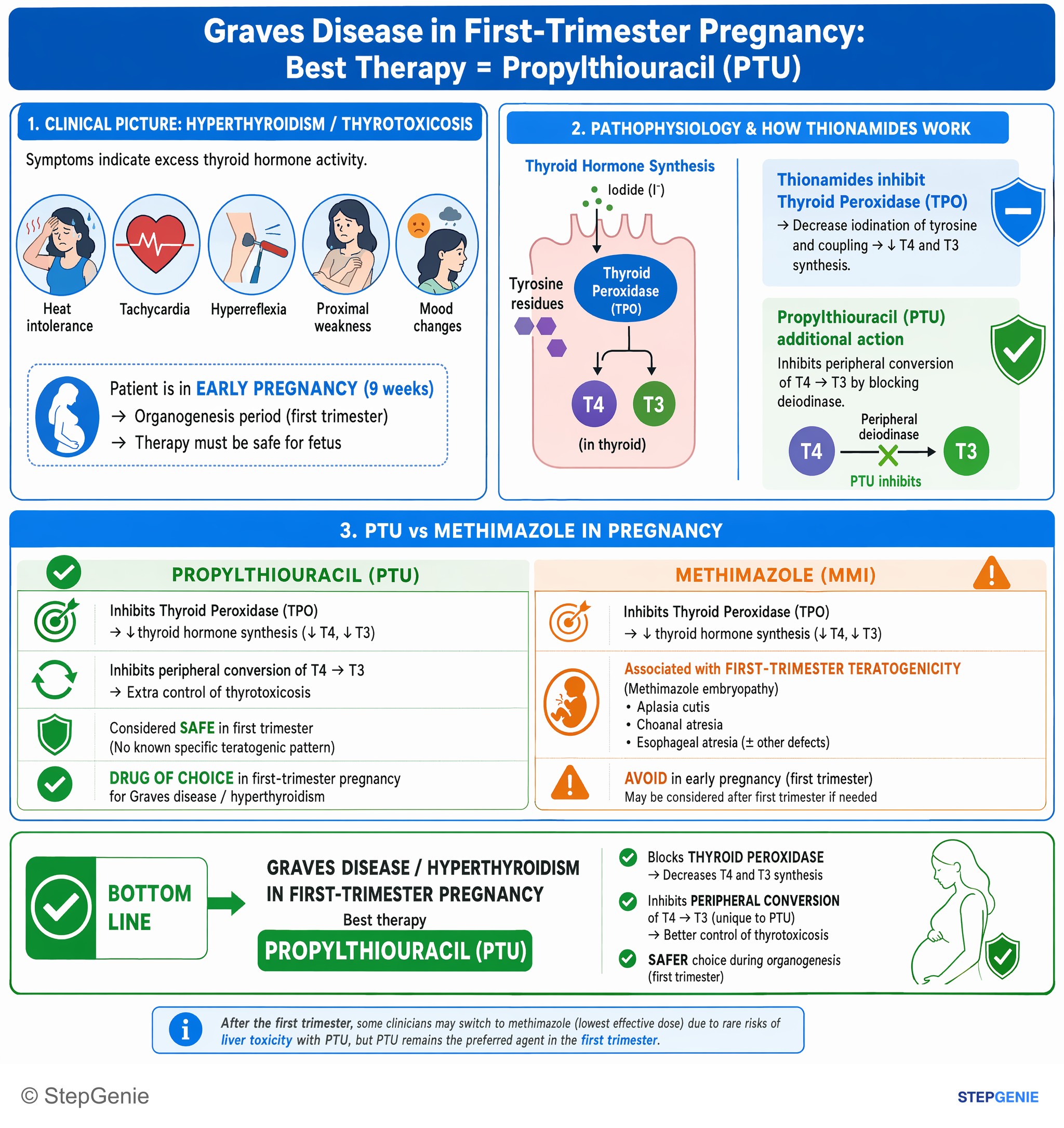
Graves disease in first-trimester pregnancy → treat with propylthiouracil (blocks thyroid peroxidase and peripheral T4→T3 conversion…
USMLE Step 2Frequently Asked Questions
Why is methimazole preferred over PTU for most patients?
Methimazole is the first-line antithyroid drug because it is taken once daily and has fewer major side effects than propylthiouracil (PTU), which carries an FDA boxed warning for severe liver injury and acute liver failure. The 2016 American Thyroid Association guideline says methimazole should be used in virtually every patient who chooses drug therapy for Graves disease, except in the first trimester of pregnancy, in thyroid storm, and in patients with minor methimazole reactions who decline radioiodine or surgery.
Why is PTU used in the first trimester of pregnancy?
Methimazole taken in the first trimester has been linked to rare birth defects, including aplasia cutis (scalp defects), choanal atresia, esophageal atresia and omphalocele. Defects with PTU are less frequent and milder, so the 2026 ATA pregnancy guideline advises switching methimazole to PTU when planning pregnancy and prefers PTU up to 16 weeks. It makes no recommendation on switching back after 16 weeks; the FDA labels suggest moving to methimazole for the second and third trimesters because PTU can injure the liver, which remains the classic exam answer.
Why is PTU preferred in thyroid storm?
Both thionamides block thyroid peroxidase, but PTU also inhibits conversion of T4 to the more active T3 in peripheral tissues. In thyroid storm, PTU is given first in high doses, followed by iodine, which blocks release of stored hormone, plus a beta-blocker such as propranolol, glucocorticoids and supportive care, while the trigger is treated. Iodine should come after the thionamide so the gland cannot use the iodine load to make more hormone.
What should you do if a patient on methimazole gets a fever or sore throat?
Stop the antithyroid drug and check a complete blood count with differential right away, because fever, sore throat or mouth ulcers can signal agranulocytosis. The PTU label puts its frequency at about 0.2-0.5% of patients, and most cases appear within the first three months of treatment. If agranulocytosis is confirmed, do not switch to the other thionamide, because of the risk of cross-reactivity; radioiodine or surgery becomes the definitive treatment.
How do methimazole and PTU work?
Methimazole and propylthiouracil are thionamides that inhibit thyroid peroxidase, the enzyme that attaches iodine to tyrosine residues on thyroglobulin (organification) and couples them to form T3 and T4. PTU also blocks peripheral 5'-deiodinase, reducing conversion of T4 to T3. Neither drug stops release of hormone already stored in the gland, so reaching a normal thyroid state takes weeks to a few months, and a beta-blocker controls symptoms in the meantime.
Which lab tests are needed before and during antithyroid drug therapy?
The American Thyroid Association suggests a baseline complete blood count with differential and a liver profile, including bilirubin and transaminases, before starting methimazole or PTU. There is no proven routine schedule for white cell monitoring, but a differential count is needed whenever the patient develops fever or a sore throat. Thyroid function is rechecked to find the lowest dose that keeps the patient euthyroid, and the drug is stopped if transaminases rise above three times normal.