Giardia lamblia (also called Giardia duodenalis or G. intestinalis) is a flagellated protozoan that causes foul-smelling, greasy, non-bloody diarrhea with bloating, cramps and flatulence, typically about a week (range 1–14 days) after a person swallows its cysts in untreated stream water, in a childcare center or through sex that involves fecal exposure. Its trophozoites cling to the duodenal and jejunal brush border with a ventral sucking disk but do not invade, so there is no blood, no fecal leukocytes and usually no fever: the diarrhea comes mainly from malabsorption. Diagnose with a stool antigen test or PCR (or repeated ova-and-parasite exams), and treat with tinidazole (one dose) or nitazoxanide (3 days), both FDA-approved for giardiasis; metronidazole is widely used but off-label for this infection.
Giardia lamblia at a glance
| Feature | What to know |
|---|---|
| Organism | Flagellated protozoan; pear-shaped trophozoite (2 nuclei, 8 flagella, ventral sucking disk) and oval cyst (4 nuclei) |
| Infective form | Cyst: infectious when passed, stays viable for weeks to months outside the body, resists routine chlorination |
| Where it lives | Lumen of the duodenum and proximal jejunum, attached to the brush border; no tissue invasion |
| Classic exposures | Untreated stream or lake water (backpackers), childcare centers, household contacts, oral–anal sex, travel to areas with poor sanitation |
| Timing | Incubation 1–14 days (average 7); acute illness usually 1–3 weeks; some cases become chronic |
| Stool | Foul-smelling, greasy, may float; no blood, no leukocytes |
| Other symptoms | Bloating, cramps, flatulence, nausea, weight loss; fever uncommon |
| Prolonged disease | Antibody deficiency: CVID, X-linked agammaglobulinemia, selective IgA deficiency |
| Diagnosis | Stool antigen or PCR; microscopy needs repeated samples |
| US treatment | Tinidazole 2 g once or nitazoxanide 500 mg twice daily for 3 days (FDA-approved); metronidazole 5–7 days (off-label) |
| Aftermath | Acquired lactose intolerance, post-infectious IBS, fatigue |
| Prevention | Boil water, or use a filter rated for cysts (≤1 µm); chlorine or iodine alone is unreliable |
The vignette: diarrhea after a backpacking trip
A 23-year-old graduate student comes to the clinic because of 8 days of foul-smelling, greasy, pale stools that float and are hard to flush, four or five a day, with bloating, crampy upper abdominal pain, excessive flatulence and nausea. He has lost 2 kg (4.4 lb). Twelve days ago he returned from a 5-day backpacking trip in the Rocky Mountains, where he drank stream water passed through a portable filter. He has had no fever, vomiting or blood in his stool, and he takes no medications. Temperature is 37.1°C (98.8°F). The abdomen is mildly distended with hyperactive bowel sounds and mild diffuse tenderness. Stool is negative for occult blood and leukocytes. Which of the following is the most likely cause of his symptoms?
- A. Campylobacter jejuni
- B. Celiac disease
- C. Cryptosporidium parvum
- D. Entamoeba histolytica
- E. Enterotoxigenic Escherichia coli
- F. Giardia lamblia
- G. Vibrio cholerae
Answer: F, Giardia lamblia
Every clue points to a noninvasive small-bowel parasite that causes malabsorption:
- Exposure: untreated stream water, with symptoms starting 4–9 days after he drank it, inside Giardia's 1–14-day incubation.
- Malabsorption: greasy, pale, floating, foul stools, bloating, flatulence and weight loss.
- No invasion: no fever, no blood and no fecal leukocytes. Trophozoites attach to the brush border but do not penetrate the mucosa.
- The filter is a decoy, not an alibi. A filter with an absolute pore size of 1 µm or smaller removes cysts, but not every portable device is rated for cysts, and a cracked filter, a contaminated bottle or unwashed hands can let them through.
Next step: a stool Giardia antigen test or PCR. Treatment: tinidazole 2 g once with food, or nitazoxanide 500 mg every 12 hours with food for 3 days.
Why every other answer choice is wrong
- A. Campylobacter jejuni: an invasive bacterium from undercooked poultry, unpasteurized milk or infected animals such as puppies. Expect fever (38–40°C), abdominal pain that can mimic appendicitis, watery and sometimes bloody diarrhea, and leukocytes in stool; it is remembered for Guillain–Barré syndrome and reactive arthritis. Review Campylobacter jejuni.
- B. Celiac disease: it does cause pale, bulky, greasy, foul stools, but it is a chronic gluten-driven enteropathy, not an illness that starts days after drinking stream water. Clues are iron deficiency without bleeding and dermatitis herpetiformis; the workup is IgA anti–tissue transglutaminase plus total IgA, then duodenal biopsy showing villous atrophy, crypt hyperplasia and intraepithelial lymphocytes. Giardia often leaves villi looking nearly normal. See the celiac disease breakdown.
- C. Cryptosporidium parvum: the closest look-alike, because it is also waterborne and non-bloody. But its diarrhea is watery rather than greasy, its oocysts survive pool-level chlorine (swimming pools, water parks), and stool shows small acid-fast oocysts. It is self-limited in healthy hosts but causes severe, chronic diarrhea in AIDS, especially with CD4 counts below 100/µL. More in the Cryptosporidium question.
- D. Entamoeba histolytica: an ameba that invades the colon, producing flask-shaped ulcers and dysentery with blood and mucus, and that can reach the liver as a usually single right-lobe abscess. Treatment is a tissue agent (metronidazole or tinidazole) followed by a luminal agent (paromomycin or iodoquinol). Non-bloody greasy stools argue against it.
- E. Enterotoxigenic E. coli (ETEC): the most common cause of traveler's diarrhea. Its heat-labile toxin raises cAMP and its heat-stable toxin raises cGMP, causing watery diarrhea that starts 12–72 hours after exposure and is usually mild and self-limited, without greasy stools or a week of weight loss. Compare the strains in the E. coli pathotypes breakdown.
- G. Vibrio cholerae: abrupt, painless, voluminous "rice-water" diarrhea with vomiting after a 1–3-day incubation; adults can lose more than 1 L an hour. Cholera toxin raises cAMP in enterocytes, and the danger is rapid dehydration with hypokalemia and metabolic acidosis, treated with rehydration plus doxycycline. Bloating, fatty stools and a mountain stream do not fit. Review Vibrio cholerae.
Life cycle: cysts in, trophozoites stick, no invasion
- Ingestion of cysts in water or food, or from hands contaminated with feces. Cysts are infectious when passed or shortly afterward, so person-to-person spread is easy.
- Excystation in the small intestine: each cyst releases two trophozoites.
- Attachment and division: trophozoites stay in the lumen of the proximal small bowel, free or attached to the mucosa by the ventral sucking disk, and multiply by longitudinal binary fission.
- Encystation as parasites move toward the colon. Cysts are the stage usually seen in formed stool; trophozoites may appear in diarrheal stool.
| Stage | Shape and size | Nuclei | Other features |
|---|---|---|---|
| Trophozoite | Pear-shaped, 10–20 µm long | 2 | 8 flagella, ventral sucking disk, median bodies; best seen on trichrome stain |
| Cyst | Oval to ellipsoid, 8–19 µm | 4 when mature (2 when immature) | Hardy wall; seen on iodine wet mounts; the infective form |
Why the stool is greasy and foul-smelling
Giardia causes diarrhea through malabsorption plus secretion, not tissue invasion:
- Microvillus shortening: diffuse shortening of epithelial microvilli shrinks the absorptive surface and lowers brush-border disaccharidase activity, so fats and sugars are poorly digested and absorbed.
- Barrier damage: the parasite triggers enterocyte apoptosis and disrupts tight junctions, increasing permeability; host CD8+ T cells help mediate the brush-border injury.
- Secretion: electrolyte (chloride) hypersecretion adds fluid to the lumen.
- Little visible damage: symptoms can occur without obvious villous atrophy.
The results match the vignette: unabsorbed fat makes stools greasy, pale and floating; colonic bacteria ferment unabsorbed sugars into gas, causing bloating and flatulence; and chronic infection brings weight loss, fatigue, vitamin B12 malabsorption and, in children, failure to thrive.
Who gets giardiasis
| Risk group | Why |
|---|---|
| Backpackers, campers, hikers | Untreated stream or lake water; cysts stay viable in surface water for weeks to months |
| Children in childcare, especially in diapers, and their households | Fecal–oral spread; cysts are infectious when passed |
| Sex with fecal exposure, especially oral–anal | CDC's STI guidelines name G. lamblia the parasite most often implicated in sexually transmitted enteritis and note enteric outbreaks in sexual networks of men who have sex with men |
| Travelers and people in areas with poor sanitation | Contaminated water and food |
| Antibody deficiency: CVID, X-linked agammaglobulinemia, selective IgA deficiency | Antibodies help clear Giardia, so infection lasts longer or recurs |
The immunodeficiency link is a favorite exam twist: recurrent giardiasis plus recurrent sinopulmonary infections should make you check immunoglobulin levels. Common variable immunodeficiency usually presents between ages 20 and 40; X-linked agammaglobulinemia presents in infant boys once maternal antibody wanes.
Diagnosis: antigen or PCR beats a single O&P
- Stool antigen tests (enzyme immunoassay or rapid cartridge) are more sensitive than routine microscopy; Merck calls antigen EIA the preferred test. CDC calls direct fluorescent antibody (DFA) microscopy the gold standard.
- Molecular tests (PCR) detect Giardia DNA, often within multiplex GI panels that test for many pathogens at once.
- Ova and parasites (O&P) microscopy finds cysts, trophozoites and other parasites, but shedding is intermittent, so collect up to three samples over several days.
- Duodenal aspirate, biopsy or the string test can show trophozoites but is rarely needed.
- Supporting findings: no blood and no leukocytes in stool. Retest only if symptoms persist after treatment.
Treatment: what the FDA labels actually say
| Drug | US label status for giardiasis | Regimen | Exam points |
|---|---|---|---|
| Tinidazole | FDA-approved, adults and children older than 3 years | 2 g once with food; children 50 mg/kg once (maximum 2 g); tablets can be crushed in cherry syrup | Nitroimidazole; as effective as metronidazole and better tolerated; bitter or metallic taste; no alcohol until 3 days after the dose; label says not to use it in the first trimester |
| Nitazoxanide | FDA-approved for diarrhea caused by Giardia or Cryptosporidium, age 1 year and older | Every 12 hours with food for 3 days: 500 mg (age 12 and older); suspension 200 mg (4–11 years) or 100 mg (1–3 years) | Inhibits pyruvate:ferredoxin oxidoreductase (PFOR); liquid suits young children; can discolor urine; no human pregnancy data |
| Metronidazole | Not FDA-approved for giardiasis (labeled for trichomoniasis, amebiasis and anaerobic infections); widely used off-label | Several doses a day for 5–7 days | Disulfiram-like reaction with alcohol; metallic taste; neuropathy and seizures reported |
| Paromomycin | Not labeled for giardiasis (labeled for intestinal amebiasis) | Oral; acts in the gut lumen | Poorly absorbed aminoglycoside; recommended for symptomatic giardiasis in the second and third trimesters |
- Exam lore vs label: classic review sources call metronidazole the drug of choice, and it still works, but tinidazole and nitazoxanide are the drugs with a US giardiasis indication.
- Nitroimidazole warnings: tinidazole and metronidazole carry a boxed warning because metronidazole caused cancer in rodents, and neither should be given within 2 weeks of disulfiram.
- Pregnancy: dehydration is a particular risk, so rehydration comes first. Tinidazole's label says not to give it in the first trimester, and nitazoxanide has no human pregnancy data; the Minnesota Department of Health recommends paromomycin for symptomatic infection in the second and third trimesters.
- Asymptomatic carriers: treatment is generally not recommended.
- Persistent symptoms: confirm infection with up to three stool tests. Before calling it resistance, look for reinfection (from household members or the environment) and an incomplete course. If infection is confirmed, combine drugs from different classes and retest no sooner than 2 weeks after the last dose. Infection that persists after combination therapy calls for an immunodeficiency workup.
After the cure: lactose intolerance and post-infectious IBS
Giardiasis often brings acquired lactose intolerance, and after parasitologic cure, lactose intolerance, irritable bowel syndrome or fatigue can last weeks to months, and sometimes years. In a cohort from a waterborne outbreak in Bergen, Norway, 46% of people with confirmed giardiasis had IBS on a questionnaire 3 years later, vs 14% of controls, and 46% vs 12% reported chronic fatigue.
Follow-up question. The student takes a single 2-g dose of tinidazole, and the greasy stools stop within a week. Three weeks later he returns with bloating, gurgling and loose, watery stools within hours of drinking milk or eating ice cream, which he tolerated daily before the trip. He has regained 1 kg, and three stool Giardia antigen tests collected over a week are negative. He has never had pneumonia or recurrent sinusitis. Which of the following best explains his current symptoms?
- A. Common variable immunodeficiency
- B. Nitroimidazole-resistant Giardia infection
- C. Post-infectious irritable bowel syndrome
- D. Primary (adult-type) lactase nonpersistence
- E. Secondary lactase deficiency
Answer: E, secondary lactase deficiency. Giardia shortens microvilli and depletes brush-border disaccharidases, including lactase. Undigested lactose draws water into the bowel (osmotic diarrhea) and is fermented to gas in the colon; stool is acidic (pH below 6), and a hydrogen breath test turns positive. It improves as the brush border recovers; limiting lactose meanwhile controls symptoms. See lactose intolerance.
- A. CVID: think of it when Giardia persists or relapses despite treatment in someone with recurrent sinopulmonary infections. His stool tests are negative and his history is clean.
- B. Resistant Giardia: treatment failure occurs with every drug, but it would leave positive stool tests and ongoing greasy stools.
- C. Post-infectious IBS: common after giardiasis, but IBS means recurrent abdominal pain tied to defecation over months, not dairy-triggered symptoms 3 weeks after cure. Reconsider it if symptoms persist despite lactose restriction; see irritable bowel syndrome.
- D. Primary lactase nonpersistence: the most common form worldwide, as lactase falls after weaning, but it does not appear suddenly after an infection in someone who drank milk daily.
Prevention: boil, filter, or both
| Method | Giardia cysts | Cryptosporidium oocysts | Viruses |
|---|---|---|---|
| Boiling (1 minute; 3 minutes above 6,500 ft) | Killed | Killed | Killed |
| Filter with absolute pore size ≤1 µm (or NSF Standard 53 or 58 for cyst reduction) | Removed | Removed | Not removed |
| Iodine or chlorine | Unreliable; depends on contact time, temperature and turbidity | Do not work well | Killed |
| Chlorine dioxide | Killed | Only somewhat effective | Killed |
| UV light (small volumes of clear water) | Killed | Killed | Killed |
- Boiling is the most reliable method. The next best is to filter and then disinfect, which covers parasites, bacteria and viruses.
- Cysts resist routine chlorination, so chlorinated water is not automatically Giardia-free.
- Wash hands with soap and water after using the toilet or changing diapers, keep children with diarrhea out of childcare until it stops, and wait several weeks after diarrhea ends before having sex.
Giardia vs Entamoeba histolytica vs Cryptosporidium
| Feature | Giardia lamblia | Entamoeba histolytica | Cryptosporidium |
|---|---|---|---|
| Type | Flagellate | Ameba | Apicomplexan |
| Infective form | Cyst | Cyst | Oocyst, infectious when passed |
| Site | Duodenal and jejunal lumen | Colon; can spread to the liver | Small-bowel epithelial cells, within the brush border |
| Invasion | None (attaches with ventral disk) | Yes: flask-shaped ulcers | Confined to the epithelial surface |
| Stool | Greasy, foul, non-bloody | Bloody with mucus (dysentery) | Watery, non-bloody; can be massive in AIDS |
| Classic setting | Backpacker, childcare, oral–anal sex | Travel or residence in endemic areas | Swimming pools, water parks, calves, AIDS |
| Microscopy | Trophozoite with 2 nuclei and 8 flagella; cyst with 4 nuclei | Trophozoite with 1 nucleus, may contain ingested RBCs; cyst with up to 4 nuclei | Acid-fast oocysts about 4–5 µm |
| Best tests | Stool antigen or PCR | Stool antigen or PCR (separates it from E. dispar); serology for liver abscess | Stool antigen, DFA or PCR; modified acid-fast stain |
| Treatment | Tinidazole or nitazoxanide; metronidazole off-label | Metronidazole or tinidazole, then a luminal agent | Often self-limited; nitazoxanide if severe or persistent; antiretroviral therapy in HIV |
| Survival outside the host | Cysts stay viable for weeks to months and resist routine chlorination | Cysts stay viable for weeks to months | Oocysts survive pool-level chlorine |
How USMLE tests Giardia beyond "camping diarrhea"
- Morphology: a pear-shaped trophozoite with two nuclei and a ventral disk is Giardia. Four nuclei is a cyst clue, not a species clue: mature E. histolytica cysts also have four.
- Mechanism: "attaches but does not invade" explains the absence of blood, fever and fecal leukocytes, whereas invasive organisms such as Shigella, Campylobacter and E. histolytica cause bloody stools.
- Immunology: recurrent Giardia means think antibody deficiency, especially selective IgA deficiency, CVID and X-linked agammaglobulinemia.
- Pharmacology: disulfiram-like reactions with tinidazole and metronidazole; nitazoxanide treats both Giardia and Cryptosporidium.
- Sequelae: dairy-triggered bloating after cure is acquired lactose intolerance, not treatment failure.
Key takeaways
- Giardia = cysts swallowed in untreated water, in childcare or through oral–anal sex → trophozoites attach in the duodenum and jejunum without invading.
- Malabsorption explains the picture: foul, greasy, floating, non-bloody stools, bloating, flatulence and weight loss, with no fever or fecal leukocytes.
- Trophozoite: pear-shaped, 2 nuclei, 8 flagella, ventral disk. Cyst: oval, 4 nuclei, infective, stays viable for weeks to months in water and resists routine chlorination.
- Test with stool antigen or PCR; send up to three O&P samples if relying on microscopy.
- Tinidazole (one dose, age over 3) and nitazoxanide (3 days, age 1 and over) are FDA-approved; metronidazole is off-label; paromomycin is recommended for symptomatic infection in the second and third trimesters of pregnancy.
- Prolonged or recurrent giardiasis suggests antibody deficiency; lactose intolerance and post-infectious IBS can follow cure.
Sources
- Giardiasis — Merck Manual Professional Edition (2024)
- Giardiasis (Giardia duodenalis) — CDC DPDx (2024)
- Patient Care for Giardia Infection — CDC (2024)
- About Water Treatment Options When Hiking, Camping, or Traveling — CDC (2025)
- TINDAMAX (tinidazole) tablets prescribing information — DailyMed, National Library of Medicine (2021)
- ALINIA (nitazoxanide) prescribing information — DailyMed, National Library of Medicine (2024)
- FLAGYL (metronidazole) prescribing information — DailyMed, National Library of Medicine (2025)
- Health Care Provider Information on Giardiasis — Minnesota Department of Health (2022)
- Buret AG. Pathophysiology of enteric infections with Giardia duodenalis — Parasite (2008)
- Wensaas KA, et al. Irritable bowel syndrome and chronic fatigue 3 years after acute giardiasis: historic cohort study — Gut (2012)
- Amebiasis — Merck Manual Professional Edition (2024)
- Cryptosporidiosis — Merck Manual Professional Edition (2024)
- Proctitis, Proctocolitis, and Enteritis — CDC STI Treatment Guidelines (2021)
- Clinical Testing and Diagnosis for Giardia Infection — CDC (2024)
Visual explanations from the StepGenie QBank
Infographics StepGenie drew to explain questions in its own QBank, matched to this article's topic. Each caption is the takeaway of the question it explains.
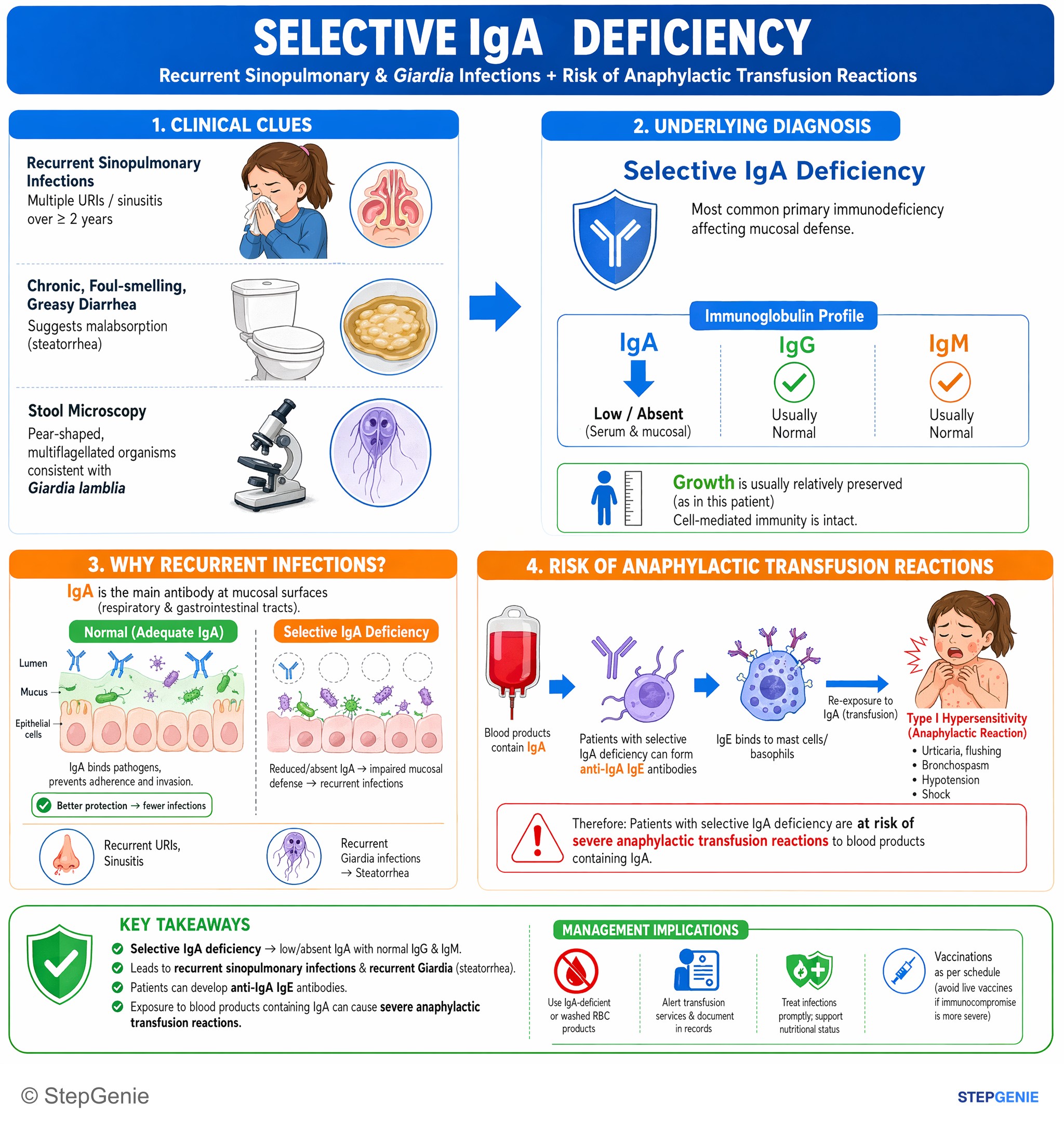
Selective IgA deficiency → recurrent sinopulmonary & Giardia infections; anti-IgA antibodies predispose to anaphylactic transfusion…
USMLE Step 1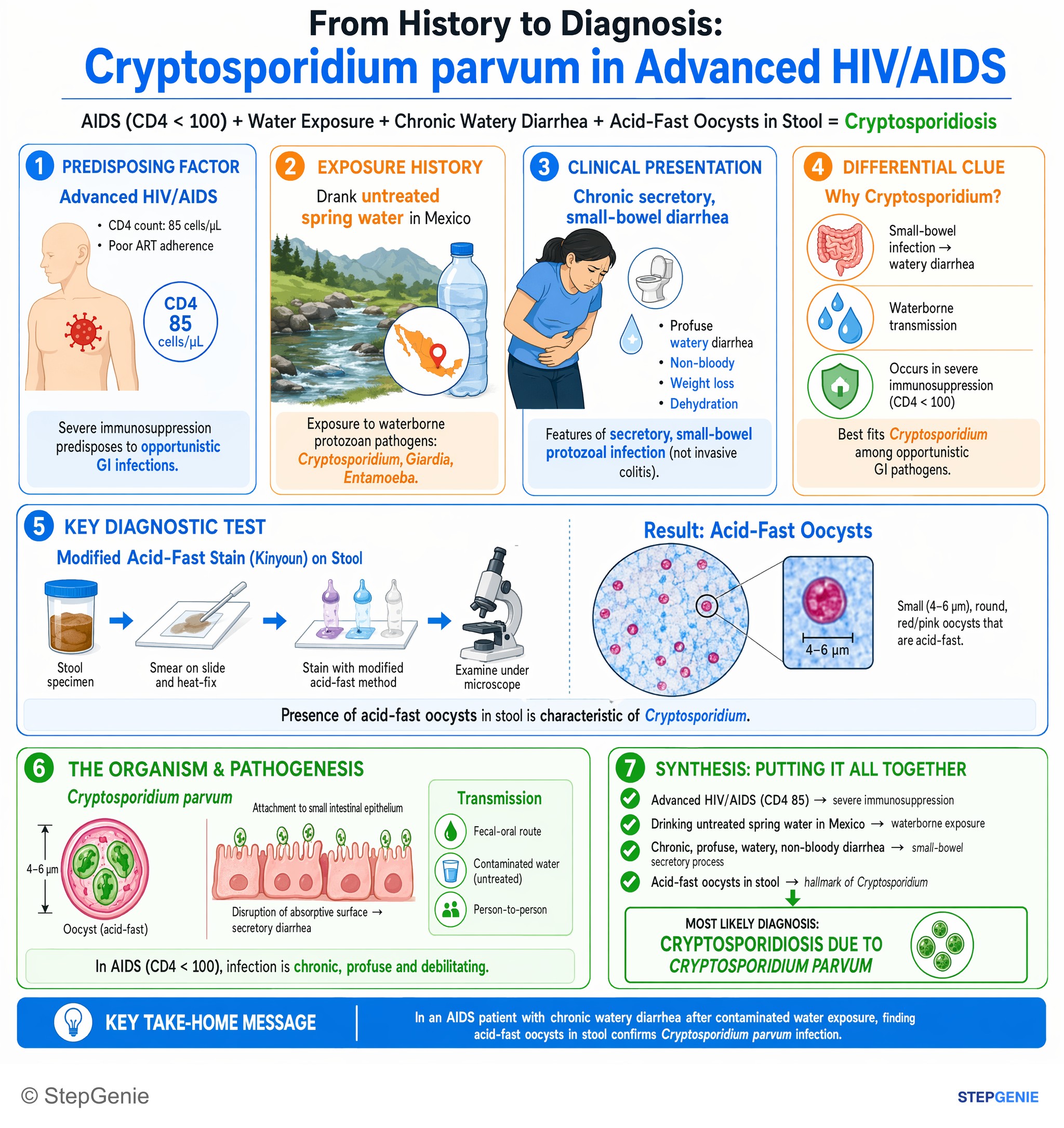
Cryptosporidiosis in AIDS: chronic profuse watery diarrhea after contaminated water exposure; acid-fast oocysts in stool confirm…
USMLE Step 1Frequently Asked Questions
What symptoms make Giardia lamblia the most likely cause of diarrhea after camping?
Giardia is the best answer when diarrhea starts about 1 to 2 weeks after drinking untreated stream or lake water and the stools are foul-smelling, greasy and sometimes floating, with bloating, cramps, flatulence, nausea and weight loss. Fever is uncommon, and stool has no blood or leukocytes. That pattern reflects malabsorption caused by a noninvasive parasite in the duodenum and jejunum. Fever with bloody stools suggests Campylobacter or Shigella instead, and watery diarrhea after swimming in a pool suggests Cryptosporidium.
Why does the absence of fever, blood, and fecal leukocytes point away from invasive diarrhea and toward Giardia?
Giardia trophozoites attach to the small-bowel brush border with a ventral sucking disk but do not invade the mucosa, so they do not cause the ulceration and inflammation behind bloody, febrile diarrhea. Instead they shorten microvilli, reduce brush-border enzymes and increase secretion, which produces greasy, malabsorptive diarrhea. Invasive pathogens such as Campylobacter, Shigella and Entamoeba histolytica typically cause fever or bloody stools. A negative fecal leukocyte test supports a noninvasive cause but does not prove it, so confirm with a stool antigen test or PCR.
Can you still get Giardia after filtering stream water on a backpacking trip?
Yes. A filter removes Giardia cysts only if it has an absolute pore size of 1 micron or smaller, or is certified to NSF Standard 53 or 58 for cyst reduction, and only if it is intact and used without contaminating the clean side. Cracked filters, dirty bottles and unwashed hands are common failure points, and such filters do not remove viruses. Boiling for 1 minute (3 minutes above 6,500 feet) is the most reliable method, and filtering followed by disinfection is next best. Iodine or chlorine alone is unreliable against Giardia cysts.
What is the treatment for giardiasis, and is metronidazole FDA-approved for it?
In the US, tinidazole and nitazoxanide are FDA-approved for giardiasis. Tinidazole is a single 2-gram dose with food for adults, or 50 mg/kg (maximum 2 g) for children older than 3 years. Nitazoxanide is taken every 12 hours with food for 3 days: 500 mg from age 12, or a liquid suspension for children from age 1. Metronidazole for 5 to 7 days works and is widely used, but its label covers trichomoniasis, amebiasis and anaerobic infections, not giardiasis. Avoid alcohol with tinidazole and metronidazole.
How is Giardia diagnosed: stool antigen, PCR, or ova and parasites?
A stool antigen test or a molecular test is the usual first choice. Antigen enzyme immunoassays are more sensitive than routine microscopy, CDC calls direct fluorescent antibody microscopy the gold standard, and PCR, often in a multiplex GI panel, detects Giardia along with many other pathogens. Ova-and-parasite microscopy can show pear-shaped trophozoites with two nuclei or oval cysts with four, but shedding is intermittent, so up to three samples collected over several days may be needed. Duodenal sampling is rarely necessary.
Why do bloating and diarrhea sometimes continue after Giardia is treated?
The usual reasons are acquired lactose intolerance and post-infectious irritable bowel syndrome. Giardia shortens microvilli and depletes brush-border enzymes such as lactase, so dairy can cause gas and osmotic diarrhea for weeks to months until the lining recovers. In a Norwegian outbreak cohort, 46 percent of patients had IBS three years later, compared with 14 percent of controls. Before blaming these, test up to three stool samples to rule out persistent infection, reinfection or resistance, and consider antibody deficiency if infection keeps returning.