The quickest Haemophilus influenzae mnemonic is HaEMOPhilus: it causes Epiglottitis, Meningitis, Otitis media and Pneumonia. Pair it with "X and V" for the lab: this small, pleomorphic gram-negative coccobacillus needs hemin (factor X) and NAD (factor V), so it grows on chocolate agar, or on sheep blood agar only as satellite colonies beside Staphylococcus aureus. Classic invasive disease in unvaccinated children is driven by the type b capsule (polyribosyl-ribitol-phosphate, PRP), and the Hib conjugate vaccine has cut invasive Hib disease by more than 99%.
The mnemonic, decoded
| Letter | Disease | Classic stem clue | Usual strain |
|---|---|---|---|
| E | Epiglottitis | Toxic, drooling child in the tripod position with stridor; "thumb sign" on a lateral neck film | Type b in unvaccinated children; now mostly adults and non-Hib causes |
| M | Meningitis | Unvaccinated infant or toddler with fever and a stiff neck; hearing loss afterward | Type b (almost all cases where children are unvaccinated) |
| O | Otitis media (plus sinusitis and conjunctivitis) | Young child with ear pain and fever | Nontypeable |
| P | Pneumonia and bronchitis | Smoker with COPD and purulent sputum showing small gram-negative rods | Nontypeable in adults with COPD; type b in unvaccinated children |
Picture version: a big "HI" walks into a day care carrying two bottles labeled X and V and wearing a pink capsule jacket. Day care attendance really is a risk factor, and the capsule (type b) is what the vaccine targets.
Lab clues: X, V, chocolate agar and satellites
| Factor | What it is | Where the organism gets it |
|---|---|---|
| X | Hemin | Blood-containing media (hemin is available even from unlysed red cells) |
| V | NAD (nicotinamide adenine dinucleotide) | Supplemented chocolate agar, or NAD supplied by S. aureus growing nearby |
- It needs both factors. On a plain agar plate with paper disks, H. influenzae grows only around the disk that contains both X and V. H. parainfluenzae needs V alone, which is how the two are told apart.
- Chocolate agar, not sheep blood agar. Chocolate agar is blood agar heated during preparation, which releases hemin; supplements add NAD. H. influenzae grows on chocolate agar but not on standard sheep blood agar.
- Satellite growth. When a sheep blood agar plate is cross-streaked with S. aureus, H. influenzae forms small satellite colonies along the staphylococcal growth, because S. aureus provides the NAD.
- Gram stain: small, pleomorphic gram-negative coccobacilli.
Memory hook: "XV" is the Roman numeral 15, and 15 cents buys the chocolate bar. The organism needs both factors, and supplemented chocolate agar supplies both.
Capsule types: why "b" matters
H. influenzae comes as six encapsulated serotypes, a through f, plus unencapsulated nontypeable strains.
- Type b (Hib): the capsule is PRP, which is also the vaccine antigen. Before vaccines, type b caused about 95% of invasive H. influenzae disease and was the leading cause of bacterial meningitis in children younger than 5; about 1 in 200 children in that age group developed invasive Hib disease. Meningitis made up 50–65% of invasive Hib cases. Hearing loss or other neurologic sequelae affect 15–30% of survivors of Hib meningitis, and its case-fatality ratio is 3–6% despite appropriate antibiotics.
- Nontypeable strains mainly cause mucosal infections: otitis media, sinusitis, conjunctivitis and bronchitis. Bacteria, especially H. influenzae, colonize the lower airways of about 30% of people with COPD, and H. influenzae often shows up as gram-negative bacilli on sputum Gram stains during exacerbations. Nontypeable strains can also cause invasive disease, particularly in newborns and adults older than 65.
- After the vaccine: in CDC surveillance areas, Hib fell from 0.1 to 0.02 cases per 100,000 people between 1997 and 2018, while invasive H. influenzae disease overall rose from 1.23 to 2.08 per 100,000. Most invasive disease is now caused by non-b strains.
- Higher risk: children younger than 5, adults 65 or older, American Indian and Alaska Native people, and people with asplenia, sickle cell disease, HIV infection, or immunoglobulin or complement deficiencies. Crowding and day care attendance also predispose.
The other encapsulated organisms that share these exam lists are covered in the Streptococcus pneumoniae Q-bank breakdown and the Neisseria meningitidis quick tips.
Hib vaccine: why it is a conjugate
- Plain PRP polysaccharide is a T-independent antigen. The original, unconjugated polysaccharide vaccine gave age-dependent responses and poor immunogenicity in children 2 years or younger.
- Conjugating PRP to a protein carrier (tetanus toxoid in PRP-T vaccines, a meningococcal outer membrane protein in PRP-OMP) turns it into a T-dependent antigen and greatly improves immunogenicity in young children. More than 95% of infants develop protective antibody after the primary series.
- Schedule: a primary series at 2, 4 and 6 months or at 2 and 4 months, depending on the product, then a booster at 12–15 months.
- Limits: no vaccine prevents disease from non-b encapsulated or nontypeable strains, so a fully vaccinated child can still get otitis media from nontypeable H. influenzae.
Epiglottitis: the "E" that gets tested
| Feature | Epiglottitis | Croup |
|---|---|---|
| Onset | Abrupt and fulminant in children | More gradual |
| Typical age | 2–8 years (especially if unvaccinated) and adults | 6–36 months |
| Barking cough | Uncommon | Characteristic |
| Epiglottis | Swollen and cherry red | Normal size, may be red |
| Neck radiograph | Enlarged epiglottis (thumb sign) | Subglottic narrowing (steeple sign) |
- Stem clues: severe sore throat and painful swallowing with little visible pharyngitis, drooling without a barking cough, high fever, a toxic and anxious child, inspiratory stridor and the tripod position.
- Airway first. Examining the throat can precipitate complete obstruction, and a child with stridor should not be sent to the radiology suite. Experienced staff secure the airway, preferably in the operating room, and a β-lactamase-resistant antibiotic such as ceftriaxone is started.
- Since Hib vaccination, epiglottitis is seen more often in adults, and causes include S. pneumoniae, S. aureus and nontypeable H. influenzae; type b still causes it in unvaccinated children and adults.
Treatment and prophylaxis
- Meningitis and other invasive disease: a third-generation cephalosporin, ceftriaxone or cefotaxime. Compare the other causes of bacterial meningitis in the bacterial meningitis Q-bank breakdown.
- Less serious infections: many US isolates make β-lactamase and resist ampicillin, so options include amoxicillin-clavulanate, oral second- or third-generation cephalosporins and macrolides.
- Household prophylaxis after invasive Hib disease: ACIP recommends rifampin for all household contacts (except pregnant women) when the household includes a child younger than 4 who is not fully vaccinated or an immunocompromised child younger than 18. An unvaccinated or incompletely vaccinated contact younger than 4 also gets a vaccine dose.
- Child care: rifampin is recommended when 2 or more cases of invasive Hib disease occur within 60 days and unimmunized or underimmunized children attend.
- Carriage: ceftriaxone and cefotaxime clear throat carriage. An index patient treated with other antibiotics gets rifampin at the end of treatment if younger than 2 or living in a household that meets the criteria above.
Exam traps
- It does not cause the flu. Richard Pfeiffer found the bacterium in sputum during an influenza outbreak in 1892 and proposed it as the cause; influenza was shown to be viral in 1933.
- Both factors, not one. Growth around the V disk alone points to H. parainfluenzae.
- No growth on sheep blood agar unless S. aureus is streaked alongside.
- Vaccinated child with otitis media: still possible H. influenzae, because nontypeable strains are not covered.
- Invasive disease today is mostly non-b, with nontypeable invasive disease concentrated in newborns and older adults.
- Epiglottitis: secure the airway before any throat examination or imaging.
Worked example
Vignette. A 2-year-old boy whose parents declined all vaccines attends day care. After a day of fever and irritability he has a stiff neck. CSF shows neutrophilic pleocytosis and a low glucose. Gram stain shows small, pleomorphic gram-negative coccobacilli. The organism grows on chocolate agar but not on sheep blood agar, except as tiny colonies next to a streak of S. aureus. Which bacterial component is the antigen in the vaccine that would most likely have prevented this infection?
Answer: The type b polysaccharide capsule, polyribosyl-ribitol-phosphate (PRP), which the Hib vaccine conjugates to a carrier protein.
Why the tempting distractors fail:
- Neisseria meningitidis: gram-negative diplococci, and it grows on both sheep blood and chocolate agar.
- Streptococcus pneumoniae: gram-positive diplococci that grow on sheep blood agar.
- H. parainfluenzae: needs V factor only, and it is a rare cause of bacteremia, endocarditis and brain abscess rather than toddler meningitis.
- Nontypeable H. influenzae: no capsule, mostly mucosal infections, and no vaccine covers it.
Key takeaways
- HaEMOPhilus: Epiglottitis, Meningitis, Otitis media, Pneumonia.
- X (hemin) + V (NAD): chocolate agar, or satellite colonies next to S. aureus on sheep blood agar.
- Type b capsule = PRP: the key virulence factor of Hib and the vaccine antigen.
- Conjugate vaccine: makes PRP T-dependent so it works in infants; invasive Hib has fallen by more than 99%.
- Nontypeable strains: otitis media, sinusitis, conjunctivitis and bronchitis, including COPD exacerbations; not vaccine-preventable.
- Treatment: ceftriaxone or cefotaxime for invasive disease; rifampin for household contacts when a child younger than 4 is not fully vaccinated or a child in the home is immunocompromised.
Sources
- Epidemiology and Prevention of Vaccine-Preventable Diseases (Pink Book), Chapter 8: Haemophilus influenzae — CDC
- Clinical Overview of Haemophilus influenzae Disease — CDC
- Prevention and Control of Haemophilus influenzae Type b Disease: Recommendations of the Advisory Committee on Immunization Practices (ACIP) — CDC MMWR (2014)
- Haemophilus Infections — Merck Manual Professional Edition
- Epiglottitis — Merck Manual Professional Edition
- Laboratory Methods for the Diagnosis of Meningitis Caused by Neisseria meningitidis, Streptococcus pneumoniae, and Haemophilus influenzae (WHO/CDS/CSR/EDC/99.7) — World Health Organization
- Xi Y, et al. A study of various factors affecting satellitism tests of Haemophilus influenzae and Haemophilus parainfluenzae using Staphylococcus aureus as the source of NAD — Journal of Microbiological Methods (2022)
- Chronic Obstructive Pulmonary Disease (COPD) — Merck Manual Professional Edition
Visual explanations from the StepGenie QBank
Infographics StepGenie drew to explain questions in its own QBank, matched to this article's topic. Each caption is the takeaway of the question it explains.
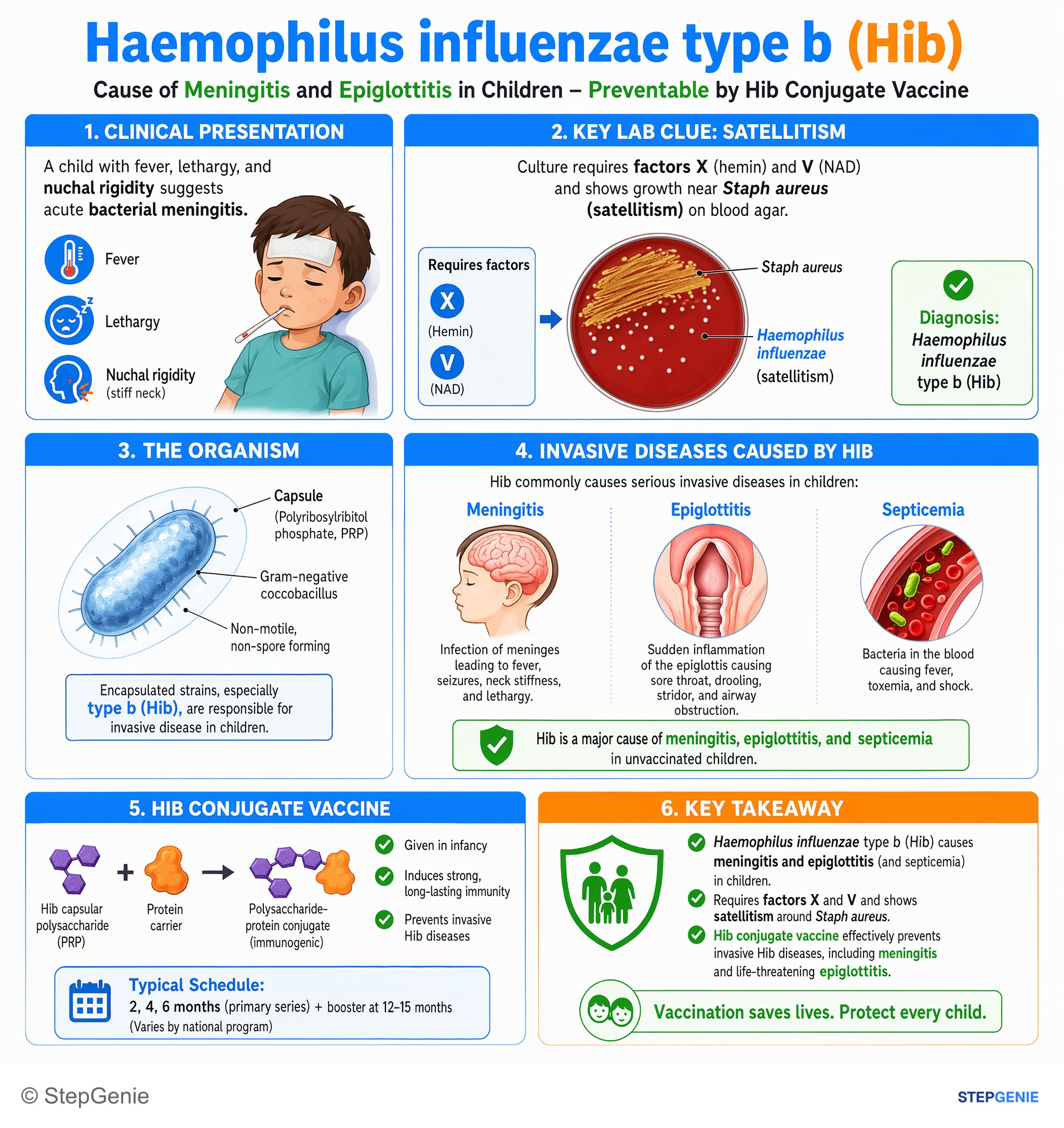
Haemophilus influenzae type b (Hib) causes meningitis and epiglottitis; Hib conjugate vaccine prevents both invasive meningitis and…
USMLE Step 1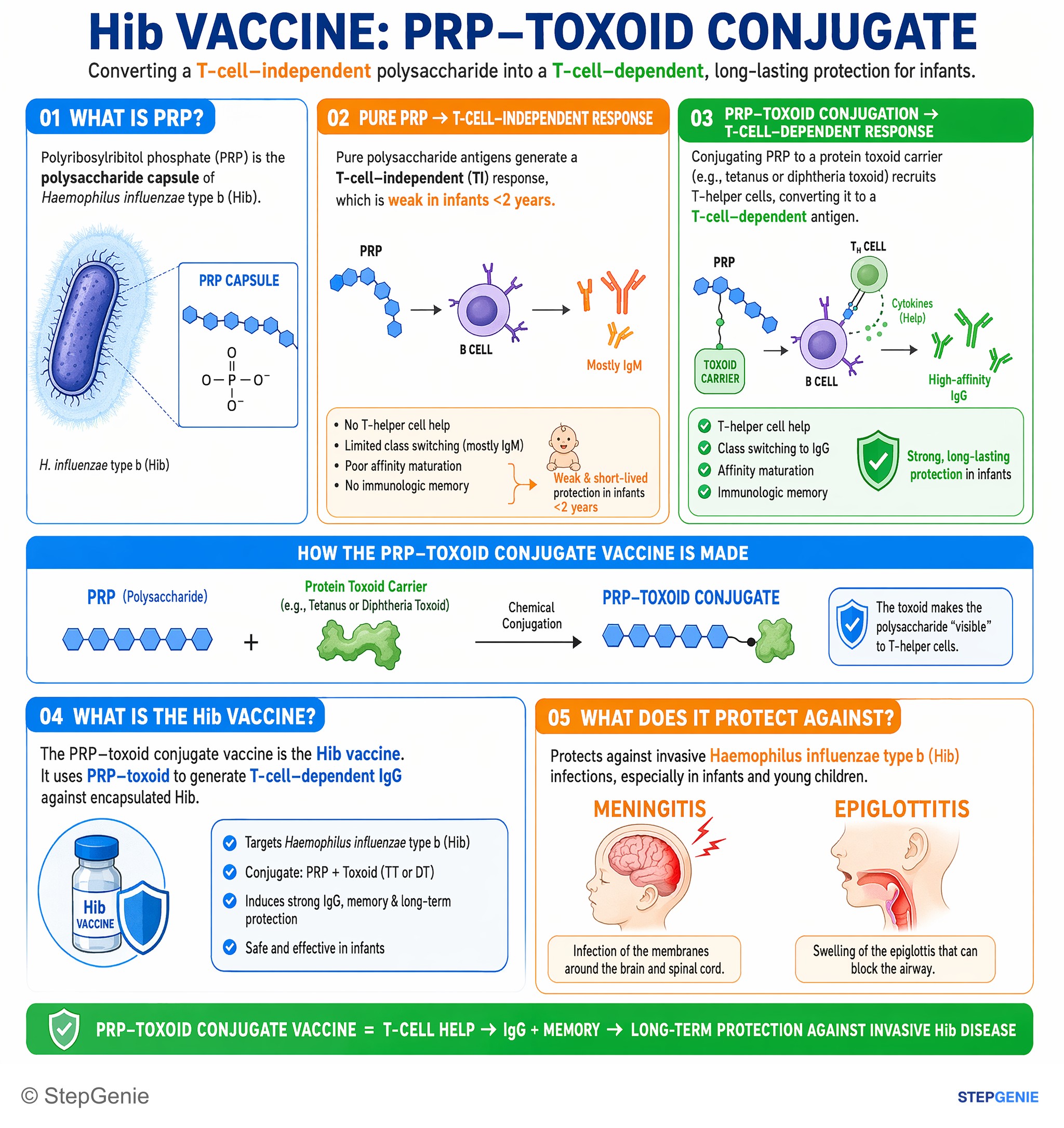
Haemophilus influenzae type b (Hib) conjugate vaccine uses PRP–toxoid to generate T-cell–dependent IgG against encapsulated Hib…
USMLE Step 1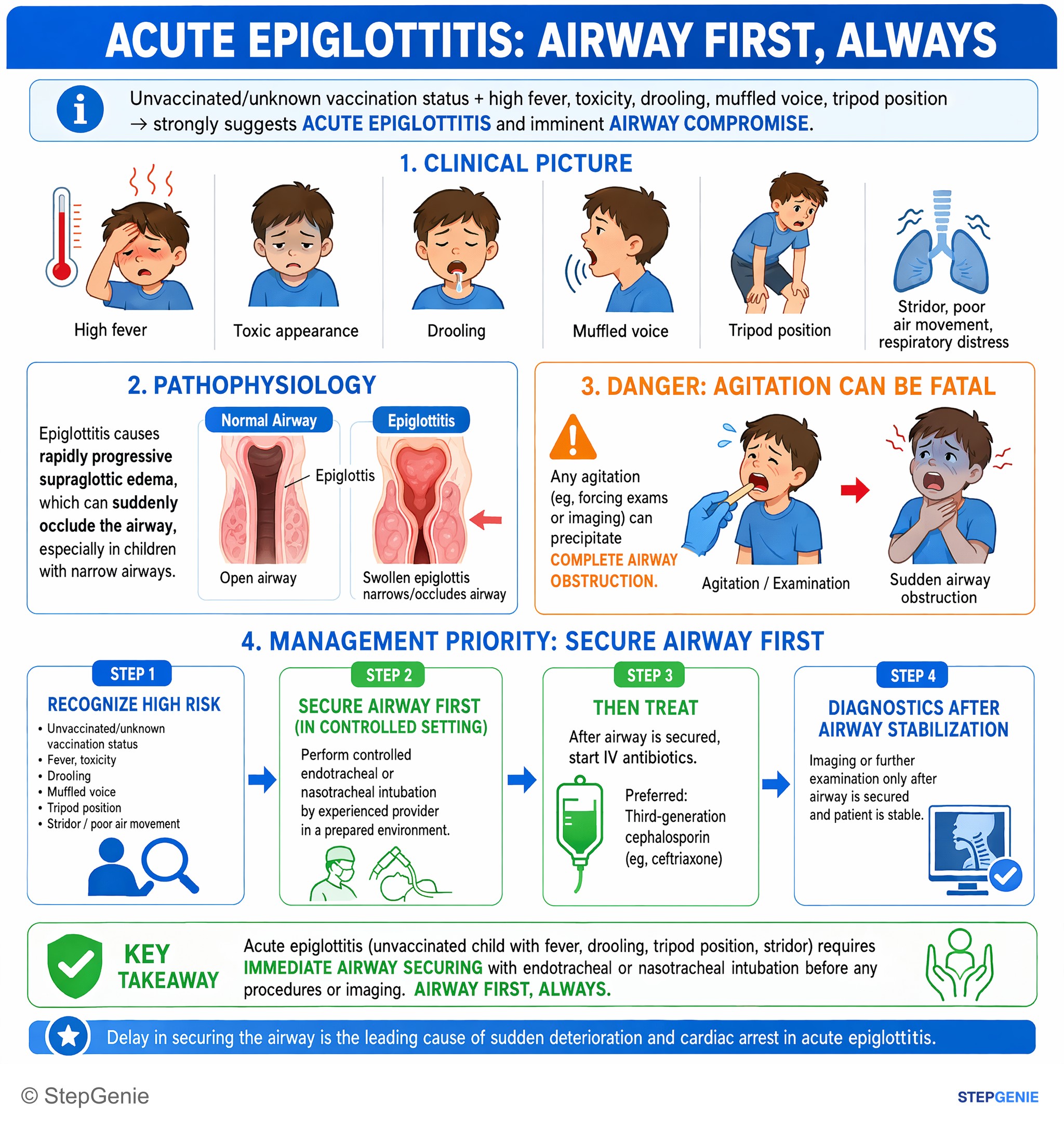
Acute epiglottitis (unvaccinated child with fever, drooling, tripod position, stridor) requires immediate airway securing with…
USMLE Step 2Frequently Asked Questions
What is the HaEMOPhilus mnemonic?
HaEMOPhilus lists the four classic infections caused by Haemophilus influenzae: epiglottitis, meningitis, otitis media and pneumonia. Epiglottitis and meningitis in an unvaccinated child point to the encapsulated type b strain, while otitis media, sinusitis, conjunctivitis and bronchitis are usually caused by nontypeable strains, which lack a capsule and are not covered by the Hib vaccine.
Why does Haemophilus influenzae grow on chocolate agar but not on blood agar?
H. influenzae needs both hemin (X factor) and NAD (V factor). Chocolate agar is blood agar heated during preparation, which releases hemin, and supplemented chocolate agar also supplies NAD, whereas standard sheep blood agar does not support growth. If sheep blood agar is cross-streaked with Staphylococcus aureus, which provides NAD, H. influenzae grows as small satellite colonies along the staphylococcal streak.
What is the difference between Hib and nontypeable Haemophilus influenzae?
Hib carries the type b polysaccharide capsule, polyribosyl-ribitol-phosphate, which lets it cause invasive disease such as meningitis, epiglottitis and bacteremia, and it is the only type the vaccine prevents. Nontypeable strains have no capsule and mainly cause mucosal infections such as otitis media, sinusitis, conjunctivitis and bronchitis, although they can cause invasive disease, especially in newborns and adults older than 65.
Why is the Hib vaccine a conjugate vaccine?
A plain polysaccharide such as PRP is a T-independent antigen, so the original unconjugated vaccine produced weak, age-dependent responses and worked poorly in children 2 years or younger. Linking PRP to a protein carrier, such as tetanus toxoid or a meningococcal outer membrane protein, makes it a T-dependent antigen and greatly improves immunogenicity in infants. More than 95% of infants develop protective antibody after the primary series.
Who gets rifampin prophylaxis after invasive Hib disease?
ACIP recommends rifampin for all household contacts, except pregnant women, when the household includes a child younger than 4 who is not fully vaccinated or an immunocompromised child younger than 18; an unvaccinated or incompletely vaccinated contact younger than 4 also gets a vaccine dose. Child care contacts need it after 2 or more cases within 60 days. The patient also needs rifampin if not treated with ceftriaxone or cefotaxime, which clear throat carriage, and is younger than 2 or lives with someone susceptible.